
Alpha Cognition’s Commercial Launch of ZUNVEYL Confronts Hurdles in Revenue Growth and Capital Efficiency
Post-launch challenges and competitive pressures overshadow Alpha Cognition’s initial FDA approval and sales efforts for its Alzheimer’s treatment.
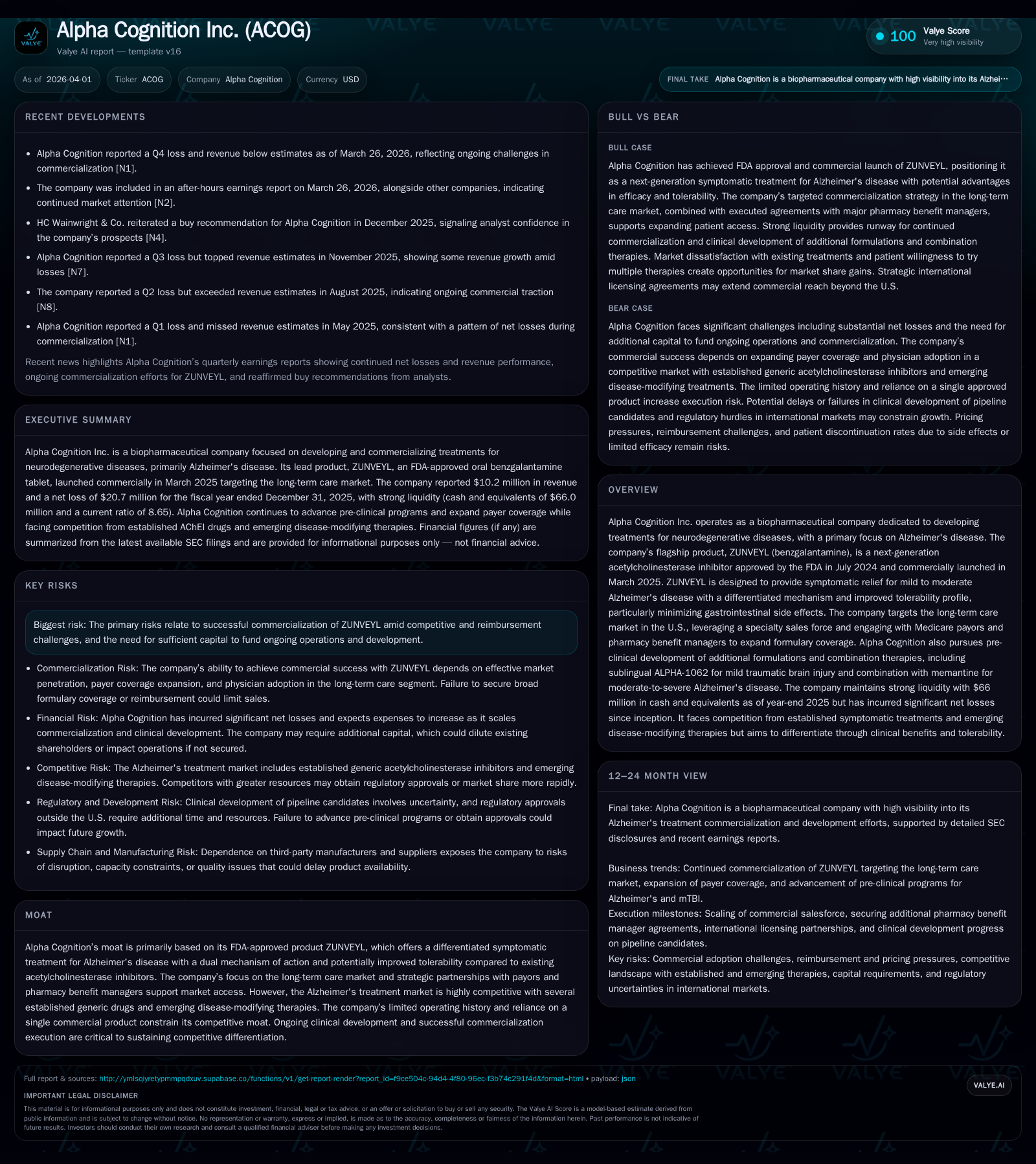
Alpha Cognition Inc. launched its flagship Alzheimer’s drug, ZUNVEYL, in early 2025 following FDA approval in mid-2024. Despite commercialization efforts targeting the long-term care market, the company reported a steep revenue drop in FY2025 alongside widening operating losses and significant cash burn. The firm remains heavily reliant on a single product and must balance aggressive market access strategies against reimbursement hurdles and manufacturing risks. Its longer-term growth hinges on pipeline advancement and commercial scaling amid intense competition from established therapies and emerging disease-modifying drugs.
Company Overview and Historical Performance
Alpha Cognition Inc., a biopharmaceutical company focused on neurodegenerative diseases such as Alzheimer's disease, has moved into the commercial stage with its sole approved product, ZUNVEYL. This next-generation acetylcholinesterase inhibitor received FDA approval in July 2024 and was commercially launched in March 2025. The drug aims to provide symptomatic relief for mild to moderate Alzheimer's disease with an improved tolerability profile characterized by reduced gastrointestinal side effects relative to existing agents like donepezil or rivastigmine [S1], [S27].
According to SEC filings [F1], revenue declined significantly from approximately $100 million reported for FY2024 to about $10.2 million in FY2025. This sharp decrease likely reflects differences in reporting basis or early commercialization dynamics rather than pure operational decline but underscores the nascent stage of sales traction. Operating income deteriorated substantially to a loss exceeding $22.6 million, more than doubling prior-year deficits. Net losses remained sizable at nearly $20.7 million compared to approximately $14.6 million previously. Operating cash flow also turned strongly negative at over $20 million outflow, reflecting investments in sales infrastructure development, marketing activities focused on long-term care channels, and ongoing research programs.
Financial Summary Table
Historical performance (annual)
| FY | Rev ($mm) | Net ($mm) | CFO ($mm) | OpInc ($mm) | Rev YoY | Net YoY |
|---|---|---|---|---|---|---|
| 2025 | 10 | -21 | -20 | -23 | -89.8% | -41.2% |
| 2024 | 100 | -15 | -8 | -12 |
Source: SEC companyfacts cache [F1].
Capital returns and efficiency (annual)
| FY | FCF ($mm) | ROE% |
|---|---|---|
| 2025 | -21 | -33.1 |
| 2024 | -8 | -35.3 |
Source: SEC companyfacts cache [F1].
*FY2024 figure may represent a pro forma or different reporting period basis as per company disclosures.
Commercialization Efforts and Market Dynamics
Following regulatory approval, Alpha Cognition's commercial strategy centers on penetrating the U.S. long-term care (LTC) market—targeting nursing homes specializing in Alzheimer's treatment where acetylcholinesterase inhibitors are commonly prescribed but adherence is often limited by tolerability issues [S1]. To address this niche effectively, the company has assembled an account-based specialty sales force experienced within LTC settings that interfaces with caregivers, consultant pharmacists, long-term care pharmacies, Medicare payors, and pharmacy benefit managers (PBMs).
Despite these efforts, recent quarterly disclosures indicate revenue shortfalls relative to expectations alongside increased operating losses [N1][N2]. Barriers include physician reluctance to switch from low-cost generic competitors; payer hesitancy due to cost containment pressures; supply chain vulnerabilities related to third-party manufacturing concentrated in Taiwan; and limited prescriber familiarity given Alpha Cognition's early commercial track record.
These factors highlight challenges faced by symptomatic treatments competing against entrenched generic products amid an Alzheimer's therapeutic landscape increasingly driven by emerging disease-modifying therapies [S27].
Pipeline Outlook and Development Milestones
ZUNVEYL remains Alpha Cognition's only commercially approved product; however, the company maintains several preclinical development programs aimed at expanding indications and delivery methods:
- Combination therapy of ZUNVEYL with memantine for moderate-to-severe Alzheimer's disease.
- Sublingual formulation of ALPHA-1062 designed for patients with dysphagia or cognitive impairment following mild traumatic brain injury (mTBI).
These programs remain preclinical without disclosed timelines or pivotal milestones as of the latest filings but represent strategic initiatives to diversify beyond symptomatic treatment alone [S1]. Progression of these assets will be critical to reducing reliance on ZUNVEYL tablet sales.
Capital Allocation and Financial Health
As of December 31, 2025, Alpha Cognition reported cash and cash equivalents exceeding $66 million alongside current assets near $79 million versus current liabilities around $9.1 million—yielding a robust current ratio of approximately 8.65 [F1]. Nevertheless, worsening net income trends—reflected by an approximate return on equity near negative 33%—combined with substantial negative operating cash flows underscore ongoing capital demands.
Capital expenditures increased nearly tenfold year-over-year but remain modest relative to overall spending ($293K versus $27K), indicating primary expenditures are directed towards selling general & administrative costs rather than fixed asset investments [F1]. Effective capital deployment will depend on successful scaling of commercial operations alongside prudent advancement of pipeline candidates.
Industry Context: Competition & Regulatory Landscape
Alpha Cognition competes within a highly competitive Alzheimer's disease treatment sector where generic acetylcholinesterase inhibitors dominate symptom management segments while novel disease-modifying agents backed by biomarker-driven trials increasingly shape standards of care [S27].
The company faces entrenched incumbents benefiting from established formularies and reimbursement pathways that may limit market expansion for newer entrants lacking extensive safety or efficacy track records.
Additionally regulatory complexities persist encompassing FDA advertising restrictions; payer scrutiny including Medicare rebate reforms; federal anti-kickback statutes; healthcare fraud laws; data privacy mandates such as HIPAA; and state-level compliance obligations—all contributing to significant compliance costs and operational risks .
Conclusion: Risks And Key Watch Points
Alpha Cognition confronts a challenging early commercial phase marked by:
- Low initial uptake contrasted with escalating operating losses,
- Heavy dependence on payer negotiations amid tightening reimbursement environments,
- Continued reliance on external manufacturers susceptible to geopolitical disruptions,
- Necessity to accelerate clinical progress beyond symptomatic treatments.
Investors should closely monitor quarterly revenue trends alongside management commentary regarding coverage expansions or setbacks. Updates on preclinical program developments will also serve as key indicators of diversification beyond the single-product portfolio.
Navigating these operational complexities while managing capital efficiently will be crucial for establishing sustainable competitive positioning within the evolving neurodegenerative disease ecosystem.
This report is based solely on publicly available SEC filings and recent news sources without offering investment advice or price forecasts.
Disclaimer: This is research-only, informational analysis and not investment advice. It may include AI-generated interpretation and general industry context. Always verify important details using primary sources.

Comments