
Decoy Therapeutics Advances Pre-Clinical Peptide Platform While Facing Nasdaq Listing Pressure and Financial Strain
Decoy Therapeutics integrates AI-driven peptide drug design with inherited small molecule assets post-merger, confronting critical funding and regulatory hurdles as it advances preclinical programs.
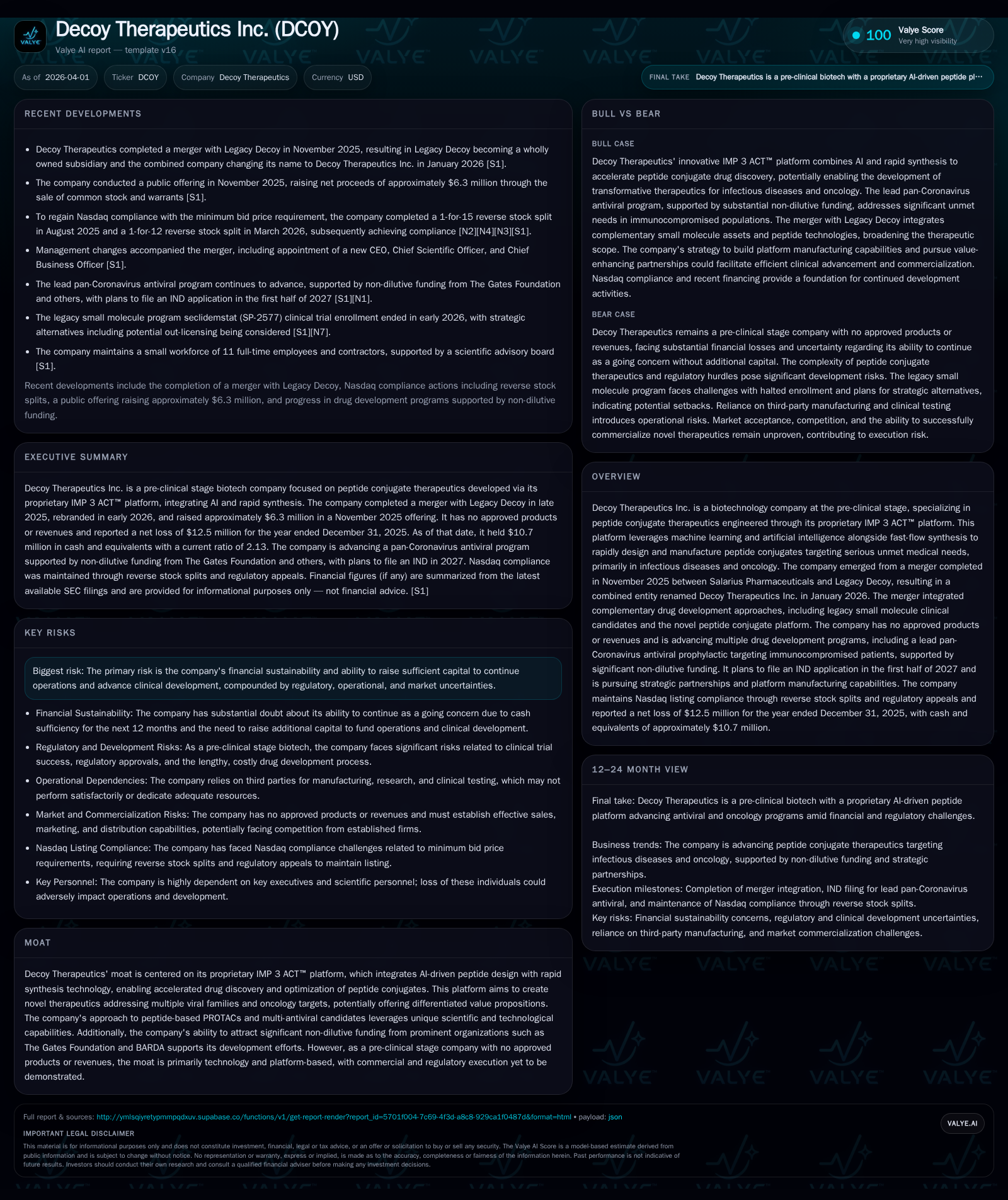
Decoy Therapeutics Inc., formed by a November 2025 merger, operates at the pre-clinical stage with no revenue and a proprietary AI-powered IMP³ACT™ platform for peptide conjugate therapeutics targeting infectious diseases and oncology. Its historical financials reflect sustained operating losses with increasing expenses, while its recent corporate actions involve navigating Nasdaq's minimum bid price requirements to maintain listing status. The company’s growth prospects rest on advancing its pipeline candidates, securing non-dilutive funding, and leveraging its platform technology. Key risks include capital sustainability, regulatory approval delays, and competitive pressures within biotech.
Company Overview and Historical Performance
Decoy Therapeutics Inc., formerly Salarius Pharmaceuticals before a transformative merger in November 2025, is focused on pioneering peptide conjugate therapeutics through its innovative IMP³ACT™ platform [S1][S24]. This platform combines artificial intelligence (AI), machine learning (ML), and rapid synthetic chemistry techniques to expedite drug discovery primarily against viral infections and malignancies. The company holds no approved products or revenues as it remains firmly in the pre-clinical development stage.
Historically, Decoy (including legacy Salarius) has demonstrated sustained net losses over recent years with intensifying operating deficits reflecting significant investments in R&D without commercial returns. Annual operating income stood at negative $12.6 million at the end of 2025 [F1], nearly doubling the loss compared to $5.7 million in 2024. Net losses mirrored this trajectory reaching $12.5 million in 2025 [F1]. While revenue has been nominal for several years ($283k in 2017), there have been no material revenues reported post-merger.
Liquidity metrics indicate adequate short-term cushion with a current ratio of approximately 2.13 at December 31, 2025 due to total current assets of $11 million exceeding current liabilities near $5.2 million [F1]. However, operating cash flows remain negative ($4.8 million outflow for 2025). The company has not paid dividends or engaged in buybacks recently [F1].
The table below summarizes key financial performance from 2022 through 2025:
Historical performance (annual)
| FY | Net ($mm) | CFO ($mm) | OpInc ($mm) | Net YoY |
|---|---|---|---|---|
| 2025 | -13 | -5 | -13 | -124.5% |
| 2024 | -6 | -5 | -6 | +55.5% |
| 2023 | -13 | -13 | -13 | +60.3% |
| 2022 | -32 | -18 | -32 |
Source: SEC companyfacts cache [F1].
Capital returns and efficiency (annual)
| FY | ROE% |
|---|---|
| 2025 | -212.6 |
| 2024 | -368.8 |
| 2023 | -237.2 |
| 2022 | -304.4 |
Source: SEC companyfacts cache [F1].
Financials reflect heavy R&D expenditure typical of preclinical biotech firms focusing on pipeline development.
Business Model and Technology Moat
Decoy's moat derives from its proprietary IMP³ACT™ technology that innovatively integrates AI/ML with accelerated peptide synthesis capabilities [S24]. This approach allows rapid iteration on peptide conjugate structures potentially capable of targeting a broad spectrum of viruses as well as oncology indications via targeted protein degradation mechanisms (PROTACs).
The merger consolidated Salarius’ clinical-stage small molecule candidates such as SP-3164 and seclidemstat (SP-2577) with Legacy Decoy’s technological platform [S1]. Together they form a diversified pipeline addressing gene dysregulation disorders and emergent viral threats through designable multi-antiviral (D-MAV) candidates engineered to be adaptable rather than rebuilt for new viral strains.
Strategically, Decoy aims to leverage substantial non-dilutive funding — notably from entities like The Gates Foundation and BARDA — emphasizing public health priority indications [S24]. The company's forward-looking commercialization model targets niche specialist healthcare provider groups including transplant centers and National Cancer Institute designated cancer centers for efficient penetration without deploying large-scale sales teams [S24]. Emerging telehealth modalities combined with digital patient engagement are intended to streamline patient access and distribution.
Growth Prospects
Growth hinges heavily on achieving critical milestones across its preclinical programs transitioning towards clinical phases that would validate technology efficacy and safety. Success in these endeavors could re-rate the asset value considerably.
Key potential drivers include:
- Successful IND filings enabling human trials.
- Progression of multi-antiviral D-MAV candidates demonstrating cross-family viral efficacy.
- Advancement of proprietary targeted protein degraders for oncological applications.
- Further enabling collaborations or grants that could underwrite expensive late-stage development phases.
Constraints involve typical biotech challenges such as high capital needs for clinical trials, competitive therapeutic alternatives under development by larger pharmaceutical companies with deeper resources [S11]. Regulatory approval processes remain complex both domestically and globally with variable requirements across jurisdictions [S14][S18]. Additionally, Decoy must navigate intellectual property landscapes carefully amid risks of patent infringement claims impacting freedom to operate [S17][S22].
Regulatory Environment & Risks
As a molecule developer without any approved product candidate yet, Decoy faces extensive regulatory risk encompassing satisfactory IND approvals followed by multi-phase clinical trials consistent with FDA's Good Clinical Practice guidelines [S13][S21]. Failure or delays at any step can materially impact timelines and cost structures.
Subsequent marketing approvals will require compliance with rigorous pharmacovigilance post-approval commitments including adverse event monitoring mandated by FDA regulations [S21][S26][S27]. Furthermore, promotional activities must strictly adhere to labelled indications under FDA oversight to avoid enforcement actions [S14][S27].
Global expansion demands parallel regulatory submissions such as EMA centralized marketing authorizations triggering their own unique procedural complexities [S14].
Other systemic risks include evolving healthcare laws affecting reimbursement and pricing frameworks particularly given political pressures surrounding drug pricing reforms such as ACA amendments or Inflation Reduction Act impacts on Medicare negotiations [S6][S15].
Nasdaq listing compliance constitutes an immediate operational challenge: after falling below the minimum bid price requirement sustained over at least thirty consecutive trading days during late 2025/early 2026 due to low stock prices partly linked to preclinical status and absence of revenues, Nasdaq issued notices requiring price restoration or risk delisting by March 20th, 2026 [S1]. This process introduces uncertainty around market liquidity and investor access that could dampen future equity financing efforts.
Capital Allocation & Financial Health
Given its early stage profile with no product sales revenue currently generated by the combined entity post-merger (prior revenues minimal from legacy operations), capital allocation has been concentrated on R&D investments supporting pipeline advancement [F1][S1]. The company recorded sizable net losses widening from approximately $5.6 million in calendar year 2024 to $12.5 million in 2025 as operational activity intensified around integrating technologies and expanding pipeline efforts.
Operating cash flow consistently burned cash ($4.8 million negative flow in 2025) while capital expenditures have remained minimal reflective of outsourced manufacturing focus rather than fixed asset investment internally [F1]. Equity rose modestly year-over-year though remains insufficient to offset cumulative losses indicated by the negative return on equity (-213%) reflective of equity base relative to net loss magnitude [F1].
There were no dividends declared nor stock repurchase programs initiated given capital conservation imperatives at this stage.
Looking forward independent financing will be imperative given continued cash burn trends inherent in bringing novel biotechnologies through costly clinical validations before any market revenue inflows.[N/A]
Manufacturing & Commercial Strategies
Decoy currently outsources manufacturing completely relying on contract development and manufacturing organizations (CDMOs) for both preclinical material supply as well as anticipated clinical trial material needs [S16][S19]. This approach aligns with industry norms allowing operational flexibility but carries dependency risks including supply chain disruptions which could delay clinical schedules if alternate sources cannot be secured rapidly.
Commercially, plans emphasize targeted small specialist sales forces aiming at specific medical centers where niche high-risk patient populations congregate — such as transplant facilities or NCI-designated cancer centers — combining cost efficiency with direct engagement strategies leveraged by digital outreach tools including telehealth services integrated into prescribing workflows[S24].
Such an approach reflects disruptive pharmaceutical commercial trends seeking to optimize gross-to-net margins reducing reliance on traditional large field sales deployments especially relevant considering limited size/focus of product candidate patient populations anticipated initially.
Competitive Landscape & Intellectual Property
Despite pioneering aspects of its platform technology Decoy must contend with intense competition from larger pharmaceutical firms with established pipelines targeting similar infectious disease or oncology indications via alternative modalities including monoclonal antibodies or antivirals based on small molecule chemistries [S11]. Smaller biotechnology start-ups also aggressively pursue novel peptide-based therapeutic strategies using varying AI/ML methodologies creating a crowded innovation environment.
Patent protection across peptides engineered via AI-enabled design platforms presents complexity; patents must navigate intricacies related both to composition claims as well as manufacturing processes potentially subject to third party contestation or infringement litigation risks that may arise once more costly clinical data are disclosed publicly through trials or regulatory documents[S17][S22]. Effective management of these IP portfolios will be crucial for long term competitiveness.
What To Watch Next (Analysis)
- Progression through IND application filings toward first-in-human trials for lead D-MAV antiviral programs.
- Achievement of additional R&D milestones validating IMP³ACT™ platform productivity benchmarks versus peers.
- Results of Nasdaq required compliance actions around minimum bid price restoration impacting stock liquidity profiles.
- Updates on partnership expansions or new grant awards enhancing non-dilutive funding runway.
- Clinical trial commencement dates if announced together with initial safety/tolerability results anticipated from early Phase I testing.
- Potential licensing deals or collaborations expanding pipeline breadth particularly within gene dysregulation/oncology space inherited from legacy Salarius assets.
- Visibility on capital raising plans given existing operating cash burn vs available cash position (~$10.7 million) per latest filings—indicating limited runway without additional infusion [F1].
Conclusion
Decoy Therapeutics represents a compelling application of AI-driven technologies applied to peptide therapeutic design yet remains nascent without commercial revenues while incurring significant losses characteristic of preclinical biotech entities. Its proprietary IMP³ACT™ platform paired with complementary small molecule assets offers differentiation within crowded infectious disease and oncology sectors but requires successful advancement through costly clinical validation hurdles compromised further by pressures surrounding public market listing status stability. Capital management strategies balancing development ambition against financial constraints will shape near-term viability while regulatory achievements remain pivotal inflection points unlocking latent company value potential going forward.
This analysis is based solely on public filings as of April 1st, 2026 along with validated financial data points without offering investment advice or price forecasts. Readers should consult additional sources before making decisions related to Decoy Therapeutics Inc.
Disclaimer: This is research-only, informational analysis and not investment advice. It may include AI-generated interpretation and general industry context. Always verify important details using primary sources.

Comments