
Classover Holdings Faces Severe Financial Challenges Amid Revenue Collapse
Classover Holdings, Inc. encounters steep revenue decline and widening losses despite an innovative AI-driven K-12 education platform and growth initiatives.
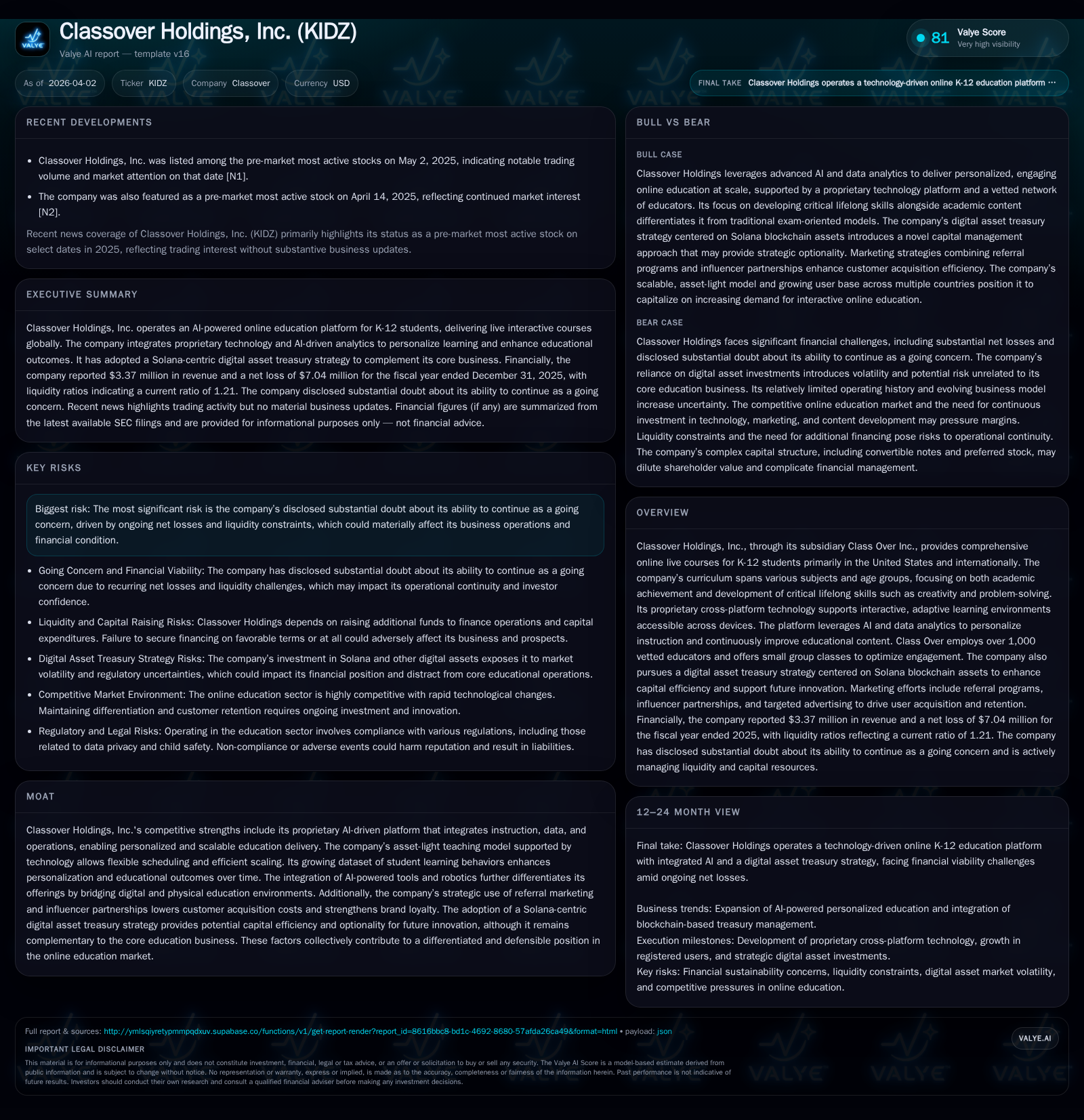
In fiscal 2025, Classover Holdings reported a sharp revenue decline from $1.07 billion in 2024 to $3.37 million, alongside increased net losses of $7.04 million, highlighting significant operational and liquidity challenges. The company’s AI-powered platform and referral marketing have supported growth historically, but financial strain raises questions about sustainability. Plans for international expansion and strategic partnerships exist amid ongoing risks related to cash flow deficits and capital constraints.
Sharp Financial Decline during Innovative Educational Technology
Classover Holdings experienced a severe downturn in fiscal year 2025 compared to 2024. Revenue plunged from approximately $1.07 billion in 2024 to just $3.37 million in 2025—a remarkable decline of nearly 99.7% as confirmed by SEC filings [F1]. Operating income turned deeply negative with losses of around $3.59 million, while net losses expanded sharply to $7.04 million from a negligible loss the prior year. This resulted in an approximate negative return on equity of -186%, underscoring acute profitability difficulties despite historical growth momentum [F1].
Operating cash flow also deteriorated significantly into a negative $3.83 million in 2025 versus breakeven previously, illustrating substantial cash outflows associated with ongoing operations during this period of contraction [F1]. These results mark a drastic reversal following rapid expansion.
Historical performance (annual)
| FY | Rev ($mm) | Net ($mm) | CFO ($mm) | Rev YoY | Net YoY |
|---|---|---|---|---|---|
| 2025 | 3 | -7 | -4 | -99.7% | -2959927.3% |
| 2024 | 1070 | 0 | 0 |
Source: SEC companyfacts cache [F1].
Capital returns and efficiency (annual)
| FY | ROE% |
|---|---|
| 2025 | -186.5 |
| 2024 | 100.8 |
Source: SEC companyfacts cache [F1].
Table: Historical financial performance highlights the dramatic revenue collapse and widening losses.
From Rapid Growth to Operational Contraction
Despite the revenue collapse, Classover's registered user base grew from approximately 61,387 at the end of 2024 to about 72,850 by the end of 2025—reflecting ongoing engagement via marketing efforts targeting domestic and international students across more than twenty countries [S5]. The company expanded its curriculum beyond initial K-12 grades up to age 17 and diversified course offerings including test preparation and lifelong skills development such as creativity and problem-solving—key differentiators for its educational platform [S4], [S6], [S7].
Marketing strategies relied heavily on referral incentives and an influencer program dubbed "SuperMOM," which leveraged parent advocates to drive organic growth while lowering customer acquisition costs. These efforts have historically yielded strong unit economics with retention rates around 54.5% repeat purchases among subscribers completing their packages in recent years [S6], [S7].
However, the precipitous revenue decline suggests challenges converting registered users into paying customers or elevated attrition possibly driven by dissatisfaction or external factors negatively affecting enrollments. Risk disclosures highlight potential issues with educational quality or service delivery impacting renewals and referrals adversely if unaddressed [S1], [S4].
Liquidity Constraints and Capital Structure
At December 31, 2025, Classover reported current assets of approximately $2.81 million against current liabilities of about $2.31 million yielding a current ratio near 1.21—providing some liquidity buffer but limited room for maneuver given operational cash flow deficits of nearly $3.83 million during the year [F1], [S10], [S18].
The company carries convertible notes with an outstanding balance around $7.78 million bearing a seven percent annual coupon secured by assets including digital currency holdings tied to their Solana-focused treasury strategy—a novel approach blending technology investment with capital management but exposing them to crypto market volatility risks as well [S25].
Restrictive debt covenants limit flexibility for raising additional capital or pursuing acquisitions without risking defaults if performance does not improve swiftly. The independent auditor expressed substantial doubt regarding the company's ability to continue as a going concern due to these liquidity pressures alongside uncertainties around obtaining new funding amid volatile markets—a critical near-term risk highlighted in official filings [S1], [S18].
Competitive Positioning Through AI-Driven Learning Platform
Classover’s competitive edge stems from its proprietary cross-platform AI-powered learning environment combining live small-group instruction with adaptive curricula informed by extensive data analytics on student interactions—enabling highly personalized education at scale uncommon among many peers focused on static or self-paced content alone [S9], [S13], [S16], [S20].
Classes are capped at six students optimizing engagement levels while incorporating robotics-enabled tools that blend physical-digital experiences—positioning the platform uniquely against competitors like LingoAce and Think Academy who also offer online live classes but often lack integrated AI-driven personalization at this scale [S9], [S20].
Nonetheless, financial strain may hinder sustained investment in R&D needed to maintain technological leadership amid intensifying competition where rivals leverage deeper resources for rapid feature rollouts or aggressive pricing strategies threatening customer loyalty if service quality diminishes under financial constraints.
Customer Acquisition via Referrals and Influencer Programs
Referral marketing combined with social media campaigns and parental endorsements through the "SuperMOM" influencer initiative historically fueled organic growth while compressing customer acquisition costs—a key advantage given direct-to-consumer models often require heavy upfront spending amortized over longer periods; Classover's package economics allowed early profitability per disclosures [S4], [S6], [S7].
Student satisfaction ratings averaged around a high score of 4.76 out of 5 across tens of thousands of reviews reinforcing perceptions of instructional effectiveness that underpin word-of-mouth growth crucial for brand community development within targeted parental networks.
However, the dramatic revenue shrinkage indicates potential disruptions either from declining new subscriber inflows or elevated attrition rates destabilizing these dynamics—possibly due to execution challenges or external headwinds diminishing course appeal or teaching consistency as noted among material risk factors related to customer retention and refund claims within official documents [S1], [S26].
Growth Plans Amid Financial Pressures
Classover aims to expand internationally through localized content adaptations tailored for cultural relevance while developing strategic partnerships with neighborhood learning centers blending online technology strengths with physical presence—efforts intended to diversify revenues beyond the U.S., which accounted for roughly two-thirds of revenue in prior years [S5], [S7].
Targeted acquisitions focus on augmenting technology capabilities or converting traditional centers into hybrid modern educational facilities extending market reach incrementally; however execution timelines remain unclear without explicit guidance or clear indications of secured financing given recent financial difficulties creating uncertainty around runway sufficiency.
These initiatives reflect promising long-term opportunities aligned with global online education trends but realistically depend on stabilizing core operational metrics before scaling further amid liquidity constraints.
Key Monitoring Metrics Going Forward
With no explicit management forecasts disclosed, critical indicators for investors include:
- Conversion rates from registered users into paying subscribers,
- Progress toward positive operating cash flow sustainability,
- Successful capital raises or refinancing reducing default risk,
- Stabilization or improvement in student retention and reduced refund incidence,
- Early signs of international revenue contributions reflecting geographic diversification,
- Continuity or enhancement of platform innovation preserving competitive advantages.
Investor attention should focus on forthcoming quarterly reports or announcements clarifying management’s tactical responses addressing acute financial stressors as these will be pivotal signals regarding Classover’s ability to realign growth leveraging its technological strengths amid solvency challenges.
Disclaimer: This analysis is based solely on publicly available information without investment advice.
Disclaimer: This is research-only, informational analysis and not investment advice. It may include AI-generated interpretation and general industry context. Always verify important details using primary sources.

Comments