
Adaptin Bio's Clinical Push to Break Blood-Brain Barrier Barriers
An analysis of Adaptin Bio's innovative bispecific T-cell engager platform for glioblastoma treatment amid escalating losses and tight liquidity.
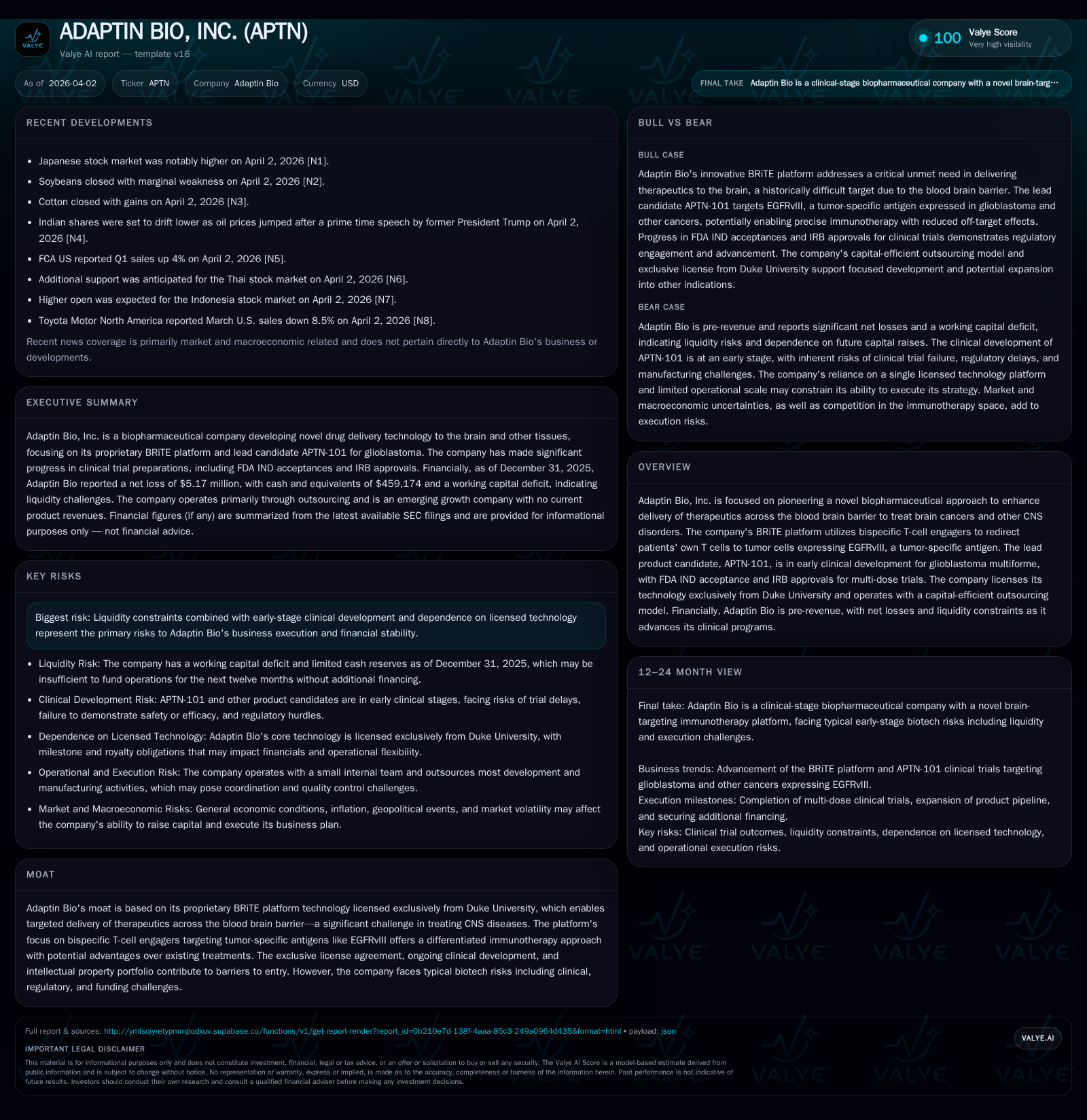
Adaptin Bio is pioneering a bispecific T-cell engager technology designed to overcome the blood-brain barrier for treating aggressive brain cancers such as glioblastoma multiforme. The company's licensed BRiTE platform and lead candidate APTN-101 are in early clinical development stages with FDA IND acceptance, but ongoing progress is challenged by significant operating losses and a weak liquidity position. Despite an exclusive license from Duke University conferring some moat, Adaptin faces typical early-stage biotech risks including funding constraints, clinical uncertainties, and regulatory complexities. Future milestones to watch include clinical trial readouts and potential additional IND filings, which will be critical inflection points in validating this novel immunotherapy approach.
From Concept to Trial: Adaptin's Historical Burden and Growth Trajectory
Adaptin Bio’s financial trajectory underscores the typical operating profile of an early-stage biopharmaceutical company transitioning from preclinical research into clinical development. Operating income plunged sharply to a loss of $5.41 million in FY2025, a -3385% change year-over-year compared with a comparatively minor loss of $155 thousand in FY2024 [F1]. This steep deterioration reflects intensified investments primarily in R&D expenditures associated with advancing APTN-101 into clinical trials, alongside significantly expanded general administrative costs occasioned by corporate activities such as public reporting obligations and merger-related expenses [S11][S23].
Net losses widened in parallel to $5.17 million in FY2025, representing a -3106% YoY decline from FY2024's $161 thousand deficit [F1]. Operating cash flow drained $4.78 million during the most recent year, worsening from only $181 thousand outflow in the prior period [F1][S22]. These figures highlight the accelerated burn rate characteristic of companies investing heavily in first-in-human studies while holding no commercial revenue streams.
Equity position contracted further into deficit territory at approximately -$1.49 million by year-end 2025 versus -$274 thousand at end-2024, emphasizing mounting accumulated losses eroding shareholders' equity [F1]. The capital structure thus reflects ongoing dilution pressures and net operating deficits common among nascent clinical-stage entities.
Historical performance (annual)
| FY | Net ($mm) | CFO ($mm) | OpInc ($mm) | Net YoY |
|---|---|---|---|---|
| 2025 | -5 | -5 | -5 | -3106.5% |
| 2024 | 0 | 0 | 0 | -88.3% |
| 2023 | 0 | 0 |
Source: SEC companyfacts cache [F1].
Capital returns and efficiency (annual)
| FY | ROE% |
|---|---|
| 2025 | 347.0 |
| 2024 | 58.8 |
| 2023 | 75.8 |
Source: SEC companyfacts cache [F1].
This rapid expansion in operating losses is consistent with industry patterns seen when companies move from discovery into regulatory-enabled clinical testing phases [S11][S23]. Adaptin remains pre-revenue and reliant on external funding to sustain its development activities.
The BRiTE Platform Edge and Therapeutic Differentiation
At the core of Adaptin Bio’s innovation is its BRiTE platform — a proprietary technological approach exclusively licensed from Duke University. This platform employs bispecific T-cell engagers (BiTEs) designed to cross the notoriously restrictive blood-brain barrier (BBB), enabling targeted immunotherapy delivery directly into central nervous system (CNS) tumors [S21].
The lead candidate utilizing BRiTE technology is APTN-101. It specifically targets EGFRvIII — a mutated tumor-specific antigen prevalent on glioblastoma cells but absent from normal tissue — thereby redirecting patients’ own cytotoxic T cells towards malignant cells [S21]. This dual-specificity mechanism potentially enhances therapeutic efficacy and limits off-target toxicity compared with conventional mono-targeted therapies.
The exclusive license agreement restricts competitors’ access to the underlying intellectual property technology embodying this BBB-penetrating capacity combined with tumor specificity [S14][S25]. Such exclusivity coupled with ongoing patent developments underpin several hurdles for new entrants seeking equivalent modalities.
Notably, BRiTE’s ability to mitigate CNS delivery challenges—a primary obstacle confronting numerous experimental therapeutics—sets the company apart within the broader immuno-oncology field focusing on aggressive brain cancers [S20]. Competitors like Amgen and Genentech working with EGFRvIII-biased T cell engagers do not currently incorporate activated T cells or demonstrate comparable BBB-crossing vectorization as per public disclosures [S20].
Evaluating APTN-101’s Clinical Development Milestones and Regulatory Green Lights
APTN-101 has gained momentum following FDA Investigational New Drug (IND) acceptance and Institutional Review Board (IRB) approvals for initiation of multi-dose clinical trials targeting glioblastoma multiforme (GBM) [S1]. These regulatory clearances establish foundational milestones enabling first-in-human studies integral to demonstrating safety and preliminary efficacy within this high-unmet medical need indication.
Absent explicit guidance on trial timelines or specific endpoint targeting disclosed by management thus far creates uncertainty regarding heterogeneity of outcomes expected mid-term. Early-phase trials typically focus on dose escalation cohorts aimed at establishing maximum tolerated doses before advancing further phases with larger patient populations.
The investigator-led IND status highlights collaboration with leading academic or clinical research centers yet indicates reliance on external partners rather than fully internal trial management infrastructure — consistent with Adaptin’s capital-efficient outsourcing operational strategy [S21]. Clinical progression will hinge heavily on whether APTN-101 can fulfill unmet needs for durable CNS tumor immune engagement without incurring serious adverse events commonly observed in immuno-oncology contexts.
Capital Structure, Operating Burn, and Liquidity Dynamics
Despite fresh equity proceeds raised through private placements totaling net approximately $5.28 million during fiscal year 2025 including conversions of convertible notes payable and bridge financings [F1][S13], Adaptin Bio’s liquidity profile remains constrained. Cash and cash equivalents stood at approximately $459 thousand at year-end 2025 versus just $34 thousand a year earlier — evidence of some replenishment yet insufficient buffer given operational burn trends [F1][S15].
Current liabilities at $2.11 million substantially outweigh current assets of $619 thousand leading to a critically low current ratio near 0.29 — signaling heightened risk that short-term obligations may outstrip available liquid resources absent near-term financings [F1][S15].
Management operates under a capital-efficient outsourcing model which employs contract research organizations (CROs), consultants, and other vendors primarily managing clinical execution costs flexibly instead of building fixed-cost internal capabilities [S21]. While this reduces structural leverage required upfront, it also necessitates constant capital availability for timely program advancement.
Adaptin currently has no debt recorded post-conversion transactions earlier in 2025 but carries accrued liabilities predominantly related to trade accounts payable and accrued expenses incurred during R&D activities and administrative support functions [S15]. No dividends or share repurchases have been authorized or planned indicating retention focus on development capital allocation [S26].
Given these factors, immediate re-capitalization efforts or substantial funding inflows will be needed soon if clinical programs are to maintain momentum beyond initial dosing stages without interruption.
Future Catalysts: What Risks and Opportunities Lie Ahead?
Looking forward, key drivers influencing Adaptin Bio’s trajectory encompass successfully completing early-phase safety assessments of APTN-101 alongside subsequent dose escalation data expected from GBM patient cohorts participating in investigator-led trials [S1]. Positive signals could catalyze additional IND filings for secondary indications such as breast or lung cancer variants presenting EGFRvIII expression—a strategic expansion envisaged within BRiTE’s platform roadmap [S21].
Regulatory risk looms large as failure to meet criteria sufficiently convincing for further trial authorization would stall progress irreversibly given current financial constraints [S3][S6]. Similarly pivotal will be navigating complex healthcare compliance requirements governing sales and promotion post-approval especially around federal anti-kickback statutes, false claims legislation, transparency mandates (physician sunshine laws), and HIPAA constraints that impose significant operational overheads on commercialization strategies [S3][S6][S10].
Reimbursement risks also factor prominently given payer sensitivity toward high-cost CNS therapies requiring demonstration of comparative cost-effectiveness versus existing standards of care [S3][S7][S10]. Orphan drug designation provisions may procure market exclusivity benefits extending up to ten years potentially offsetting part of commercial risk but depend heavily on timely approvals coupled with robust trial dossiers substantiating clinical advantage over competitors [S5].
Competitive landscape considerations include presence of large pharma entities engaged in parallel bispecific T-cell engager programs albeit differing mechanistically or product stage maturity; such dynamics stress Adaptin’s imperative to de-risk pipeline swiftly through data validations ensuring sustainable differentiation [S20].
Navigating Reimbursement and Market Access Challenges in CNS Immunotherapy
Adaptin Bio explicitly acknowledges uncertainty inherent in securing broad payer coverage despite confidence that third-party payers might cover approved products eventually [S3][S7]. However, managed care organizations increasingly enforce rigorous adjudication processes emphasizing value frameworks anchored on quantifiable benefit-risk assessments relative to existing interventions.
Pricing pressures driven by cost-containment efforts impose additional scrutiny on emerging therapies demanding costly head-to-head comparative effectiveness studies before favorable reimbursement decisions emerge—barriers amplified within neurology-oncology where treatment outcomes are notoriously difficult to benchmark consistently at population levels.
Hence a successful market access pathway will require not only regulatory approval but also proactive engagement with payer stakeholders early during late-phase trials to shape evidence generation plans aligned with expectations for coverage determination criteria specific to neuro-oncology indications characterized by heterogeneous patient populations.
Adaptin's business strategy must accommodate these multiple axes simultaneously—clinical validation combined with regulatory compliance plus sufficient liquidity—to unlock eventual commercial viability.
Disclaimer: This report presents an analytical overview based on publicly available information as of April 2, 2026. It is not intended as investment advice. Financial figures are cited explicitly from SEC filings ([F1],[S#]). Forward-looking statements about development timelines or commercial prospects reflect informed interpretation rather than guaranteed outcomes due to inherent uncertainties in drug development processes.
Disclaimer: This is research-only, informational analysis and not investment advice. It may include AI-generated interpretation and general industry context. Always verify important details using primary sources.

Comments