
Tilray Brands Battles Losses While Integrating Craft Beers and Expanding Medical Cannabis
Examining how Tilray’s dual focus on cannabis and craft beer amidst regulatory hurdles affects its financial outcomes and strategic deployment of capital.
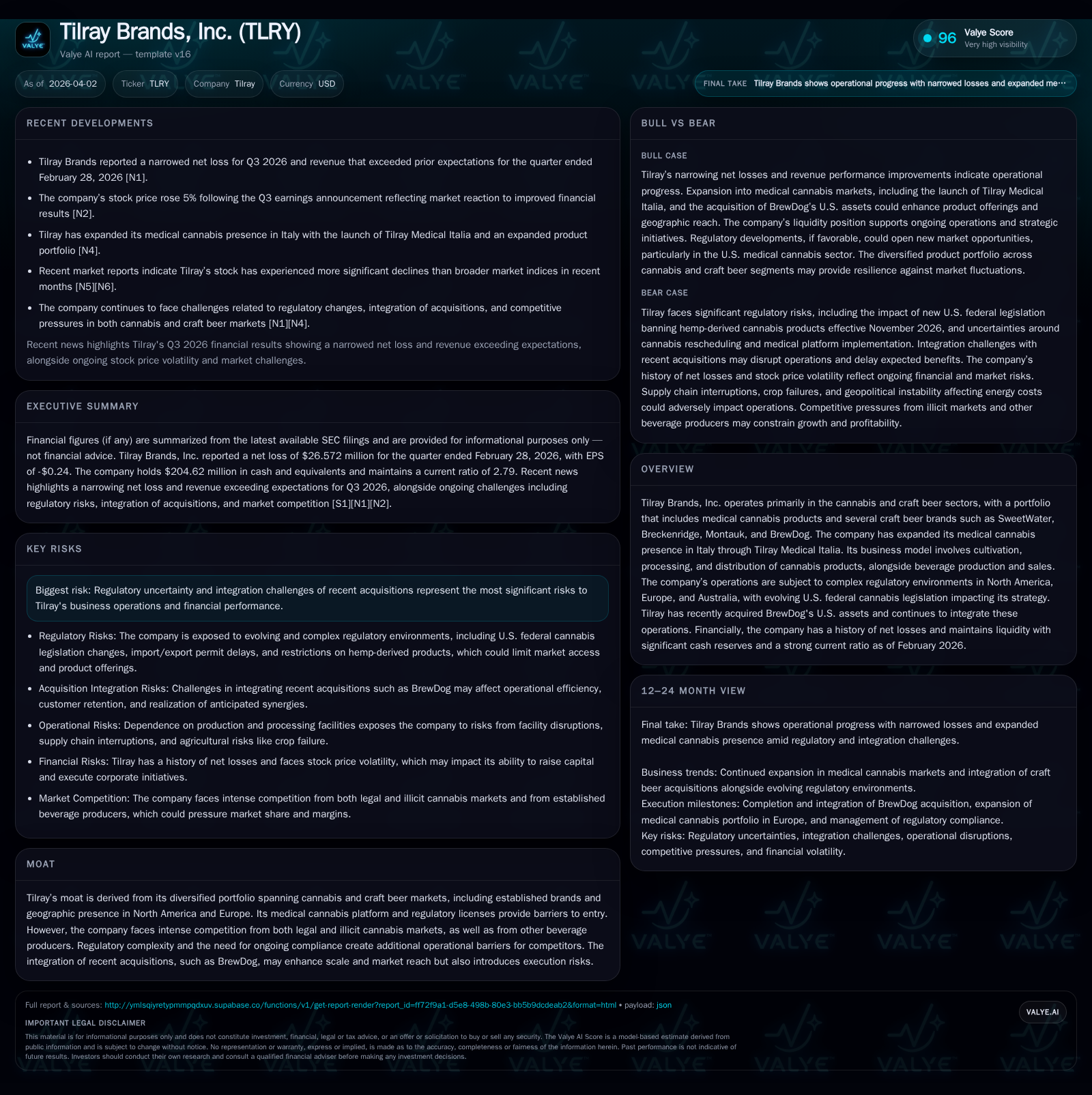
Tilray Brands, Inc. has experienced significant revenue growth driven by acquisitions in both cannabis and craft beer sectors but concurrently faces escalating operating losses, with FY2025 operating income plunging to a negative $2.28 billion against prior years [F1]. Its strategy to integrate diverse brands like SweetWater and BrewDog introduces operational complexity amid a challenging regulatory landscape, particularly regarding U.S. hemp legislation effective in late 2026 [S8][S9]. Liquidity remains robust with a current ratio near 2.79 as of early 2026, yet persistent losses and negative free cash flow constrain capital flexibility [F1][S28]. Key risks include regulatory uncertainty, competitive pressures from illicit markets, and integration execution—all of which will critically shape Tilray's trajectory [S2][S6].
Historical Performance: Growth With Deepening Losses
Tilray Brands has undergone significant top-line growth tied mainly to strategic acquisitions across cannabis cultivation and craft beer segments. However, this expansion has been accompanied by a sharp deterioration in profitability metrics over the past four fiscal years ending May 31.
Operating income declined dramatically from -$610 million in FY2022 to a staggering -$2.28 billion in FY2025, representing a ~-1206% year-over-year plunge largely due to integration expenses and impairment charges related to recent acquisitions [F1]. Net income similarly deepened losses from -$477 million in FY2022 to -$2.19 billion in FY2025 (-793% YoY), signaling ongoing difficulties converting revenue gains into profitability.
Operating cash flow fluctuated negatively as well, with FY2025 recording a steep decline to -$94.6 million from marginally positive cash flow in FY2023 [F1]. Capital expenditure trends have eased somewhat post-peak but remain significant relative to available cash.
Historical performance (annual)
| FY | Net ($bn) | CFO ($mm) | OpInc ($bn) | Net YoY |
|---|---|---|---|---|
| 2025 | -2.2 | -95 | -2.3 | -792.6% |
| 2024 | -0.2 | -31 | -0.2 | +83.1% |
| 2023 | -1.5 | 8 | -1.4 | -204.7% |
| 2022 | -0.5 | -177 | -0.6 |
Source: SEC companyfacts cache [F1].
Capital returns and efficiency (annual)
| FY | ROE% |
|---|---|
| 2025 | -144.7 |
| 2024 | -7.1 |
| 2023 | -43.8 |
| 2022 | -10.8 |
Source: SEC companyfacts cache [F1].
This financial trajectory underscores the operational challenge of scaling a dual-segment company amid considerable regulatory and market complexity.
Craft Beer and Cannabis: Dual Engines or Drag?
Tilray's hybrid business model combines cannabis cultivation and distribution with craft beer production under well-known labels including SweetWater Brewing Company and Breckenridge Brewery alongside recent acquisition of BrewDog's U.S.-based operations completed in March 2026 [N1][S26]. This diversification seeks to leverage cross-category consumer profiles while mitigating sector-specific volatility.
However the dual focus complicates supply chain management and branding efforts within highly competitive markets. The craft beer division faces intense competition from established beverage firms alongside shifting consumer preferences that may reduce demand [S8][S9]. Meanwhile the cannabis segment grapples with regulatory constraints that limit product assortment and market accessibility.
Revenue contributions from these craft beer brands have augmented topline figures but have not proportionally offset the high fixed costs and integration expenses introduced by these acquisitions—thus contributing to the steep losses reported [N14][S2]. This tension between diversification benefits versus operational drag remains a key strategic dynamic for management.
Regulatory Crosscurrents Impacting Expansion
Regulatory dynamics stand as pivotal variables influencing Tilray’s capacity to capitalize on growth opportunities. A critical new development is the federal legislation enacted in the U.S. in November 2025 banning production or sale of hemp-derived Delta-9 products starting November 12, 2026—directly impacting key product lines especially within the hemp/CBD categories [S8][S9].
Additionally, ongoing uncertainty surrounds the rescheduling of cannabis under the Controlled Substances Act from Schedule I toward Schedule III status—a move anticipated to expand medical cannabis commercialization but fraught with implementation ambiguities delaying market rollout [S4][S5].
Outside North America, export/import permit delays and evolving regulations in Europe and Australia also restrict expansion timelines for international operations such as Tilray Medical Italia—clouding visibility on expected medical segment growth trajectories [S6][S9]. These overlapping regulatory obstacles necessitate proactive compliance investments but also pose material risks if approvals falter.
Integrating BrewDog U.S. Assets: Progress and Pitfalls
The March 2026 acquisition of BrewDog’s U.S.-based business assets represents a strategic step enhancing Tilray’s craft beer footprint with marquee sub-brands like Punk IPA and Hazy Jane included in the transaction [N1][S26]. Completion occurred via a pre-packaged administration process aimed at maintaining business continuity.
Investor attention has focused sharply on the risks inherent to integrating BrewDog’s disparate operations into Tilray’s platform. Potential challenges include retaining customer loyalty during the transition period while streamlining overlapping supply chains and corporate infrastructure [N6][S10]. Market reaction post-Q3 earnings showed positive stock movement suggesting cautiously optimistic sentiment around progress; however execution risk remains elevated given historical difficulties integrating multiple acquisitions concurrently.
The Outlook for Medical Cannabis in New Markets
Management places high strategic priority on expanding medical cannabis offerings internationally where regulatory frameworks offer more stable commercial pathways relative to recreational markets prone to federal prohibitions. Tilray Medical Italia exemplifies this approach as the company strengthens presence within Italy’s evolving healthcare cannabis ecosystem through focused licensing initiatives [N3][S5].
This medical segment is viewed internally as higher margin compared with recreational products yet depends materially on timely license renewals and import/export permit procurement—both vulnerable to bureaucratic delays inherent in new regulations across jurisdictions. Future growth potential is thus contingent upon favorable regulatory outcomes particularly concerning U.S. federal rules governing medical cannabis introductions slated for later this year or next [S9].
Financial Position and Capital Allocation Priorities
Despite mounting losses eroding profits severely (approximate ROE of -145% for FY2025 based on net income relative to equity), Tilray sustains solid liquidity footing with $205 million cash & equivalents plus current assets totaling $719 million against liabilities near $258 million producing a healthy current ratio of approximately 2.79 as of February 28, 2026 [F1][S28]. This buffer supports ongoing operational funding needs amid integration activities.
Notably absent are dividends or share repurchase programs recently; capital allocation has concentrated instead on financing acquisitions and investment in production capabilities consistent with growth ambitions [S13][S17]. However negative free cash flow estimated around -$139 million—operating cash flows minus capex—signals constrained flexibility necessitating prudent capital stewardship while pursuing expansion fronts.
Risks from Regulatory Uncertainty and Competitive Pressure
Tilray’s risk disclosures explicitly highlight several core concerns shaping operational outlooks: evolving regulatory regimes carry uncertainties affecting license grants alongside newly imposed product restrictions; intense competition arises not only from legal entities but persistent illicit cannabis suppliers depressing price realizations; further exposures include possible adverse facility incidents threatening supply continuity; additionally cultural shifts impacting alcohol consumption weigh upon beverage sales potential [S4][S6][S7].[N13]
Legal challenges around federal legalization timing augment risk profiles; management must navigate complex compliance regimes that can alter cost structures unpredictably while protecting intellectual property within acquired brands adds complexity amid tight market contestation.
What Investors Should Watch Moving Forward
Key monitorables encompass forthcoming milestones such as the practical implementation status of November 2026 hemp-derived Delta-9 restrictions which may reshape product portfolios rapidly; updates on licensing advances for medical cannabis commercialization primarily in the U.S. market hold potential as pivotal growth catalysts; quarterly earnings releases remain critical barometers assessing progress integrating BrewDog assets with improvements—or lack thereof—in margin performance informing corporate strategy efficacy; working capital trends will reveal operational efficiency gains needed to tame cash burn dynamics [N3][N6][S2][S9].
Collectively these factors delineate essential checkpoints defining whether Tilray can stabilize its financial descent while leveraging its diversified platform across challenging multi-jurisdictional landscapes.
This analysis synthesizes publicly available financial data alongside SEC filings and recent market news without endorsing any investment action or projecting future stock movements. It aims solely at illuminating key business drivers and operational challenges shaping Tilray Brands’ evolving corporate trajectory.
Disclaimer: This is research-only, informational analysis and not investment advice. It may include AI-generated interpretation and general industry context. Always verify important details using primary sources.

Comments