
Kodiak Sciences Advances Retinal Therapeutics with Positive Phase 3 Data and Commercialization Readiness
Kodiak Sciences leverages its ABC platform to deliver long-acting retinal biologics, progressing tarcocimab through late-stage trials while navigating clinical and financial challenges.
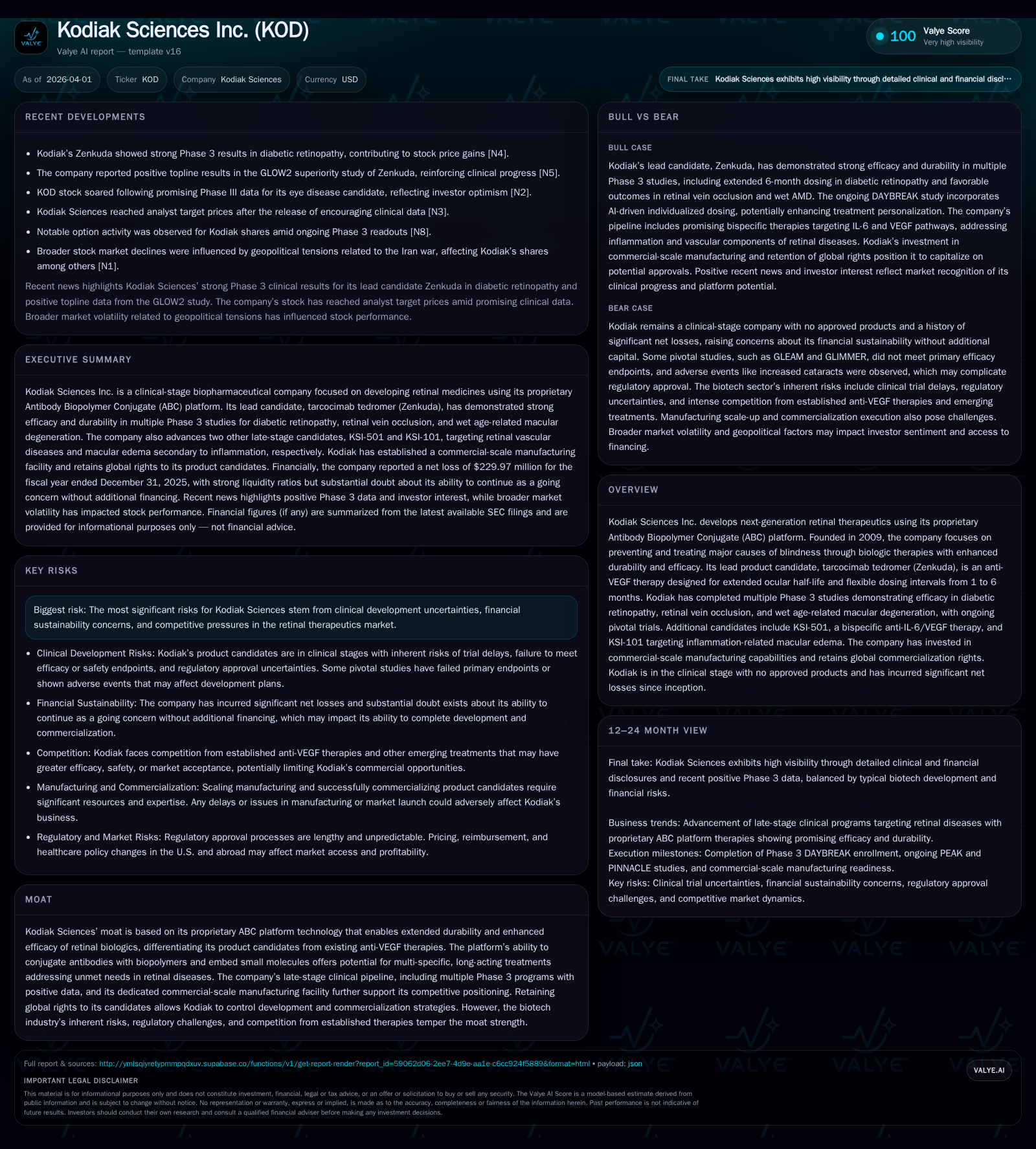
Since its inception in 2009, Kodiak Sciences has developed a proprietary Antibody Biopolymer Conjugate (ABC) platform enabling extended durability in retinal therapies. Its lead candidate, tarcocimab tedromer (Zenkuda), has reported strong Phase 3 results in diabetic retinopathy and related retinal diseases. While the company continues pivotal studies, including the ongoing DAYBREAK trial, it faces substantial operating losses and clinical development risks. Kodiak maintains significant cash reserves and operational control over manufacturing, positioning it for potential near-term commercialization pending regulatory milestones.
Company Overview and Proprietary Platform
Kodiak Sciences Inc., founded in 2009, has developed next-generation retinal therapeutics using its proprietary Antibody Biopolymer Conjugate (ABC) platform [S1]. This technology conjugates antibodies with biopolymers to extend intraocular half-life approximately threefold compared to current anti-VEGF treatments, addressing unmet needs in retinal diseases such as diabetic retinopathy (DR), retinal vein occlusion (RVO), and wet age-related macular degeneration (wet AMD).
Kodiak's lead clinical candidates—tarcocimab tedromer (Zenkuda), KSI-501 (a bispecific anti-IL-6/VEGF agent), and KSI-101—are internally developed. The company retains exclusive worldwide rights to all assets and operates commercial-scale manufacturing facilities supporting anticipated product launch volumes [S1].
Historical Performance and Financials
Kodiak remains in clinical development without approved products or revenue generation. The company incurs substantial expenses resulting in consistent operating losses. Key annual financial metrics from FY2022 through FY2025 are presented below based on SEC filings [F1]:
Historical performance (annual)
| FY | Net ($mm) | CFO ($mm) | OpInc ($mm) | Capex ($mm) | Net YoY |
|---|---|---|---|---|---|
| 2025 | -230 | -136 | -234 | 1 | -30.5% |
| 2024 | -176 | -117 | -187 | 0 | +32.4% |
| 2023 | -260 | -154 | -277 | 41 | +22.0% |
| 2022 | -334 | -206 | -341 | 37 |
Source: SEC companyfacts cache [F1].
Capital returns and efficiency (annual)
| FY | FCF ($mm) | ROE% |
|---|---|---|
| 2025 | -137 | -146.1 |
| 2024 | -118 | -117.2 |
| 2023 | -196 | -98.0 |
| 2022 | -243 | -76.5 |
Source: SEC companyfacts cache [F1].
Operating losses have narrowed since FY2022 due to cost containment following manufacturing capacity build-out and progression into later-stage trials [F1]. Despite improvement, net losses remain elevated reflecting continued investment in pivotal programs.
Operating cash flow remains negative but improved by approximately 16% year-over-year, indicating enhanced cost management amidst advancing clinical activity. Capital expenditures sharply declined after FY2023's peak associated with facility scaling.
The balance sheet shows strong liquidity with $210 million cash against current liabilities near $45 million, yielding a current ratio of approximately 4.7x at year-end FY2025 [F1]. This supports funding of ongoing pivotal trials without immediate refinancing needs.
Clinical Development Progress: Lead Candidate Tarcocimab Tedromer
Tarcocimab tedromer (Zenkuda) is Kodiak’s lead asset targeting multiple retinal vascular diseases through sustained VEGF inhibition. It features an ocular half-life around 20 days—about three times longer than existing anti-VEGF agents like aflibercept (Eylea)—aiming to reduce treatment burden by extending dosing intervals up to six months [S1].
Four pivotal Phase 3 trials support Zenkuda’s clinical profile:
- GLOW1 & GLOW2: Demonstrated efficacy in diabetic retinopathy with most patients achieving six-month dosing intervals at one year.
- BEACON: Showed comparable vision outcomes for retinal vein occlusion patients despite extended dosing intervals versus aflibercept.
- DAYLIGHT: Demonstrated non-inferior efficacy at once-monthly dosing in wet AMD.
The ongoing DAYBREAK study evaluates flexible dosing intervals from one to six months guided by an AI-driven disease activity model paired with an enhanced formulation balancing immediacy and durability [S1]. Enrollment is complete; topline one-year data is expected in Q3 2026 [N1][N2].
Recent GLOW2 superiority data released March 2026 confirmed durable vision outcomes on extended dosing regimens for diabetic retinopathy patients [N2], reinforcing Kodiak’s therapeutic hypothesis. Positive trial readouts have driven investor interest [N4][N10].
Pipeline Expansion Beyond Tarcocimab
Kodiak also advances KSI-501—a bispecific molecule targeting IL-6 and VEGF pathways—to address inflammation-driven mechanisms insufficiently managed by current monotherapies [S1]. KSI-101 targets macular edema via similar conjugate strategies but remains earlier in development.
These candidates illustrate Kodiak’s aim to expand its franchise with differentiated mechanisms offering potential efficacy or safety advantages. However, these programs face typical clinical uncertainties inherent to biopharmaceutical innovation [S2][S27].
Market Context and Competition
The retinal therapeutics market features established agents like Roche’s Lucentis, Regeneron’s Eylea, and newer entrants such as Vabysmo—a bispecific targeting VEGF-A/Angiopoietin-2—that have secured meaningful market share through extended durability claims [S24][S20].
Competition intensifies as payors favor longer interval regimens that improve patient convenience and reduce costs. Kodiak’s ABC platform targets this value proposition by enabling flexible monthly to six-month dosing without compromising efficacy or safety [S24]. Success depends on robust comparative evidence securing reimbursement favorable to Kodiak.
Regulatory Pathway Considerations
Biologic approvals require extensive preclinical and clinical validation alongside compliance with current good manufacturing practices (cGMP) regulations [S17][S21][S29]. Post-marketing obligations may include Risk Evaluation and Mitigation Strategies (REMS).
The inclusion of AI-driven dosing algorithms in DAYBREAK adds regulatory complexity but offers innovative potential if integrated into labeling or real-world use frameworks.
Kodiak faces typical clinical-stage biotech risks: trial delays or failures, competitive approvals ahead of theirs, or adverse safety findings could impact timelines adversely [S2][S26][S28]. Additionally, evolving healthcare policies domestically and internationally affect pricing dynamics [S7][S9][S13].
Capital Allocation and Returns Profile
Without commercial revenue, Kodiak incurred a net loss near $230 million in FY2025 alongside an operating loss of $234 million consistent with prior years’ investment phase [F1]. Operating cash outflows improved modestly yet remain significant at $136 million annually while capital expenditures dropped sharply reflecting completed fixed asset investments.
Shareholders’ equity stood at approximately $157 million end-FY2025 after accumulated losses reduced equity from prior levels [F1], indicating no immediate solvency concerns. No dividends or buybacks have been declared given development priorities.
Return on equity approximates negative 146% reflecting large accumulated losses relative to shareholder equity—a common profile among pre-commercial biotech firms.
Cash reserves of $210 million support operations through key milestones such as the DAYBREAK topline readout expected mid-2026 which will influence potential regulatory submissions thereafter [F1][N1].
Risks Summary
Key risks include:
- Clinical risk: Potential failure or delay of pivotal trials impacting approval timelines;
- Regulatory risk: Uncertain timing and conditions for marketing authorization including label flexibility;
- Competitive risk: Established products with entrenched positions plus emerging rivals;
- Financial sustainability: Continued negative cash flow necessitates future capital access unless approvals or partnerships materialize;
- Operational risk: Dependence on third-party contractors and FDA compliance burdens;
- Pricing & reimbursement: Heightened scrutiny on drug prices driven by legislative reforms affecting coverage dynamics domestically and abroad [S13][S25].
No material legal proceedings currently affect Kodiak; ongoing compliance with complex healthcare laws including off-label promotion restrictions remains critical .
Outlook: Key Milestones To Watch
The forthcoming release of DAYBREAK Phase 3 topline data expected Q3 2026 represents a major catalyst validating Zenkuda's flexible dosing across wet AMD patients. Subsequent market uptake hinges on regulatory label terms encompassing dosing intervals alongside safety profiles demonstrated during this study phase [N1][S1].
Advancement of second-generation candidates KSI-501/KSI-101 toward IND filings will diversify risk but remain secondary currently.
Given its sizable cash position, Kodiak appears positioned to sustain operations through critical inflection points without immediate dilution pressures barring unforeseen events. Post-regulatory approval commercialization scale-up may necessitate additional capital raising.
Kodiak's proprietary technology coupled with vertically integrated manufacturing infrastructure provides competitive advantages compared with typical early-stage biotechs reliant on outsourcing. Ultimately, success depends on demonstrating clinically meaningful durability gains while managing commercialization complexities amid a competitive environment.
This report is for informational purposes only. It does not constitute investment advice or recommendations regarding securities transactions.
Disclaimer: This is research-only, informational analysis and not investment advice. It may include AI-generated interpretation and general industry context. Always verify important details using primary sources.

Comments