
BOS BETTER ONLINE SOLUTIONS: Growth, Innovation, and Capital Dynamics to Watch
BOS BETTER ONLINE SOLUTIONS integrates supply chain components, RFID technologies, and custom robotics to drive growth and capital efficiency.
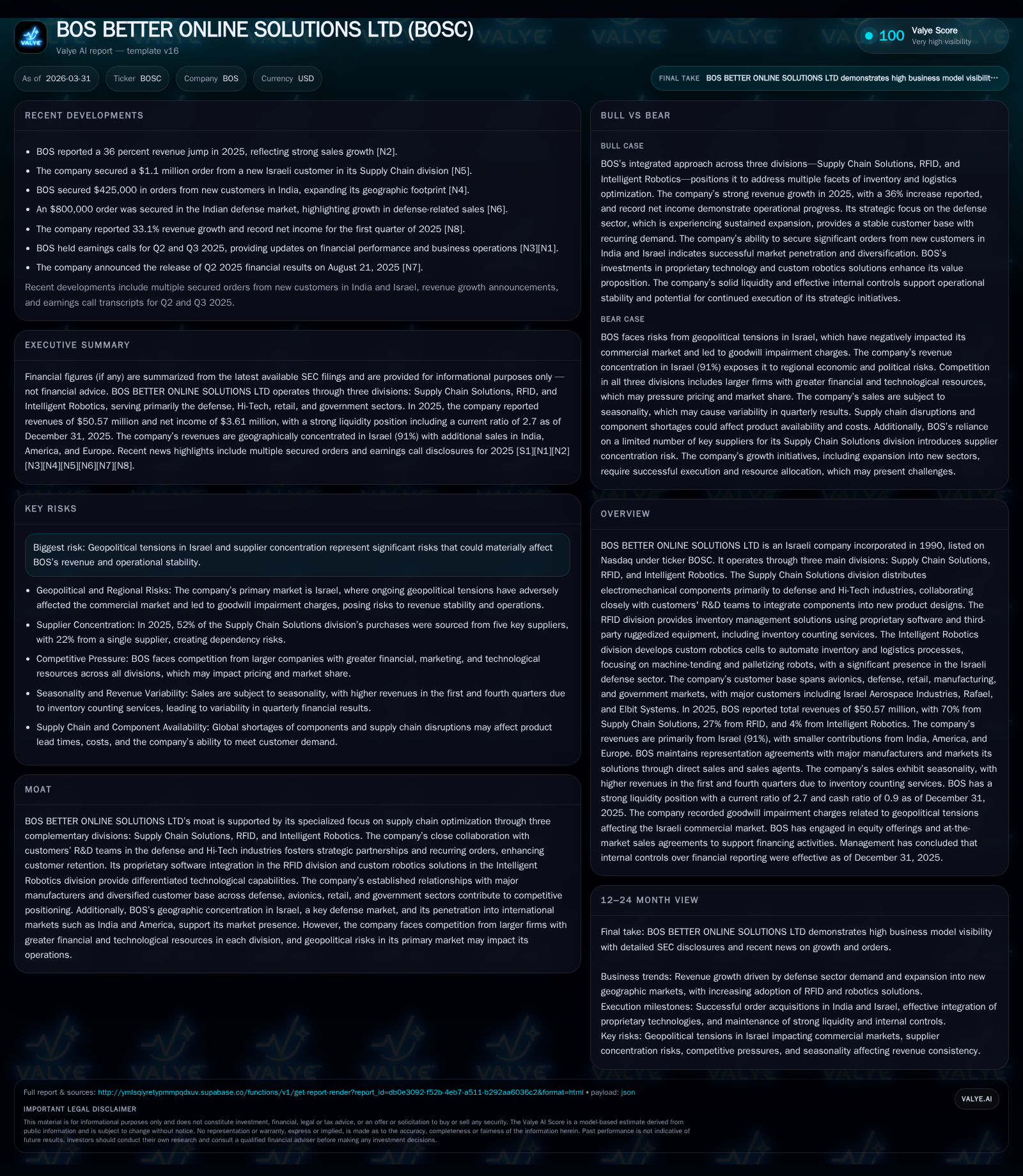
BOS BETTER ONLINE SOLUTIONS Ltd has evolved from a niche electromechanical components distributor into a multifaceted technology provider serving defense, Hi-Tech, retail, and governmental sectors. The firm's three divisions—Supply Chain Solutions, RFID, and Intelligent Robotics—have driven a 26.6% revenue increase to $50.57 million in 2025 alongside impressive operating leverage that doubled operating income year-over-year. Robust working capital and prudent debt management support its capital structure, while R&D investments underpin ongoing innovation in robotic automation. Geopolitical risks in Israel and supplier concentration represent notable headwinds as BOS pursues geographic diversification and expanding applications of its inventory automation technology.
Surging Revenues and Operating Gains: Recent Financial Accomplishments
BOS BETTER ONLINE SOLUTIONS LTD’s financial trajectory through FY2025 displays compelling growth fueled by intensified defense sector demand and operational efficiencies. Total consolidated revenues reached $50.57 million for FY2025, marking a 26.6% increase over $39.95 million recorded the prior year [F1]. This top-line acceleration was largely driven by the Supply Chain Solutions division which posted revenues of $35.55 million—a substantial rise from $25.83 million in FY2024—as geopolitical tensions amplified capital spending by defense customers [S1][S20].
Operating income more than doubled from $1.44 million in FY2024 to $2.91 million in FY2025, achieving an operating margin expansion benefiting from improved product mix favored by higher-margin robotics solutions and scale efficiencies [F1][S20]. Net income improved 57% to $3.61 million while operating cash flow surged nearly fourfold to $5 million due to better working capital management, notably a decrease in trade payables alongside growing collections [F1][S10]. Capital expenditures remained moderate at $452,000 for FY2025, down slightly year-over-year reflecting disciplined investment [F1][S10].
The financial gains highlight BOS’s growing operating leverage as its Intelligent Robotics division margin advanced alongside strong recurring orders bolstering profitability.
Trifecta of Divisions Driving Technological Synergies and Market Reach
BOS operates through three complementary business units that harness hardware, software, and mechanical automation technologies tailored for inventory automation across diverse verticals.
The Supply Chain Solutions division acts as a global distributor of electromechanical components sourced directly from manufacturers including Positronic Global Connector Solutions and Amphenol TCS Inc., supplying primarily the defense and Hi-Tech industries [S6][S13]. It provides customers with franchised kits integrated into new product designs via collaborations with their R&D teams—a major source of recurring revenue once production phases commence [S7][S13].
RFID division focuses on Automatic Identification Data Capture (AIDC) equipment including ruggedized handheld computers, barcode scanners, RFID readers/printers sourced from vendors like Zebra and Honeywell complemented by BOS’s proprietary inventory management software systems developed alongside Mantis Informatics Israel Ltd. The division also conducts biannual inventories for retail clients via trained staff employing this integrated hardware-software platform [S6][S7][S14]. Approximately 27% of revenues derive from this segment as of 2025 [F1][S6].
The Intelligent Robotics division delivers custom-made mechanical automation cells using internal mechanical designs with components integrated from off-the-shelf robots primarily configured for machine-tending production lines and palletizing tasks within logistics centers [S6][S14]. Its clients are predominantly Israeli defense entities such as Elbit Systems where over half the backlog is concentrated [S5][S6].
Each pillar leverages distinctive technology: AIDC equipment sales under RFID; customized electro-mechanical kits under Supply Chain; bespoke robotics automation in Intelligent Robotics—all collectively enhancing supply chain automation.
Deepening Customer Integration in Defense and Hi-Tech R&D Pipelines
BOS's competitive advantage is reinforced by deep collaborative relationships with customer R&D teams across its divisions—most notably within the defense sector where product design integration ensures strategic partnerships with high switching costs [S1]. Sales engineers embed themselves into client development cycles, enabling seamless incorporation of franchised components into next-generation systems which transition into ongoing production orders [S7][S13].
This model yields durable revenue streams as margins benefit from knowledge transfer barriers to competitors alongside recurrent orders securing longer-term visibility especially among marquee customers like Israel Aerospace Industries, Rafael Advanced Defense Systems, Elbit Systems, Vinyas India, and Sasmos Interconnection Systems Ltd from India [S5][S6]. Such close integration particularly supports their Supply Chain Solutions division revenue base.
Capital Structure Strength and Prudential Cash Flow Management
BOS maintains a robust balance sheet underpinning operational expansion while judiciously managing liquidity risks [F1][S4]. At year-end 2025, current assets stood at approximately $35.54 million versus current liabilities of around $13.18 million resulting in a healthy current ratio of about 2.7—indicating ample short-term liquidity buffers [F1]. Total bank borrowings remained moderate with about $972,000 long-term debt net of current maturities plus $672,000 short-term loans secured primarily through first-ranking fixed charges over company assets including unpaid share capital and goodwill [F1][S4].
Equity rose steadily from $16.63 million in FY2022 to $28.70 million in FY2025 signifying retained earnings growth from profitable operations without significant reliance on dilution or excessive leverage [F1]. Cash flows reflect prudence with operating cash flow ballooning to $5 million last fiscal year against restrained capex outlays (~$452K), enabling free cash flow near $4.6 million—a foundation for reinvestment or potential strategic acquisitions [F1][S10]. The company has also raised equity intermittently but currently depends largely on internally generated funds supplemented by manageable bank credit lines primarily arranged through Bank Beinleumi [S4][S17]. Interest rate risk remains modest given limited variable-rate exposure.
R&D Investments Supporting Robotic Automation Innovations
Research & Development resources focus exclusively within the Intelligent Robotics division aiming at state-of-the-art automation tailored for industrial logistics processes [S5]. BOS invested approximately $175K–178K annually during FY2024–25 maintaining consistent funding levels despite growing scale elsewhere [F1][S5]. These expenditures enable engineering work to configure custom robotics cells integrating mechanical designs with off-the-shelf robotic platforms catering specifically to high-mix low-volume applications prevalent in defense manufacturing ecosystems.
This targeted R&D aligns with BOS’s strategy emphasizing bespoke solutions rather than commoditized hardware products—supporting margin durability through differentiated technical capabilities not easily replicated by competitors focused on mass-market industrial robots or traditional distributors.
Risks from Geopolitical Sensitivities and Supplier Dependencies
Operational risk factors arise principally from BOS's geographic concentration within Israel—a region subject to ongoing geopolitical tensions since late 2023 that have intermittently suppressed commercial demand outside the resilient defense verticals [S18][S28].
The company's dependence on key suppliers is significant; five principal suppliers accounted for approximately 52% of Supply Chain division purchases during FY2025 with Positronics alone representing around 22%—a concentration risk that could affect lead times amid global component shortages post-pandemic [S13]. Inflationary pressures also affected cost structures notably via wage inflation raising cost base though partially offset by price list adjustments [S14][S20]. Additionally, impairment charges related to goodwill were recorded cumulatively ($700K in 2024; $1.2M in 2025) reflecting challenges faced particularly within the RFID commercial market segment impacted by reduced activity under geopolitical strains [S20][S25].
Forward-Looking Growth Drivers and Uncertainties to Monitor
Looking ahead, BOS targets mitigating geopolitical concentration risks by expanding into more stable regulated sectors including medical device manufacturing alongside continued defense market penetration domestically and internationally—especially targeting geographic diversification into India and Americas where BOS has established presence albeit currently smaller contributor (<10%) compared to Israel's dominant 91% of total revenues [S6][S15]. Automation adoption trends across global logistics segments may fuel accelerated uptake of custom robotic cells enhancing operational accuracy thereby enlarging Intelligent Robotics backlog beyond currently modest revenue share (4%) [F1]. However macroeconomic uncertainties relating to inflationary wage pressures and possible supply chain disruptions remain potential headwinds impacting gross margins and operating costs that management will need to navigate carefully amid ramped sales & marketing expenses commensurate with growth initiatives planned for rollout starting FY2027 horizon [S23]. Monitoring order book velocity for robotics cells alongside successful onboarding of regulated sector accounts will be critical early indicators for sustainable growth validation.
Key Metrics Table: Financial Progression Over the Past Four Years
Historical performance (annual)
| FY | Rev ($mm) | Net ($mm) | CFO ($mm) | OpInc ($mm) | Rev YoY | Net YoY |
|---|---|---|---|---|---|---|
| 2025 | 51 | 4 | 5 | 3 | +26.6% | +57.0% |
| 2024 | 40 | 2 | 1 | 1 | -9.6% | +14.7% |
| 2023 | 44 | 2 | 2 | 2 | +6.4% | +57.1% |
| 2022 | 42 | 1 | 1 | 2 |
Source: SEC companyfacts cache [F1].
Capital returns and efficiency (annual)
| FY | FCF ($mm) | ROE% |
|---|---|---|
| 2025 | 5 | 12.6 |
| 2024 | 1 | 10.8 |
| 2023 | 1 | 10.6 |
| 2022 | -1 | 7.7 |
Source: SEC companyfacts cache [F1].
Note: Revenue YoY percentages reflect annual percent changes; Operating Income reflects profit before interest/tax; CFO denotes cash provided by operations per fiscal year.
This analysis summarizes publicly disclosed information as of March 31st , 2026 without making investment recommendations or claims regarding future performance outcomes. Investors should weigh these findings alongside broader market considerations and conduct additional due diligence before forming conclusions about BOS BETTER ONLINE SOLUTIONS LTD's prospects or valuation metrics.
Disclaimer: This is research-only, informational analysis and not investment advice. It may include AI-generated interpretation and general industry context. Always verify important details using primary sources.

Comments