
ASE Technology’s Expansion and Innovation Fuel Semiconductor Service Leadership
ASE Technology Holding Co., Ltd. leverages capital investments and R&D to enhance advanced packaging and testing services within a cyclical semiconductor environment.
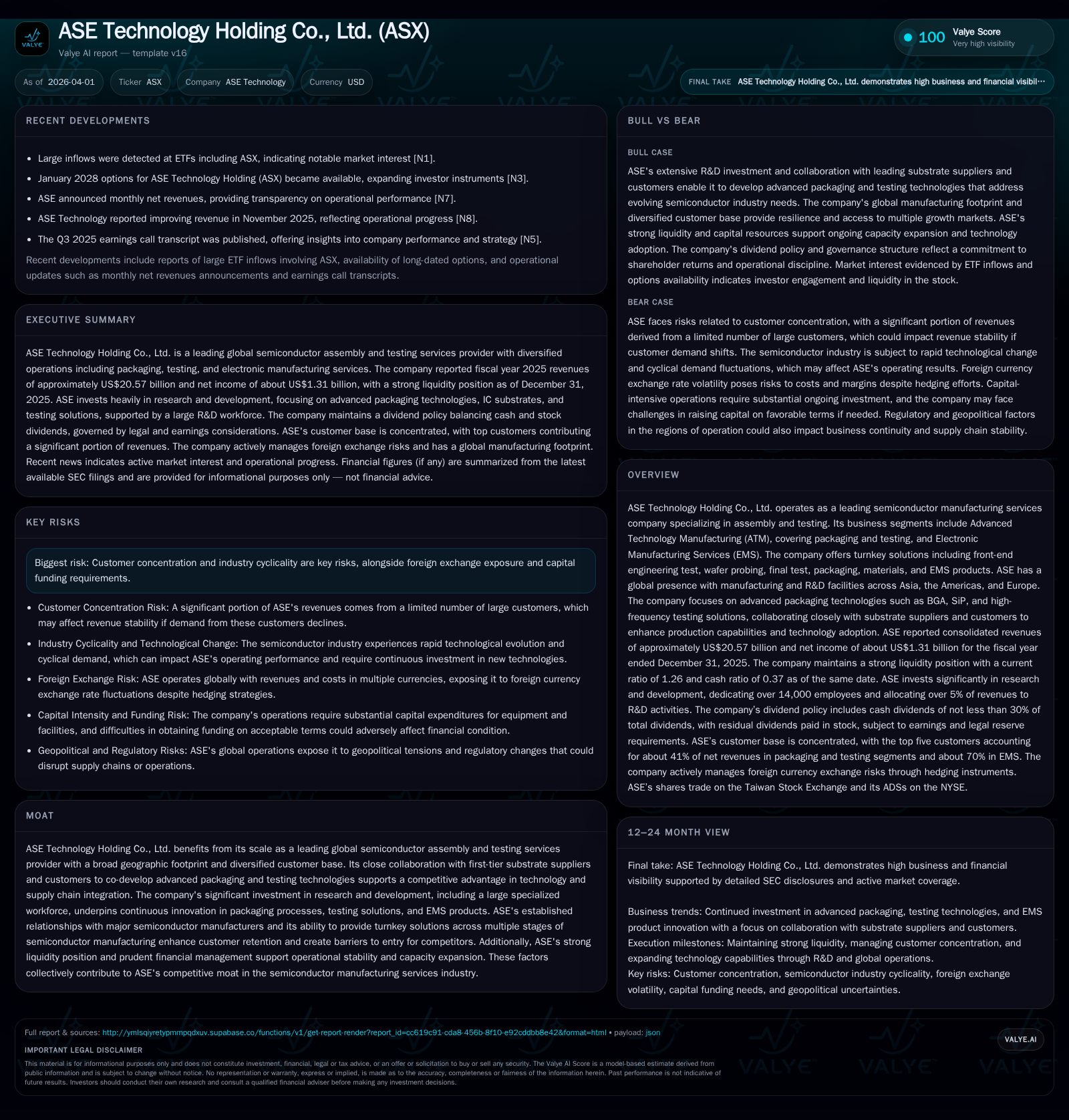
ASE Technology Holding Co., Ltd. demonstrated a rebound in revenue and net income in 2025 following modest declines in prior years, driven by growth in its Advanced Technology Manufacturing segment and geographic diversification. The company’s aggressive capital expenditure program, exceeding NT$171 billion in 2025, supports capacity expansion aligned with evolving packaging technologies such as BGA and SiP. R&D investment remains a strategic priority, representing over 5% of revenues, focusing on innovative packaging and testing solutions that underpin ASE’s competitive moat. While the balance sheet shows solid liquidity with a current ratio above 1.2, capital intensity generates dependency on external funding, exposing ASE to cyclical semiconductor market risks and foreign exchange volatility. Dividend policy balances shareholder returns with substantial reinvestment needs.
Historical Revenue Momentum and Segment Drivers
ASE Technology experienced notable revenue volatility over recent years but reversed course with robust growth in 2025. Consolidated revenues declined from US$21.83 billion in 2022 to US$19.00 billion in 2023 (-12.9%), compounded by pandemic aftereffects and supply chain disruptions [F1]. However, the company rallied in 2024 with revenues rising to US$18.16 billion (+13.3% YoY), further accelerating in 2025 to approximately US$20.57 billion, an expansion of another +13.3% [F1]. This recovery is closely linked to the Advanced Technology Manufacturing (ATM) segment — responsible for assembly, testing, and materials — which posted a +32.8% increase YoY reported through monthly updates [S3].
The product mix emphasis on advanced packaging technologies such as Ball Grid Array (BGA), System-in-Package (SiP), and high-frequency testing solutions aligns well with customer demand trends favoring multi-functional modules suitable for HPC and wireless applications . Geographically diversified manufacturing footprints across Asia (notably Taiwan), Europe, and the Americas helped absorb regional market fluctuations while securing proximity to key customers [S9].
Historical performance (annual)
| FY | Rev ($bn) | Net ($bn) | Rev YoY | Net YoY |
|---|---|---|---|---|
| 2025 | 20.6 | 1.3 | +13.3% | +27.3% |
| 2024 | 18.2 | 1.0 | -4.5% | -15.4% |
| 2023 | 19.0 | 1.2 | -12.9% | -42.1% |
| 2022 | 21.8 | 2.1 |
Source: SEC companyfacts cache [F1].
Capital returns and efficiency (annual)
| FY | ROE% |
|---|---|
| 2025 | 11.2 |
| 2024 | 9.9 |
| 2023 | 11.9 |
| 2022 | 20.6 |
Source: SEC companyfacts cache [F1].
*Latest full year data from [F1]
Investment in Capacity Expansion: Capital Expenditure Trends and Implications
Capital expenditures have escalated markedly as ASE aligns capacity with cutting-edge packaging demands [S1]. In NT dollar terms, annual capex surged from approximately NT$48.76 billion in 2023 to over NT$171.6 billion (US$5.47 billion) in 2025 [S18]. The spending breaks down predominantly into machinery & equipment (over NT$106 billion), building improvements (NT$65 billion), and land enhancements [S18]. These investments focus on expanding production scale while incorporating specialized equipment for advanced package assembly.
Commitments for pending capex stood at NT$135.25 billion (circa US$4.31 billion) at year-end ’25, reflecting significant ongoing obligations that may be adjusted based on market dynamics [S1]. To fund this capital-intensive growth without jeopardizing liquidity or operational capability, ASE leverages a combination of internal cash flow backed by strong operating cash generation alongside credit facilities [S4]. Nonetheless, management flags potential needs for additional equity issuance should external funding terms become unfavorable – a structural risk tied to rapid industry technological evolution requiring expensive upgrades [S1].
Research & Development Focus: Advancing Packaging and Testing Technologies
R&D investment remains a cornerstone enabling ASE’s sustained technology leadership amid sector competition [S11]. Total R&D expenditures rose from NT$28.83 billion (about US$920 million) in 2024 to almost NT$32.85 billion (~US$1.05 billion) in ‘25 representing approximately five percent of revenues [S1]. ASE's research workforce surpassed fourteen thousand engineers by end-2025, making it one of the largest dedicated semiconductor assembly R&D teams globally [S1].
Core R&D efforts center on optimizing package design efficiency covering BGA miniaturization, SiP integration improvements facilitating multi-chip modules combining mixed signals or memory components, as well as enhancing reliability test capabilities for complex high-frequency products including mmWave communications modules [S11]. There is also focus on collaborative equipment development with suppliers improving automation precision while reducing cost-per-test through proprietary handler designs featuring enhanced thermal management systems.
EMS segment innovation complements these activities through tailored computing peripherals and automotive-grade component engineering that balance performance with manufacturability considerations [S19]. These endeavors collectively strengthen ASE’s turnkey solution offer blending front-end engineering test through final test & packaging cycles.
Financial Health Overview: Liquidity, Leverage, and Risk Management
At fiscal year-end ’25 ASE held roughly US$2.95 billion in cash & equivalents giving it a healthy liquid buffer against near-term obligations along with current assets totaling US$10 billion compared against current liabilities near US$7.92 billion yielding a current ratio around 1.26x [F1][S4]. Long-term contractual liabilities amounting to over US$9 billion within three years require strategic liquidity management but are manageable via expected operating cash flow plus credit line access.
Debt profile is diversified across multiple currencies – predominantly local currency borrowings denominated in New Taiwan dollars complemented by USD-, EUR-, RMB-, JPY-, and KRW-denominated loans – enabling risk distribution across markets [S14][S17]. Average borrowing interest rates remain historically low between ~1.8%-4% contingent on instrument type; ASE deploys hedging instruments including forwards, swaps, options targeting foreign exchange exposure mitigation between USD/TWD/EUR/others critical due to multinational operations [S14].
Exposure analysis reveals earnings before taxes can swing moderately on ~1% fluctuation currency moves with internal controls offsetting much realized forex volatility impacts via designated hedge accounting ensuring earnings stability despite semiconductor cycle volatility [S12][S14][S22]. Nonetheless cyclical demand shifts pose ongoing risks given large fixed asset base deployed for volatile industry end-markets [S26].
Dividend Policy and Shareholder Returns in a Capex-Heavy Environment
Despite capital intensity driven by heavy capex requirements ASE maintains shareholder remuneration discipline balancing reinvestment with returns sustainability [S6]. The company's formal dividend policy mandates minimum cash dividends account for no less than thirty percent of the total declared payout; residual amounts are distributed as stock dividends.
Cash dividends per common share have fluctuated recently from NT$8.80/share in ’23 down to around NT$5.30/share for ’25 reflecting variable net income levels under cyclical pressures but showing commitment towards consistent yield support [S6][F1]. This flexible policy enables adjusting distributions alongside earnings performance ensuring no compromise on liquidity required for capex commitments while rewarding shareholders suitably.
There are no active share repurchases currently given competing capital demands though the board retains authority under Taiwanese corporate law frameworks permitting such actions if conditions improve materially [S7][S10]. Legal reserves accruement ensures prudent basis before distributions maintaining regulatory compliance over retained earnings usage alongside transparent governance.
Future Outlook: Growth Prospects, R&D Payoffs, and Market Constraints
The roadmap ahead will hinge critically upon successful scale-up of ongoing expansion projects funded by record capex outlays combined with technology maturation from advanced packaging research initiatives integrated into commercial offerings including system-in-package modules catering HPC/high-frequency markets expected to grow persistently globally due to AI/telecom infrastructure upgrades [N3].
However constraints persist notably around capital availability if worse-than-expected market downturns occur potentially pressuring liquidity necessitating equity issuance risking shareholder dilution; this is compounded by high customer concentration amidst cyclicality leading to fluctuating volumes impacting utilization rates thus profitability margins vulnerable especially during semiconductor troughs [S1][S12][N2][S26]. Close monitoring of macro semiconductor demand signals alongside successful timely deployment of newly developed package/testing innovations will dictate trajectory.
Key Milestones and Metrics to Watch in ASE’s Journey Ahead
Important upcoming indicators include milestones tied to completion rates of committed capital projects totaling over US$4 billion which will expand front-line production capacities enhancing throughput for next-generation BGA/SiP packages pivotal for product differentiation as reported during recent disclosures [N3][S18]. Additionally watch quarterly revenue growth snapbacks after known cyclic dips validate sustained demand fidelity.
Operational efficiency improvements stemming from pilot-to-commercial transitions of new packaging processes led out of flagship Kaohsiung/Taichung R&D hubs will be critical signals measuring technical execution capability affecting cost structures long term [S11]. Consistent ROE improvements above current ~11% level will also serve as barometers for effectiveness of investment returns amid pressure from increased asset bases given intense fixed cost deployments reflected year-on-year profit gains observed most recently [F1]. Finally liquidity metrics confirming stable working capital funding amidst heavy capex intensity including adherence to forecasted cash flow targets will merit close attention given risk factors noted.
This analysis integrates financial data verified from ASE Technology Holding Co., Ltd.’s SEC filings up to fiscal year-end December 31, 2025 ([F1]) along with recent company disclosures ([S#]) and market insights ([N#]). It presents an objective view grounded strictly on documented information without speculative projections or investment guidance.
Disclaimer: This is research-only, informational analysis and not investment advice. It may include AI-generated interpretation and general industry context. Always verify important details using primary sources.

Comments