
IAC Inc. Confronts Declining Revenue and Operating Losses While Leveraging Strong Liquidity and Active Buybacks
IAC’s diversified digital media portfolio faces top-line contraction and profitability challenges amid evolving industry risks, offset by robust cash reserves and share repurchases.
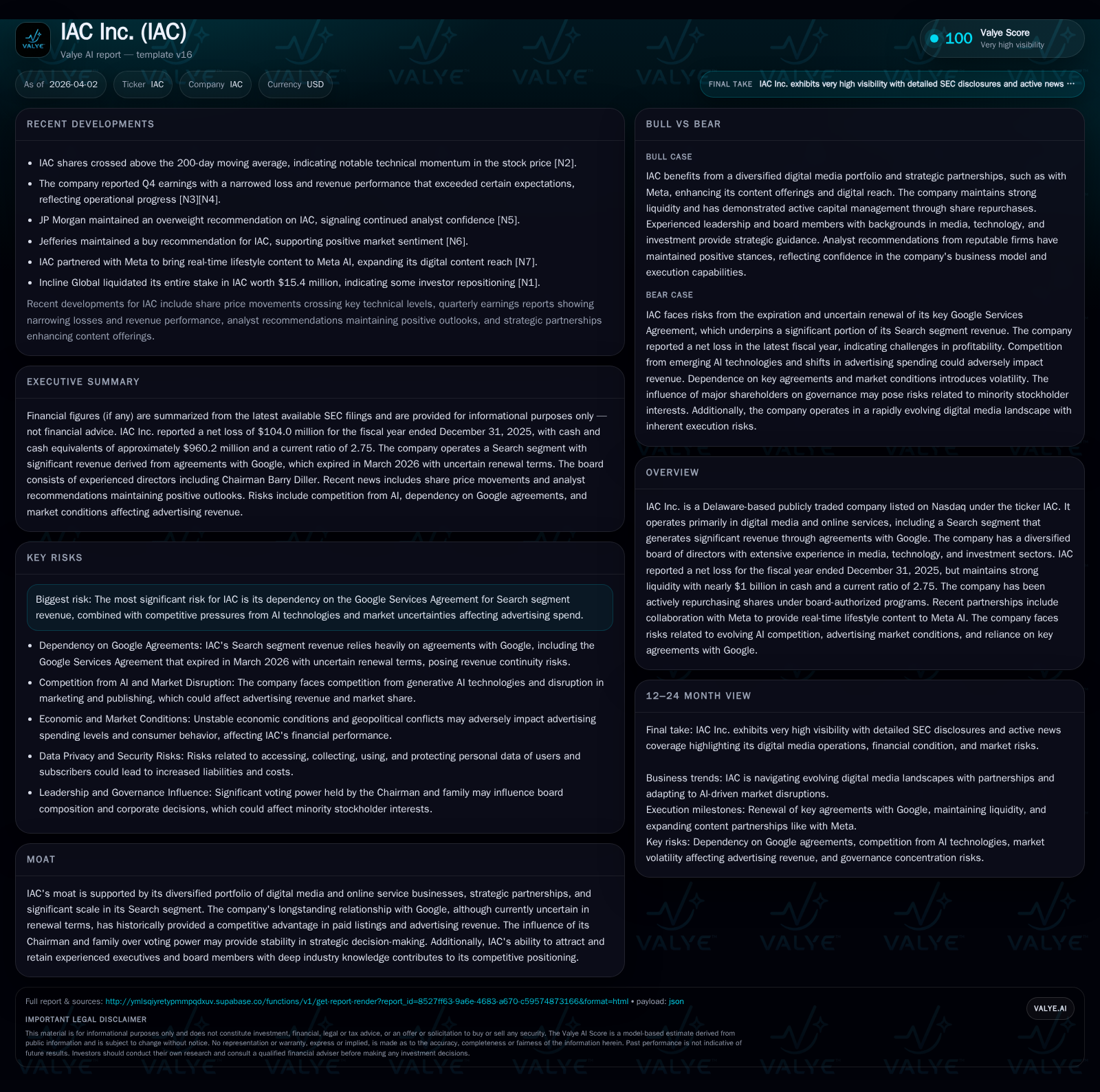
IAC Inc. reported $4.37 billion revenue for fiscal 2023, down 16.6% year-over-year, alongside a $97 million operating loss in 2025 as its Search segment faces uncertainty over Google agreements and AI competition intensifies. Despite these headwinds, the company maintains nearly $1 billion in cash with a strong current ratio of 2.75, supporting continued share buybacks totaling $315 million in 2025. Prospects hinge on renewing key search monetization deals, advancing digital media partnerships such as with Meta, and navigating advertising market volatility.
Historical Performance and Financial Trajectory
IAC Inc., trading under ticker IAC on Nasdaq, has experienced significant top-line fluctuation recently amid structural shifts within its core digital media businesses. Total revenue stood at approximately $4.37 billion for fiscal year ending December 31, 2023, representing a decline of about 16.6% compared to $5.24 billion the year prior [F1]. This contraction largely reflects pressure on IAC's Search segment revenue chiefly derived from Google agreements which face renewal uncertainty.
Profitability metrics mirror this challenge as operating income showed a marked swing from heavy losses towards modest improvement before deteriorating again: the company posted an operating loss of roughly $26 million in 2023 after larger deficits of $475 million in 2022 but saw this loss widen to approximately $97 million by the end of 2025 [F1]. Correspondingly, net income reflected volatility—turning positive briefly at about $266 million in 2023 but reverting to a net loss nearing $104 million by the close of 2025 [F1].
Despite profitability challenges, operational cash flow resilience is notable with CFO soaring by over 129% year-on-year from an undersized base (details from interim filings). Capital expenditures have concurrently decreased significantly by over 70%, signaling tighter capex discipline or potential shift away from capital-intensive investments [F1].
Summary Annual Financials
Historical performance (annual)
| FY | Rev ($bn) | Net ($mm) | OpInc ($mm) | Capex ($mm) | Rev YoY | Net YoY |
|---|---|---|---|---|---|---|
| 2025 | -104 | -97 | 19 | +80.7% | ||
| 2024 | -540 | -4 | 66 | -303.0% | ||
| 2023 | 4.4 | 266 | -261 | 141 | -16.6% | +122.7% |
| 2022 | 5.2 | -1170 | -475 | 140 | +41.5% |
Source: SEC companyfacts cache [F1].
Capital returns and efficiency (annual)
| FY | ROE% |
|---|---|
| 2025 | -2.2 |
| 2024 | -9.7 |
| 2023 | 4.4 |
| 2022 | -19.7 |
Source: SEC companyfacts cache [F1].
Note: Operating cash flow for FYs other than specifically mentioned is unavailable for comparison.
Future Growth Prospects
Looking ahead, IAC’s growth outlook hinges predominately on three dimensions: the renewal and terms of its Google Services Agreement which underpins the lucrative Search segment; the progression of its digital content and online services portfolio especially synergy creation with partners like Meta; and broader advertising market dynamics heavily influenced by macroeconomic conditions and technological shifts.
The company recently announced enhanced collaboration with Meta to embed real-time lifestyle content within Meta's AI framework—a strategic move attempting to capitalize on artificial intelligence trends rather than being marginalized by them [N11]. Nonetheless, ongoing intensification of AI-enabled search features (e.g., Google's generative AI overlays) generate risk of disintermediation.
Moreover, IAC divested its Care.com unit earlier this year to concentrate resources on core businesses [S3]. This signals focus but also raises questions about diversification strategy going forward.
Forecasts and Milestones
No explicit long-term financial guidance was provided publicly within the latest SEC filings or regulatory communications [S1][S27]. Market observers should monitor developments related to Google's contract negotiations as well as quarterly advertising trends given their disproportionate impact on short- to medium-term results.
Additionally, milestones such as integration success with Meta AI content initiatives and earnings inflection points post-Care.com disposal will be critical barometers.
Returns and Capital Allocation
IAC’s capital management policy remains shareholder-friendly amid operational pressures. The firm maintained substantial liquidity with nearly $960 million cash and equivalents along with a conservative current ratio of approximately 2.75 as of December 31, 2025 [F1][S1], underpinning operational flexibility.
Notably, share repurchase programs are actively pursued; in fiscal year 2025 alone, buybacks amounted to around $315 million—far exceeding previous years’ levels—and continue under board-approved authorizations [F1][S4][S6][S27]. This sizable return contrasts with absent dividends indication.
Calculated return on equity remains negative (~-2.2%) reflecting ongoing net losses amidst sizeable equity base exceeding $4.7 billion as of end-2025 [F1]. Such ROE aligns with transitional phase status where investment outweighs near-term earnings.
Industry Analysis & Competitive Context (Analysis)
IAC operates amid accelerating disruption within digital media characterized by an evolution towards AI-driven user engagement models. The company’s moat primarily derives from scale across various digital properties combined with long-standing contractual arrangements directing substantial paid search volume through Google platforms—terms that historically ensured preferential placement but now face renegotiation risk.
Furthermore, concentrated voting control by founding leadership offers strategic stability but also accountability concerns typical for controlled firms navigating cutting-edge tech transitions.
Most advertising-dependent entities confront cyclicality amplified by economic uncertainty; hence IAC’s dual reliance on external agreements plus advertising revenue renders agility crucial.
Conclusion
IAC Inc.'s recent financial profile depicts a company grappling with declining sales growth and recurring operating losses driven chiefly by contractual uncertainties and competitive pressures within its signature Search business segment. However, the resilience embodied in solid liquidity reserves alongside proactive capital returns via repurchases signal financial prudence and confidence management’s strategic maneuvers can stabilize performance.
The path forward rests heavily on successfully navigating renewals of pivotal partnerships particularly with Google while expanding new alliances leveraging artificial intelligence capabilities exemplified by collaboration with Meta. Market participants should rigorously track these developments along with broader ad spending trends to gain insights into forthcoming financial momentum shifts.
This document is prepared solely for informational purposes without any recommendation or investment advice concerning securities or strategies discussed.
Disclaimer: This is research-only, informational analysis and not investment advice. It may include AI-generated interpretation and general industry context. Always verify important details using primary sources.

Comments