
CN Healthy Food Tech Group's AI-Driven Fusion of Tradition and Innovation Under Nasdaq Suspension
CN Healthy Food Tech Group melds AI-powered biotech with traditional Chinese medicine to grow its health food portfolio amid regulatory and capital market challenges.
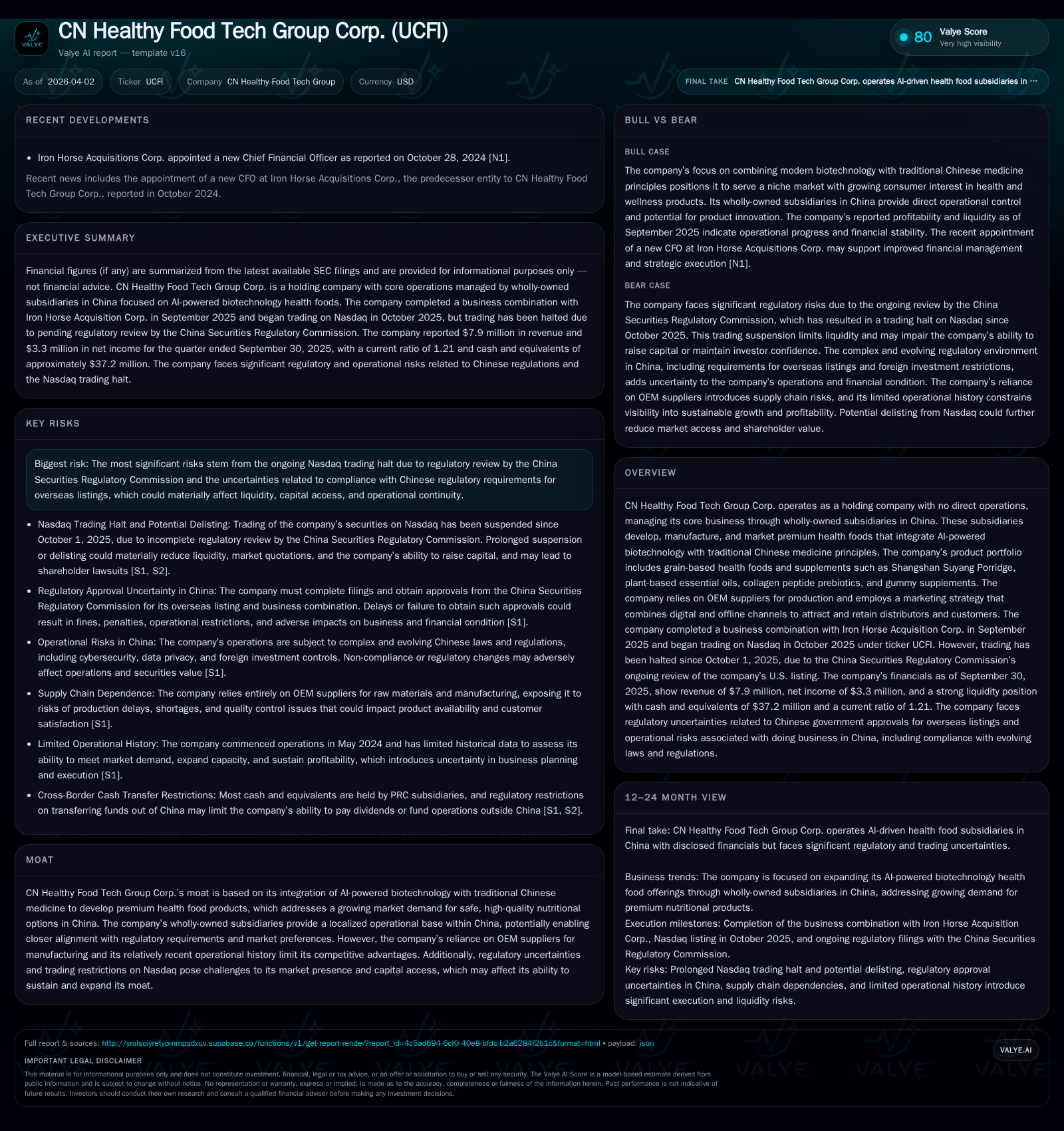
CN Healthy Food Tech Group Corp. (UCFI) operates through wholly-owned Chinese subsidiaries that leverage AI-enhanced biotechnology combined with traditional Chinese medicine principles to develop premium health food products. Despite its innovative product suite including grain-based porridge, collagen peptides, and gummy supplements, UCFI faces significant headwinds from a Nasdaq trading halt initiated due to pending regulatory approval from China’s CSRC. Financially, the company shows rising net income amidst operating losses and negative cash flow, highlighting its nascent stage and operational challenges. Key risks include operational dependence on OEM manufacturing, intellectual property enforcement complexities in China, as well as uncertain cross-border regulatory compliance and capital access. Monitoring the resolution of the Nasdaq suspension and CSRC filing will be critical for the company’s future growth trajectory.
Tracing UCFI’s Early Growth and Financial Performance
CN Healthy Food Tech Group's financial footprint remains modest but indicative of early-stage expansion efforts. For the fiscal year ending December 31, 2024, UCFI reported revenue near $7.9 million for the twelve months ended September 30, 2025 [F1], largely underpinned by its health foods portfolio aimed at China’s growing nutritional supplement market.
Despite this top-line growth, operating income remained negative at approximately -$1.7 million in FY2024 - a steep deterioration from FY2023’s operating loss of about -$0.3 million (a -453% change YoY) [F1]. Contrastingly, net income swung positively by over 545%, reaching around $1.38 million in FY2024 from a net loss of almost $0.31 million in FY2023 [F1]. This net income aberration amid operating losses suggests significant non-operating income or one-time accounting effects rather than organic profitability.
Operating cash flows also reflected setbacks with outflows expanding from roughly -$83k in FY2023 to about -$1 million in FY2024 [F1]. The company remains cash-intensive during this phase while investing or scaling up its business.
Historical performance (annual)
| FY | Net ($) | CFO ($) | OpInc ($) | Net YoY |
|---|---|---|---|---|
| 2025 | ||||
| 2024 | 1375819 | -1012960 | -1709829 | +545.5% |
| 2023 | -308792 | -83200 | -309018 |
Source: SEC companyfacts cache [F1].
Capital returns and efficiency (annual)
| FY | ROE% |
|---|---|
| 2025 | |
| 2024 | -33.2 |
| 2023 | 11.5 |
Source: SEC companyfacts cache [F1].
Table: CN Healthy Food Tech Group annual financial performance showing growing revenue alongside intensifying operating losses but improved net income driven by non-operational items [F1].
The Role of AI Biotech and Traditional Chinese Medicine in Product Differentiation
At the heart of UCFI’s strategic positioning lies an ambitious fusion of modern biotechnology powered by artificial intelligence with time-honored traditional Chinese medicine (TCM) principles. This hybrid approach enables 'biotechnology-driven ingredient formulation' across its health foods portfolio.
Products include grain-based Shangshan Suyang Porridge designed for optimized nutrition absorption, collagen peptide prebiotics aimed at gut health synergy, and gummy supplements tailored for palatability and efficacy [S1]. These represent examples of nutraceutical innovation leveraging data-driven R&D to reimagine TCM for the contemporary consumer.
Such a blend targets an emergent demographic seeking safe yet scientific wellness products aligned with cultural familiarity—a niche demanding both functional efficacy validated via biotech methods and holistic heritage credibility.
Operational Structure and Reliance on OEM Partners
Structurally, CN Healthy Food Tech Group Corp is a holding company executing core operations solely through its five wholly-owned Chinese subsidiaries focused on product development and market execution within mainland China [S1].
The company does not maintain direct manufacturing facilities; production is completely outsourced to third-party OEM suppliers [S7]. This model offers scalability benefits without capital intensity but introduces supply chain vulnerabilities such as quality control risks and dependency on supplier capacity expansions.
This OEM partnership must be tightly managed since any disruption upstream could cascade into inventory shortages or compromised product launches downstream—factors central to sustaining distributor confidence and end-customer satisfaction.
Capital Market Suspension: Causes and Consequences
UCFI entered Nasdaq trading on October 1, 2025 following its merger with Iron Horse Acquisition Corp but was immediately halted due to an unresolved regulatory review by the China Securities Regulatory Commission (CSRC), which had not completed its assessment of UCFI’s overseas listing application at that time [S1; S2].
This suspension has profound effects:
- Limited liquidity as shares cannot be freely traded reduces secondary market activity.
- 'Penny stock' designation could impose stringent broker-dealer regulations diminishing investor interest.
- Reduced access to further capital raising via public markets constrains growth investments.
- Potential delisting risks exacerbating shareholder value erosion.
Delisting would likely push securities trading to less liquid OTC markets further impairing valuation visibility and financing avenues—representing substantial operational risk for a growth-dependent health food tech enterprise reliant on capital flows [S1; S2].
Regulatory Environment and Compliance Complexities in China-US Listings
UCFI faces entrenched cross-jurisdictional regulatory challenges amplified by evolving oversight frameworks governing Chinese companies seeking US listings.
The firm is subject to mandatory filings with the CSRC related to its business combination finalized in late 2025. Although documentation submissions were made timely, uncertainty regarding final approval persists [S19]. Chinese regulations actively examine foreign ownership controls, cybersecurity mandates under PIPL and Data Security Law regimes, product certification standards, environmental rules, occupational safety laws, as well as compliance obligations spanning the entire supply chain ecosystem of health foods [S3; S4; S16].
This tangled legal environment elevates operational complexity costs while complicating investor confidence given opaque timelines for regulatory clearances necessary for compliance continuity and overseas fundraising legitimacy.
Financial Health and Capital Allocation
UCFI reported substantial liquidity of over $37 million as cash and equivalents at September 30, 2025 alongside a current ratio around 1.21 (current assets approximately $46 million vs liabilities near $38 million) indicating moderate working capital adequacy given ongoing operating cash outflows totaling nearly $1 million annually [F1; S23].
However:
- Negative operating earnings combined with negative free cash flow signal continued reliance on external financing or equity dilution for funding operations.
- The absence of declared dividends or share repurchase programs aligns with typical growth-stage firms prioritizing reinvestment given uncertain profit sustainability.
- Return on equity is negative at roughly -33%, reflecting balance sheet deficits driven by accumulated losses despite recent net income improvements suggesting unresolved profitability hurdles persist [F1].
Capital allocation thus remains constrained by trading suspensions restricting public market access crucial for funding strategic initiatives such as R&D acceleration or expanded distribution capabilities.
Intellectual Property Risks and Competitive Moat Sustainability
While CN Healthy Food Tech holds registered patents and numerous trademarks domestically underpinning its AI-driven formulations and branding strategies ([S25]), IP protection remains precarious due to intrinsic legal system challenges including inconsistent enforcement mechanisms against infringement or circumvention [S5; S6].
The firm relies heavily on proprietary trade secrets safeguarded through confidentiality agreements; however leaks or independent rival discovery remain tangible threats compromising competitive advantages derived from nuanced biotechnological know-how ([S11]). Trademarks face opposition risks requiring potentially costly legal defense or rebranding scenarios impairing brand equity building efforts ([S6]).
Hence sustaining moat durability depends equally on proactive IP portfolio management combined with strategic operational execution amidst a fast-evolving legal regime governing biotech innovation in China.
Conclusion Disclaimer
This analysis summarizes publicly available financial data from SEC filings alongside company disclosures as of early April 2026 without speculative forecast endorsement. Readers should consider regulatory developments and market dynamics may significantly influence CN Healthy Food Tech Group Corp.’s financial condition beyond disclosed information.
Disclaimer: This is research-only, informational analysis and not investment advice. It may include AI-generated interpretation and general industry context. Always verify important details using primary sources.

Comments