
Tailwind 2.0 Acquisition’s SPAC Model Anchored on Electron Economy Business Combination
A newly launched blank check company with a $172.5 million IPO targets high-growth energy and compute infrastructure businesses.
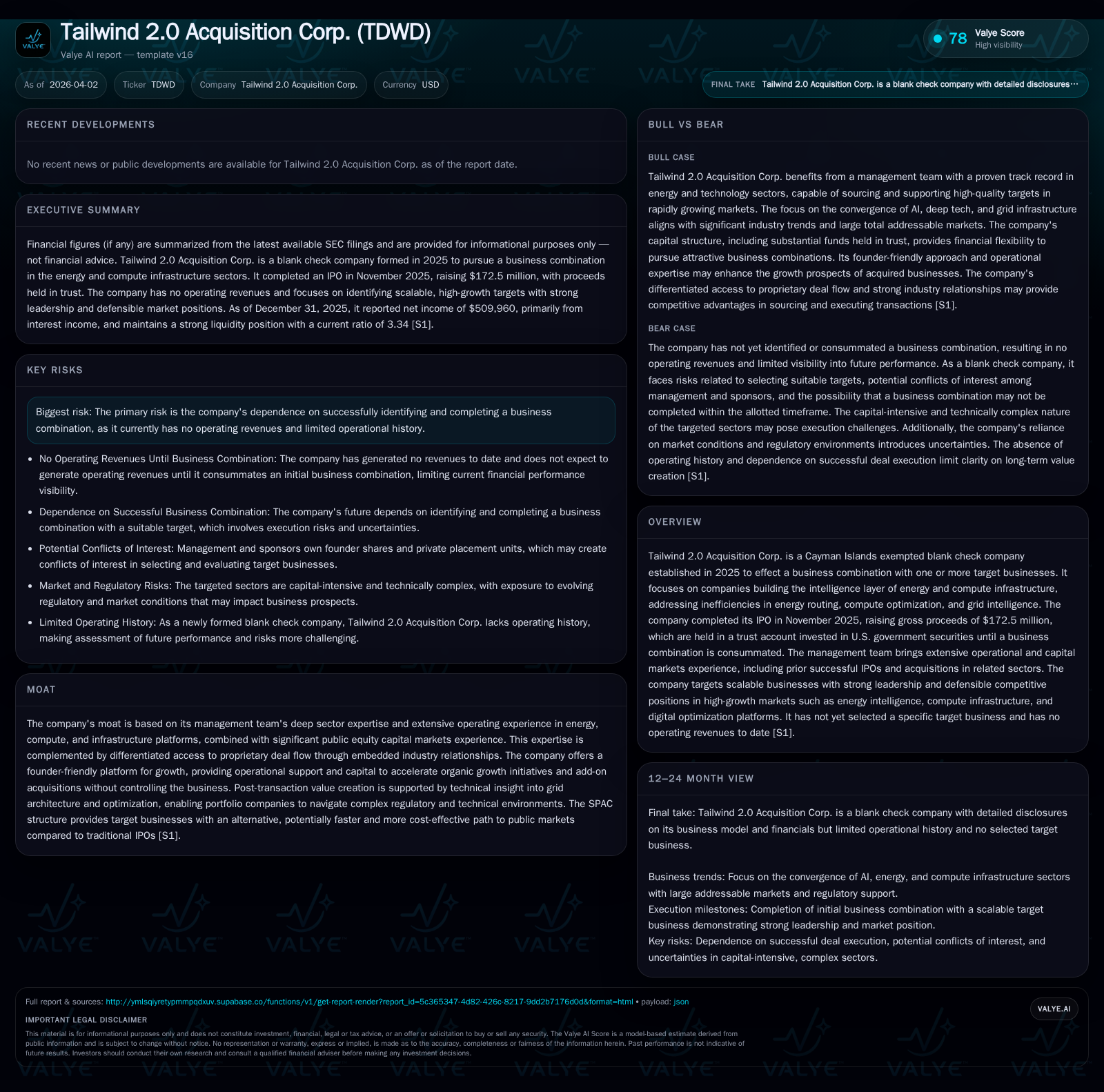
Tailwind 2.0 Acquisition Corp., established in mid-2025 and incorporated in the Cayman Islands, completed its IPO in November 2025, raising $172.5 million primarily targeting companies focused on the intelligence layer of energy and compute infrastructure. While it has no operating revenues yet, the SPAC leverages a management team with deep sector and capital markets expertise seeking scalable platform targets within high-growth Electron Economy markets. The firm’s future growth hinges on successfully completing a business combination by November 2027, with risks centered around deal execution and target selection.
Company Background and Historical Performance
Tailwind 2.0 Acquisition Corp. was incorporated on May 29, 2025 as a Cayman Islands exempted blank check company formed exclusively to consummate a merger, acquisition, share exchange or similar business combination with one or more target companies [S1]. The company completed its IPO on November 10, 2025, offering 17,250,000 units at $10 each including full exercise of underwriters’ over-allotment, raising gross proceeds of approximately $172.5 million [S1]. Additionally, a private placement sale of 545,000 units to the Sponsor and underwriters raised $5.45 million simultaneously.
The proceeds from the IPO have been placed in a trust account investing solely in U.S. government securities with short maturities to preserve capital until used for an acquisition or returned upon liquidation [S1][S24]. As of December 31, 2025, approximately $173.4 million (including accrued interest) was held in trust [F1]. Outside of this trust account, Tailwind held around $1.1 million in cash available for operational costs such as due diligence activities during its pre-combination phase [S3][F1].
Since inception through year-end 2025 Tailwind has not operated any revenue-generating business and is solely engaged in organizational activities preparatory to effectuating a business combination [S1]. Net income for this period was about $509,960, primarily derived from interest income earned on trust account holdings minus general administrative expenses totaling $432,339 [F1]. Operating losses reflect expected spending on legal, accounting, compliance and transaction sourcing costs typical for SPACs.
Historical performance (annual)
| FY |
|---|
| 2025 |
Source: SEC companyfacts cache [F1].
Units sold includes public offering units plus private placement units; net income includes interest income net of expenses.
Industry Focus and Market Opportunity
Tailwind’s strategic focus lies at the intersection of energy infrastructure and computing — specifically targeting companies developing the intelligence layer that addresses inefficiencies related to energy routing, grid management intelligence and compute resource optimization [S1][S15][S16]. This space is described as part of the "Electron Economy," encompassing deep tech convergence between AI applications and grid infrastructure modernization trends.
The management team’s sector expertise along with capital markets experience provides sourcing advantages over competitors lacking embedded networks within utility-scale ISOs (Independent System Operators), energy providers and compute service providers [S16]. The SPAC vehicle offers prospective targets an expedited path to public markets with founder-friendly structures designed to support organic growth initiatives alongside potential add-on acquisitions post-combination.
Future Growth Prospects and Strategic Considerations
As a blank check company without current operations or revenue streams beyond interest income on trust holdings, Tailwind’s trajectory depends entirely on completing an initial business combination by November 10, 2027—or earlier if decided by the board [S6][S9]. No target has been publicly identified yet.
Management seeks businesses demonstrating scalable models capable of exceeding $100 million annual revenue with less than $50 million invested capital while possessing defensible competitive moats such as proprietary technology or regulatory positioning [S15][S16]. Ideal targets address urgent customer problems validated by market demand traction within electron economy subsectors.
Failure to identify or consummate a suitable business combination risks liquidation whereby public shareholders are redeemed pro-rata based on trust account value—initially expected around $10 per share plus accrued interest less dissolution costs [S14][S26].
Capital Allocation and Shareholder Returns
Currently Tailwind generates operating cash flow only from nominal interest income earned on invested IPO proceeds within its trust account—which is restricted for use only upon successful business combination consummation or liquidation events [S1][F1]. Expenses relate strictly to administrative costs linked to public company compliance plus due diligence costs related to searching for acquisition candidates.
There are no declared dividends or repurchase programs; shareholder returns will derive principally from equity appreciation following successful deployment of capital into an operating company post-business combination [S10].
Sponsor arrangements include monthly payments of $20,000 for office space and administrative services until consummation or liquidation ends these obligations [S19][S25]. Working capital loans may be provided by sponsor affiliates for transaction expenses but none were outstanding as of December 31, 2025 [S12][S19].
Risks and Uncertainties
Key risk centers on Tailwind’s reliance on completing a suitable business combination within the allotted window to avoid liquidation losses [S9]. With no operating history or revenues beyond passive interest income through trust investments—and ongoing costs related to pursuit activities—the company’s valuation depends entirely on deal execution success.
Additional risks include potential conflicts of interest given founder shares held by management who may benefit disproportionately if particular transactions are pursued despite possible misalignment with public shareholder interests [S15][S25]. Complications could arise if third-party financing is required but unavailable ahead of deal closure [S20].
Outlook: What to Watch
Absent explicit financial guidance beyond current disclosures, key milestones include:
- Announcement of identified target(s) aligned with stated criteria;
- Filing and shareholder approval documents relating to proposed business combinations;
- Details regarding financing mix (cash/debt/equity) deployed at closing;
- Redemption activity levels signaling market reception;
- Post-merger integration plans supporting growth synergies.
Given industry specialization coupled with thematic tailwinds towards smarter grids and compute infrastructure modernization fueled by AI workloads—the underlying sector merits long-term consideration independent of SPAC-specific execution risks.
This memorandum is prepared solely for informational purposes reflecting publicly filed documents and does not constitute investment advice or an endorsement of any securities mentioned herein.
Disclaimer: This is research-only, informational analysis and not investment advice. It may include AI-generated interpretation and general industry context. Always verify important details using primary sources.

Comments