
PAID INC’s E-Commerce Platform Growth Tempered by Profitability and Liquidity Constraints
PAID INC’s integrated SaaS offerings for SMB e-commerce and shipping show revenue gains but ongoing losses and capital limitations persist.
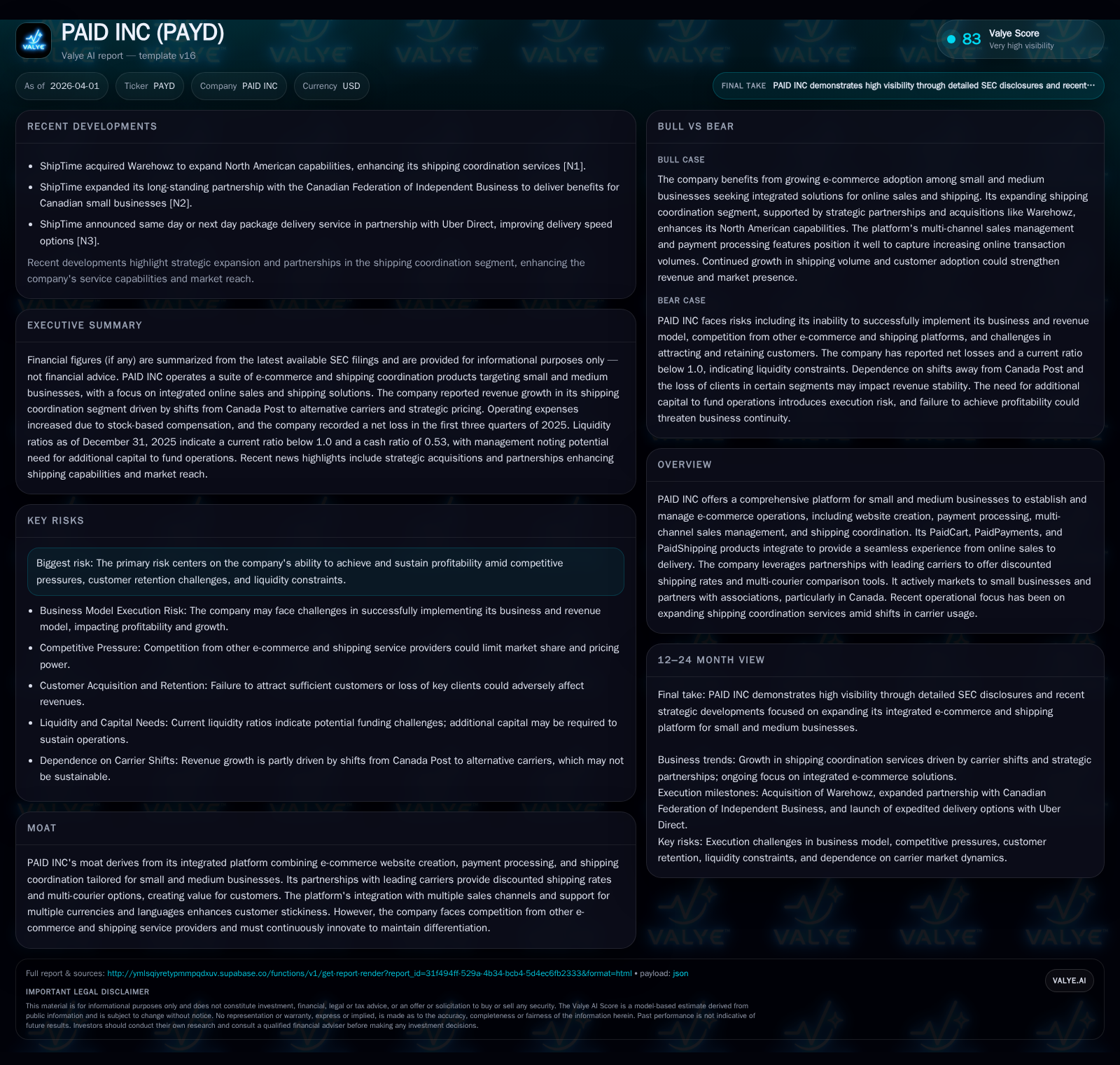
PAID INC provides a multi-faceted e-commerce platform integrating website creation, payment processing, and shipping coordination geared toward small and medium businesses. Its historical revenue growth—mainly from shipping coordination—increased about 22.5% year-over-year as of 2025, driven particularly by shifts from Canada Post to alternative carriers and expanded customer adoption. However, profitability remains elusive with continuing operating losses and negative operating cash flows. Liquidity is cautiously sufficient for now, but additional financing may be necessary to sustain growth initiatives. The company focuses on expanding its shipping services, leveraging unique carrier partnerships to differentiate its platform in a competitive environment.
Company Overview
PAID INC operates a SaaS-based integrated e-commerce platform designed for small and medium businesses (SMBs). Its core products—PaidCart for multi-channel sales management, PaidPayments for payment processing across currencies like USD, CAD, EUR, and PaidShipping offering shipping coordination through partnerships with leading parcel and less-than-truckload (LTL) carriers—create a comprehensive ecosystem from online storefront to delivery fulfillment [S1][S2]. The company actively pursues customer acquisition through direct SMB sales channels as well as strategic partnerships with associations primarily in Canada.
Historical Performance
Examining PAID INC's revenue trajectory reveals a general uptrend over recent years supported primarily by its shipping coordination and label generation services segment. Total reported revenue rose approximately 22.5% year-over-year into the most recent fiscal periods available [F1]. This uplift was largely driven by operational responses to market disruptions—namely delivery reliability issues involving Canada Post that prompted SMB customers to shift shipping volume to alternative carriers integrated within PAID's platform.
Despite this top-line growth, profitability metrics reflect headwinds. Operating income declined by about 32.7% year-over-year culminating in an operating loss of $654,777 in FY2025 [F1]. Net income similarly swung negative to -$368,243 from prior profitable years indicating margin pressures amplified by increased expenses including notable stock-based compensation charges [S23]. This deterioration underscores the high fixed cost nature combined with competitive pricing dynamics facing the company.
Cash flow trends mirror earnings challenges as operating cash flow turned negative (-$53k in FY2025) while capital expenditure was modest ($2.5k), leaving free cash flow also negative [F1]. The balance sheet registers a net working capital deficit given current liabilities ($2.1 million) exceed current assets (~$1.8 million), resulting in a current ratio of 0.85—a liquidity measure underlining funding risks despite cash reserves near $1.1 million [F1].
Historical performance (annual)
| FY | Net ($) | CFO ($) | OpInc ($) | Capex ($) | Net YoY |
|---|---|---|---|---|---|
| 2025 | -368243 | -53171 | -654777 | 2469 | -148.2% |
| 2024 | 763592 | 447643 | -493382 | 6526 | +116.2% |
| 2023 | 353214 | 235516 | -587823 | -45.8% | |
| 2022 | 652146 | 801412 | 58993 | 0 |
Source: SEC companyfacts cache [F1].
Capital returns and efficiency (annual)
| FY | Buybacks ($) | FCF ($) | ROE% |
|---|---|---|---|
| 2025 | 0 | -55640 | -6.6 |
| 2024 | 3996 | 441117 | 15.2 |
| 2023 | 0 | 7.9 | |
| 2022 | 106993 | 801412 | 19.3 |
Source: SEC companyfacts cache [F1].
Revenue figures not recent beyond FY2020 snapshot but historical trend indicates growth; see narrative for segmentation.
Business Segments and Growth Drivers
PAID's main revenue streams are divided into:
Shipping Coordination & Label Generation Services: This segment consistently accounts for the lion’s share of revenue growing by mid-teens percentages annually as per quarterly reports . Key catalysts here include expanded carrier choices following Canada Post service uncertainties which caused Canadian SMB customers to adopt alternative couriers integrated into PAID’s ShipTime platform. Discounted rates via negotiated partnerships add defensibility.
E-Commerce Services: Comprised of PaidCart website builder capabilities with multi-channel selling features such as abandoned cart recovery and currency/language management plus online payment collections via PaidPayments [S18][S19]. E-commerce revenues have shown variable performance; recent periods reveal declines affected by client attrition particularly in paid payment services though marked by recovery attempts in web hosting aspects.
Client Services: Previously including brewery management software and online shipping calculators that have been systematically wound down reflecting a strategic refocus towards core e-commerce/shipping integration .
The recent acquisition of an approximate 80% stake in Warehowz Inc., a provider of U.S.-based on-demand warehousing solutions further signals PAID's intention to broaden its logistics footprint addressing end-to-end supply chain needs for SMBs [S3]. This addition complements the integrated platform approach enhancing value proposition beyond checkout to inventory movement.
Future Outlook Considerations
The company’s guidance expressed in SEC filings centers around sustaining growth momentum via intensified marketing efforts targeting Canadian small businesses alongside further integrating more courier alternatives to capture market share amid postal uncertainties [S22]. Future growth is heavily dependent upon:
- Successfully converting shifting carrier preferences into stable recurring revenues from higher shipment volumes.
- Expanding adoption of its PaidCart ecosystem especially fueling multi-channel retail where SMBs seek turnkey solutions combining web presence with seamless payment/shipping.
- Managing costs prudently including tempering stock compensation expenses that have inflated operating expenses recently.
- Realizing synergies from Warehowz's warehousing capabilities potentially extending service depth.
Constraints include fierce competition from larger omnichannel platforms with sophisticated logistics offerings (e.g., Shopify logistics integrations, FedEx/UPS shipping APIs), potential erosion of carrier discounts due to contract renegotiations, and persistent challenges converting revenue growth into sustainable profitability amidst operational scale hurdles.
Capital Allocation & Returns
Equity capital has grown steadily reaching over $5.5 million by end-FY2025 [F1], driven partly by retained earnings during profitable cycles earlier than FY2025 as well as issuance activities (details scant). However:
- No buybacks were executed in the most recent fiscal period reflecting conservation of capital amid profitability struggles.
- Dividend distributions are not indicated suggesting all reserves are reinvested or retained to fund operations.
- Return on equity has turned negative (~ -6.6%) coinciding with net losses damaging shareholder value metrics.
- The modest CapEx profile shows limited investment intensity likely due to SaaS nature but also possibly constraining innovation pace necessary against competitive threats.
Cash flow management appears critical given ongoing net working capital deficits raising financing risk factors discussed below.
Risks & Challenges
PAID INC enumerates principal risks prominently including:
- The historical pattern of substantial operating losses since inception without assurance of future profitability causing fundamental viability concerns [S1].
- Liquidity constraints despite currently adequate cash reserves imply potential need for additional equity or debt raise which could dilute shareholders or increase leverage exposure [S4][S16].
- Competitive threats from more established e-commerce platform providers offering integrated or proprietary logistics solutions potentially diminishing PAID’s market share gains.
- Dependence on continuous carrier relationships offering discounted pricing; deterioration here impacts both cost competitiveness and customer retention.
- Uncertainty surrounding technological acceptance among targeted SMB clientele tied to evolving product standards and dynamic e-commerce technology landscape.
Analytical Summary
PAID INC represents a niche-focused attempt at creating an end-to-end commerce engine tailored for smaller merchant segments blending online storefront operations with payment facilitation and critical logistics integration advantages through multi-carrier options at discounted rates—a moat built around practical SMB pain points removed from enterprise complexities.
The company has demonstrated commendable top-line expansion primarily anchored by disruptive shifts away from incumbent postal monopolies facilitating increased shipment volumes. Yet translating these volumes into net profitability remains unresolved as fixed costs elevate operating expense bases coupled with aggressive marketing spend and stock-based compensation inflating SG&A costs.
Going forward, sustaining momentum requires careful navigation of liquidity needs balanced against investments needed to deliver continuous product enhancement while fending off increasingly sophisticated competition encroaching on their core value proposition areas. Strategic moves such as acquiring Warehowz inject supply chain depth but raise execution complexity requiring close monitoring.
Investors should watch for key milestones including sustained revenue growth cadence specifically from PaidCart migrations and PaidShipping volume upticks, narrowing operating losses evidenced through improved gross margins or expense efficiencies, any material changes in debt/equity structure indicating funding pathways chosen, and progress integrating warehousing solutions creating new cross-selling opportunities.
This analysis is based solely on publicly filed SEC documentation ([S1]-[S29]) and validated numeric data snapshots ([F1]). It avoids speculative estimates beyond source material while aiming to provide an informed internal perspective useful for understanding PAID INC's current status and outlook within its specialized sector niche. It does not constitute investment advice or recommendations.
Disclaimer: This is research-only, informational analysis and not investment advice. It may include AI-generated interpretation and general industry context. Always verify important details using primary sources.

Comments