
Urban Outfitters Accelerates Multi-Brand Growth with Strategic Store Expansion and Enhanced Omni-Channel Capabilities
Urban Outfitters posted solid operating income growth in fiscal 2026, underpinned by expanded retail presence and rising Subscription segment sales.
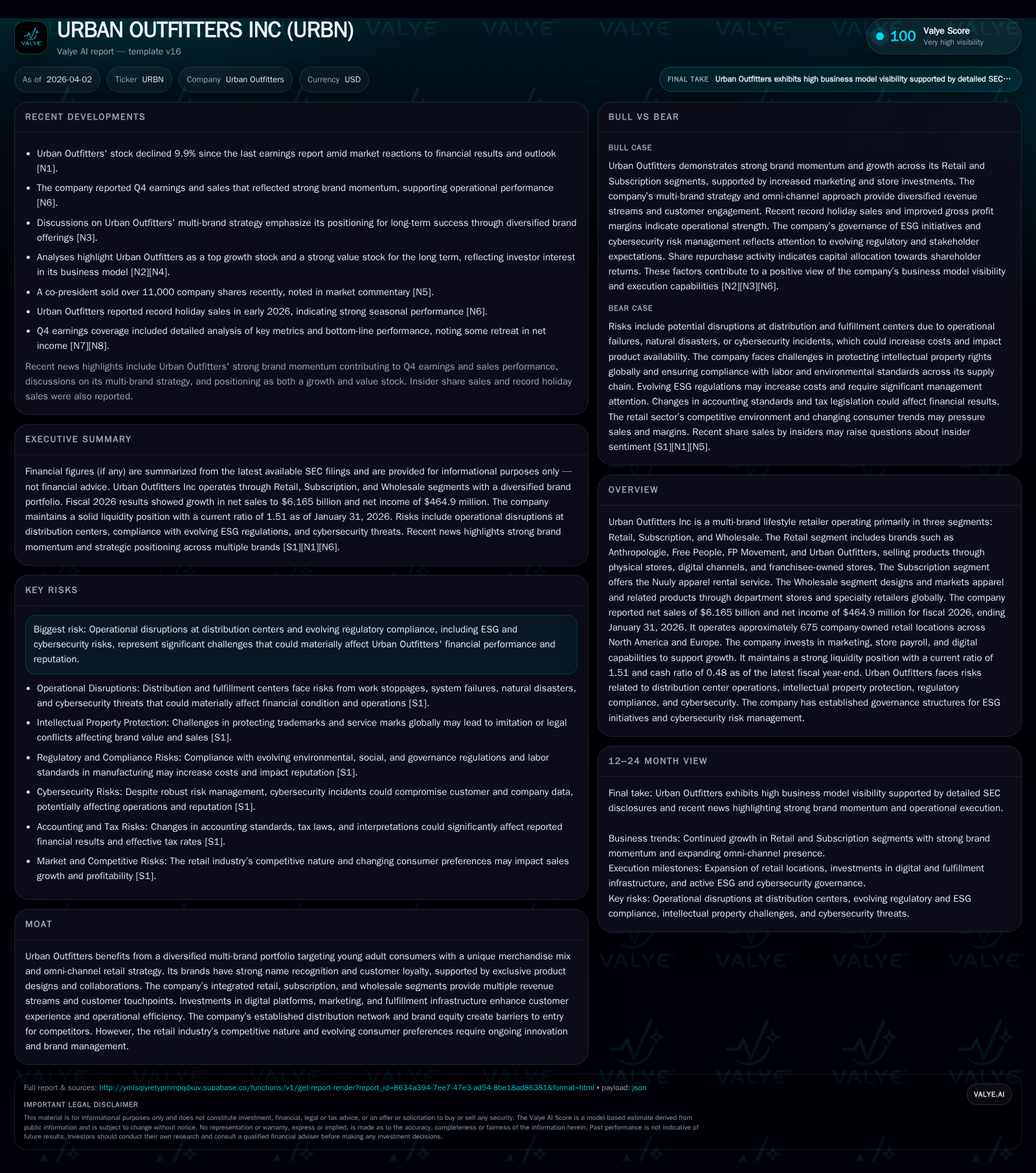
Urban Outfitters Inc. (URBN) operates a multi-brand lifestyle retail model spanning Retail, Subscription, and Wholesale segments. Fiscal 2026 saw a 2% revenue increase to $6.17 billion and a nearly 28% jump in operating income to $606 million, driven by omni-channel growth, subscription momentum, and efficient cost management. The company plans aggressive capital expenditures (~$475 million in fiscal 2027), including new store openings and fulfillment center investments, to fuel ongoing expansion. Despite risks from regulatory compliance and operational disruptions in distribution centers, URBN’s portfolio diversity and brand loyalty provide competitive barriers amid evolving consumer trends.
Company Overview
Urban Outfitters Inc. (URBN) operates a diversified multi-brand lifestyle retail platform encompassing three main segments: Retail, Subscription, and Wholesale [S7][S8]. Its Retail brands—Anthropologie, Free People (including FP Movement), Urban Outfitters, among others—connect directly with consumers through an omnichannel strategy blending physical stores, digital platforms, franchisee stores in select regions like the Middle East, social media channels, and contact centers [S7][S8]. The Subscription segment stands out with Nuuly apparel rentals targeting sustainability-conscious customers seeking rental options for women's fashion [S21]. Wholesale primarily engages department stores and specialty retailers globally with branded merchandise designed internally or collaboratively [S20][S21].
Historical Financial Performance
For the fiscal year ended January 31, 2026 (fiscal 2026), Urban Outfitters reported net sales of approximately $6.165 billion and net income of $465 million [N2][F1]. Revenue increased roughly 2% year-over-year from fiscal 2025's level of $6.04 billion (derived from YoY calculation based on F1 historical data). Operating income rose substantially by nearly 28% to $606 million driven by broader gross profit margins (36.0% vs. prior year's 34.7%) and operating leverage [F1][S17]. This improvement was mainly due to lower markdowns at key brands Urban Outfitters and Free People coupled with efficiencies in occupancy costs and delivery expenses [S17].
Cash flow from operations improved by about 14%, providing $575 million in fiscal 2026 up from around $503 million the prior year. Capital expenditures increased sharply to $260 million as the company aggressively invested in store network expansion and fulfillment infrastructure enhancements [F1][S16]. A summary of key financials is presented below:
Historical performance (annual)
| FY | Net ($mm) | CFO ($mm) | OpInc ($mm) | Capex ($mm) | Net YoY |
|---|---|---|---|---|---|
| 2026 | 465 | 575 | 606 | 260 | +15.5% |
| 2025 | 402 | 503 | 474 | 183 | +39.9% |
| 2024 | 288 | 509 | 370 | 200 | +80.1% |
| 2023 | 160 | 143 | 227 | 200 |
Source: SEC companyfacts cache [F1].
Capital returns and efficiency (annual)
| FY | Buybacks ($mm) | FCF ($mm) | ROE% |
|---|---|---|---|
| 2026 | 154 | 315 | 16.5 |
| 2025 | 52 | 320 | 16.3 |
| 2024 | 0 | 310 | 13.6 |
| 2023 | 112 | -57 | 8.9 |
Source: SEC companyfacts cache [F1].
Note: FY revenue for prior years approximated based on observed YoY growth rate derived from F1 data.
Growth Drivers
Urban Outfitters’ growth has been fueled by:
- Expansion of company-owned retail locations numbering approximately 784 stores worldwide—675 company-owned plus franchisee locations—as of January 31, 2026; the mix spans Anthropologie (
254 stores), Free People (180), Urban Outfitters (~253), among others across North America and Europe [S1]. - The Subscription segment’s accelerated adoption with Nuuly net sales contribution growing from less than 5% of consolidated sales in fiscal 2024 to over 9% in fiscal 2026 due to rising active subscriber base (>45% increase year-over-year) [S17][S21].
- Enhanced omni-channel integration leveraging websites, mobile apps, social media engagement plus third-party platform partnerships that create seamless cross-channel customer experiences [S8][S28].
- Improved gross margin management via better inventory control leading to reduced markdowns at prominent brands Urban Outfitters & Free People [S17].
- Geographic diversification with rising European Retail net sales shares contributing slightly above prior years despite minority share compared to North America [S7].
Constraints & Risks
Several headwinds may temper future growth prospects:
- Operational risks tied to reliance on sophisticated distribution centers employing computer-controlled automation pose potential disruption risks from system failures or external events such as labor stoppages or climatic disasters that can adversely affect product availability and increase costs [S5][S15].
- Evolving regulatory environments complicate compliance efforts especially concerning ESG disclosure requirements, product quality standards across jurisdictions, and international trade tariffs that remain volatile amidst shifting global policies [S15][S19][S20].
- Challenges protecting intellectual property internationally given varied trademark laws potentially limiting certain overseas operations or exposing the company to imitation risks [S5][S9][S15].
- Tariff uncertainty impacting costs despite mitigation strategies such as dual sourcing and logistics adjustments; these increase pricing pressure on margins even as URBN strategically raises prices cautiously where feasible [S19][S20].
Forward-Looking Considerations
The company outlined plans for approximately $475 million capital expenditures in fiscal year ending January 31, 2027—a substantial rise reflecting committed investments toward opening roughly 57 new stores, expanding fulfillment capabilities including acquisition of Nuuly’s previously leased fulfillment center, enhancing digital platforms, boosting omni-channel marketing expenditures plus home office expansions to support scaling business demands [S22][S29]. URBN anticipates funding these initiatives via operating cash flow along with existing cash reserves totaling around $1.16 billion including marketable securities [S22][F1].
While no explicit earnings guidance was disclosed recently post FY26 results release [N3], performance metrics worth monitoring include comparable store sales trends within each brand (Urban Outfitters & Anthropologie mix), subscription user growth velocity for Nuuly services relative to retention rates, wholesale channel dynamics amid changing retail partner environments globally, cross-channel conversion efficiencies online versus physical stores, inventory turnover improvements given past inventory build-ups plus margin trajectory influenced by tariff pass-through effectiveness versus competitive reactions.
Capital Allocation & Returns
Urban Outfitters has actively engaged in share repurchase activity with $154 million spent buying back stock in fiscal year ended January 2026 – nearly triple the prior year’s repurchase level – reflecting management confidence paired with no cash dividends since IPO aligned with leveraging cash towards growth investments alongside returning capital through buybacks [F1][S12][S27].
The company generated approximately $315 million free cash flow last fiscal year after accounting for capex versus CFO indicating healthy internal funding capability supporting liquidity cushions evidenced by a current ratio near 1.5 which underscores short-term solvency strength as of January 31, 2026 [F1][S13][S22]. With shareholder equity at about $2.82 billion last reported period yielding an approximate return on equity near 16.5%, URBN demonstrates solid profitability relative to invested capital underpinning its ability to reinvest while rewarding shareholders structurally through repurchases rather than dividends given credit facility constraints around dividend distributions [F1][S12].
Industry Context Analysis
The contemporary apparel retail market remains highly competitive amid digital transformation accelerations paired with fragmented consumer preferences prioritizing sustainable fashion options prompting companies like URBN to innovate beyond traditional selling models via subscriptions or rental offerings (Nuuly). Furthermore, the combination of well-known niche brands under a conglomerate umbrella helps buffer against volatility affecting single-brand players. Yet ongoing inflationary pressures on input costs coupled with geopolitical tensions influencing tariffs compel continuous supply chain agility internally.
Conclusion
By leveraging its diversified portfolio managed through integrated omnichannel operations alongside proactive capital investments into physical expansion and technology-enabled customer engagement tools, Urban Outfitters positions itself well for mid-term incremental growth tempered by macroeconomic uncertainties surrounding global trade policies and operational continuity risks at distribution hubs.
Maintaining momentum particularly within subscription services while balancing wholesale clients’ evolving demand will be essential components alongside preserving brand exclusivity where product design collaborations remain competitive advantages.
This report compiles publicly available disclosures complemented by recent news summaries without providing investment recommendations or price forecasts. Readers should conduct further due diligence tailored to their individual informational needs.
Disclaimer: This is research-only, informational analysis and not investment advice. It may include AI-generated interpretation and general industry context. Always verify important details using primary sources.

Comments