
Zoned Properties Faces Liquidity Challenges While Planning Management Buyout and Asset Liquidation
A niche player in cannabis-focused commercial real estate navigates regulatory risks, financial losses, and a strategic shift towards asset sale.
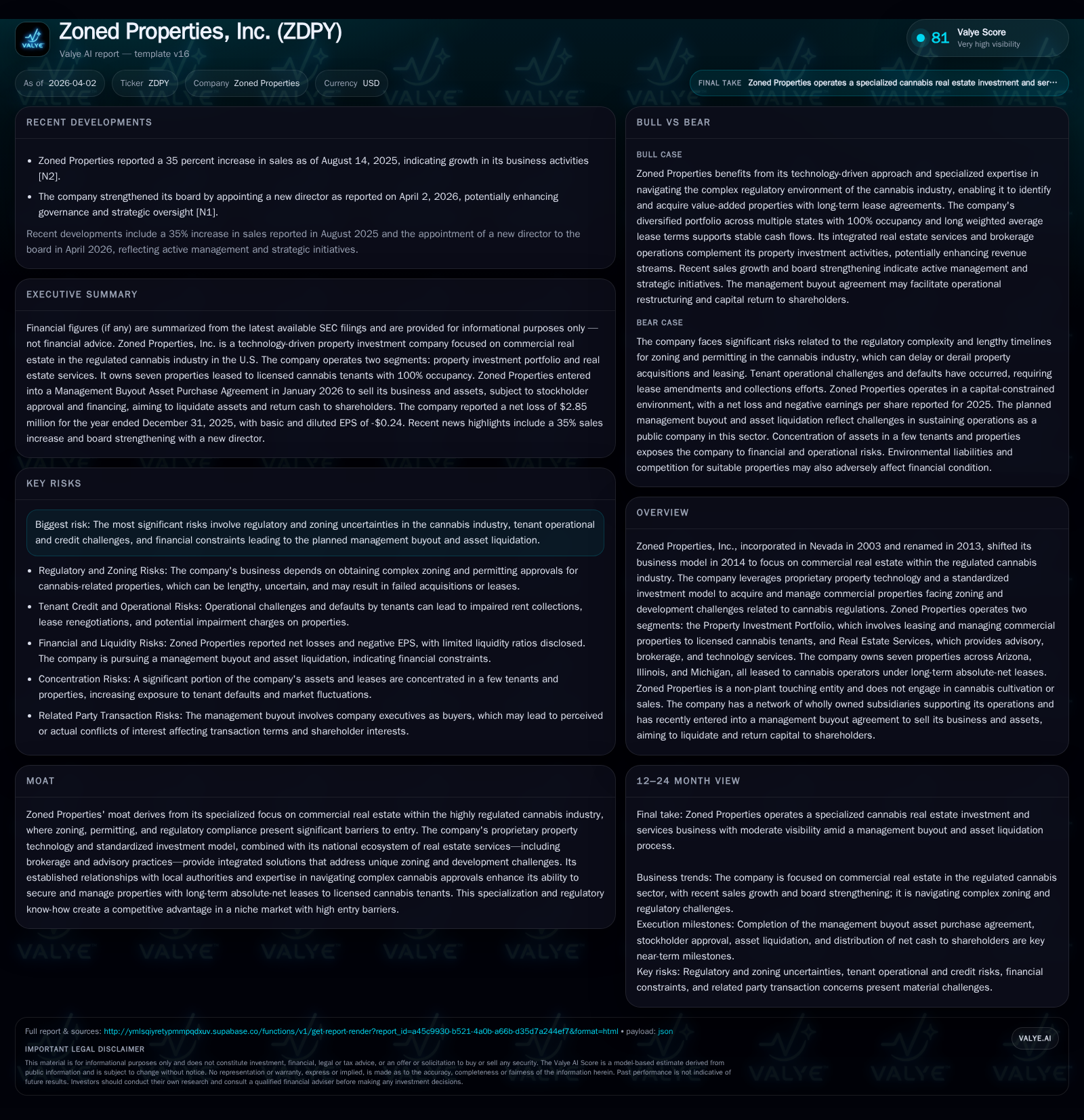
Zoned Properties, Inc. operates a specialized commercial real estate business catering exclusively to the regulated cannabis industry, leveraging proprietary technology and a unique leasing model. Despite steady revenue growth from 2020 to 2023, financial performance deteriorated sharply in 2025 with significant net losses and operating deficits. Regulatory uncertainties, tenant credit risks, and capital access constraints culminated in the company pursuing a management buyout and planned liquidation of assets. The company’s future operations hinge critically on completion of this transaction and ensuing strategic decisions.
Company Overview
Zoned Properties, Inc., incorporated in Nevada since 2003 and rebranded in 2013, shifted its operational focus in 2014 toward commercial real estate tailored for the regulated cannabis industry in the United States [S1]. Headquartered in Scottsdale, Arizona, Zoned Properties utilizes proprietary property technology and a standardized investment model to manage properties that face unique zoning or developmental obstacles related to cannabis regulations.
The company operates through two key business segments:
- Property Investment Portfolio — entails acquisition, leasing under long-term absolute-net leases (where tenants bear all expenses), and management of commercial real estate leased exclusively to licensed cannabis operators.
- Real Estate Services — encompasses advisory services, brokerage functions, and technology services linked to cannabis-focused commercial properties.
Currently owning seven properties across Arizona, Illinois, and Michigan — states with varying regulatory frameworks for cannabis — Zoned Properties maintains leases predominantly with operators subject to intricate local zoning mandates [S23][S26]. Crucially, the company remains strictly non-plant touching; it does not engage directly in cultivation or distribution but focuses on providing an enabling real estate platform within a highly regulated ecosystem.
Historical Financial Performance
Zoned Properties experienced consistent revenue growth during the early part of the decade as its portfolio expanded alongside progressive legalization trends. Revenues rose from approximately $1.2 million in FY2020 to nearly $2.9 million by FY2023 ([F1]). However, despite top-line gains averaging about 8.5% year-over-year between FY2022 and FY2023, profitability exhibited notable volatility.
Operating income improved from negative territories (-$109k in FY2022) to positive figures by FY2024 ($1.1M), only to plunge back into deep losses (-$1.9M) by FY2025 ([F1]). Similarly, net income followed a volatile path: losses of over half a million dollars in FY2023 turned profitable in FY2024 ($574k), before deteriorating again into a -$2.85 million loss for FY2025 ([F1]).
Operating cash flow has remained positive throughout this period—$781k in FY2025—and supported ongoing operations despite recurring net losses ([F1]). Capital expenditures have been modest relative to cash generation (near $6.5k as of FY2025), consistent with Zoned's capital-light model focused on leasing and advisory rather than heavy development ([F1]).
Historical performance (annual)
| FY | Rev ($mm) | Net ($mm) | CFO ($) | OpInc ($) | Rev YoY | Net YoY |
|---|---|---|---|---|---|---|
| 2025 | -3 | 781476 | -1885542 | -597.3% | ||
| 2024 | 1 | 578218 | 1103170 | +206.2% | ||
| 2023 | 3 | -1 | 82547 | 169187 | +8.5% | +5.9% |
| 2022 | 3 | -1 | 871901 | -108951 | +46.1% |
Source: SEC companyfacts cache [F1].
Capital returns and efficiency (annual)
| FY | FCF ($) | ROE% |
|---|---|---|
| 2025 | 774996 | -93.0 |
| 2024 | 571738 | 9.8 |
| 2023 | 81468 | -10.3 |
| 2022 | 868137 | -10.1 |
Source: SEC companyfacts cache [F1].
*Revenues displayed where available; YoY represents latest trailing figures.
Competitive Positioning & Moat
Zoned Properties' competitive strength lies squarely in its niche specialization within the cannabis industry—a space fraught with zoning constraints, permitting complexity, and rapidly shifting regulatory environments . Its proprietary property technology platform enables standardized acquisition strategies coupled with robust lease structures that mitigate landlord risks through absolute-net agreements.
By maintaining close working relationships with local authorities and understanding localized regulations—often idiosyncratic across municipal boundaries—the company overcomes significant barriers that deter most traditional real estate investors from entering this market segment [S23]. The integrated offering that combines investment holdings alongside brokerage and advisory services serves to entrench its foothold further.
However, this moat is tempered by broader regulatory uncertainty at federal levels—cannabis remains classified under Schedule I until only recently reclassified toward Schedule III following executive action at end-2025—alongside inconsistent enforcement priorities absent guidance like the Cole Memo reinstatement [S29][S14].
Risks & Challenges
Zoned Properties contends with substantial industry-specific risks:
- Regulatory Uncertainty: Evolving state laws combined with federal prohibition complicate compliance efforts. Future restrictive regulations could impose costly operational changes or diminish market opportunities [S10][S14][S17].
- Tenant Credit & Operational Risk: Cannabis operators face financial pressures amid market contraction scenarios including product price declines and consolidation trends leading to potential lease defaults [S14].
- Capital Access Constraints: Financing is challenging due to sector stigma tied to federal illegality even as reform progresses; banks are wary about collateral backed by cannabis-linked real estate [S11]. This affects acquisition capacity and operational liquidity.
- Management Buyout & Liquidity: As of January 15, 2026, Zoned Properties entered into an MBO agreement selling substantially all assets to management-affiliated buyers for $7 million less debt assumed [S13][S8]. This transaction carries conflicts of interest risks typical of related-party deals [S21][S26].
- Going Concern Doubts: The company’s own filings express substantial doubt regarding its ability to continue operations absent asset sales or capital infusion [S1].
- Post-MBO Uncertainties: Potential liquidation or reverse merger after MBO exit creates execution risk; shareholder distributions depend on successful asset sales net of liabilities which may be delayed or diminished by market conditions [S16].
Recent Developments & Strategic Outlook
The signing of the Management Buyout Asset Purchase Agreement (MBO APA) signals a fundamental turning point for Zoned Properties’ business model [S13][N1]. The transaction envisions transferring ownership of core assets including properties located in Tempe AZ, Surprise AZ, Chicago IL along with equity interests in subsidiaries handling brokerage and technology services.
The MBO is contingent on stockholder approval by mid-2026 along with successful financing raised by BPB Partners LLC—the buyer entity controlled by the current CEO Bryan McLaren and COO Berekk Blackwell—and aims for closing before year-end 2026 ([N1], [S8], [S13]).
If completed as planned, Zoned Properties anticipates paying off remaining debts, settling agreements including preferred shares liquidation, and returning residual cash to shareholders via special dividend distributions ([S16]). Following this event the company will likely either wind down operations as a publicly-traded shell or seek a reverse merger target for reactivation as an alternate business entity.
This pivot reflects recognition that continued public operation amid persistent losses—operating income swung from positive $1.1M in FY24 to negative $1.9M FY25—and tightening capital markets renders expansion unfeasible for now ([F1],[S11]). Furthermore, lingering risk surrounding federal enforcement policy towards cannabis-related assets constrains broader institutional investor appetite.
Stakeholders should monitor:
- Completion status of MBO including shareholder vote outcomes.
- Financing progress by BPB Partners LLC given macroeconomic cost-of-capital environment.
- Any announcements on asset disposition timing including pending sales such as Pleasant Ridge Michigan property outside current MBO scope but potentially included if unsold pre-closing ([S27]).
- Regulatory developments especially regarding Schedule III reclassification impact enforcement risk profiles.
- Tenant performance signaling potential lease default probabilities that could affect sale valuations.
Returns & Capital Allocation History
Zoned Properties has never paid dividends on common stock nor conducted recent share repurchases beyond small transactions prior to FY2016 ([F1],[S9]). Given recurring net losses particularly pronounced in FY25 (-$2.85 million), there has been no scope for capital returns through dividends or buybacks recently.
Operating cash flow has held relatively steady positive at $780k for FY25 versus ~$580k prior year despite top-line challenges ([F1]). Capital expenditures remain minimal ($6.5k annually) consistent with limited development activities since properties are leased under absolute-net terms passing most costs onto tenants (capex).
Equity base stood near $3 million at end-FY25 down from over $5 million prior years reflecting cumulative earnings erosion ([F1]). This results roughly in an adverse return on equity exceeding -90%, highlighting poor capital efficiency due mainly to escalating operating losses ([F1]).
Future distributions post-MBO depend largely on realized proceeds from property sales net liabilities; current plans anticipate debt clearance followed by special dividends if valuation permits ([S16],[S8]).
Conclusion
Zoned Properties occupies a uniquely specialized niche addressing regulated cannabis real estate needs through distinctive leasing structures combined with supportive advisory capabilities. While top-line growth was encouraging through early-to-mid decade expansion phases supported by proprietary tech solutions and regulatory expertise outlining an attractive moat, the recent sharp deterioration into sustained operating losses coupled with structural financing difficulties pose existential challenges.
The ongoing management buyout agreement marks an inflection point driven by these constraints amid ongoing federal-state regulatory uncertainties inherent across U.S. cannabis markets. How successfully this transaction closes—and how efficiently acquired assets are monetized—will define Zoned Property’s fate over coming months as it contemplates dissolution or strategic reinvention once divested from public markets.
Disclaimer: This analysis is intended solely as informational content based on publicly filed reports and news sources without offering any investment advice or recommendations.
Disclaimer: This is research-only, informational analysis and not investment advice. It may include AI-generated interpretation and general industry context. Always verify important details using primary sources.

Comments