
Scinai Immunotherapeutics Advances R&D and Expands CDMO amid Liquidity Constraints
The Israeli biotech firm pursues innovative nanosized antibody therapies and broadens manufacturing capabilities following key acquisitions.
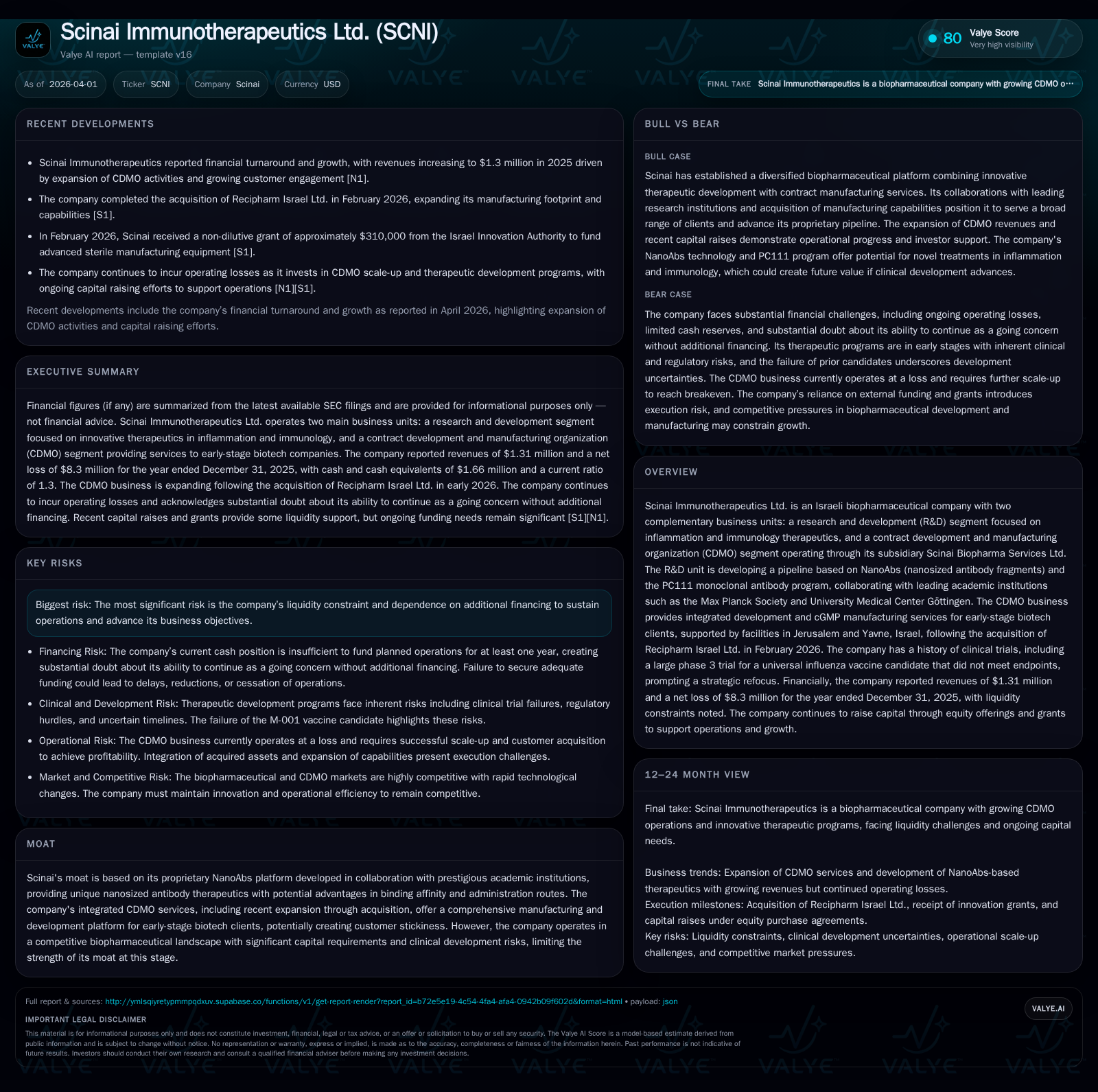
Scinai Immunotherapeutics Ltd., an Israeli biopharmaceutical company, operates two complementary business units: research and development (R&D) focused on inflammation and immunology therapeutics, and a contract development and manufacturing organization (CDMO) through its subsidiary Scinai Biopharma Services Ltd. Its pipeline centers on NanoAbs and the PC111 monoclonal antibody program, developed in collaboration with the Max Planck Society and University Medical Center Göttingen. Recent acquisitions expanded its CDMO footprint to include small-molecule synthesis alongside biologics. Revenues nearly doubled to $1.31 million in 2025, led by CDMO growth, while operating losses narrowed modestly to $7.54 million due to ongoing R&D investment and scale-up costs. The company’s cash position was $1.66 million at year-end 2025 with a current ratio of 1.3, underscoring continued funding needs to support operations and clinical development.
Company Overview
Scinai Immunotherapeutics Ltd. is an Israeli biopharmaceutical company engaged in research, development, and manufacturing of novel therapeutics targeting inflammation and immunological disorders. It operates two main business units: an R&D segment focused on therapeutics based on its proprietary NanoAbs platform—nanosized antibody fragments derived from camelids known as VHH antibodies—and a contract development and manufacturing organization (CDMO) serving emerging biotech clients.
The R&D activities are anchored by two pillars: the PC111 monoclonal antibody program targeting keratinocyte cell death pathways relevant to severe dermatological diseases, acquired via an option agreement for Pincell S.r.l., and a diversified NanoAbs pipeline developed through exclusive licenses and collaborations with academic partners including the Max Planck Society (MPI for Multidisciplinary Sciences) and University Medical Center Göttingen (UMG) [S1]. These collaborations span indications such as psoriasis, psoriatic arthritis, asthma, and macular degeneration.
Historical Performance and Growth Drivers
Financially, Scinai transitioned from pre-revenue status into generating sales mainly from its CDMO business starting in 2024. Revenue nearly doubled from approximately $0.66 million in 2024 to $1.31 million in 2025 [F1], driven by expanding client engagements within its Jerusalem-based manufacturing operations—capacity further enhanced by February 2026 acquisition of Recipharm Israel Ltd., adding a cGMP site in Yavne specializing in early-stage chemistry and small molecule active pharmaceutical ingredient (API) manufacturing [S1,S21]. This acquisition expands service offerings beyond biologics into integrated small molecule programs.
Despite improving top-line trends, the company remains unprofitable with operating losses narrowing modestly from -$8.64 million in 2024 to -$7.54 million in 2025 [F1]. The reduced losses reflect expenditure realignment: research and development expenses decreased sharply from $5.6 million to $2.4 million due to reprioritization following setbacks with earlier candidates (notably phase 3 failure of universal influenza vaccine M-001), while marketing, general & administrative expenses remained steady near $2.6 million [F1]. Cash used in operating activities was approximately -$6.03 million for 2025 [F1], indicating continued investment without positive cash flow generation.
Historical performance (annual)
| FY | Rev ($) | Net ($mm) | CFO ($mm) | OpInc ($mm) | Rev YoY | Net YoY |
|---|---|---|---|---|---|---|
| 2025 | 1311000 | -8 | -6 | -8 | +99.2% | -273.2% |
| 2024 | 658000 | 5 | -6 | -9 | +173.8% | |
| 2023 | -6 | -9 | 10 | -12.1% | ||
| 2022 | -6 | -7 | -11 |
Source: SEC companyfacts cache [F1].
Capital returns and efficiency (annual)
| FY | FCF ($mm) | ROE% |
|---|---|---|
| 2025 | -6 | -102.5 |
| 2024 | -6 | 48.1 |
| 2023 | -10 | 142.3 |
| 2022 | -8 | 329.3 |
Source: SEC companyfacts cache [F1].
Table: Scinai Immunotherapeutics annual financials showing revenue growth alongside stabilized operating losses.
The net income swing from positive $4.8 million in 2024 to negative $8.3 million in 2025 largely stems from non-recurring financial income related to loan conversions recognized in prior year that did not recur [F1].
Future Growth Prospects
Scinai aims to advance its clinical pipeline anchored by the NanoAbs platform—offering advantages like strong binding affinity, thermal stability, flexible administration routes—and the PC111 antibody program targeting dermatological inflammation [S1]. The company is evaluating its IL-17 antagonist program amid evolving competitive dynamics, considering alternative approaches or prioritization [S1].
Long-term growth depends on milestones including progressing NanoAb candidates through clinical trials; acquiring or licensing complementary assets; commercializing product candidates; expanding CDMO revenues especially integrating Recipharm’s small molecule capabilities; and potentially forming partnerships leveraging proprietary platforms.
Key risks include escalating clinical development costs; regulatory compliance challenges across markets such as FDA/EMA standards applicable to its Jerusalem facility; inherent uncertainties of biotech pipelines; intense competition particularly among IL-17 therapies; and operational challenges scaling commercial efforts [S20,S21].
Funding Outlook & Capital Structure
Liquidity remains constrained given ongoing operating losses paired with limited cash reserves of about $1.66 million as of December 31, 2025 [F1] and a current ratio near 1.3 [F1]. The company’s ability to sustain operations beyond one year without additional financing is uncertain [S7,S10]. Historically it has raised capital through equity offerings including standby equity purchase agreements exceeding $5 million through mid-2025, complemented by non-dilutive grants such as an Israel Innovation Authority subsidy awarded early 2026 covering roughly two-thirds of costs for advanced sterile fill-and-finish equipment installation [S4,S15,S18].
A loan restructuring with the European Investment Bank converted approximately €26.6 million debt into preferred stock as part of recapitalization efforts [S22]. The remaining loan balance stands near $260,000 without interest payments until maturity, easing immediate debt burdens but leaving substantial future capital needs tied to CDMO expansion and clinical programs advancement [S9,S10,S15].
No dividends or share repurchases have been declared or executed; capital allocation focuses on sustaining operations and advancing pipeline assets . Equity incentives are issued for key personnel retention but contribute dilution amid ongoing funding rounds [S23].
Operational & Strategic Developments
Following a phase 3 trial failure of M-001 universal influenza vaccine candidate terminating expected royalties [S22], Scinai underwent strategic turnaround involving leadership changes and refocused efforts on nanoscale biologics licensed via German academic partnerships established since late 2021–22 [S1]. This pivot emphasizes intellectual property generating differentiated candidates addressing unmet needs across immuno-inflammatory indications.
An internal CDMO unit launched September 2023 provides integrated process development plus GMP biologic manufacturing at Jerusalem facilities compliant with FDA/EMA standards—critical for smaller biotechs seeking scalable contract services without large CAPEX commitments [S21]. Acquisition of Recipharm Israel Ltd.’s Yavne site further expanded these capabilities into chemistry process development supporting small molecule APIs alongside biologics—a diversification strengthening client value proposition amid growing biotech outsourcing demand post-pandemic [N1,S21].
Industry Context & Competitive Considerations
Inflammation/immunology biotech is highly competitive with blockbuster IL-17 antagonists marketed by major players like Eli Lilly/AbbVie alongside emerging bispecific antibodies aiming improved efficacy/safety profiles. Scinai’s NanoAb platform offers unique biophysical properties facilitating multispecific designs potentially more stable or suitable for alternate delivery routes such as inhalation or topical application—advantages over conventional full-length monoclonal antibodies though commercial differentiation remains challenging.
Building vertically integrated CDMO presence aligns with industry trends favoring agile end-to-end outsourcing enabling smaller biotechs rapid transition from discovery to clinic-ready materials without heavy fixed asset investments or complex supply chains.
Nonetheless, clinical-stage biotechs face intensified pressure to demonstrate value amid rising trial costs coupled with tighter investor scrutiny on capital efficiency—constraints framing Scinai’s imperative for additional financing despite recent revenue gains.
What To Watch Going Forward
Key upcoming developments include:
- Progression of clinical trials for PC111 or advanced NanoAb candidates;
- Integration and revenue ramp-up at Recipharm Israel facility supporting biologics/small molecule projects;
- Licensing deals or partnerships leveraging proprietary IP portfolio;
- Fundraising activity signaling investor confidence given liquidity challenges;
- Regulatory filings related to new fill-and-finish capabilities supported by IIA grants;
- Management commentary regarding IL-17 program prioritization amidst competitive landscape shifts.
Operational metrics such as quarterly CDMO revenue growth will also indicate trajectory toward financial sustainability despite current losses.
Conclusion
Scinai Immunotherapeutics balances innovation based on unique nanosized antibody platforms addressing multiple inflammatory disorders against operational realities imposed by constrained liquidity and capital-intensive biotech cycles. Its dual strategy combining proprietary therapeutics R&D with growing contract manufacturing services reflects industry best practices catering both internal pipeline advancement and external client needs.
Near-term results highlight progress with nearly doubling revenue mainly via CDMO expansion post-acquisition yet underline persistent operating deficits necessitating ongoing capital raises amid typical risks faced by pre-commercial biotech firms developing novel biologics therapies across competitive immunology segments.
This analysis is based solely on publicly available information including SEC filings dated up to April 2026 ([S1]-[S29]), financial data snapshots ([F1]), and relevant news releases ([N1]). It does not constitute investment advice or recommendations.
Disclaimer: This is research-only, informational analysis and not investment advice. It may include AI-generated interpretation and general industry context. Always verify important details using primary sources.

Comments