
Innate Pharma’s Immuno-Oncology Pipeline Faces Revenue Decline and Liquidity Pressures
The French biotech’s innovative innate immunity platform contends with abrupt revenue contractions and the imperative to secure financing beyond third quarter 2026.
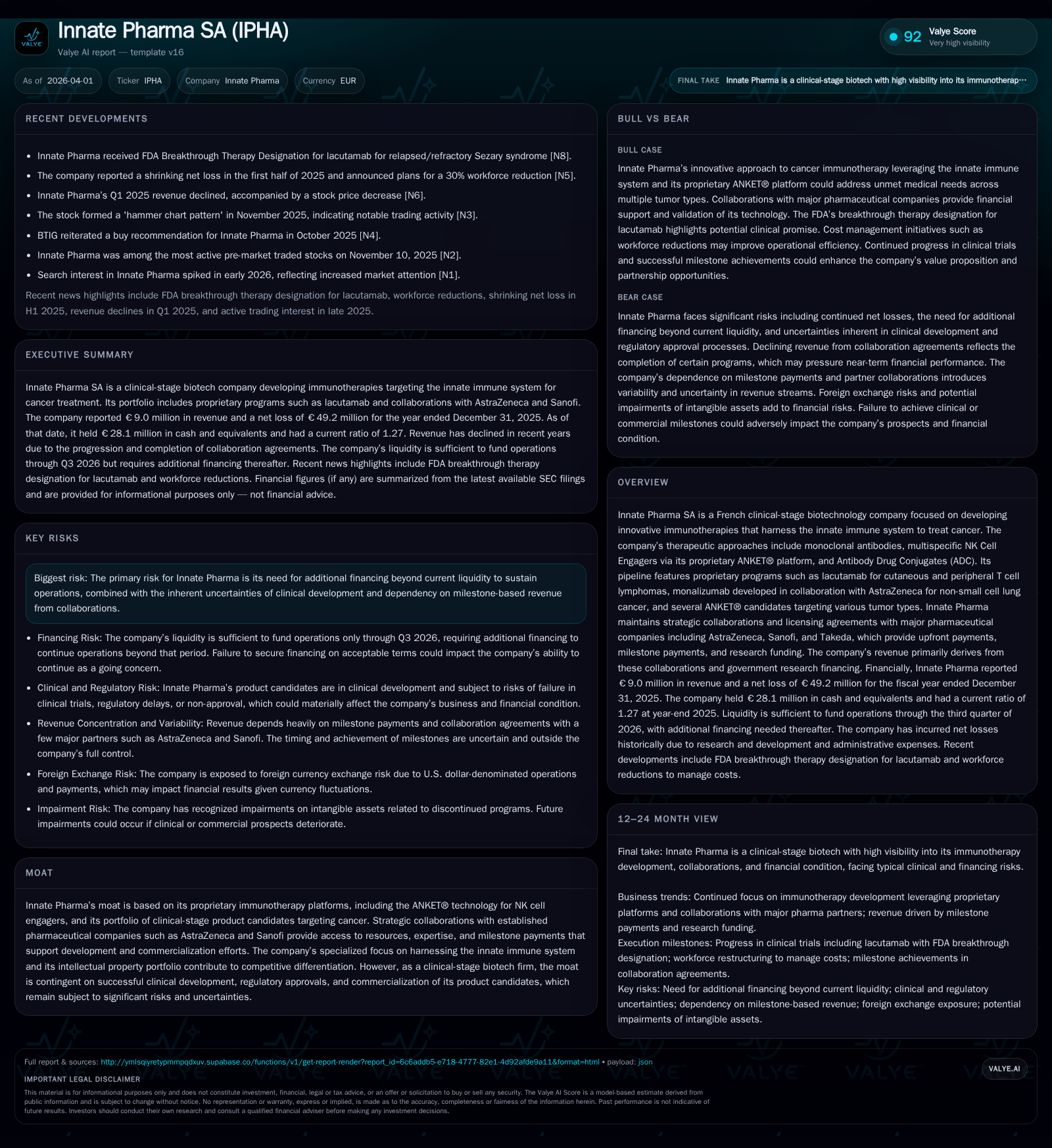
Innate Pharma SA, a clinical-stage biotech specializing in immunotherapies leveraging the innate immune system, experienced a sharp revenue drop of over 55% in 2025 driven by declining milestone payments from collaborators. Despite strategic alliances with AstraZeneca, Sanofi, and Takeda underpinning its R&D progress, the company reported sustained losses exceeding €49 million in 2025 and negative equity. With cash resources sufficient only through Q3 2026, Innate Pharma faces urgent funding needs while advancing its proprietary ANKET® NK cell engager platform and late-stage candidates like lacutamab. Monitoring clinical milestones, milestone payment flows, and capital raises will be critical indicators of its development trajectory and financial stability.
Company Overview
Innate Pharma SA is a French clinical-stage biotechnology company pioneering immunotherapies that harness the innate immune system to treat cancer. Its therapeutic modalities include monoclonal antibodies, multispecific natural killer (NK) cell engagers developed via its proprietary ANKET® platform, and antibody-drug conjugates (ADC). The company's pipeline features proprietary programs such as lacutamab targeting cutaneous and peripheral T-cell lymphomas, monalizumab co-developed with AstraZeneca for non-small cell lung cancer (NSCLC), as well as multiple earlier-stage ANKET® candidates addressing diverse tumor types [S1].
Strategic collaborations form a cornerstone of Innate's business model. Partnerships with global pharma leaders like AstraZeneca, Sanofi, and Takeda provide upfront payments, milestone payments linked to development progress, research funding, plus access to resources that accelerate innovation [S1].
Historical Performance and Revenue Dynamics
The period through 2025 was marked by a precipitous decline in top-line revenue. Annual revenue fell from €20.1 million in 2024 to €9.0 million in 2025—a year-over-year drop of approximately 55% [F1]. This contraction primarily reflects reduced milestone payments as programs mature or transition phases within existing collaborations.
Historical performance (annual)
| FY | Rev ($mm) | Net ($mm) | Rev YoY | Net YoY |
|---|---|---|---|---|
| 2025 | 9 | -49 | -55.2% | +0.6% |
| 2024 | 20 | -49 | -67.4% | -553.5% |
| 2023 | 62 | -8 | +6.9% | +87.0% |
| 2022 | 58 | -58 |
Source: SEC companyfacts cache [F1].
Capital returns and efficiency (annual)
| FY | ROE% |
|---|---|
| 2025 | 226.6 |
| 2024 | -560.0 |
| 2023 | -14.6 |
| 2022 | -107.3 |
Source: SEC companyfacts cache [F1].
Net losses have persisted throughout Innate Pharma's history except brief profitability spells in selected years such as 2016 and 2018 [S1]. The company reported net losses of approximately €49 million for both fiscal years ending December 31, 2024 and December 31, 2025 [F1], reflecting sustained heavy investment in R&D alongside operational expenditures.
Research & Development Spending
Research and development remains the largest operating expense category but showed some cost efficiencies amid mature clinical stages in certain programs.
- Total R&D expenses decreased by approximately €8.4 million (16%) from €52 million in 2024 to €43.6 million in 2025 [S4].
- Direct R&D spending declined by about €7.5 million (26%) due to phased reductions in clinical program expenditure related largely to IPH4502 (ADC program) after transitioning into clinical stage earlier in the year and reduction in lacutamab phase II costs [S11].
- Personnel-related expenses marginally decreased despite restructuring charges.
- R&D still accounted for nearly 69% of total operating expenses through end-2025 [S4].
Within the pipeline, lacutamab continues progression in advanced cutaneous T-cell lymphoma trials; IPH4502 entered clinical studies during early 2025; while monalizumab associated costs remained relatively low due to external co-development management by AstraZeneca [S11]. These trends indicate shifting resource allocation consistent with clinical maturity.
Capital Allocation and Liquidity Situation
Innate Pharma's cash position deteriorated significantly during calendar year 2025:
- Cash & equivalents plus short-term investments declined from roughly €80.8 million at end-2024 to about €28.1 million at the end of December 2025—a near two-thirds reduction reflecting operational burn [F1], [S7], [S8].
- Net cash (cash less current financial liabilities) was negative after accounting for liabilities tied to collaboration financing agreements.
- The company reports an estimated runway extending only until the third quarter of 2026 based on current liquidity levels [S8].
Innate has historically relied on capital raises—including public equity offerings (€66 million IPO proceeds on Nasdaq in 2019) and private placements with partners such as Sanofi (€15 million raise in April 2025)—and collaboration payments totaling over $650 million cumulatively since inception [S1], [S14]. Yet ongoing financing needs persist due to high cash burn associated with advancing late-stage immuno-oncology trials.
Financial Position Summary
The firm’s equity turned negative by the end of fiscal year 2025 (-€21.7 million), marking a material deterioration from positive equity of approximately €8.8 million at the end of fiscal year 2024 [F1]. The company's return on equity is strongly negative but reflects typical capital-intensive nature of clinical-stage biotech companies yet to commercialize products.
General & administrative expenses remained relatively stable near ~€19 million annually despite restructuring measures intended to optimize overhead costs [S4], indicating fixed-cost pressures even amid a strategic pivot toward leaner operations.
Collaborations and Strategic Alliances Impact
Innate's collaborations are core revenue drivers via milestone triggers contingent on achieving predefined regulatory or developmental events across partnered product candidates [S1]. Notably:
- AstraZeneca co-development of monalizumab has yielded phased contingent payments alongside shared costs for pivotal NSCLC trials INTERLINK-1 and PACIFIC-9 [S11].
- Sanofi recently participated directly in equity financing signaling partner confidence though also retains rights tied to specific phase developments.
These alliances mitigate standalone risk but expose Innate Pharma's financial health to idiosyncratic program successes or delays that may impact milestone timing or realization.
Risks Outlook
Key risks outlined include:
- Ongoing need for substantial additional financing beyond current cash balances creates uncertainty around continued operations without successful capital raises or sustained milestone inflows [S13], [S21].
- Dependence on collaborative agreements for revenue introduces variability linked closely to partner-driven decision points or shifting development priorities.
- Foreign currency exchange exposures tied mainly to USD-denominated subcontracting activities; no active hedging is employed currently [S18].
- Execution risks inherent within complex late-stage clinical trials including regulatory hurdles threaten timelines and cost structures.
Analysis: Future Growth Prospects & Milestones To Watch
Innate’s growth trajectories hinge principally upon successful advancement of its therapeutic candidates—chiefly lacutamab’s ongoing clinical trial milestones expected over the next several quarters—as well as incremental progress across newer ANKET® molecules targeting various solid tumors.
Milestone payments from collaborators remain pivotal near-term drivers though highly dependent on positive data readouts and regulatory approvals which carry inherent uncertainty common to oncology biotech firms.
Given liquidity constraints identified extending only into late Q3/Q4 of calendar year 2026 absent new funding [S8], investors should watch for timely announcements regarding capital raises either via equity offerings or expanded licensing deals that might provide non-dilutive sources such as milestone acceleration or option fees.
Meanwhile, operating expense management focusing on sustaining critical R&D programs while containing G&A is likely fundamental to preserving runway during these pivotal stages of product candidate maturation.
Conclusion
Innate Pharma exemplifies many hallmarks of innovative early-to-mid stage biotechnology enterprises: a compelling scientific platform targeting unmet oncology needs; extensive partnerships providing technology validation; yet enduring financial strain marked by heavy R&D spending outpacing incoming revenues dominated by variable milestone payments.
While its proprietary ANKET® NK cell engager technology sets it apart within immuno-oncology therapeutics, material near-term challenges around liquidity sufficiency coupled with execution-dependent revenue streams underscore high operational leverage coupled with significant risk exposure across development timelines.
Monitoring how effectively Innate navigates these financing imperatives while delivering meaningful clinical data will determine whether it can sustain momentum from a promising yet financially constrained base.
Disclaimer: This report is for informational purposes only and does not constitute investment advice or a recommendation concerning any securities. The information herein is compiled solely from publicly available sources dated up to April 1, 2026.
Disclaimer: This is research-only, informational analysis and not investment advice. It may include AI-generated interpretation and general industry context. Always verify important details using primary sources.

Comments