
Idea Acquisition Corp.: Early Steps in SPAC Lifecycle and Investment Implications
A newly public Cayman Islands SPAC holds $350 million in trust, facing typical pressures to identify and close a qualifying business combination within two years.
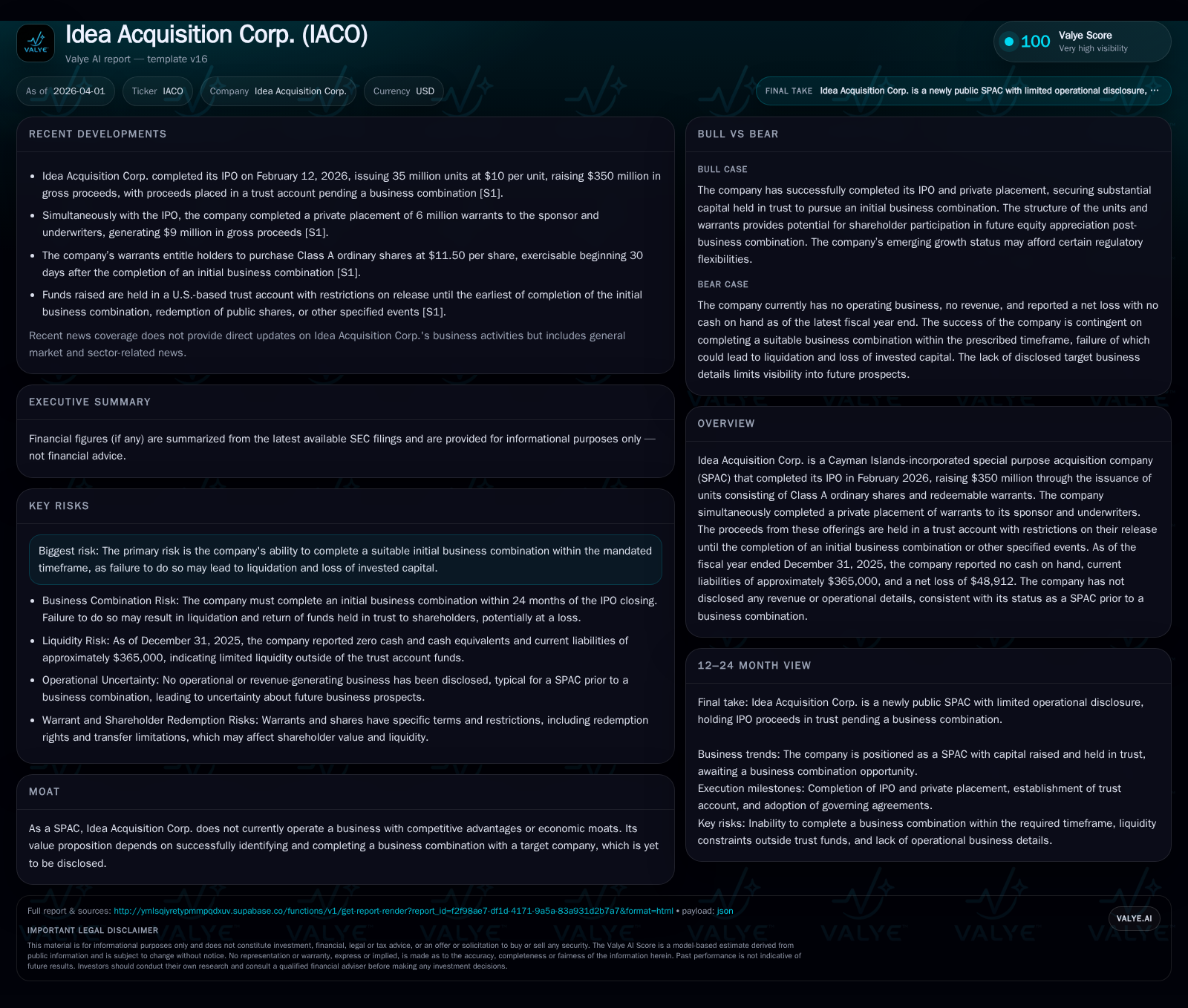
Idea Acquisition Corp. completed its IPO, raising $350 million placed in a trust account until an initial business combination is consummated. The company currently reports no operating revenue, a net loss of $48,912 for the year ended December 31, 2025, and current liabilities near $365,000. It must complete a qualifying merger or acquisition within 24 months or liquidate, returning capital to shareholders. Capital allocation includes sponsor and underwriter warrants with specific terms aligning interests but presenting dilution potential post-combination.
Introduction to Idea Acquisition Corp. and its SPAC Framework
Idea Acquisition Corp. (IACO), incorporated in the Cayman Islands, completed its IPO on February 12, 2026. The offering raised gross proceeds of $350 million through issuance of 35 million units, each comprising one Class A ordinary share and one-third of one redeemable warrant [S3][S8]. Concurrently, a private placement sold an additional 6 million warrants to the sponsor and underwriters at $1.50 each, generating $9 million more in gross proceeds [S13].
As a special purpose acquisition company (SPAC), IACO currently has no operating business or revenue generation; its purpose is solely to identify and complete an initial business combination within a defined timeframe [S1][S4]. The IPO proceeds are held in a U.S.-based trust account managed by Continental Stock Transfer & Trust Company as trustee. This structure safeguards public investors' principal with limited exceptions primarily covering tax obligations on interest earned and liquidation expenses [S8].
IACO trades on Nasdaq under symbols IACO (Class A shares) and IACOW (warrants), leveraging Cayman Islands incorporation alongside U.S. capital market access [S3].
Historical Financial Snapshot: Cash Position and Early Losses
For the fiscal year ended December 31, 2025—prior to IPO completion—IACO reported no cash or equivalents outside arrangements established post-IPO. Current liabilities stood at roughly $364,955 reflecting minimal operational costs during formation. Net loss for that period was $48,912 attributable to administrative expenses without any operating revenues [F1].
Historical performance (annual)
| FY |
|---|
| 2025 |
Source: SEC companyfacts cache [F1].
This financial profile confirms IACO's status as an "empty box" entity whose principal asset post-IPO is the trust-held cash pending deployment through an acquisition.
Strategic Imperatives: Closing the Initial Business Combination Within 24 Months
IACO must consummate an initial business combination within twenty-four months following IPO close or face mandatory liquidation pursuant to shareholder redemption rights [S14][S15]. This transaction typically involves merging with or acquiring a private operating company.
Management is thus incentivized to source attractive candidates meeting growth potential criteria while balancing valuation realities amid market conditions. In absence of operations, value creation depends entirely on deal sourcing quality rather than organic growth factors [S4]. Failure triggers return of capital held in trust to public shareholders but terminates sponsor incentives.
Capital Allocation: Trust Account Restrictions and Warrant Structures
Gross proceeds from the IPO plus private placements total approximately $359 million (including deferred underwriting commissions capped around $14 million). These funds reside predominantly in the trust account subject to strict disbursement rules limiting use mostly to tax obligations on interest income or up to $100k for liquidation costs before any business combination closes [S8][S10][S13].
Warrants included with IPO units allow holders to purchase Class A shares at $11.50 per share after a mandatory waiting period post-combination completion. Private placement warrants sold separately carry distinct provisions such as non-redeemability before combination closure, transfer restrictions until 30 days after closing, cashless exercise options versus cash exercises for IPO warrants, registration rights for holders, and longer expiration terms extending up to five years after IPO sales commenced [S16].
These structures align sponsor interests with deal execution success but introduce dilution risk upon warrant exercise.
Timeline Constraints: Redemption Rights Protecting Investors
Investor protections include redemption rights enabling public shareholders to redeem shares at IPO price plus accrued interest if they reject proposed amendments extending timelines or altering redemption conditions [S14][S15]. Should IACO fail to complete a qualifying business combination within two years from IPO close, it must dissolve returning invested capital minus permitted costs.
This imposes significant pressure on management's transaction pipeline and diligence processes.
Risks from Capital Lockup and Market Uncertainty
Capital remains inaccessible outside narrow conditions pending deal closure or liquidation exposing investors to market volatility during search phases typical of SPACs like IACO [S4][F1]. Potential conflicts may arise if sponsors pursue deals favoring their interests over public shareholders.
Absence of operational cash flows means investor returns depend exclusively on successful deal sourcing rather than organic margin improvements.
Growth Outlook: Sector-Agnostic Targeting Amid Market Themes
While no explicit target sectors are identified publicly due to confidentiality norms post-IPO, market commentary highlights investor appetite for acquisitions in areas including cloud computing infrastructure and AI applications consistent with broader trends [N1][N2]. This sector flexibility offers opportunity but introduces uncertainty around future portfolio composition until deals are announced.
Key Milestones Investors Should Track
Important upcoming events include:
- Public disclosures identifying prospective acquisition targets;
- Announcements regarding preliminary transaction terms;
- Shareholder votes approving business combinations;
- Amendments impacting timeline extensions or redemption rights. These will materially influence valuation given absence of ongoing earnings guidance pre-combination [S3][S5].
Capital Returns Summary: No Dividends or Buybacks Pre-Combination
Prior to completing an initial business combination, IACO neither pays dividends nor repurchases shares legally or operationally. Investor returns principally derive from redemption rights allowing pro-rata capital recovery held in trust if opting out of proposed deals or upon liquidation [F1][S7][S8]. ROE metrics have limited relevance given lack of productive assets outside trust-held cash.
This analysis is based on SEC filings including Form S-1 registration materials, Form 10-K annual report excerpts, contemporaneous 8-K filings around the IPO date along with supplemental news commentary capturing sector trends influencing potential acquisition landscapes. Findings should be interpreted considering that details remain fluid pending completed acquisitions inherent in nascent SPAC entities like Idea Acquisition Corp.
Disclaimer: This is research-only, informational analysis and not investment advice. It may include AI-generated interpretation and general industry context. Always verify important details using primary sources.

Comments