
HUMBL’s Strategic Shift: Blockchain Tokenization Meets Real Estate Innovation
An internal review of HUMBL, Inc.’s pivot to real estate tokenization, exploring its financial trajectory, platform licensing model, and market positioning.
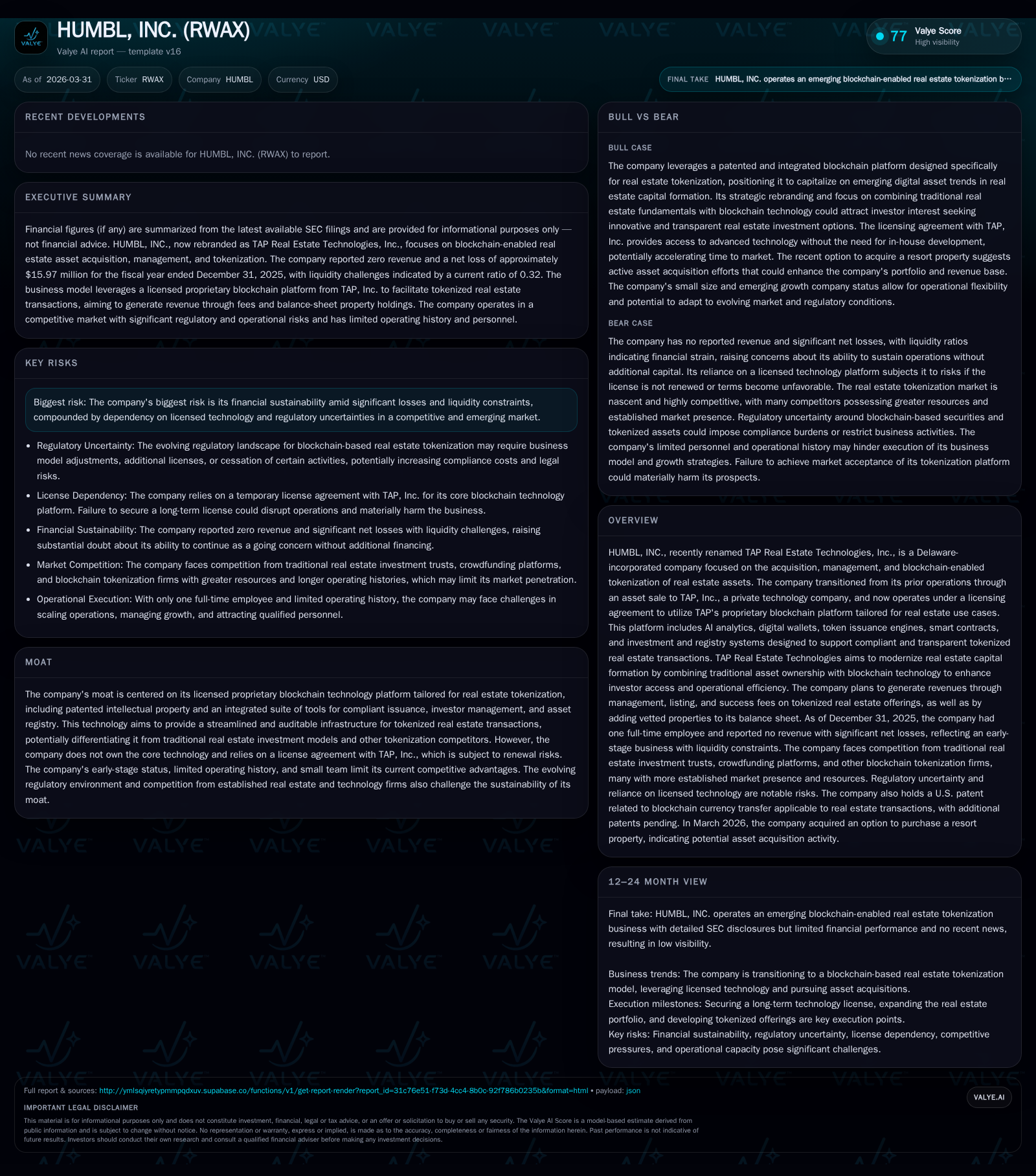
HUMBL, Inc., rebranded as TAP Real Estate Technologies, shifted from fintech payment services to blockchain-enabled real estate tokenization. The company relies on a licensed proprietary platform integrating AI analytics and smart contracts. Despite zero revenue in 2025, operating losses have decreased over recent years. The business faces liquidity constraints with a current ratio of 0.32 and ongoing risks tied to renewing technology licenses. Capital allocation focuses on sustaining operations amid recurring net losses and negative cash flow, with no dividends or buybacks. Notable milestones include a $250,000 option agreement for the Zermatt Resort acquisition and near-term negotiations for a long-term license agreement critical to platform access.
Business Evolution: From Fintech Payments to Real Estate Tokenization
HUMBL, Inc. completed a strategic pivot culminating in its rebranding as TAP Real Estate Technologies in March 2026 [S1][S3]. This transformation involved divesting prior fintech assets and acquiring a license to operate TAP Inc.’s proprietary blockchain platform focused on real estate tokenization. Instead of owning the core technology outright, HUMBL operates under a time-limited license covering patented systems that integrate AI analytics, digital wallets, token issuance engines, and smart contracts tailored for compliant fractional ownership of real estate assets [S1][S25][S26].
The platform aims to disrupt traditional capital formation by enabling real estate assets to be represented as digital tokens embedding ownership rights on an auditable blockchain ledger. It abstracts blockchain complexity through automated compliance (KYC, investor accreditation) and wallet management features [S25].
While this positions the company at the forefront of proptech innovation, it also introduces operational dependency on third-party technology licensing.
Historical Financial Performance
Financial results reflect an early-stage business still developing its revenue model. HUMBL reported zero revenue for fiscal year 2025 [F1]. Operating losses have narrowed from approximately -$41.2 million in 2022 to about -$7.6 million in 2025 [F1], indicating some operational improvement though profitability remains distant.
Net income remained negative at nearly -$16 million in FY2025 [F1], aligned with persistent negative operating leverage. Operating cash flow improved from -$11.7 million in FY2022 to -$1.65 million by FY2025 [F1], coinciding with reduced capital expenditures.
Working capital is constrained with current assets of $1.36 million versus current liabilities of $4.23 million at year-end 2025—a current ratio of 0.32—signaling liquidity stress [F1]. Shareholders’ equity was negative $2.87 million as of December 31, 2025 [F1], reflecting accumulated deficits and dilution effects.
Historical performance (annual)
| FY | Net ($mm) | CFO ($mm) | OpInc ($mm) | Capex ($) | Net YoY |
|---|---|---|---|---|---|
| 2025 | -16 | -2 | -8 | -10.6% | |
| 2024 | -14 | -3 | -8 | -259.1% | |
| 2023 | -4 | -4 | -13 | 8510 | +91.7% |
| 2022 | -49 | -12 | -41 | 13572 |
Source: SEC companyfacts cache [F1].
Capital returns and efficiency (annual)
| FY | FCF ($mm) | ROE% |
|---|---|---|
| 2025 | 556.5 | |
| 2024 | 417.1 | |
| 2023 | -4 | 97.5 |
| 2022 | -12 | 137.6 |
Source: SEC companyfacts cache [F1].
Note: Capex figures are limited in availability; omitted here per data constraints.
Licensing Model: Operational Dependencies and Risks
HUMBL’s operations rely heavily on a license agreement with TAP Inc., which grants rights to use patented blockchain technology including U.S. Patent #12,118,613—a system enabling blockchain-mediated currency transfer methods relevant to real estate transactions [S1][S9][S16]. This includes AI tools such as the TAURUS AI-Agent for automated payments management alongside user-facing components like the TAP Wallet.
As of December 30th, 2025 the license is a short-term royalty-free arrangement lasting only 90 days pending negotiation of longer-term terms [S9]. Failure to secure an extended license could disrupt access to essential technology underpinning HUMBL’s platform operations [S9][S16]. Even if renewed under less favorable conditions—such as higher costs or narrower rights—the company’s scalability and margins could be materially affected.
Additionally, the licensor controls prosecution and defense of the underlying intellectual property; any weakening or loss here could erode HUMBL’s competitive position [S16]. This creates a dual-edged dependency balancing technological moat against operational vulnerability.
Market Opportunity Amid Regulatory Uncertainty
Real estate tokenization represents an emerging market niche aiming to enhance transparency and liquidity in traditionally opaque private real estate investment [S8]. Adoption depends on stakeholder willingness—including property owners adapting legal frameworks for token issuance—and investor acceptance of digital asset models.
Regulatory uncertainty remains significant: federal securities laws under tests like Howey may classify tokenized offerings as securities requiring complex compliance involving SEC registration or exemptions plus state-level rules enforced by FINRA and others [S1][S5][S8]. These ambiguities impose compliance costs and enforcement risk that could disrupt offerings or increase expenses.
Liquidity limitations inherent in secondary markets for tokenized assets combined with general unfamiliarity among traditional investors may slow adoption despite technological promise.
Capital Structure and Liquidity Position
Authorized common shares expanded dramatically—from roughly 7.45 billion post-2021 reverse merger approval to over 85 billion shares by mid-2025—indicating significant shareholder dilution potential [S21].
Balance sheet data reveals working capital deficiency with current liabilities ($4.23M) substantially exceeding current assets ($1.36M) as of December 31, 2025 [F1], underscoring ongoing liquidity pressure.
Negative equity reflects accumulated losses partially offset by capital raises but highlights financial fragility typical of early-stage ventures reliant on external funding [F1][S4][S6].
Capital Allocation: Focused on Liquidity Preservation Amid Losses
There are no dividends or share repurchase programs disclosed as of March 31st, 2026 filings [F1][S21][S27]. Capital allocation emphasizes conserving cash amid recurring net losses (-$15.97M FY25) and negative operating cash flow [-$1.65M FY25] [F1].
Return metrics such as return on equity are distorted due to negative equity balances (~556% calculated from net income over negative equity) and do not indicate value creation but rather ongoing operating deficits [F1].
Key Near-Term Milestones Investors Should Monitor
- On March 24th, 2026 HUMBL entered into an Option Agreement granting a 60-day exclusive right to acquire Zermatt Resort in Midway Utah for a $250k option fee—signaling strategic expansion into physical asset holdings [S3].
- Negotiations for converting the interim TAP Inc licensing into a long-term agreement are reportedly near completion; securing this deal is critical given platform dependency risks [S9].
- Regulatory developments around security classification of tokenized real estate offerings remain pending; outcomes will materially influence compliance costs and business viability [S8].
- Progress on onboarding users onto the token issuance platform and integration within ecosystem partners remains key operational indicators though detailed forecasts are unavailable.
This review synthesizes HUMBL's corporate evolution supported by audited financial data primarily from SEC filings balanced against risk disclosures highlighting substantial uncertainties inherent in nascent blockchain-tokenized real estate ventures facing financial constraints and regulatory ambiguity. Success hinges on securing long-term technology licenses, navigating evolving regulations effectively, achieving sustainable capital funding amidst ongoing cash burn,and driving market adoption of a novel investment model.
Readers should interpret this analysis strictly based on documented facts without extrapolation beyond reported information or implicit valuation judgments.
Disclaimer: This is research-only, informational analysis and not investment advice. It may include AI-generated interpretation and general industry context. Always verify important details using primary sources.

Comments