
Specialty Food Distribution: Innovative Food Holdings’ Growth and Capital Challenges
Innovative Food Holdings exhibits a distinctive specialty food distribution model marked by logistical strengths and concentrated customer risks amid recent profitability struggles.
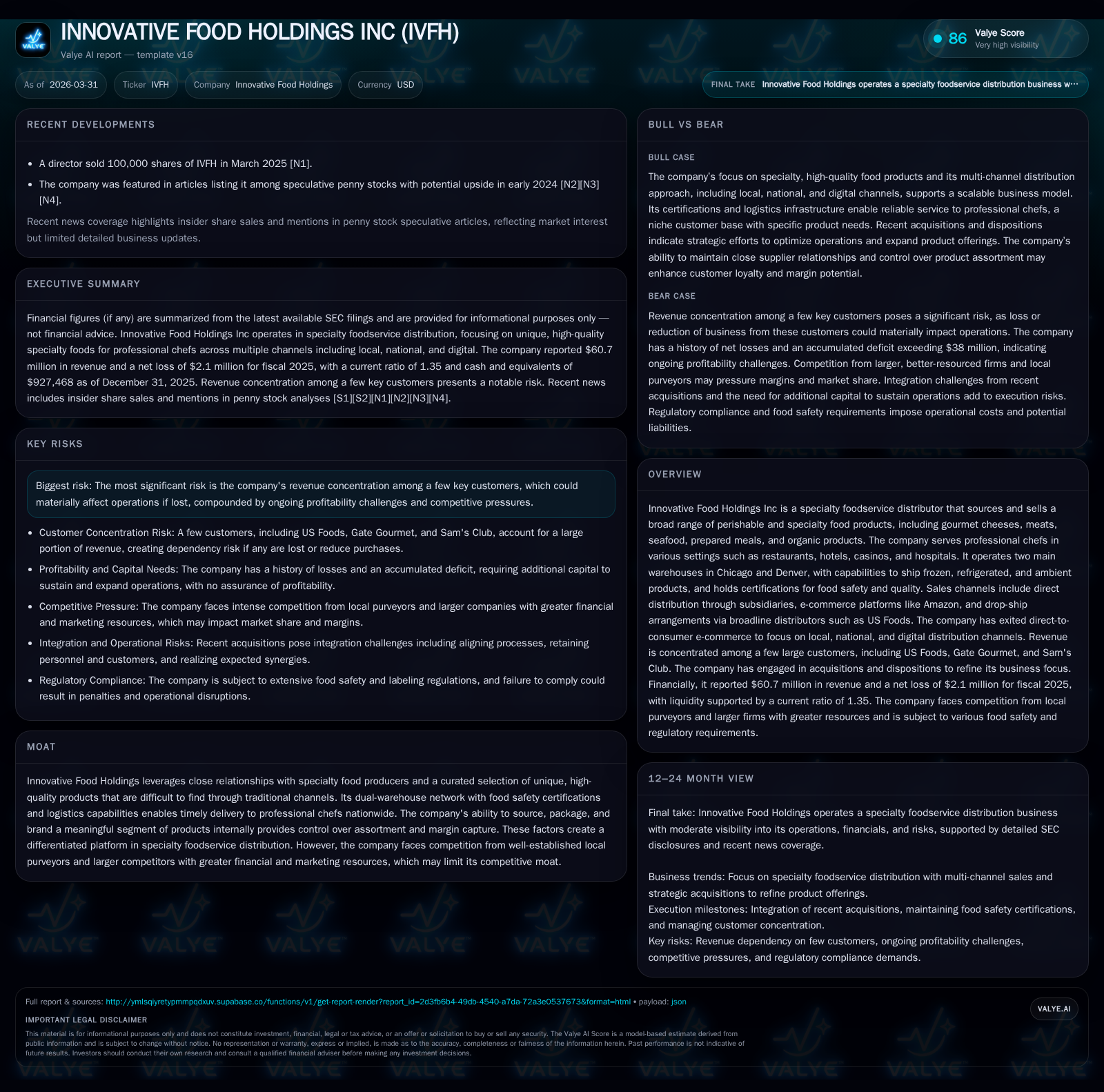
Innovative Food Holdings, a specialty foodservice distributor with dual-warehouse operations focusing on perishable gourmet products, has experienced a notable decline in revenue over the past several years while making strides toward operating profitability. The company's business relies heavily on a limited number of large customers such as US Foods, Gate Gourmet, and Sam’s Club, which poses significant concentration risk. Despite improved operating income in FY2025, net income remains negative, driven by persistent losses and cash flow challenges. Financial flexibility is constrained by prior debt covenants and limited liquidity, though recent debt repayment has partially alleviated covenant restrictions. Key growth drivers lie in expanding digital drop-ship channels and broadening customer diversification; however, success depends on managing operational costs and mitigating concentrated revenue risks.
Revenue Trajectory and Operational Performance: Historical Context
Innovative Food Holdings has reported a clear downward trajectory in revenue over recent years. From a top-line peak near $80.1 million in fiscal year (FY) 2022, revenues declined to approximately $60.7 million by FY 2025 [F1]. This drop primarily reflects strategic portfolio shifts including the discontinuation of the retail cheese business segment that had contributed meaningful sales volume and SKU density.
Nonetheless, this revenue contraction coincided with a substantive improvement in operating income performance. Operating income progressed from a loss of $1.0 million in FY 2022 to a positive $2.6 million in FY 2025—a nearly fourfold increase year-over-year in the latest period [F1]. This recovery was driven by tighter SKU mix optimization favoring higher margin specialty products sourced through proprietary supply relationships and an enhanced emphasis on gross margin management. Exiting lower-margin segments like retail cheese allowed rationalization of overheads associated with those SKUs.
Despite these strides at the operating level, net income remained negative at about -$2.1 million in FY 2025 with corresponding equity showing an approximate -33% return on equity (ROE), signaling ongoing challenges absorbing non-operating expenses or tax impacts [F1]. Operating margins thus improved materially though net profitability remains elusive for the foreseeable term given historical trends.
Historical performance (annual)
| FY | Rev ($mm) | Net ($mm) | CFO ($mm) | OpInc ($mm) | Rev YoY | Net YoY |
|---|---|---|---|---|---|---|
| 2025 | 61 | -2 | 0 | 3 | -15.9% | -179.1% |
| 2024 | 72 | 3 | -6 | 1 | -0.1% | +160.0% |
| 2023 | 72 | -4 | 0 | -3 | -9.8% | -222.6% |
| 2022 | 80 | -1 | -1 | -1 |
Source: SEC companyfacts cache [F1].
Capital returns and efficiency (annual)
| FY | FCF ($mm) | ROE% |
|---|---|---|
| 2025 | 0 | -33.1 |
| 2024 | -7 | 31.9 |
| 2023 | -1 | -155.2 |
| 2022 | -1 | -20.5 |
Source: SEC companyfacts cache [F1].
Note: Figures exclude discontinued operations impact where applicable.
Customer Concentration and Sales Channel Strategy
A salient feature of Innovative Food Holdings’ revenue profile is its high dependency on a narrowly concentrated set of key customers—US Foods (USF), Gate Gourmet, and Sam's Club collectively represent over 60% of total sales [S1][F1]. US Foods alone contributed roughly $26.9 million or 37% of revenues for FY 2025 down from $31.2 million or 43% in FY 2024 [S1][F1]. Meanwhile Gate Gourmet accounted for roughly $11.3 million (14%) while Sam’s Club made up about $8.6 million (12%) in FY 2025 [S1].
This concentration introduces material risk related to potential client churn or contract renegotiations—as acknowledged by management—with adverse impacts possibly compelling operational curtailment if not mitigated effectively [S1][S14]. Particularly notable is that sales efforts are heavily reliant on the US Foods' sales force rather than proprietary channel/sales team deployment; this structural dependence constrains direct customer relationship control [S1]. With recent exits from direct-to-consumer e-commerce channels—such as retail cheese—the firm is recalibrating emphasis toward local markets served by subsidiaries Artisan Specialty Foods (Chicago) and Golden Organics (Denver), alongside broader national footprint supported through digital drop-ship agreements including Amazon-hosted platforms [S15][S26].
Maintaining balance between preserving longstanding large-volume customers while orchestrating diversification across smaller accounts and new channels will be critical for revenue resilience moving forward.
Competitive Positioning Through Specialty Product Curation and Logistics
At its core Innovative Food Holdings leverages a differentiated platform centered around specialty foods unavailable through broadline distributors' standard assortments—an articulation of its moat [S1]. The company sources thousands of perishable premium products such as artisan cheeses; wild game; origin-specific seafood like Alaskan wild king salmon; dry-aged meats; exotic mushrooms; organic produce; truffle oils; aged vinegars; among others [S19][S26].
Crucially this operates atop dual warehouse facilities—28K sq ft near Chicago and 22K sq ft near Denver—equipped for frozen/refrigerated/ambient storage aligned with GFSI/SQF certifications that meet rigorous global food safety standards demanded by professional chefs nationwide [S15]. This certified cold chain logistics network enables rapid order fulfillment generally within a next-day delivery window via both third-party carriers and an owned truck fleet serving local customers directly.
Additionally the company performs internal packaging and branding for select SKUs which reduces reliance on third-party providers allowing better assortment control and incremental margin capture—a vertical integration advantage uncommon among small batch specialty distributors competing more regionally [S1]. However competition remains intense against entrenched local purveyors who focus narrowly by geographic territory but also against larger players capable of broadline distribution scale paired with extensive marketing budgets [S13][S27].
Profitability and Cash Flow Trends Amid Changing Market Dynamics
While operating income turned positive in FY2024-FY2025 time frame reflecting effective gross margin improvement through SKU optimization and cost rationalization initiatives [F1], net profits have oscillated due to recurring non-operating expenses including impairment charges or interest burden as well as gains/losses from discontinued operations previously reported.
Negative return on equity stands at approximately -33%, indicative of accumulated deficits totaling $38+ million as noted at year end December 31, 2025 [F1][S8]. Operating cash flow remains persistently negative albeit markedly improved to near breakeven levels (-$27K) versus multi-million dollar outflows seen just prior year (-$6.3M) largely aided by adjustments such as inventory valuation write-downs related to facility closures or asset dispositions over prior periods [F1][S21][S23]. After deducting capital expenditures consistently around mid-$300K annually reflective of modest warehouse/technology investments related to operations upkeep—not growth capex—free cash flow remains slightly negative (~-$380K) for FY25 [F1].
Within specialty foodservice distribution sectors like this one inventory turnover cycles profoundly impact working capital due to perishability requiring accurate demand forecasts balanced against freshness criteria limiting stock aging—a balancing act that strains cash flows especially when scale compresses margins under competitive pressure.
Capital Structure, Covenants, and Financial Flexibility Constraints
The Company's financial position has been shaped by evolving debt arrangements accompanied by restrictive covenants aimed at preserving lender collateral value but limiting operational maneuverability [S4][S5]. As of late December 2025 constructs included limitations against incurring additional indebtedness beyond preset thresholds; restrictions on paying dividends or repurchasing shares; prohibitions on certain mergers or asset sales without lender consent; constraints on investments or expenditures exceeding defined parameters; prohibitions against altering core business scope without approval—all typical clauses designed to mitigate credit risk exposure yet detrimental to tactical agility in volatile markets.
Liquidity information disclosed shows restricted cash balances declining roughly $352K year-over-year to about half a million dollars alongside low unrestricted cash approximating $927K at year-end December ‘25 down about $351K relative to prior fiscal close [F1][S8]. Such tight liquidity compounded with negative working capital metrics increases refinancing risk absent robust earnings turnaround or asset divestiture proceeds as evidenced by recent sale of warehouse assets generating approx $9.2 million early March ‘26 relieving some balance sheet pressure though timing effects remain relevant for upcoming reporting cycles [S6][S24].
Importantly the full repayment of MapleMark Bank loan on March 6th '26 ended prior covenant encumbrances specific to that facility improving financial flexibility modestly but underscored continuing dependency upon external capital access strategies to maintain solvency should operating cash flows fail to turn sustainably positive going forward [S12][S24].
Strategic Outlook: Growth Opportunities and Pressing Risks
Looking ahead Innovative Food Holdings pursues expansion primarily via three channels: Local Distribution focused on Chicago/Denver markets through subsidiaries Artisan Specialty Foods and Golden Organics; National Distribution extending reach beyond local footprints utilizing warehouses plus third-party logistics partners; Digital Channels emphasizing digital drop-shipping nationally leveraging e-commerce platforms like Amazon alongside broadline distributor websites including US Foods’ portals enabling wider geographic penetration without inventory holding overheads beyond core warehouses [S15][S26].
Key growth opportunities hinge upon successfully scaling digital drop-ship distribution capabilities supporting next-day delivery promises while continuing internal sourcing-branding initiatives sustaining unique SKU assortments commanding pricing premiums versus commodity-driven competitors.
However risks loom prominently: further client concentration exacerbates vulnerability should any one major customer curtail orders or switch vendors given limited alternative accounts generating significant volume currently; competitive encroachment from well-financed large broadline distributors could intensify pricing/margin pressure; regulatory compliance costs tied to evolving food safety laws may increase cost burdens; constant need for investment in technology upgrades necessary to maintain seamless omnichannel order processing poses further cash requirement headwinds under constrained liquidity conditions documented [S16][F1].
Key Metrics to Monitor in Upcoming Reporting Periods
Absent explicit forward guidance from management, stakeholders should focus decisively on metrics reflecting operational recovery fundamentals including:
- Revenue growth or stabilization reversing multi-year declines,
- Continued improvements in gross margin percentage via optimized SKU mix,
- Operating income margin demonstrating consistent profitability beyond one-off gains,
- Positive conversion of operating profits into sustainable free cash flow,
- Maintenance of food safety certification statuses (GFSI/SQF) critical to premium client retention,
- Progress toward customer diversification reducing top-three client share below current ~63%,
- Liquidity trends marked by net unrestricted cash positions improving versus liabilities,
- Compliance status relative to any new or refinanced debt covenants post MapleMark loan payoff,
- Efficiency gains realized within warehouse logistics or automation upgrades affording scale benefits.
Monitoring these indicators will highlight whether Innovative Food Holdings can solidify its specialized niche model while overcoming capital structure limitations threatening long-term viability.
This analysis is based solely on disclosures contained within publicly available SEC filings up to March 31st, 2026 ([F1],[S#]) without attempting projections beyond documented corporate commentary nor offering investment recommendations.
Disclaimer: This is research-only, informational analysis and not investment advice. It may include AI-generated interpretation and general industry context. Always verify important details using primary sources.

Comments