
Rand Capital’s Turnaround: From Portfolio Volatility to Dividend Growth
Rand Capital Corp emerged from net losses in 2024 with restored profitability in 2025, driven by a diversified investment portfolio and enhanced dividend distributions.
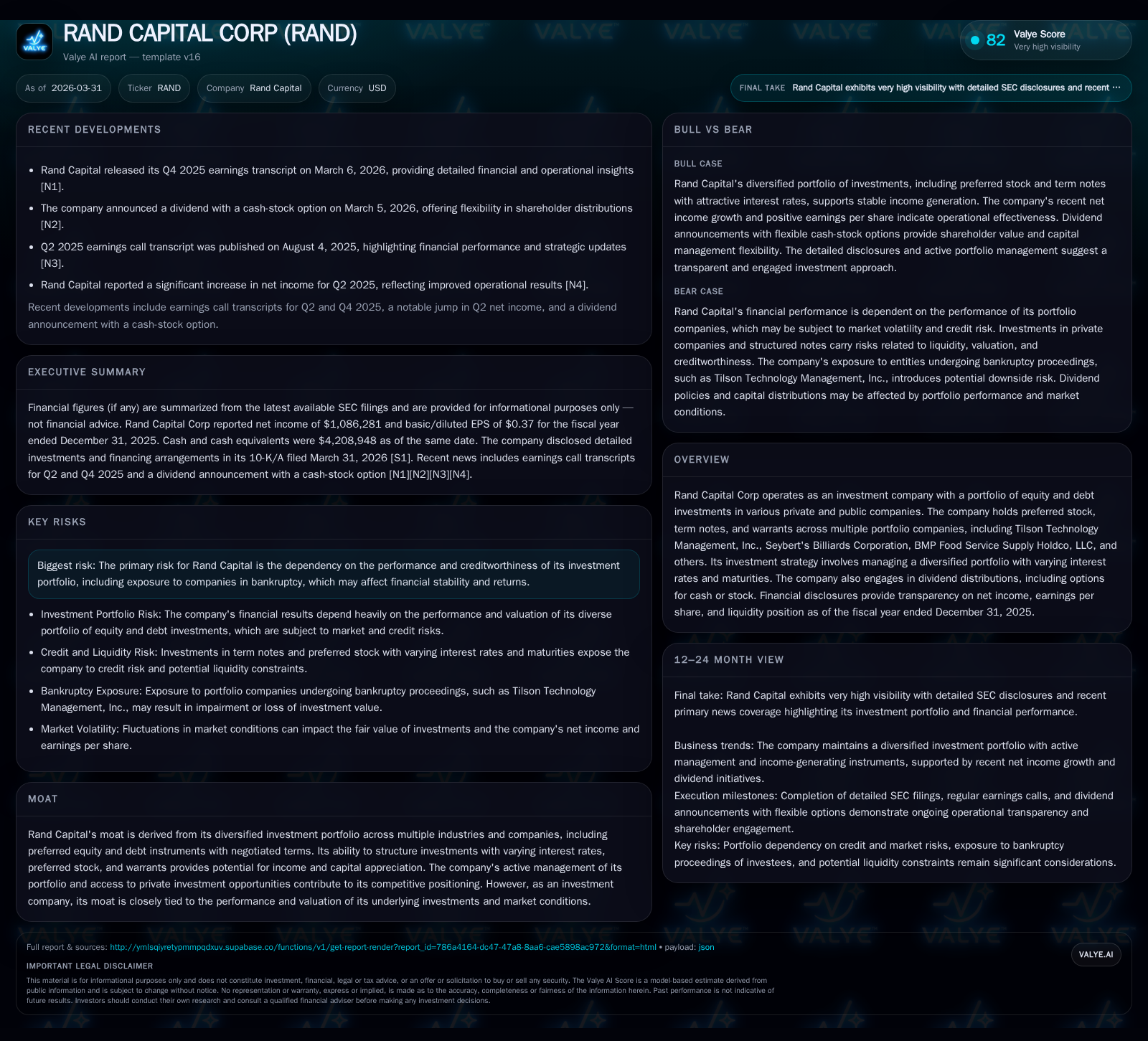
Rand Capital Corp's financial trajectory shifted markedly between fiscal years 2024 and 2025, moving from a net loss of approximately $2.95 million to a net income exceeding $1 million. This rebound reflects strategic portfolio management focused on preferred stock, term notes, and warrants with negotiated terms supporting income stability. Despite slower operating cash flow year-over-year, dividend distributions expanded considerably, with flexible options for shareholders. Ongoing risks tied to credit exposure and bankrupt holdings underscore the fragility of returns, while liquidity remains solid at over $4 million in cash and equivalents. Market watchers should monitor portfolio valuations and dividend policies as the company balances risk with capital return priorities.
Historical Financial Performance: Growth and Setbacks
Rand Capital Corp exhibited significant financial volatility over the past three fiscal years. A striking nadir occurred in 2024 with a net loss of approximately -$2.95 million USD, diverging sharply from positive net incomes near $1.09 million USD reported both in 2023 and rebounded again in 2025 ([F1]). This swing underscores sensitivity to fair value adjustments in its private equity and debt investments.
Operating cash flow (CFO) further elucidates this volatility: following a decline into negative territory in 2023 (-$8.34 million), the Company posted strong positive CFOs over both 2024 ($15.33 million) and 2025 ($11.25 million), yet with a noticeable contraction of nearly 27% between the last two years ([F1]). These dynamics reflect realized investment inflows offsetting valuation headwinds.
Equity fluctuated accordingly—from about $60.8 million at end-2023 peaking at nearly $65.3 million at end-2024 before retreating to approximately $52.2 million by end-2025 ([F1]). Dividends paid demonstrate an aggressive shift toward income distribution, rising substantially from ~$2.14 million in 2024 to over $7.27 million in 2025 ([F1]). This represents more than a threefold increase despite lower CFO, signaling prioritization of shareholder returns.
Historical performance (annual)
| FY | Net ($mm) | CFO ($mm) | Net YoY |
|---|---|---|---|
| 2025 | 1 | 11 | +136.9% |
| 2024 | -3 | 15 | -370.5% |
| 2023 | 1 | -8 |
Source: SEC companyfacts cache [F1].
Capital returns and efficiency (annual)
| FY | Div ($mm) | ROE% |
|---|---|---|
| 2025 | 7 | 2.1 |
| 2024 | 2 | -4.5 |
| 2023 | 3 | 1.8 |
Source: SEC companyfacts cache [F1].
Net income rebounded strongly after deep losses; operating cash flow softened yet remained positive; dividend distributions increased markedly.
Investment Portfolio Composition and Strategic Drivers
Rand Capital operates as an investment company holding a wide array of financial instruments across multiple private and public companies ([S1]). Core components include preferred stock shares bearing negotiated terms such as fixed dividends ranging predominantly from 12% to 14%, term notes often secured with staggered maturities extending beyond five years and sometimes carrying Payment-In-Kind (PIK) features allowing interest accumulation instead of immediate cash payments.
Notable investees encompass Tilson Technology Management with numerous preferred classes (Series B through F), Seybert's Billiards Corporation holding term notes plus warrants representing membership interests conferring potential equity upside,[S1], BMP Food Service Supply Holdco with second amended term notes offering up to a combined coupon plus PIK rates upwards of around mid-teens percentage points.[S1]
Warrants held confer rights to acquire common or membership units at defined terms enhancing potential capital appreciation beyond fixed-income yield alone.[S1] This layered investment approach seeks steady income via high coupons coupled with upside optionality through warrants or equity-like instruments.
"Preferred stock" here refers to equity interests prioritized for dividend payments before common holders; "term notes" are debt instruments with scheduled principal repayment dates issuing fixed or variable interest; "PIK features" allow deferred interest compounding rather than immediate cash disbursement; warrants entitle acquiring equity stakes conditional on specified events.
This diversified makeup undergirds Rand Capital’s moat by distributing risk exposures while securing contractual income streams supported by active negotiation tailored to each investment’s credit profile.
2025 Earnings Highlights and Dividend Policy Update
The fiscal year ended December 31, 2025 brought renewed profitability totaling roughly $1.09 million USD net income after overcoming prior-year losses ([F1],[N1]). Earnings per share details were consistent with modest growth driven primarily by recognition of investment income rather than operational scale expansion.
Parallelly appropriate dividend policy steps appeared designed for flexibility amid liquidity considerations; the Company announced dividend distributions allowing shareholders the option between receipt in cash or additional stock ([N2],[S9]). This approach mitigates direct cash flow pressures while maintaining commitment to regular income returns characteristic of investment companies’ distribution policies.
Dividends paid tripled relative to the prior year despite operating cash flow declining by around one-quarter ([F1]), suggesting deliberate use of accumulated liquidity reserves for rewarding shareholders while preserving operational funding buffers.
This dual-path dividend mechanism exemplifies strategic balancing between shareholder value proposition and prudent liquidity management common within diversified portfolio managers navigating fluctuating reinvestment opportunities.
Portfolio-Driven Risks: Creditworthiness and Exposure to Troubled Assets
Central risk aspects revolve around credit quality of portfolio holdings including several investees facing financial difficulties—most prominently Tilson Technology Management which filed for Chapter 11 bankruptcy protection during FY2025 ([N1],[S4]).
This debt restructuring event weighs on Rand Capital’s valuation inputs as investments are subject to fair value adjustments largely based on Level 3 inputs reflecting unobservable market data ([S1]). Such valuation volatility induces swings in reported earnings independent of realized cash flows.
Creditworthiness challenges are compounded by concentration within certain moderately sized investments representing appreciable fractions of net assets (e.g., Tilson Technology Preferred Stock accounting for ~14–15% of net assets) that magnify financial statement impact from impairment or delayed recoveries ([S21]).
Risk mitigation follows active portfolio management emphasizing negotiated contractual protections—e.g., secured promissory notes at high coupon rates—to partially offset downside risk while preserving avenues for recovery or capital appreciation if restructuring succeeds.
Overall portfolio credit quality remains pivotal given the Company holds instruments across varying seniorities including subordinated secured loans alongside preferred interests implying differing degrees of priority claim upon issuer value realization.
Liquidity Position and Capital Structure Overview
The liquidity position was solid entering calendar year-end 2025 with cash & equivalents approximating $4.21 million USD ([F1]), complemented by access to revolving facilities managing short-term financing needs ([S6],[S8]).
Capital structure reflects predominantly equity funding supplemented by bespoke debt instruments provided through term notes extended into portfolio companies at diverse maturities (ranging up to decade-long horizons). Coupon rates vary largely between approximately 12% and as high as the mid-teens when including PIK components ([S13],[S18]).
No significant external indebtedness was reported on Rand Capital’s balance sheet aside from internal financing arrangements linked directly to its investments ([S22]), implying low leverage risk from corporate standpoint whilst emphasizing dependence on portfolio asset performance for sustainable funding.
Amortization schedules coupled with staggered debt maturities among portfolio entities necessitate ongoing monitoring but do not currently impose immediate refinancing pressures given available liquid assets.
Capital Allocation Framework: Dividends and Cash Flow Utilization
Capital allocation has principally favored dividend distributions as key returns vehicle aligning with shareholder expectations typical for investment companies focused on income generation ([S7],[S10],[F1]). Dividends more than tripled in amount during FY2025 versus FY2024 despite softer operating cash flows highlighting prioritization toward unlocking shareholder value.
Buybacks were notably absent; no documented share repurchase programs were launched or executed according to all filings reviewed ([S19],[S11]), indicating that capital return emphasis remains firmly on dividends rather than capital structure optimization via treasury transactions.
Operating cash flow usage reflects a conservative posture maintaining reserve buffers whilst selectively funding distribution commitments—a prudent stance amid underlying asset valuation uncertainties stemming from credit risk exposures described previously.
Dividend distribution policy offering payout flexibility via cash or stock option further tempers liquidity strain while sustaining investor access to returns during periods of variable underlying investment-generated income streams ([N2],[S29]).
Key Milestones and What to Watch in Coming Quarters
Investors should closely observe forthcoming quarterly reports detailing:
- Fair value remeasurements especially related to Level 3 input-driven investments demonstrated sensitivity during recent periods ([N1]);
- Credit developments surrounding distressed holdings such as Tilson Technology including bankruptcy proceedings progress impacting recoverability assumptions;
- Changes or refinements to dividend distribution mechanisms reflective of evolving liquidity positions;
- Potential new investments added that diversify income sources or alter overall portfolio risk profile;
- Operating cash flow trajectory vis-à-vis investment repayments or impairments signaling financial flexibility shifts;
- Any signaling on possible future capital allocation changes including introduction of buybacks if liquidity improves materially ([N2],[N1]).
Monitoring these factors will be crucial as Rand Capital attempts to sustain both profitability growth and stable capital returns against backdrop of enduring asset-level uncertainties.
Concluding Analysis: Assessing Sustainability of Rebound
Rand Capital’s rebound from steep losses in 2024 to positive net income in 2025 evidences effective reset via active portfolio management centered on diversified instruments delivering contractual yield alongside capital gain optionality. Nonetheless considerable exposure remains toward investees undergoing financial distress predominantly impacting earnings volatility through fair value fluctuations rather than realized impairments series-to-series.
The Company’s moat is distinctly tied to this structured diversification strategy blending preferred stock positions bearing fixed dividends at elevated rates combined with term notes leveraging PIK features granting payment deferral when necessary—and warrants adding asymmetric upside potential ([S1]). While this arrangement does not eliminate downside risks intrinsic to credit exposures within private-equity styled portfolios it provides measured buffers supporting ongoing income generation challenging periods.
Capital allocation signals a disciplined yet shareholder-conscious stance prioritizing escalating dividend distributions borne via adequate liquidity reserves albeit amidst lower operating cash inflows underscoring short-term trade-offs required in balancing growth versus return priorities. Absence of share buybacks points toward conservative capital deployment emphasizing flexibility rather than financial engineering.
In sum, sustaining this turnaround hinges critically upon continued credit quality stabilization or improvement among largest underlying holdings plus prudent liquidity stewardship facilitating consistent dividend flows without eroding operational capacity. The mosaic of multi-instrument investments supplemented by active engagement remains Rand Capital’s core defense against inherent market volatility although vigilance toward downside scenarios remains warranted given concentrated exposures documented within SEC filings.
Disclaimer: This analysis is based solely on information available as of March 31, 2026 including SEC filings [F1], [S#], and news releases [N#]. It does not constitute investment advice nor recommendation regarding any securities issued by Rand Capital Corp.
Disclaimer: This is research-only, informational analysis and not investment advice. It may include AI-generated interpretation and general industry context. Always verify important details using primary sources.

Comments