
MIRA Pharmaceuticals’ Clinical Progress and Capital Strategies Shape Early-Stage Viability
MIRA Pharmaceuticals navigates early-stage drug development amid mounting losses and a robust liquidity position.
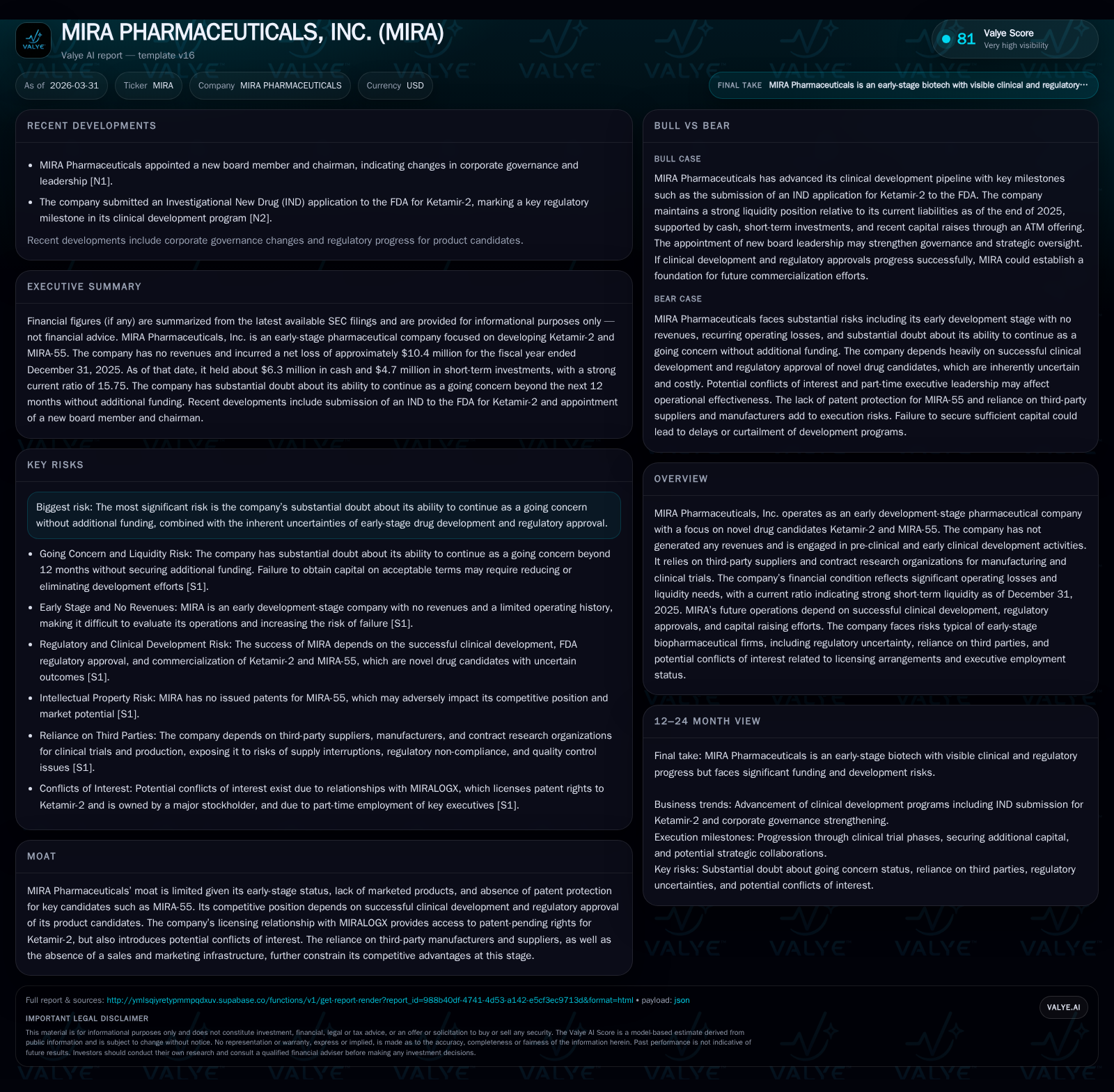
MIRA Pharmaceuticals remains a pre-revenue, early development-stage biopharma focused on two novel drug candidates: Ketamir-2, a ketamine analog, and MIRA-55, a synthetic cannabinoid. Its financial trajectory shows widening net losses driven by escalating R&D expenses, while operating cash flows have moderately improved. A strong current ratio signals liquidity resilience, yet the firm acknowledges substantial doubt regarding its going concern status, reliant on additional capital raises. Clinical progress includes promising preclinical safety signals for MIRA-55 supporting an upcoming IND submission, but regulatory challenges and trial execution risks persist. Corporate governance is evolving with recent board appointments amid potential conflicts of interest linked to licensing arrangements.
Historical Financial Performance: Rising Losses Amid Intensified R&D
MIRA Pharmaceuticals' financial record portrays a company deeply invested in its early-stage drug pipeline but unprofitable with sustained cash burn. Net losses narrowed somewhat from $11.98 million in FY2023 to $7.85 million in FY2024 but widened again to $10.44 million in FY2025—a 33% increase year-over-year illustrating a renewed escalation in operating expenditures, likely attributable to more aggressive preclinical and early clinical development activities [F1]. The company’s operating cash flow (CFO) paints a related picture: despite negative values representing cash outflows from core operations each year (-$4.53M in 2023 to -$5.56M in 2024), FY2025 showed improvement with a CFO of -$4.66 million, a 16.2% improvement relative to FY2024 [F1]. This suggests better expense control or timing efficiencies despite expansion efforts.
Equity financing has served as the primary capital source underpinning this burn rate—total equity rose sharply to $10.39 million as of December 31, 2025 from just $2.20 million the year before [F1]. The company’s capital structure reflects typical early biopharma dependence on external funding without operating revenue streams.
A robust current ratio of approximately 15.75 (current assets of $11.06 million versus current liabilities of $0.70 million) provides a solid cushion for upcoming obligations [F1]. However, this solvency strength contrasts with auditor cautions about 'substantial doubt' regarding MIRA's ability to continue as a going concern without raising further capital [S1][S13][S18][S21].
Historical performance (annual)
| FY | Net ($mm) | CFO ($mm) | Net YoY |
|---|---|---|---|
| 2025 | -10 | -5 | -33.0% |
| 2024 | -8 | -6 | +34.5% |
| 2023 | -12 | -5 |
Source: SEC companyfacts cache [F1].
Capital returns and efficiency (annual)
| FY | ROE% |
|---|---|
| 2025 | -100.5 |
| 2024 | -357.0 |
| 2023 | -273.9 |
Source: SEC companyfacts cache [F1].
This table highlights trends in net losses increasing alongside significant equity injections and improved operational cash flow volatility[F1].
Development Pipeline and Drug Candidate Profiles
MIRA’s pipeline centers on two proprietary compounds: Ketamir-2 (a novel ketamine analog) and MIRA-55 (a synthetic cannabinoid), both embodying cutting-edge approaches intended to address pain management with differentiated profiles versus existing opioids or cannabinoids.
Ketamir-2 aims to leverage ketamine's analgesic mechanisms while potentially reducing abuse liability common with dissociative anesthetics; however, regulatory hurdles await given its classification considerations under DEA schedules [S6]. Meanwhile, MIRA-55 has demonstrated in preclinical inflammatory pain models efficacy comparable to morphine without THC-associated or rimonabant-like central nervous system side effects—a pivotal finding supporting planned Investigational New Drug (IND) application filings for an inflammatory pain indication [N1][S3].
Both molecules represent relatively novel pharmacological classes prompting considerable uncertainty during clinical programs due to limited precedents for synthetic cannabinoids or next-generation ketamine analogs within FDA review frameworks [S1][S10]. Rigorous safety monitoring is imperative given potential CNS side effect risks common across these classes.
The forthcoming IND submission for MIRA-55 is anticipated as an inflection point that will dictate feasibility of ensuing Phase 1 trials [N1], validating the therapeutic hypothesis founded on preclinical safety and efficacy data.
Capital Position and Liquidity Cushion Analysis
Despite lacking revenue streams to date—as expected for an early-stage firm—MIRA's balance sheet reveals substantial liquidity strength as measured by its current ratio near 15.75 at fiscal year-end 2025 [F1]. This unusually high ratio stems from accumulated cash reserves relative to modest payables and short-term debt totaling approximately $0.7 million.
The company’s cash and equivalents balance stood at roughly $6.35 million at end of December 2025 [F1], providing a meaningful runway for ongoing R&D activities though insufficient alone for long-term sustainability given recurring multi-million dollar operational outlays.
Capital formation has relied heavily on equity issuance mechanisms including At-The-Market offerings authorized up to $75 million [S13], allowing periodic stock sales when market conditions permit.[S21] Nevertheless, management explicitly warns about material uncertainties impacting ability to continue as a going concern absent securing additional funding—a familiar scenario for small biopharma ventures facing extended timelines before commercialization milestones can unlock revenues [S18][S21].
This dynamic situates MIRA firmly within a capital raising cycle environment where maintaining liquidity buffers (“runway”) while advancing clinical programs is critical.
Risks in Clinical Development and Regulatory Approval
The early phase status of MIRA’s product candidates entails classical yet acute development risks compounded by their pharmacological novelty.
Clinical trials involving synthetic cannabinoids and ketamine analogs face heightened scrutiny due to limited historical precedents regarding safety profiles and abuse potential[S6][S10]. The FDA approval pathway can be protracted and unpredictable owing to evolving regulatory policies on these controlled substances.
Risks encompass trial design challenges such as patient recruitment issues; adherence inconsistencies; protocol deviations; investigator engagement; and potential disruptions arising from compliance lapses by contract research organizations (CROs)[S9][S23]. Additionally, emerging Risk Evaluation and Mitigation Strategies (REMS) might be imposed post-approval if safety concerns warrant stringent usage controls[S7].
Product liability is another key risk: notwithstanding an absence of lawsuits so far,[S14] any adverse events during trials or post-marketing could lead to costly litigation hindering commercialization prospects.
Finally, legislative healthcare reforms—including amendments impacting drug pricing and reimbursement—may affect future revenue generation possibilities even if approvals are secured[S4][S5][S10].
Collaborations, Licensing Complexities, and Governance Changes
MIRA maintains an important licensing relationship with MIRALOGX providing access to patent-pending rights specifically for Ketamir-2[S1][N1]. Such arrangements often introduce potential conflicts of interest originating from overlapping executive roles or dual affiliations between entities[S26].
Most recently documented governance enhancements include appointment of new board members and chairman aimed at bolstering oversight standards[N1], signaling attempts to address transparency concerns evident in past disclosures.
Reliance on third-party manufacturers and CROs continues as an operational imperative but also represents exposure points where contractual or performance failures could disrupt study timelines[S23][S29].
Ensuring clarity around intellectual property prosecution responsibilities within licensing agreements remains crucial given ongoing patent challenges inherent in biotech industry competitive dynamics[S27].
Future Growth Outlook: Milestones to Monitor and Funding Challenges
Prospects hinge almost entirely on successful advancement through clinical milestones primarily:
- IND submission completion for MIRA-55 targeting inflammatory pain indication[N1][S3]
- DEA classification decisions regarding controlled substance scheduling of Ketamir-2 and MIRA-55 impacting market access[S6]
- Execution progress on planned Phase 1/early-stage human trials following regulatory green lights
No explicit financial forecasts or formal guidance were provided; investors must focus instead on these developmental inflection points which will materially influence valuation outlooks.
Additionally noteworthy is the company's stated intent to continue raising capital through equity offerings backed by shelf registration statements[S13], necessary given ongoing operational losses. Failure to secure timely funding may necessitate cuts or delays impacting overall trajectory.
Capital Allocation Focus: Absence of Returns and Financing Strategy
Reflecting its developmental stage status, MIRA has neither declared nor paid dividends nor initiated share buyback programs[S24]. Expectedly,the company intends to retain all available earnings—if any arise—in support of operational runway extension.
Return metrics such as ROE remain deeply negative (~ -100%), consistent with absence of profits amid ongoing spending[F1]. Such performance aligns broadly with sector norms wherein initial years prioritize heavy R&D investments over profitability pending commercial launch.
Financing activities primarily comprise public equity raises including ATM sales which generated net proceeds totaling several millions across recent years[S13][F1]. This approach provides flexibility though exposes shareholders to dilution risk absent tangible top-line growth.
Continued prudent stewardship of capital resources balanced against aggressive clinical program execution will remain foundational considerations for management moving forward.
Disclaimer: This report synthesizes publicly available information including SEC filings and verified news sources as of March 31, 2026. It does not constitute investment advice or recommendations but aims solely to deliver comprehensive factual analysis.
Disclaimer: This is research-only, informational analysis and not investment advice. It may include AI-generated interpretation and general industry context. Always verify important details using primary sources.

Comments