
MAGELLAN COPPER & GOLD's Financial Struggles and Exploration Prospects in 2026
MAGELLAN COPPER & GOLD Corp remains an early-stage exploration company challenged by ongoing losses and liquidity constraints while seeking to unlock value through strategic property acquisitions.
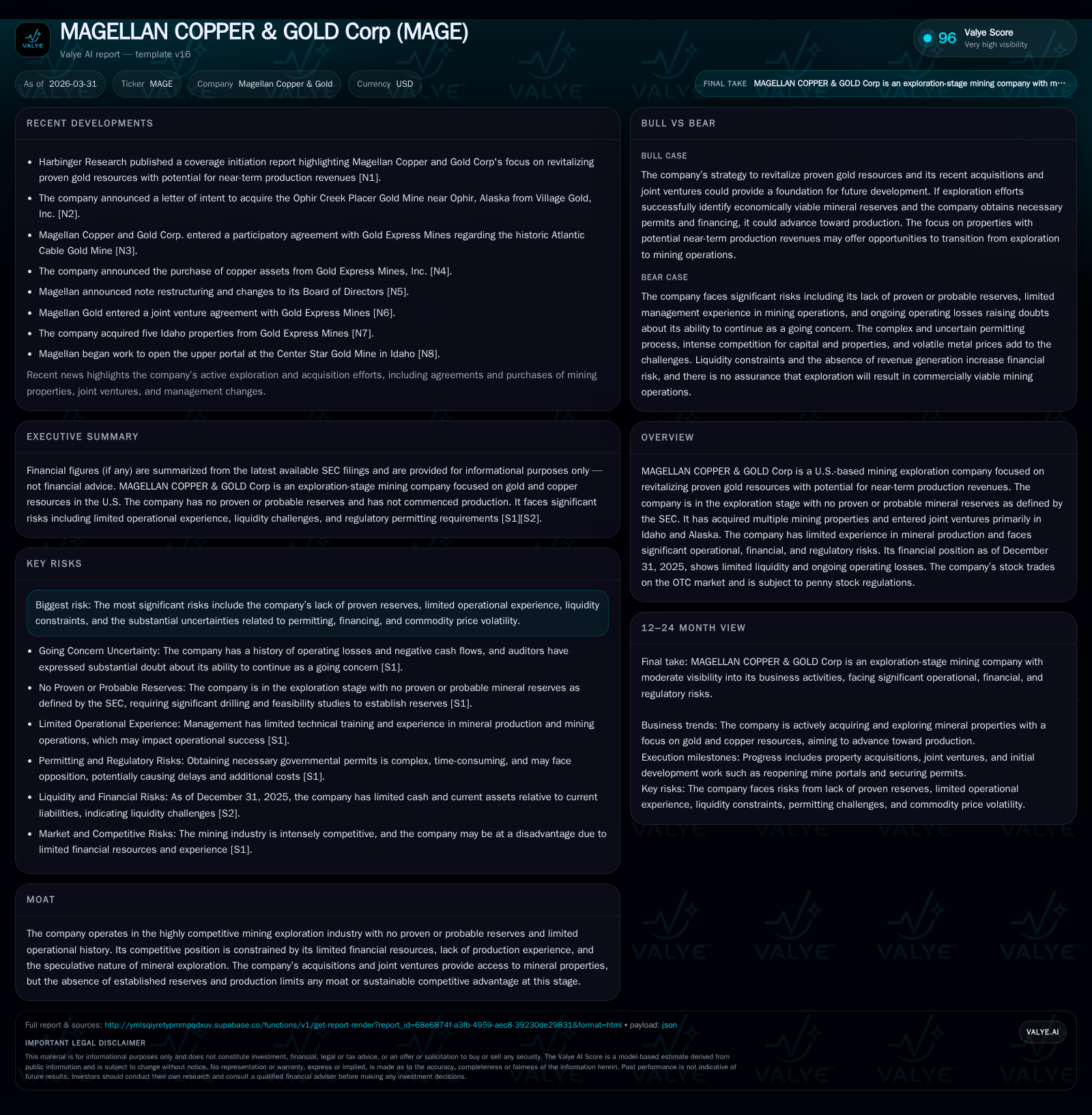
MAGELLAN COPPER & GOLD Corp operates without proven or probable mineral reserves, focusing on revitalizing gold resources in Idaho and Alaska. Despite a modest improvement in operating losses in 2025, the company continues to face significant negative cash flows and a severely constrained liquidity position. Its growth prospects hinge on successful exploration outcomes, regulatory permitting progress, and securing additional financing, all against a backdrop of limited operational experience and intense regulatory scrutiny. Investors should monitor upcoming milestones such as drilling results and permit acquisitions, noting the heightened risks from OTC penny stock trading and capital deficits.
From Operating Losses to Exploratory Ambitions: Historical Performance Review
MAGELLAN COPPER & GOLD Corp’s financial history underscores the difficulties typical of a mineral exploration entity with no producing assets. From fiscal year (FY) 2022 through FY2025, the company registered consecutive operating losses. However, it achieved a significant improvement in FY2025 when operating losses narrowed to approximately $0.28 million from a loss exceeding $0.74 million in FY2024—reflecting a 62.1% year-over-year reduction [F1]. Net income similarly improved but remained negative at about $0.43 million in 2025 versus nearly $0.77 million in 2024.
Operating cash flow remained negative throughout this period, though the outflow dropped sharply by about 74% in FY2025 relative to FY2024, registering a negative $37 thousand [F1]. Capital expenditures data is sparse post-2019 but historically limited ($15,760 in CY2018) underscores investment restraint tied to scarce liquidity. Equity has deteriorated progressively into negative territory, reaching approximately -$2.09 million at end-2025, reflecting accumulated losses outweighing contributed capital.
Historical performance (annual)
| FY | Net ($) | CFO ($) | OpInc ($) | Net YoY |
|---|---|---|---|---|
| 2025 | -432025 | -36959 | -281548 | +43.9% |
| 2024 | -769810 | -142703 | -742503 | +47.4% |
| 2023 | -1464036 | -70543 | -1424336 | +6.1% |
| 2022 | -1559929 | -148254 | -1280383 |
Source: SEC companyfacts cache [F1].
Capital returns and efficiency (annual)
| FY | ROE% |
|---|---|
| 2025 | 20.6 |
| 2024 | 40.9 |
| 2023 | 86.9 |
| 2022 | 104.1 |
Source: SEC companyfacts cache [F1].
Despite narrowing losses in the latest fiscal year examined and modest cash flow improvements, MAGELLAN remains fundamentally constrained by its low scale and persistent cash burn.
Evaluating MAGE’s Mineral Property Acquisitions and Joint Venture Strategy
MAGELLAN’s strategy revolves around acquiring mining claims with potential gold resources primarily in Idaho and expanding into Alaska. A recent disclosure dated January 30, 2026 detailed intentions to pursue mining claims in Alaska that could enhance the company's asset base [N1][S3]. However, none of these properties currently host proven or probable reserves as defined by the SEC’s stringent requirements for reserve classification [S1][S26]. Achieving such status necessitates extensive exploratory drilling demonstrating mineral continuity sufficient for feasibility studies establishing economic extractability.
Thus far MAGELLAN remains firmly at the exploration stage—submitting to work commitments stipulated under claim agreements but yet without material confirmations via feasibility study data. This places the firm among many junior explorers seeking to revitalize historically known deposits yet fraught with high uncertainty regarding commercial viability.
Financial Liquidity and Capital Structure Risks Constraining Growth
A critical concern lies within MAGELLAN’s balance sheet health where current assets stand at roughly $10 thousand against approximately $2.1 million of current liabilities as of December 31, 2025 [F1]. This implies a near-zero current ratio signaling acute liquidity risk that could impede meeting short-term obligations absent capital infusion or operational turnaround [S22]. The company's negative equity position at more than $2 million deepens financial vulnerability.
Shares trade on the OTC market under penny stock regulations due to sub-$5 pricing levels [S5][S10], restricting market participation through mandatory broker disclosures and suitability requirements which typically depress trading volume and price stability. The illiquid market creates heightened volatility risk for investors attempting secondary sales.
Prospects for Near-Term Production Revenue: Geology Meets Feasibility Challenges
While management targets "near-term production revenues" by revitalizing known resources [N1], this objective remains speculative without demonstration of economic ore reserves supported by feasibility studies mandated by SEC guidelines [S1][S26].
Mining projects require substantial expenditures for extensive drilling campaigns focused on delineating mineral continuity followed by comprehensive metallurgical testing tailored to ore grade characteristics and recovery methods [S8][S24]. Moreover regulatory permitting on federal lands involves complex environmental impact analyses across air quality, water discharge rights, wetland conservation statutes, dam safety for tailings storage facilities as well as compliance with endangered species protections; all likely extending project timelines [S6][S18].
Given these conditions combined with volatile metals pricing that can undermine project economics unexpectedly [S23], actual production commencement—and meaningful revenue generation—could extend several years beyond initial exploration success.
Operational Hurdles: Management Experience and Environmental Regulatory Risks
Management acknowledges limited technical expertise related to mining operations including exploration execution or mine development nuances which elevates operational execution risk considerably [S1]. Industry-standard practices such as site-specific feasibility studies—which integrate geological modeling with engineering design—require skilled leadership to navigate complexities effectively.
Additionally, increasing emphasis on environmental social governance (ESG) factors translates into rising compliance costs with evolving federal and state regulations emphasizing pollution control measures including land reclamation obligations post-mine closure which can be financially onerous especially if unforeseen contamination arises [S6][S7][S18]. Mining waste streams increasingly face hazardous designation threats under EPA rules further complicating site management budgets.
Capital Allocation Priorities: No Dividends or Buybacks Amid Cash Burn
Reflecting ongoing operating deficits and constrained financial resources MAGELLAN has neither declared nor paid dividends historically nor does it anticipate initiating any dividends going forward—the strategy hinges on retaining earnings fully for operational sustaining capital supporting exploration programs [F1][S5][S13].
Return metrics such as Return on Equity (ROE) appear nominally positive mathematically due to deeply negative equity denominators but fail to reflect profitable operations meaningfully [F1]. Capital allocation choices prioritize drilling expenditures tied directly to resource delineation efforts while eschewing shareholder distributions until sustainable positive cash flow materializes.
Critical Upcoming Milestones and Market Liquidity Considerations for Investors
Investors should closely monitor catalyst events including permit acquisitions essential for continuing drill programs as well as emerging assay results that might justify advancing towards feasibility stages or joint venture expansions potentially unlocking value increments [N1][S29]. These are balanced against prolonged timing uncertainties inherent to regulatory reviews compounded by an illiquid trading venue hampered by penny stock rules limiting market access for retail participants [S10].
Therefore even material positive operational news may not translate quickly into share price appreciation absent broader market recognition and institutional investor engagement.
The Competitive and Regulatory Environment in U.S. Mining Exploration
Within the intensely competitive U.S. mining exploration sector MAGELLAN confronts competition from better-capitalized entities possessing advanced technical capabilities capable of acquiring producing operations or superior prospects more rapidly [S4][S28].
Federal land policies impose rigorous environmental scrutiny including compliance with statutes like CERCLA (Superfund), Clean Water Act (CWA), National Historic Preservation Act (NHPA), alongside endangered species legislations—all driven by an increasingly stringent ESG framework leading regulators towards higher standards of enforcement impacting smaller players disproportionately due to limited resources dedicated to managing complex permitting obligations and potential environmental liabilities uninsured through conventional means [S9][S11][S12][S18][S19].
Furthermore legal title uncertainties arising from incomplete claim surveys introduce project delays when conflicting ownership or native land interests surface complicating tenure confidence necessary for financing arrangements [S9].
This analysis synthesizes publicly available filings and disclosures reflecting MAGELLAN COPPER & GOLD Corp's current status as an exploratory entity navigating typical early-stage mining risks compounded by financial liquidity challenges. The company remains fundamentally dependent on successful exploration advancements supported by adequate financing while contending with operational hurdles presented by regulatory frameworks and limited managerial mining experience.
Readers are reminded that this report is not investment advice but an informational overview based solely on reported facts as of March 31, 2026.

Comments