
Lexeo Therapeutics Harnesses Non-Viral RNA Tech to Revolutionize Cardiac Gene Therapy
Lexeo Therapeutics advances cardiology-focused gene therapies using a proprietary non-viral RNA platform, supported by strategic partnerships and substantial capital raises.
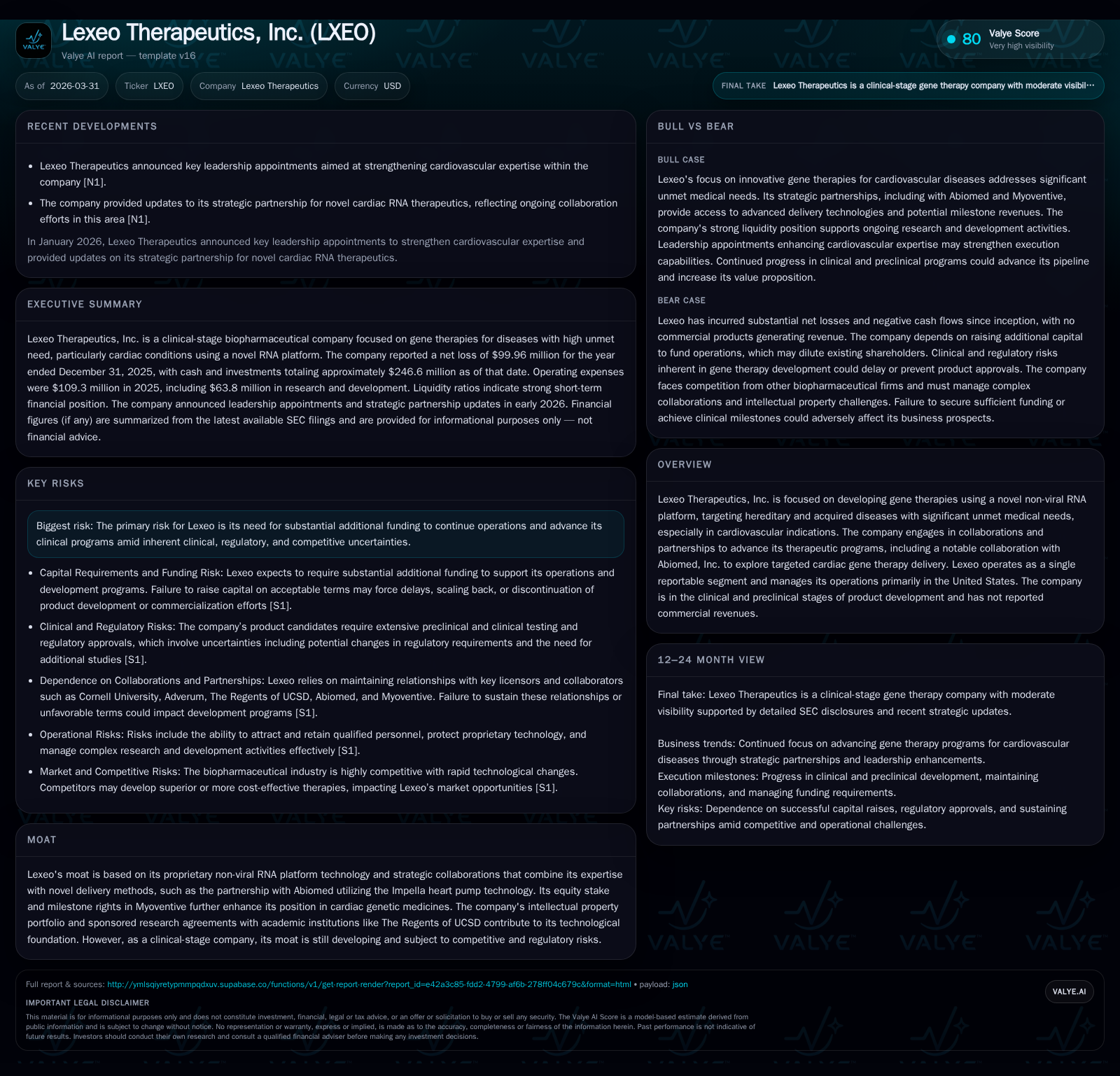
Lexeo Therapeutics is fostering innovation in cardiac gene therapy through its novel non-viral RNA delivery platform and collaboration with Abiomed leveraging the Impella heart pump for targeted gene delivery. While the company operates with significant operating losses and negative cash flows characteristic of clinical-stage biotech, it has fortified its balance sheet via multiple sizeable equity raises, enabling continued R&D investments. Key near-term milestones hinge on clinical progress and regulatory outcomes amid a competitive landscape and ongoing legal risk resolution.
Innovative Origins: Lexeo’s Proprietary Non-Viral RNA Platform
Lexeo Therapeutics places its technological moat squarely around a cutting-edge non-viral RNA platform designed to overcome inherent limitations of viral vector-based gene therapies. Unlike traditional viral vectors that may provoke immunogenicity or present payload size constraints, Lexeo's approach leverages engineered RNA constructs delivered via non-viral mechanisms, theoretically improving safety profiles and repeat dosing capabilities — critical for chronic cardiac conditions where precision and minimal off-target effects are paramount. The partnership with academic institutions like The Regents of UCSD and licensing agreements such as the one with Adverum Biotechnologies underpin this platform with valuable intellectual property and technical know-how beyond core internal capabilities.
Further bolstering this foundation is the strategic collaboration with Abiomed which integrates Impella heart pump technology within Lexeo’s delivery strategy. This synergy exploits mechanical circulatory support devices to enhance localized gene delivery directly into cardiac tissue, demonstrating sector-native sophistication in marrying device and gene therapy modalities for targeted intervention. This intersection of device-enabled precision delivery with a versatile RNA platform positions Lexeo distinctively within cardiovascular genetics medicine.
Historical Financial Performance: Navigating Losses Amid R&D Expansion
From FY2023 through FY2025, Lexeo has exhibited an intensifying loss profile typical of early-stage biotechs scaling clinical operations. Operating income declined from -$68.5 million in 2023 to -$109.3 million in 2025 — a nearly 60% increase in operating losses over two years, albeit the latest year’s loss growth moderated to a 3.3% increase relative to 2024 [F1]. Net income followed a parallel trajectory, reaching -$99.96 million in FY2025, slightly worse than the -$98.33 million loss two years prior.
Operating cash flow (CFO) worsened significantly by approximately 21.5% from -$81.15 million in FY2024 to -$98.56 million in FY2025 [F1], reflecting expanded cash demands associated with advancing pipeline candidates through costly preclinical and early clinical stages. Notably, capex remained modest relative to overall spend at $397K, down from $481K in FY2024, highlighting that R&D rather than capital asset buildout drives cash burn [F1][S7][S9].
Historical performance (annual)
| FY | Net ($mm) | CFO ($mm) | OpInc ($mm) | Capex ($) | Net YoY |
|---|---|---|---|---|---|
| 2025 | -100 | -99 | -109 | 397000 | -1.7% |
| 2024 | -98 | -81 | -106 | 481000 | -48.1% |
| 2023 | -66 | -59 | -69 | 115000 |
Source: SEC companyfacts cache [F1].
Capital returns and efficiency (annual)
| FY | Buybacks ($) | FCF ($mm) | ROE% |
|---|---|---|---|
| 2025 | 17000 | -99 | -40.5 |
| 2024 | 17000 | -82 | -84.2 |
| 2023 | -60 | -58.5 |
Source: SEC companyfacts cache [F1].
Capital Structure Evolution: Financing Growth Through Private Placements and Equity Issuance
Lexeo’s operational model relies heavily on periodic equity infusions to fuel its research programs absent commercial revenues. The March 2024 Private Placement brought net proceeds near $89 million after ~$6.3 million in fees [S4], establishing foundational runway into late 2024.
In 2025, two major financings deepened liquidity substantially: the May 2025 Private Placement generated net proceeds around $73 million while an October financing delivered approximately $144 million net after commissions—a combined injection exceeding $217 million in the year [S1][S4]. As a result, Lexeo’s aggregate cash, cash equivalents, and U.S. Treasury securities climbed by nearly $28 million over 2024 levels despite intensifying operational outflows [F1][S1].
An at-the-market (ATM) equity program was authorized in Q1 2025 but remained unused through year-end, indicating Lexeo’s preference so far for larger lump-sum private placements over ongoing issuance at market prices [S4]. Concurrently, share count expanded dramatically from ~33M issued shares at end-2024 to over 73M at end-2025 reflecting dilution linked to these capital raises [F1][S10][S21].
Strategic Partnerships Accelerate Cardiac Gene Therapy Programs
Central to Lexeo’s developmental thrust is its partnership with Abiomed focusing on integrating the Impella heart pump technology as a vector-delivery adjunct allowing precise transcatheter intracardiac administration of genetic payloads. This device-enabled approach facilitates controlled infusion pressures and localization deep within myocardial tissues—a crucial innovation addressing common hurdles of systemic vector spillover or inefficient uptake prevalent in cardiac gene therapy attempts.
This partnership exemplifies translational synergy between engineered medical devices supporting therapeutic delivery platforms—a promising clinical development vector that blends patient care engineering sophistication with molecular therapy advancement. Such strategy should improve dose control, reduce immune reactions linked to systemic exposure, and potentially shorten timelines required for dose escalation studies.
Clinical Pipeline Outlook: Development Milestones and Regulatory Headwinds
Lexeo remains firmly within preclinical and early clinical stages without reported commercial revenue streams yet. Its lead candidates address genetic etiologies within cardiovascular disease space—areas characterized by high unmet medical need yet stringent regulatory scrutiny given cardiac safety concerns.
Management outlines expectations contingent on successful progression through preclinical models into rigorously regulated human trials with periodic milestones pertaining to FDA or other agency approvals for IND-enabling studies along with interim data readouts manacled by trial design complexities inherent to gene therapies—particularly those employing novel delivery systems like non-viral RNA vectors combined with mechanical pumps [S1][S12].
Regulatory paths may demand ancillary studies; thus timing remains fluid dependent on iterative feedback loops from regulators potentially requiring expansion of toxicology datasets or novel immunogenicity assessments unique for this modality.
Operating Leverage in a Clinical-Stage Biotechnology Enterprise
The company’s operating leverage assessment reveals rising personnel-related R&D headcount costs alongside facility overhead expenses partially attributable to lease accounting under ASC 842 that mandates capitalization of right-of-use assets on balance sheets [S7][S9][S16].
Total property & equipment net grew moderately to approximately $1.14 million at year-end 2025 versus $1.03 million prior year chiefly driven by lab equipment purchases that remain marginal relative to overall burn indicating limited heavy asset intensity but necessary scientific infrastructure enhancement supporting advanced R&D throughput [F1][S9][S22].
Lease liabilities—both operating and finance—remain low yet are recognized on the balance sheet reflecting modern GAAP treatment shifting expenses from pure operating line items towards financing presentations marginally affecting EBITDA approximations but providing greater transparency about contractual expenditure commitments embedded in laboratory real estate arrangements [S7][S9].
Capital Allocation Philosophy and Shareholder Returns
Given its clinical-stage status devoid of revenues or profits or positive operating cash flow metrics below zero since inception, capital allocation focuses entirely on sustaining pipeline advancement vs shareholder distributions.
No dividends have been declared or paid throughout reported fiscal years; share repurchases are nominal — roughly $17K spent back on common stock via treasury actions exclusively tied to early exercised stock options during periods ending December 31, 2024 only—with zero repurchase activity noted through end 2025 underscoring absent buyback intentions given capital preservation imperatives [F1][S4].
Stock-based compensation expense consistently registers near double-digit millions annually illustrating use of equity incentives central to talent retention within competitive biotech labor markets—standard practice where cash incentives alone insufficient to attract expertise required for specialized gene therapy development programs [S16][F1]. Equity raised has led to substantial dilution yet built a robust equity base above $246 million by December-end 2025 supporting long-term operational runway [F1].
Risk Landscape: Funding Needs, Litigation Resolution, and Competitive Pressures
Risk disclosures underscore ongoing necessity for substantial external funding flanked by uncertainties surrounding developmental success rates inherent across pioneering therapeutics field encompassing gene therapies utilizing nascent delivery platforms like mRNA/non-viral constructs subject to evolving regulatory frameworks globally [S6][S18].
A noteworthy legal dispute initiated by Rocket Pharmaceuticals alleging misappropriation of trade secrets involving former employees was resolved amicably without admission of liability mid-2025 eliminating immediate legal distractions but confirming IP contestation risks not uncommon among innovator biotech companies competing over similar modality territories [S6][S15].
Competition remains fierce from established viral vector players expanding into non-viral areas as well as new entrants exploiting other nucleic acid types or editing technologies placing premium on speed-to-data milestones alongside strategic alliance formation ability facilitating access to complementary technologies like Abiomed's device partnership.
Key Metrics Recap: Operating Income, Cash Flows & ROE Trends
| Year | Operating Income (USD) | Net Income (USD) | Operating Cash Flow (USD) | Capex (USD) |
|---|---|---|---|---|
| 2025 | -109,257,000 | -99,961,000 | -98,561,000 | 397,000 |
| 2024 | -105,766,000 | -98,333,000 | -81,151,000 | 481,000 |
| 2023 | -68,513,000 | -66,394,000 | -59,496,000 | 115,000 |
Based on latest fiscal data,[F1] Lexeo’s financials portray a path consistent with most clinical-stage biotech enterprises where accelerating exploration phases demand increasing operating losses coupled with deteriorating cash flows due largely to expanded trial activity offset partially by commensurate equity raises inflating shareholder equity balances which dilute earnings metrics leading currently into negative ~40% ROE territory derived from annualized losses divided by current equity base.
Disclaimer: This analysis is based solely on information provided by official SEC filings and credible sources cited herein up to March 31, 2026. It does not constitute investment advice or recommendations regarding Lexeo Therapeutics’ securities or products but aims to objectively summarize financial trends and company strategies relevant within the biotechnology sector context.
Disclaimer: This is research-only, informational analysis and not investment advice. It may include AI-generated interpretation and general industry context. Always verify important details using primary sources.

Comments