
Pyrophyte Acquisition Corp. II’s Structural Dilution and Execution Risks Define Its Value Trajectory
As a SPAC focusing on energy sector targets, Pyrophyte Acquisition has raised $175 million but faces inherent dilution and governance challenges.
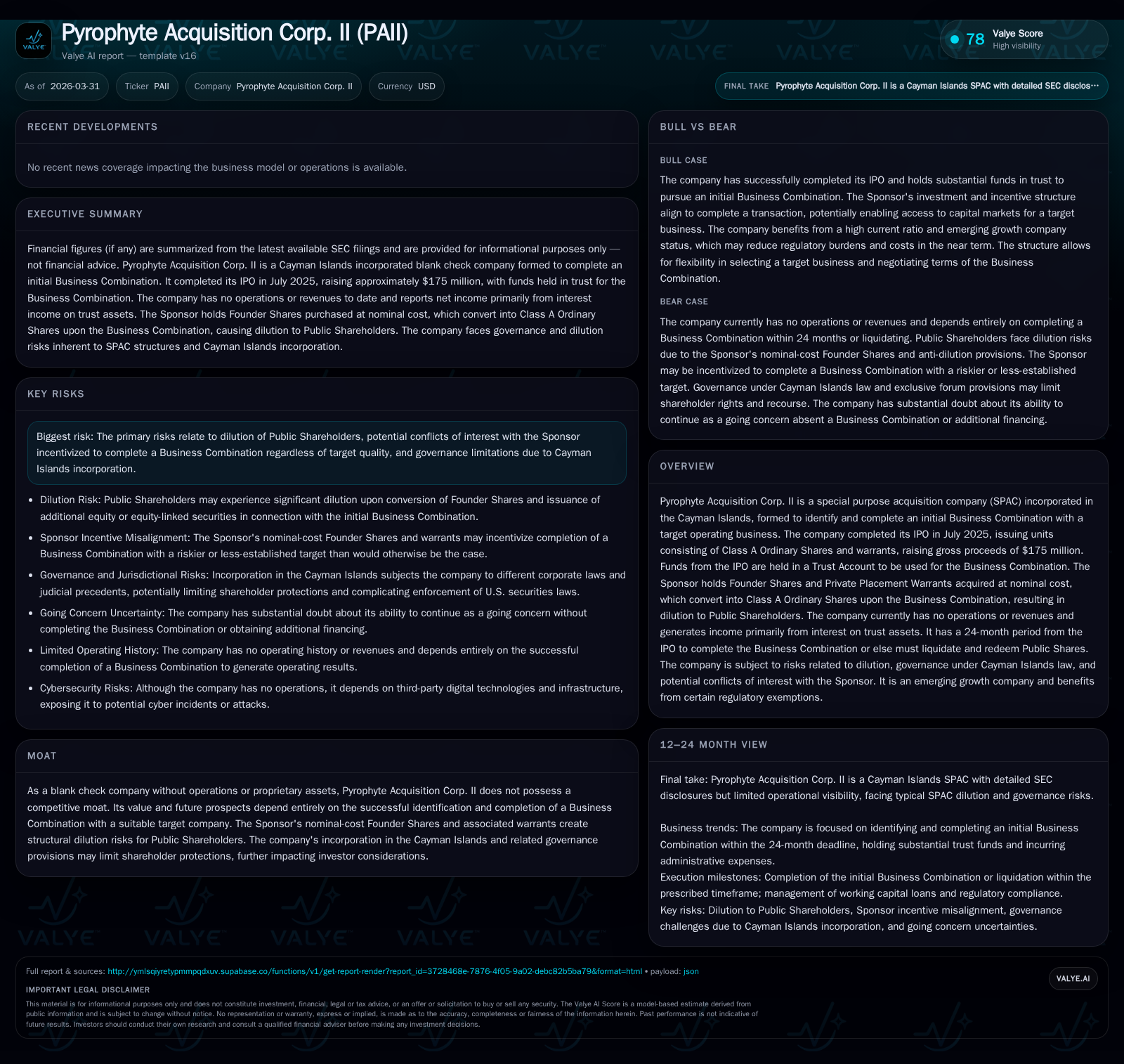
Pyrophyte Acquisition Corp. II (PAII), a Cayman Islands-incorporated blank check company, completed its IPO in July 2025 raising $175 million to pursue a business combination primarily in the critical minerals and energy supply chain sectors. The company currently lacks operating revenues, generating income from interest on trust assets, and faces a tight 24-month deadline to complete a deal or liquidate. Structural dilution risks imposed by founder shares and associated warrants held by the Sponsor loom over public shareholders’ interests. The Cayman jurisdiction limits shareholder protections, compounding governance concerns. With no announced target or explicit transaction guidance, investors must monitor asset deployment timing and deal terms carefully to assess value creation potential.
Company Background and Formation
Pyrophyte Acquisition Corp. II (PAII) was incorporated on May 1, 2025 as a Cayman Islands exempted company formed specifically as a special purpose acquisition company (SPAC). Its mandate is to effect an initial Business Combination encompassing mergers, share exchanges, asset acquisitions or similar transactions with one or more operational businesses primarily within the energy sector [S1].
The Cayman Islands incorporation subjects PAII to governance frameworks that differ materially from typical U.S.-incorporated entities, creating weaker minority shareholder protections relative to domestic SPACs [S9].
IPO Details and Capital Structure
In July 2025, PAII completed its IPO issuing units consisting of one Class A Ordinary Share and one-half warrant at $10 per unit. The offering raised gross proceeds of approximately $175 million from 17.5 million units plus an additional partial over-allotment exercise generating roughly $25 million more [S4][S19]. Concurrently, the Sponsor purchased 5,050,000 Private Placement Warrants for about $5 million in gross proceeds [S4].
Net proceeds after underwriting fees totaling approximately $12.8 million were placed into a U.S.-based Trust Account invested exclusively in U.S. government securities pending consummation of the Business Combination or liquidation event [S4][S8]. This Trust Account ensures capital preservation for public shareholders until transaction completion or dissolution.
The Sponsor received approximately 7.2 million Founder Shares classified as Class B ordinary shares for a nominal aggregate price of $25,000 ($0.003 per share). These Founder Shares convert one-for-one into Class A Ordinary Shares immediately prior to or following the Business Combination [S1][S11][S13].
This disparity between nominal Sponsor share cost versus public purchase price at IPO creates structural dilution pressure for public shareholders upon conversion [S1][S18], a common but notable feature of SPACs.
Financial Performance Since Inception
PAII has not commenced operations beyond organizational activities related to the IPO and target search process; thus it generates no operating revenue [S16].
For its first fiscal year ended December 31, 2025, earnings derived solely from interest income on cash equivalents held in trust reached approximately $3.6 million while general and administrative expenses totaled about $628 thousand resulting in net income near $3 million for the period [F1].
Liquidity metrics show current assets of approximately $744 thousand against current liabilities under $64 thousand as of year-end 2025 yielding a robust current ratio around 11.64x indicative of minimal near-term obligations outside the Trust Account [F1].
Historical performance (annual)
| FY |
|---|
| 2025 |
Source: SEC companyfacts cache [F1].
Note: Revenues are zero due to absence of operations; net income reflects interest income offset by administrative expenses.
Business Combination Strategy and Industry Focus
PAII aims to acquire companies within the energy ecosystem focused on critical minerals/materials supply, equipment manufacturing, or technologies supporting both traditional fossil fuel and renewable energy segments [S1].
This strategic focus aligns with structural growth trends around sustainable energy transitions combined with ongoing demand for foundational energy infrastructure inputs.
Despite this sector emphasis, PAII has not publicly disclosed any prospective targets nor initiated substantive discussions as of its latest disclosures reflecting an early stage search phase [S1].
Risks Arising from Capital Structure and Market Dynamics
Structural dilution represents a material risk for public investors since Founder Shares acquired at nominal cost translate into roughly 26.5% of pro forma fully diluted equity post-transaction conversion [S13][S18]. This dilutes public shareholder value causing implied per-share values to drop from the IPO price of $10 down near about $7.01 after combination under illustrative assumptions provided by management [S13]. This shift transfers economic benefit disproportionately toward Sponsors.
Additionally, Cayman Islands incorporation reduces customary U.S.-style shareholder protections such as proxy voting rigor or redemption rights linked directly with deal approval processes potentially constraining minority investor influence over transaction terms or target selection [S9].
Sponsor incentives—holding significant Founder Shares plus warrants—may encourage deal closure within the strict two-year window ending July 2027 regardless of valuation quality given liquidation risks otherwise looming [S8]. This dynamic elevates execution risk potentially leading to suboptimal deals detrimental to public shareholders.
Broader macroeconomic uncertainties including geopolitical tensions present general market risks though not uniquely impacting PAII’s timeline or strategy .
Capital Allocation and Liquidity Considerations
Beyond funds secured in the Trust Account earmarked for Business Combination or redemptions (approximately $191 million net after underwriting fees), PAII maintains working capital outside the Trust Account used for due diligence costs, legal fees, travel related to target evaluation and other organizational expenses currently reflected by cash balances near $442 thousand as of year-end 2025 [F1][S3][S16].
Management can access unsecured non-interest bearing promissory notes and working capital loans up to $1.5 million from Sponsor or affiliates intended solely for pre-deal operational liquidity; none were drawn through December 31, 2025 [S6][S16].
No dividends or share repurchases have been declared or executed reflecting absence of operating cash flow generation typical for SPACs prior to completing their initial Business Combination [S7][S10][S13][S15].
Milestones to Monitor Going Forward
Key developments shaping investor outlook include:
- Identification and announcement of credible acquisition target(s) aligned with stated sector focus,
- Timing and structure of shareholder votes or tender offers mindful of Cayman governance nuances,
- Potential Sponsor buy-ins or additional financing arrangements,
- Deal structure announcements clarifying dilution impact,
- Market reception evidenced via share price movements post-announcement,
- Utilization status of Private Placement Warrants issued at IPO,
- Any amendments extending mandated transaction deadlines,
- Emergence of litigation or governance disputes related to sponsor conflicts remain absent but warrant monitoring. These indicators will illuminate PAII’s ability to consummate accretive transactions within regulatory timeframes while managing dilution risks effectively.
Summary: Value Drivers and Constraints
PAII’s intrinsic value derives principally from successful execution on locating high-quality targets within its energy sector thesis capable of delivering valuations exceeding transaction costs plus dilution effects inherently embedded via Founder Shares economics.
Principal constraints include:
- Structural dilution reducing implied per-share values by nearly 30% absent redemptions;
- Governance limitations due to offshore incorporation weakening minority protections;
- Sponsor incentives potentially prioritizing deal closure over quality;
- Lack of operating history limiting financial visibility;
- External market conditions influencing valuation multiples available. In essence, PAII functions primarily as an option on management’s execution capability within energy transition themes but carries significant downside risk stemming from embedded ownership asymmetries.
This analysis synthesizes information solely from Pyrophyte Acquisition Corp. II’s latest SEC filings through March 31, 2026 including Form 10-K dated March 30, 2026 ([F1], [S1]–[S28]) without extrapolating beyond disclosed data points. Readers should consider this context when evaluating PAII’s business model and capital structure complexities alongside future prospects contingent on successful Business Combination execution.
Disclaimer: This is research-only, informational analysis and not investment advice. It may include AI-generated interpretation and general industry context. Always verify important details using primary sources.

Comments