
AgEagle Aerial Systems' Full-Stack UAV Strategy Confronts Profitability and Growth Headwinds
The company combines fixed-wing drones, sensors, and software but faces persistent operating losses amid product shifts and regulatory milestones.
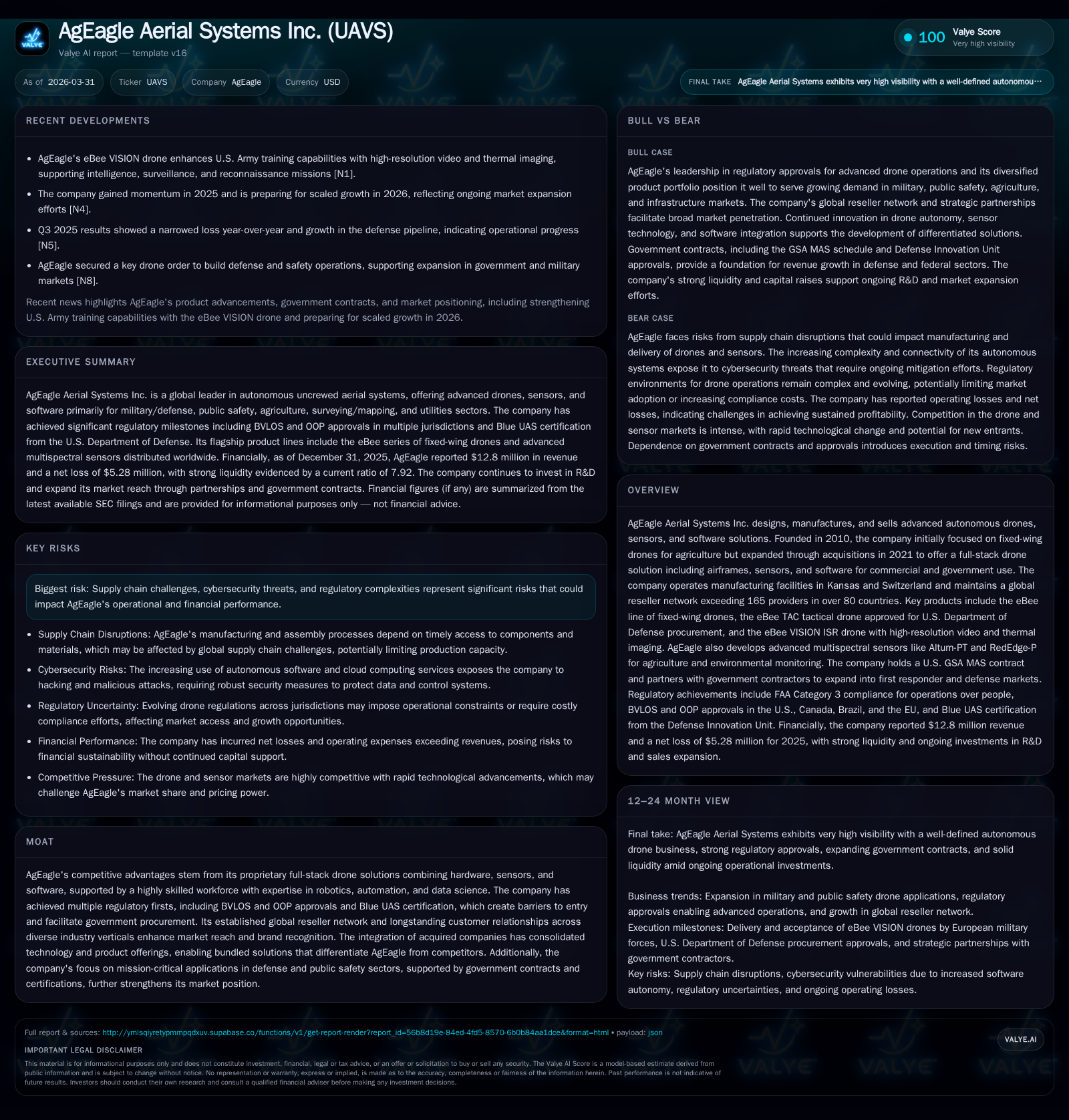
AgEagle Aerial Systems Inc. has evolved from an agriculture-focused fixed-wing drone maker to a global provider of integrated unmanned aerial systems (UAS), combining hardware, sensors, and software for commercial and military markets. While revenues saw modest declines in 2025 after several years of growth, operating losses narrowed but remain substantial. The firm benefits from unique regulatory certifications enabling beyond visual line of sight (BVLOS) operations and strong government contracts. Growth depends on further adoption of its bundled solutions across agriculture, defense, infrastructure, and public safety sectors yet is tempered by supply chain and cybersecurity challenges. Capital expenditure remains low as the company invests selectively in product development and manufacturing enhancements.
Company Evolution and Product Focus
Founded in 2010 with a primary focus on fixed-wing drones for agriculture applications, AgEagle Aerial Systems Inc. has strategically transformed its business model into a full-stack unmanned aerial system provider offering proprietary flight hardware, advanced sensor technology including multispectral cameras (e.g., Altum-PT and RedEdge-P), embedded software platforms for autonomous flight management, and data analytics tools serving multiple industries.
Key acquisitions completed in 2021 integrated complementary businesses producing UAS airframes, sensors, and software into one cohesive portfolio supporting both commercial enterprises and government agencies globally [S1][S23]. The company rebranded as EagleNXT in 2025 to reflect this broadened mission.
Historical Financial Performance
AgEagle's revenue grew from approximately $1.3 million in FY2020 to nearly $13.4 million by FY2024 before declining slightly to about $12.8 million in FY2025 [F1]. The decline was mainly due to softness in the sensor segment caused by staffing challenges and delays in marketing new sensor versions [S10].
Despite revenue growth through 2024, operating results were challenged by elevated expenses leading to large net losses; FY2024 net loss exceeded $35 million partly due to goodwill impairments related to the sensor reporting unit [F1][S10]. Improvement followed with net loss narrowing to roughly $5.3 million in 2025 driven by cost controls, renegotiated reseller agreements that limited discounts thereby boosting gross margins above 50%, and reduced R&D expenses after ceasing certain business lines [F1][S10]. However, operating income remained negative around -$14.7 million due to ongoing structural costs.
Historical performance (annual)
| FY | Rev ($mm) | Net ($mm) | CFO ($mm) | OpInc ($mm) | Rev YoY | Net YoY |
|---|---|---|---|---|---|---|
| 2025 | -5 | -10 | -15 | +84.9% | ||
| 2024 | 13 | -35 | -7 | -13 | -2.5% | +17.4% |
| 2023 | 14 | -42 | -11 | -39 | ||
| 2021 | 10 | -30 | -12 | -30 | +659.4% |
Source: SEC companyfacts cache [F1].
Capital returns and efficiency (annual)
| FY | FCF ($mm) | ROE% |
|---|---|---|
| 2025 | -10 | -14.8 |
| 2024 | -7 | 610.3 |
| 2023 | -11 | -396.6 |
| 2021 | -13 | -39.3 |
Source: SEC companyfacts cache [F1].
Data source: SEC filings [F1]
Competitive Positioning
AgEagle's competitive advantage stems from its integrated solution approach—bundling airframes with proprietary sensors and data analytics software—rather than standalone drone hardware alone [S23][S26]. This enables turnkey autonomous flight solutions tailored for applications including agriculture monitoring, infrastructure inspection, defense surveillance, public safety missions such as first responders, surveying/mapping tasks, and utilities/engineering projects.
Technological capabilities include robotics autonomy; advanced multispectral imaging sensors enhanced with proprietary spectral bands for vegetation and water analysis; embedded secure wireless networks; lightweight composite airframes optimized for fixed-wing efficiency; plus human-machine interfaces simplifying complex data interpretation [S1][S16][S22].
Pioneering regulatory achievements further strengthen the moat: eBee series drones hold C2 and C6 class designations facilitating Beyond Visual Line of Sight (BVLOS) and Operations Over People (OOP) compliant with FAA regulations in the US and EASA certifications across Europe [S4][S8][S17]. These clearances open markets previously restricted by safety or regulatory hurdles.
Strategic government contracts include a five-year Multiple Award Schedule (MAS) contract via the U.S. General Services Administration (GSA), easing federal procurement processes, complemented by Blue UAS certification from the U.S Department of Defense's Defense Innovation Unit for tactical drone models like eBee TAC [S12][S20][N1]. The global reseller network exceeding 165 partners across over eighty countries enhances distribution reach.
Growth Drivers and Challenges
Growth prospects rely on expanding penetration within defense/government sectors modernizing towards autonomous aerial surveillance supported by GSA contract wins alongside commercial uptake enabled by regulatory clearances allowing broader operational scope [N1][S6][S20]. New sensor technologies such as RedEdge-P dual camera solutions introducing innovative coastal blue bands enhance differentiation [S22]. Cross-selling bundled hardware-plus-software suites through resellers can also drive incremental revenues.
Challenges include supply chain disruptions affecting component availability; cybersecurity risks as interconnected drones become targets requiring robust defenses; fragmented international regulations imposing compliance burdens potentially slowing deployments; plus impairment charges reflecting slower sensor sales highlight execution risks amid restructuring efforts focused on core segments [S1][S10][S23].
Financial Outlook & Milestones
While explicit formal guidance is not provided in available materials, key indicators include:
- Expansion of government contracts usage including new military or civil agency orders leveraging eBee TAC drones;
- Uptake among reseller networks post-integration;
- Headquarters relocation to Texas planned for 2026 aiming at operational efficiencies [S13][S24];
- Software platform enhancements underpinning potential recurring revenue streams;
- Regulatory developments extending BVLOS/OOP permissions or new certification classes reshaping accessible markets;
- Cybersecurity initiatives safeguarding against threats targeting drone control systems.
Growth depends on execution across multi-industry adoption combined with sustained innovation.
Capital Allocation & Returns Analysis
Capital expenditures remain modest at under $75k for FY2025 reflecting selective investments rather than capacity expansion [F1][S10]. Operating cash flows continue negative near -$10 million due to ongoing operating losses despite cost rationalizations reducing general administrative expenses alongside R&D spending falling about nine percent year-over-year following divestitures [F1][S10].
No dividends have been declared consistent with reinvestment focus amid unprofitability since going public.
Equity totaled approximately $35.7 million at year-end 2025 after recovering from prior negative equity levels indicating successful capital raises supporting liquidity without impairing solvency or operational continuity [F1][S11]. Approximate return on equity remains negative around -15% given continuing net losses though showing improvement versus earlier periods.
Industry Contextual Analysis
The commercial drone industry increasingly values integrated ecosystem players offering complete sensing-to-insight pipelines suitable for complex missions spanning energy infrastructure inspections requiring high-resolution imaging with real-time analytics or rapid-deployment ISR missions supporting tactical defense needs.
Fixed-wing designs like eBee series gain preference over multi-rotors due to longer endurance advantages important when covering large geospatial areas such as agricultural fields or pipeline corridors—segments where AgEagle historically roots lie yet now expanded across diversified demanding applications benefiting from regulatory-certified products mitigating legacy barriers common elsewhere.
End-users demand solutions minimizing operational complexity while maximizing actionable intelligence delivered via cloud-enabled platforms emphasizing ease-of-use with AI-driven analytics—areas aligned with AgEagle's internal R&D focus combined with acquired expertise spanning avionics engineering through data science.
Risks Highlighted by Management
Key risks include supply chain interruptions potentially delaying order fulfillment; cybersecurity threats targeting autonomous vehicle command-and-control links requiring continual defensive advances; evolving regulations imposing compliance burdens or restricting operational envelopes especially internationally where harmonization lags; economic uncertainties impacting customer budgets notably within government procurement cycles sensitive to federal appropriations shifts affecting contract timing reliability [S1].
Litigation risks exist but are managed with professional liability insurance coverage though management warns of uninsured exposures that could negatively impact operations if unfavorable outcomes arise .
Conclusion
AgEagle Aerial Systems positions itself as a comprehensive UAV solution provider combining hardware innovation with next-generation sensing technologies supported by certified software platforms targeting diverse verticals aligned with fast-evolving market needs where autonomy paired with regulated deployment capability create entry barriers.
Despite promising foundations underpinned by hard-won regulatory clearances and strategic government engagements serving as potential growth levers, financial results reflect early-stage scaling typical among tech-centric aerospace firms transitioning beyond niche footholds toward broader viability.
Execution on expanding government contract market share alongside revitalizing sensor sales post-restructuring will be key indicators of improving operational leverage over coming years.
This analysis is based solely on information available through SEC filings up to March 31, 2026 ([F1],[S#]), verified news accounts ([N#]), without speculative projections or investment recommendations.
Disclaimer: This is research-only, informational analysis and not investment advice. It may include AI-generated interpretation and general industry context. Always verify important details using primary sources.

Comments