
Bitfarms Ltd: From Bitcoin Mining Legacy to High-Performance Computing Infrastructure Leader
Bitfarms is transitioning from its established Bitcoin Mining business to focus on developing HPC and AI data center infrastructure leveraging exclusive power assets in constrained North American markets.
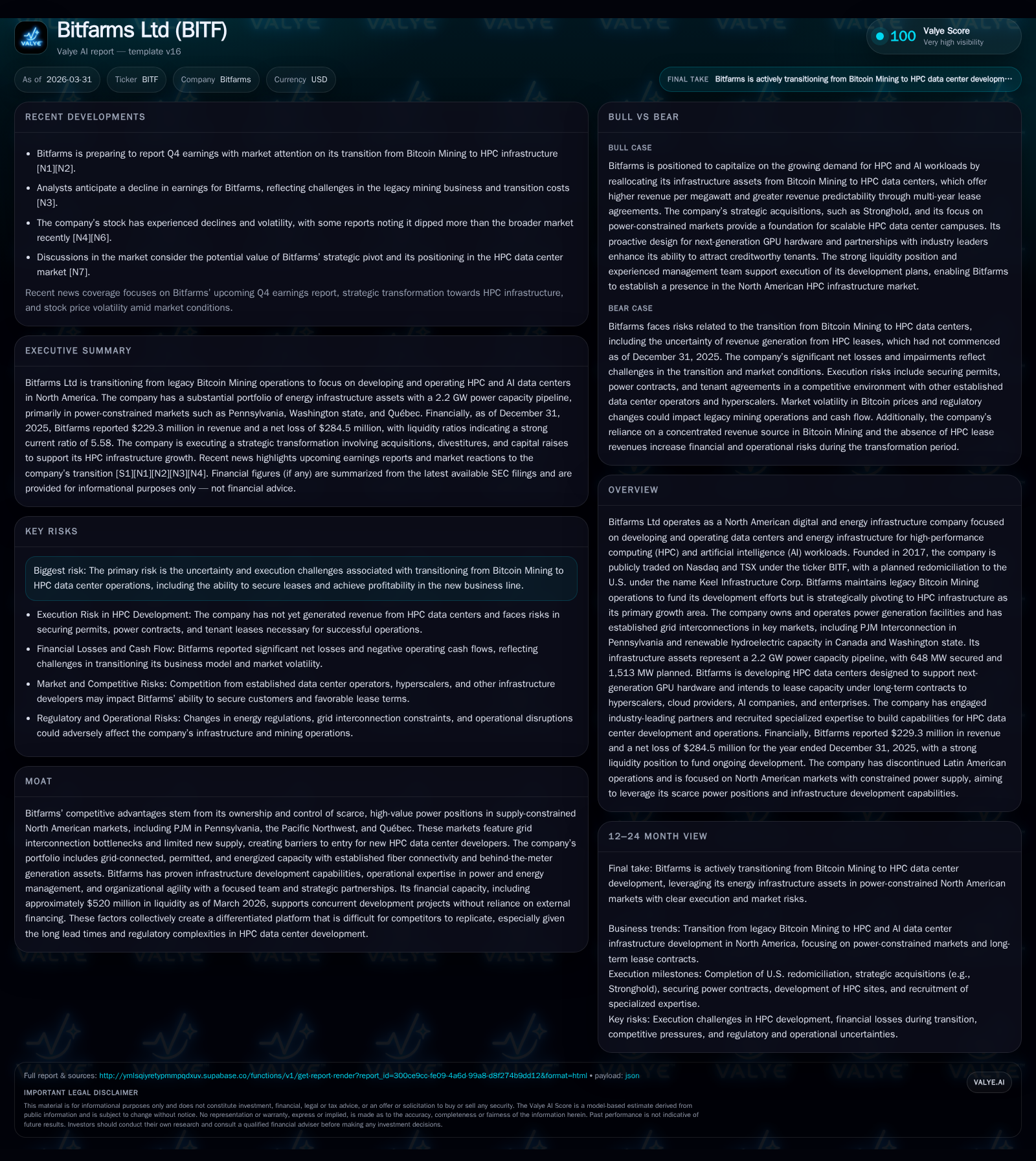
Bitfarms Ltd has evolved from a primarily Bitcoin mining operator into an emerging developer of high-performance computing (HPC) and AI data centers, capitalizing on its ownership of scarce grid-connected power assets across key regions such as PJM Interconnection and Québec. Historically, its legacy Bitcoin Mining business generated modest growth in BTC output but suffered margin pressure due to halving events and energy costs, resulting in sustained operating losses. The company’s transition involves redeploying infrastructure for HPC workloads with expected initial revenues by 2027, supported by strong liquidity including $520 million on hand and a $588 million convertible note issuance in late 2025. Execution risk remains elevated given the challenges of market acceptance and operational shift, while financial returns have been negative during the reinvestment phase.
Historical Performance: Bitcoin Mining Output and Operational Efficiency Trends
Bitfarms’ legacy revenue foundation lies firmly in Bitcoin Mining operations headquartered mainly in North America. Over the three-year span ending FY2025, the company reported a significant ramp in revenues from $120.4 million in 2023 to $229.3 million in 2025—an impressive compound growth driven by incremental increases in total BTC mined despite industry-wide challenges [F1]. Specifically, Bitfarms increased total Bitcoin earned to approximately 2,008 BTC in 2025 versus 1,992 BTC in the prior year—a marginal increase of 1% [S1]. However, this occurred alongside substantial headwinds: the April 2024 Bitcoin halving event cut block rewards from 6.25 to 3.125 BTC per block mined, effectively compressing yield per unit of computational effort.
This dynamic forced Bitfarms to expand computing capacity aggressively just to maintain flat output amid rising network difficulty and competition. Simultaneously, energy costs per kWh rose slightly to $0.049 in FY25 from $0.047 previously [S1], partly offsetting gains from deploying newer ASIC miner models like Bitmain S21 XP and Pro units which improved power efficiency metrics: Average watts per terahash dropped from about 36 (2023) down to ~18 (2025), showing a trend of capital investment towards more energy-efficient fleets. However, overall operating results suffered; operating income declined into a loss of -$149.6 million for FY2025 while net losses ballooned to -$284.5 million as capital expenditures and blockchain mining economics pressured margins significantly [F1]. This negative earnings outcome corresponds with an approximate -51% return on equity illustrating the stress inherent within legacy Bitcoin Mining during the recent period of network adjustments and crypto market volatility.
Historical performance (annual)
| FY |
|---|
| 2025 |
Source: SEC companyfacts cache [F1].
The above table summarizes annual revenue growth juxtaposed against mounting operating losses dramaticized by intensifying expenditure demands [F1].
Strategic Transition: Phasing Out Mining, Building HPC & AI Data Centers
Recognizing margin pressures and volatility inherent in cryptocurrency mining compounded by regulatory uncertainty and supply chain bottlenecks for ASIC miners and digital asset hardware, Bitfarms has articulated a strategic pivot positioning high-performance computing infrastructure at the core of its growth model [S1,N2]. The company leverages its extensive owned power generation portfolio to build scalable HPC data centers designed specifically for AI workloads targeting hyperscalers, cloud service providers, and AI-centric enterprises.
As prescribed in corporate disclosures, this nascent segment lacks historical revenue—expected initial services commencement is projected for fiscal year 2027 with long-term contracted leases foreseen as a path toward stabilized cash flow profiles superior to the intermittent Bitcoin mining fee structures under Full Pay Per Share (FPPS) arrangements currently utilized [N2,S1]. Transitioning presents immediate execution hurdles including securing tenant contracts amid competitive pressures where larger incumbents or new entrants compete fiercely for limited capacity access.
Moreover, redeployment involves shifting physical infrastructure usage from ASIC miners dedicated solely to cryptographic hashing toward state-of-the-art networking convergence gear adept at supporting latency-sensitive HPC tasks—requiring expensive upgrades and robust project management capabilities.
Power Assets in Supply-Constrained Markets: A Structural Competitive Advantage
Bitfarms’ core moat derives largely from ownership or control over grid-limited power resources strategically located across constrained North American electricity markets characterized by grid interconnection bottlenecks—namely PJM Interconnection serving Pennsylvania and adjacent states; hydroelectric plants situated in Québec; plus renewable facilities within Washington state’s Pacific Northwest corridor [S17]. This portfolio constitutes roughly a projected pipeline totaling approximately 2.2 gigawatts (GW) of power capacity—of which about 648 megawatts (MW) are currently secured through permits or contracts fostering development certainty.
Owning behind-the-meter generation assets allows Bitfarms considerable insulation against wholesale market price volatility that otherwise plagues data center operators depending purely on open grid supplies vulnerable to congestion pricing during peak loads typical of major metropolitan hubs. Likewise, fiber optic connectivity co-located within these sites enhances value proposition for large-scale HPC tenants demanding ultra-low latency connections necessary for AI model training regimes or high-throughput computational workflows.
Such infrastructural depth constructs formidable barriers to entry for competitors lacking comparable control over critical land parcels with grid access rights—a nodal scarcity intensified by regulatory permitting delays and community opposition frequently encountered when siting new power plants or substations.
Capital Structure and Liquidity: Funding Growth While Managing Legacy Commitments
Capital robustness constitutes a fundamental enabler amid Bitfarms’ transformation journey. The company closed FY2025 with liquidity approximating $520 million inclusive of cash reserves supported by proceeds from a significant $588 million convertible senior notes issuance completed October 2025 alongside capped calls designed prudently to mitigate potential common stock dilution risk upon conversion events [S4,S5,S6]. Concurrently, Bitfarms eliminated reliance on the Macquarie credit facility by fully repaying this project-level debt early February 2026 illustrating disciplined deleveraging within new constraints imposed by its growing financing mix.
Its current ratio stands at an enviable ~5.58 indicative of substantial short-term solvency capacity at period end December 31st, pointing toward solid working capital management despite aggressive capex outlays related primarily to developmental initiatives supporting HPC infrastructure rollout [F1]. The successful execution of a Normal Course Issuer Bid (NCIB), resulting in repurchase of approximately 7.8 million common shares during FY25 at an average price ~ $1.27 further indicates Board’s proactivity addressing shareholder interests while balancing funding requirements [S9,S10].
Financial Returns, Cash Flows, and Capital Allocation Overview
Financial metrics continue to reflect transitional realities confronting Bitfarms during these expansionary phases with net losses reaching -$284.5 million as reported for FY25 alongside operating losses near -$149.6 million evidencing negative EBITDA proximity given impairment or depreciation expenses inherent within asset-heavy industries like mining and data centers alike [F1]. Free cash flow burned approximately $327 million underscoring heavy reinvestment emphasis as Capex requirements surged amid development push into HPC operations deprioritizing immediate profitability shifts.
Return on equity lagged markedly at roughly negative –51% signaling that shareholders have yet to realize value accretion commensurate with invested capital amidst ongoing losses compounded by write-down risks inherent during reconfiguration periods. The absence of dividend payments aligns logically with capital conservation priorities dictated by continued project finance needs without jeopardizing liquidity buffers [S9,S10].
This reallocation toward fixed asset investments portends future potential stabilizations once leasing revenues materialize from HPC clientele exhibiting longer contract tenures compared to volatile coin rewards experienced historically under FPPS mining pools.
Key Risks: Execution Challenges, Market Acceptance, and Regulatory Factors
The company explicitly identifies several critical risk domains tied intricately with its business combination shift including legal-regulatory overheads heightened by cross-border U.S.-Canada regulatory complexities especially concurrent with impending U.S redomiciliation slated April 2026 [[S15],[S22]]. Execution uncertainty stems heavily from challenges associated with securing profitable lease agreements for HPC data center space within stringent timelines relative to planned commissioning dates coupled with inherent technology obsolescence risks faced when adopting next-generation HPC hardware amidst tight global supply conditions.
Moreover regulatory scrutiny intensifies around cryptocurrency mining environmental impacts albeit subsiding somewhat owing to increasing renewable reinforcement yet remains an area necessitating careful navigation given evolving governmental policies potentially influencing operational cost structures adversely.
Litigation exposure linked historically to restatement events injects additional volatility into near-term valuation dynamics necessitating continuous monitoring [[S15],[S21]]. Investors should consider that each incremental step towards establishing reliable contracted cash flows under the HPC model carries latent default risks particularly given nascent customer segments exposed themselves to macroeconomic downturns disrupting payment hierarchies leading eventually possibly into bankruptcy proceedings complicating rent collection efficacy [[S23]].
What Investors Should Monitor Next: Milestones and Forward Outlook
Looking forward through mid-2026 into early-stage operational phases encompassing Keel Infrastructure Corp.’s formal registration completion anticipated around April’s opening days represents a key corporate milestone marking structural shift continuity poised for Nasdaq ticker symbol migration from BITF likely enhancing U.S market visibility [[N2],[S2]]. Subsequent quarters warrant close observation on announcements relating specifically to initial HPC lease signings expected earliest runs commencing calendar year-end cycle FY27.
Quarterly earnings releases scheduled post-quarterly closes provide critical transparency windows capturing cash flow trends during ongoing capital deployment periods offering real-time data regarding effectiveness navigating transitional risks described earlier [[N1],[N3]]. Given continued reliance upon legacy Bitcoin Mining generating interim funding streams until full redeployment concludes there exists palpable risk surrounding sustainability if crypto price cycles reignite downward pressure suddenly disrupting treasury inflows somewhat unpredictably [[N3]].
In summary, Bitfarms Ltd stands at an inflection point bridging pioneering digital asset operations toward emergent infrastructure provisioning tailored explicitly toward computationally intensive AI workloads centralizing around rare grid-accessible assets locked within supply-demand constrained regional grids across North America — all whilst backed up robustly by deep pockets enabling simultaneous project development without excessive external financing dependence but still contending with formidable execution complexity inherent throughout such evolutionary transformations.
This report is prepared solely for informational purposes reflecting publicly available data as of March-April 2026 without recommendation regarding any securities mentioned herein.
Disclaimer: This is research-only, informational analysis and not investment advice. It may include AI-generated interpretation and general industry context. Always verify important details using primary sources.

Comments