
Gold Fields Ltd: Financial Resilience and ESG-Linked Capital Structure in Transition
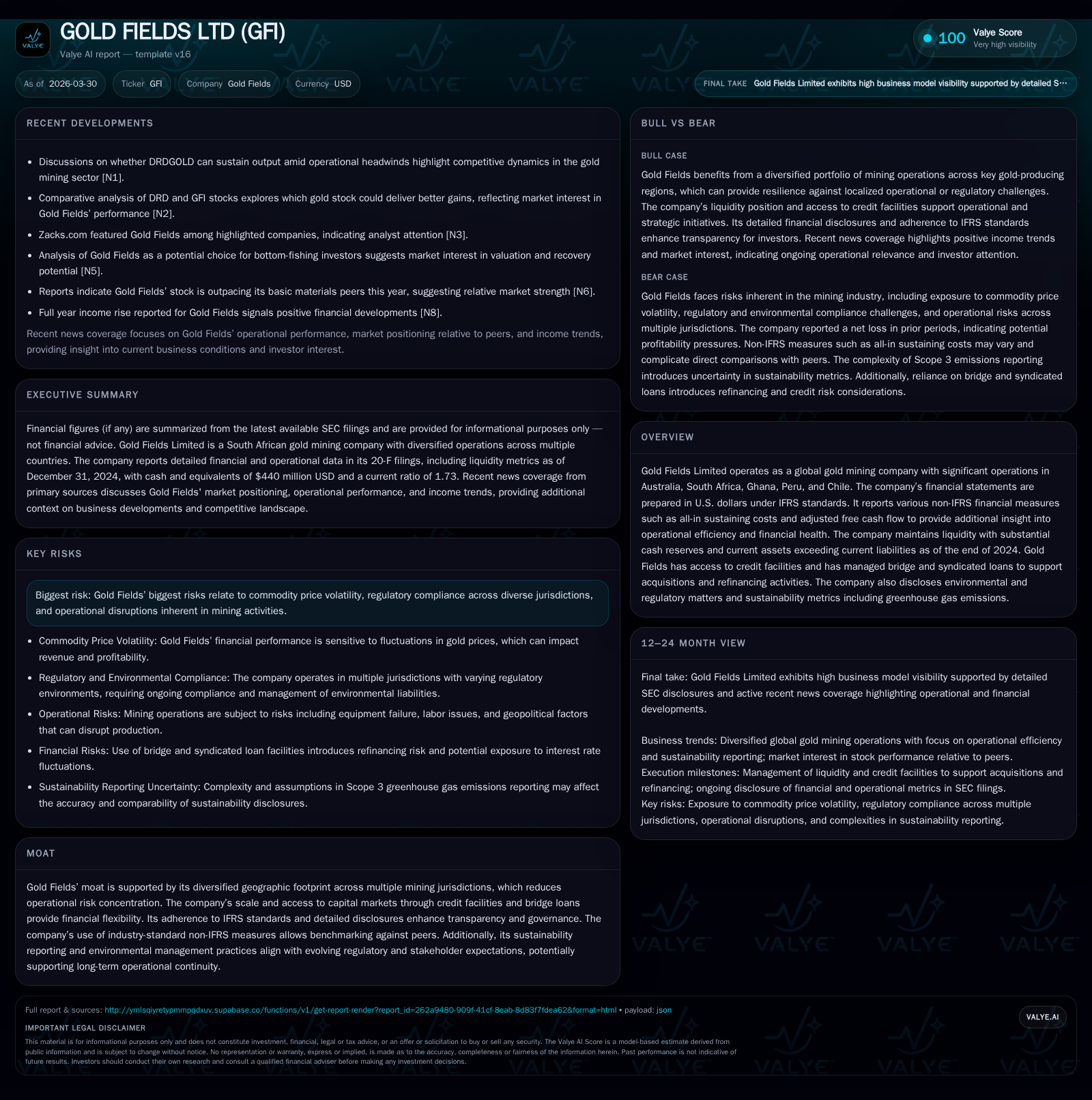
Gold Fields demonstrates robust revenue growth alongside evolving ESG-linked financing while contending with operational and regulatory challenges.
Gold Fields Ltd achieved a notable 15.6% revenue increase to $5.2 billion in fiscal 2024, reflecting the strength of its diversified mining portfolio across key jurisdictions. Despite this top-line expansion, net income remains challenged by legacy operational complexities and elevated costs, resulting in a negative return on equity of approximately -13.5%. The company's pivot toward sustainability-linked credit facilities—anchored in ESG-driven KPIs such as gender diversity and CO2 reduction—marks a significant evolution in its capital structure aimed at balancing growth with environmental and social governance commitments. Moving forward, Gold Fields faces regulatory headwinds across multiple jurisdictions, including South Africa’s MPRDA compliance and pending legislative reforms in Ghana, alongside ongoing contingent liabilities from health-related settlements. Capital allocation remains disciplined with dividend increases supplemented by special payouts and share buybacks, though cash flow generation is tempered by substantial sustaining and non-sustaining capital expenditures focused on mine life extension.
Historic Revenue Gains and Margin Evolution Through 2024
Gold Fields Ltd displayed significant top-line momentum in fiscal year 2024, posting revenue of $5.2 billion—a 15.6% increase over the prior year’s $4.5 billion level [F1]. This growth stems largely from operational contributions across its diversified footprint spanning Australia, South Africa, Ghana, Peru, and Chile, which mitigates country-specific risks intrinsic to the mining sector [S1]. The company’s adherence to International Financial Reporting Standards (IFRS) ensures transparent financial disclosures.
Operating income figures have historically demonstrated volatility reflective of fluctuating commodity prices and operational complexities inherent within long cycle mining projects. While precise operating income data for recent years beyond mid-2010 is not available in the latest snapshot [F1], management disclosed ongoing focus on managing all-in sustaining costs (AISC)—a non-IFRS measure widely used within gold mining—as a key lever for margin control [S18]. These cost metrics enable benchmarking against peers amid challenging input cost environments.
Net income performance has been uneven; historical losses—such as a reported net loss of $345 million in 2015—highlight earnings sensitivity to external factors like metal price swings and operational disruptions [F1]. This volatility continues to put pressure on profitability despite robust revenue trends.
Historical performance (annual)
| FY | Rev ($bn) | Rev YoY |
|---|---|---|
| 2024 | 5.2 | +15.6% |
| 2023 | 4.5 | +5.0% |
| 2022 | 4.3 | +2.2% |
| 2021 | 4.2 |
Source: SEC companyfacts cache [F1].
Note: Annual revenue figures drawn from IFRS-compliant filings; 'N/A' indicates unavailable consistent operating income or CFO data for these recent years.
Analyzing Cash Flow Generation and Investment in Mine Life Extension
Operating cash flow (CFO) witnessed a decline of approximately 22% year-over-year as reported for comparable periods [F1], attributed partly to elevated working capital demands amid strategic expansion efforts. Capital expenditures around $435 million focused on both sustaining capital to support current operations and significant non-sustaining investments connected with the Windfall project acquisition finalized in late 2024 [S18][S5].
This capital-intensive approach reflects the mining sector's characteristic need for long-term mine development funding alongside optimisation of asset lifecycles. Operational leverage is double-edged: while new projects offer future production upside, they also constrain free cash flow (FCF) generation near term due to upfront outlays.
Estimated adjusted free cash flow remains positive but modest at about $145 million after capex deductions from operating cash flows reported in recent annual statements [F1]. Maintaining balanced investment discipline will be critical as Gold Fields integrates acquired assets.
The Pivot to Sustainability-Linked Financing: A Credit Structure Overview
In May 2023, Gold Fields established a $1.2 billion revolving credit facility maturing initially over five years with two optional one-year extensions—the facility uniquely tied to key sustainability performance indicators (KPIs) related to gender diversity, water re-use/recycling targets, and Scope 1 & 2 greenhouse gas (GHG) emission reductions through renewable energy adoption [S4][S5].
Under this framework, Gold Fields benefits from interest rate margin reductions upon achieving stipulated ESG milestones but faces premium margins if KPIs are missed—an innovative blend of financial strategy and corporate social responsibility seldom seen at this scale within the mining industry.
Parallel sustainability-linked facilities include an Australian dollar syndicated facility totaling A$500 million aligned with similar ESG goals [S7]. These measures signal institutional acknowledgement that environmental stewardship directly influences borrowing costs and long-term viability.
Credit agreements are guaranteed by Gold Fields Limited alongside several subsidiaries encompassing operational entities including newly acquired Windfall assets, underscoring consolidated risk management across jurisdictions [S4].
Navigating Regulatory Complexities Amid Diverse Geographies
Gold Fields operates under complex legal frameworks subject to multiple regulatory regimes including:
- South Africa's Mineral and Petroleum Resources Development Act (MPRDA): Mining rights require ministerial approval with stringent compliance on environmental authorisations and Social Labour Plans mandating employment equity initiatives, workforce training, improved living conditions, and local economic development commitments—all reviewed periodically by the Department of Mineral Resources and Energy (DMRE) [S9].
- Silicosis/Tuberculosis Class Action Settlement: The company’s provision for related claims stands at approximately U.S.$5.7 million while actual payouts exceed R2.5 billion (~US$150 million), exposing ongoing litigation risk despite actuarial estimates underpinning provisions [S9].
- Ghana Legislative Reforms: Proposed amendments threaten existing Development Agreements’ renewability post-April 2027 with potential reductions in mineral right tenures from 30 to potentially as low as five years for stability periods. Increased government participation via free carried interests may dilute economic stakes [S20]. Litigation concerning parliamentary ratification of mining leases remains unresolved adding uncertainty.
- Environmental Compliance: Across all operations stringent oversight governs emissions monitoring under national statutes; Gold Fields reports comprehensive Scope 1 & 2 GHG emissions data internally aligned with leading frameworks despite sector challenges quantifying Scope 3 supply chain emissions comprehensively [S18].
These multi-jurisdictional regulatory demands necessitate robust compliance structures integrated with forward-looking risk mitigation.
Expected Milestones and Market Sentiment Into 2026
Explicit forward guidance remains cautious without detailed published forecasts; however:
- Recent CEO commentary highlights strategic focus on integrating acquired assets while maintaining operational stability [N6][N7][S1].
- Project commissioning timelines tied particularly to the Windfall initiative offer discrete catalysts for production growth realization within mid-term horizons.
- Commodity price sensitivities continue to impact short-term revenue expectations given gold market volatility highlighted in analyst discussions emphasizing Gold Fields’ momentum stock profile despite prevailing cyclical headwinds [N3][N8].
Investors are advised to monitor quarterly results updates along with regulatory developments particularly out of Ghana which may materially influence asset valuations.
Capital Allocation Focus: Dividends, Buybacks, and Return on Equity Challenges
Gold Fields declared a final dividend for fiscal year ending December 2025 amounting to approximately 1,850 South African cents per ordinary share plus special dividends totaling roughly U.S.$253 million alongside a $100 million share repurchase program executed early in calendar year 2026 reflecting proactive shareholder returns amid prudent balance sheet management [S16][F1].
Historically dividends experienced some decline post-2014 lows but recent increases denote confidence amidst improved liquidity profiles supported by current ratios near 1.73 stemming from surplus current assets over liabilities as per latest filings [F1][S8].
Despite revenue advances, negative ROE approximated at -13.5% evidences persistent net income pressures likely reflecting commodity price fluctuations and legacy operational costs challenging profitability stabilization [F1]. Cash flow generation remains positive yet constrained given continued investment in sustaining operations supporting future mine life extensions.
Debt refinancing completed via bridge loan repayments substituted by longer tenor notes including $750 million due in 2032 assures financing flexibility while preserving investment-grade credit ratings integral for access to global capital markets [S10][S12].
Sustainability Metrics and ESG Risk Management Impacting Operations
Gold Fields rigorously tracks GHG emissions predominantly focusing on Scope 1 & Scope 2 consistent with IFRS requirements supplemented by voluntary disclosures on Scope 3 associated upstream supply chain impacts—reflecting growing sector-wide emphasis on climate-related risks embedded within operational continuity metrics [S18].
Environmental governance also intertwines with legacy health compensation provisions stemming from Silicosis and Tuberculosis litigations signifying material contingent liability exposure which could influence capital expenditure prioritisation moving forward [S9].
The company’s sustainability-linked debt instruments explicitly embed environmental targets into financial terms indicating forward integration between ESG performance outcomes and cost of capital components—a structural innovation signaling potential broader adoption among miners grappling with regulatory scrutiny and stakeholder demands for transparency.
Disclaimer: This analysis is based exclusively on officially disclosed information from Gold Fields Ltd's SEC filings ([F1],[S#]), integrated annual reports (), news releases ([N#]), and publicly available documents as of March 30, 2026. No projections or investment recommendations are made herein.
Disclaimer: This is research-only, informational analysis and not investment advice. It may include AI-generated interpretation and general industry context. Always verify important details using primary sources.

Comments