
Steele Bancorp Inc's Post-Merger Trajectory: Assessing Growth and Profitability
An analysis of Steele Bancorp’s financial and operational metrics after its 2025 merger, with focus on its growth drivers, capital management, and competitive position in Pennsylvania.
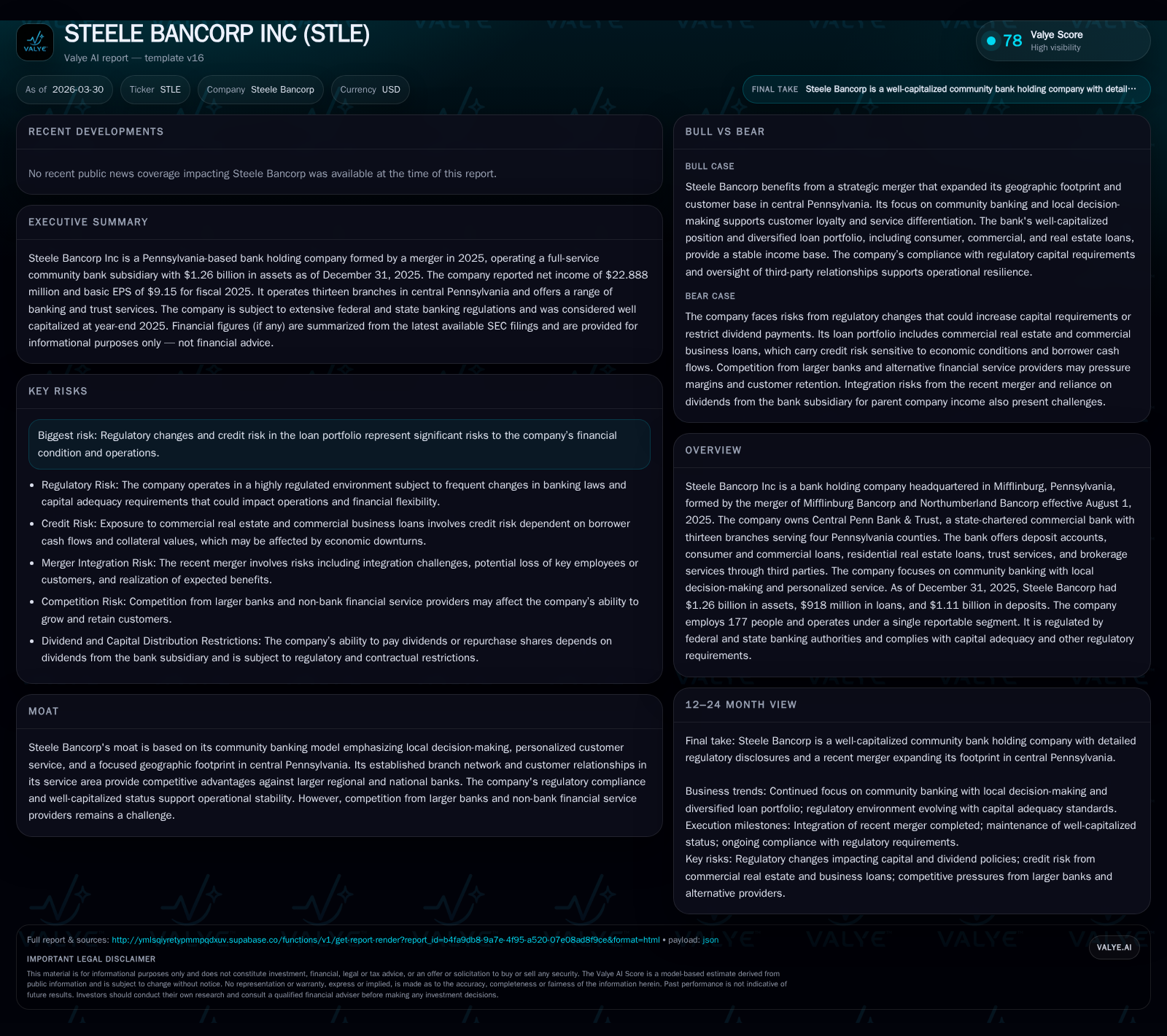
Steele Bancorp Inc emerged in 2025 from the merger of Mifflinburg Bancorp and Northumberland Bancorp, combining their assets and market footprints to operate as Central Penn Bank & Trust with thirteen branches across four counties in Pennsylvania. The company reported $1.26 billion in assets and $918 million in loans as of year-end 2025, achieving a robust return on equity near 19.3%. Its community banking model emphasizes local decision-making and personalized service, creating a niche defensible against larger regional competitors despite ongoing industry pressures. Regulatory compliance, credit risk, and the integration of merger operations remain critical focal points for the company’s trajectory. Future growth depends on successful leveraging of its expanded footprint while managing regulatory constraints and competition.
Merger Completion and Its Immediate Impact on Business Scale
On August 1, 2025, Mifflinburg Bancorp merged with Northumberland Bancorp to form Steele Bancorp Inc, marking a strategic consolidation within central Pennsylvania’s community banking space [S1][S4]. This merger amalgamated the two institutions’ branch networks into a cohesive platform operating under the name Central Penn Bank & Trust with thirteen branches spanning Union, Snyder, Northumberland, and Centre counties. The transaction consideration totaled approximately $40.45 million, consisting primarily of newly issued common shares valued at $26 per share alongside cash payments covering fractional shares and dissenter rights [S1]. This integration fundamentally redefined Steele Bancorp’s scale – total assets reached $1.26 billion by December 31, 2025, with gross loans nearing $918 million and deposits exceeding $1.11 billion [S4].
The merger consolidated not only financial resources but also operational infrastructure; combining employees (177 headcount) and aligning product offerings under one state-chartered entity streamlined decision-making locally while expanding service reach [S4]. From a regulatory standpoint, the unified entity complies fully with capital adequacy requirements imposed by federal and state authorities [S4], setting the stage for measured growth leveraging the combined footprint.
Historical Financial Performance: Growth and Profitability Trends Post-Merger
Steele Bancorp’s maiden full year as a combined entity reveals healthy profitability metrics driven by integration synergies and operational effectiveness. Net income for the year ending December 31, 2025 amounted to approximately $22.9 million [F1], delivering an impressive return on equity around 19.3% when viewed against stockholders’ equity of $118.4 million reported at year-end [F1][S4]. This elevated ROE signals strong earnings generation relative to invested capital despite the challenges typical to community banks navigating post-merger adjustments.
Free cash flow—defined here as cash flows from operations minus capital expenditures—totaled about $13.07 million in fiscal 2025 [F1], reflecting steady cash conversion from earnings before discretionary spending. Operating cash flow robustness supports liquidity flexibility crucial for local lending activity.
Historical performance (annual)
| FY |
|---|
| 2025 |
Source: SEC companyfacts cache [F1].
Note: Year-over-year comparison metrics omitted due to one-year post-merger data availability.
Loan Portfolio Dynamics and Asset Composition
Following the merger, Steele Bancorp’s balance sheet centers around its loan portfolio totaling about $918 million as of late 2025 [S4]. This aggregate comprises consumer loans, commercial business lending, and residential real estate loans that together reflect core community banking credit exposures.
A defining metric for such institutions is the loan-to-deposit ratio — here approximately 82.6% ($918M loans / $1.11B deposits) — indicative of prudent liquidity management balancing asset growth against deposit funding stability [S4]. Community banks like Steele typically maintain lower ratios versus larger peers to cushion against localized economic shocks.
Credit risk concentration within commercial real estate (CRE) loans warrants careful monitoring given their sensitivity to borrower cash flows and collateral valuations tied to property performance [S19][S25]. These risks are mitigated through underwriting discipline emphasizing borrower quality over collateral alone as well as conservative internal lending limits below statutory maximums (15% of bank capital per borrower) [S16]. Additionally, residential real estate loans anchor portfolio stability through household mortgage demand in these four Pennsylvania counties.
Community Banking Focus Amid Competitive Pressures
Steele Bancorp's moat is rooted firmly in its community banking ethos emphasizing "local decision-making" and "personalized customer service" [S6][S5]. Such an approach aligns well with servicing individuals, families, nonprofits, and especially small- to medium-sized businesses that dominate its geographic footprint.
The bank’s carefully selected branch locations facilitate close client relationships enabling swift credit decisions attuned to regional economic nuances absent at larger national or regional banks [S6]. However, this localized focus confronts competitive headwinds including marketing campaigns from larger institutions endowed with greater technological resources and scale advantages.
Fintech entrants applying technology-first models also pressurize traditional deposit-taking through innovative digital platforms offering convenience often unattainable by smaller players with brick-and-mortar bases [S6][S10]. Balancing these challenges requires continued investment in banking innovations without diluting personalized services that define Steele's brand identity.
Regulatory Environment and Risk Factors Impacting Operations
Operating within an extensively regulated banking framework imposes significant compliance demands on Steele Bancorp consistent with federal/state mandates [S1][S5][S10][S13]. Capital adequacy remains paramount—the bank meets Basel III-aligned standards with well-capitalized status supported by regulatory buffers exceeding minimum Tier 1 leverage ratios at year-end [S8][S18].
Compliance extends prominently into anti-money laundering controls under the Bank Secrecy Act alongside heightened scrutiny from FinCEN for suspicious activity reporting obligations [S5][S10]. Missteps could lead to civil money penalties or operational restrictions potentially impairing growth or earnings prospectively.
Credit risk remains pivotal; reliance on borrower-provided financial data introduces inherent uncertainty necessitating rigorous monitoring of allowance for credit losses to absorb probable defaults as local economic cycles fluctuate [S14][S16][S25]. Regional economic slowdowns would disproportionately impact loan repayment capacity due to limited geographic diversification characteristic of community banks.
Privacy laws including Gramm-Leach-Bliley impose additional costs related to safeguarding customer information amidst evolving cybersecurity threats—a contemporary industry-wide challenge requiring ongoing investments in information security infrastructure [S10][S15].
Capital Structure, Dividends, and Shareholder Returns
At December 31, 2025 equity stood at $118.4 million underpinning Steele Bancorp’s capital adequacy strategy [F1][S4]. The firm complies with FDICIA-sanctioned “well capitalized” thresholds mitigating risks associated with asset growth or adverse loss developments [S8].
Dividend declarations are discretionary guided by earnings performance alongside regulatory constraints designed to preserve bank soundness given depositors’ interests precede those of shareholders in claim hierarchy [S23]. The absence of share repurchase programs suggests capital retention focused primarily on organically funding balance sheet expansion or meeting potential support requirements under Federal Reserve expectations linked to subsidiary oversight responsibilities [S9][S23].
Return on equity exceeding 19% provides a favorable context for sustainable dividends subject to stable operating results and regulatory approvals while remaining cognizant of heightened macroeconomic uncertainties influencing future payout flexibility.
Future Growth Prospects in Central Pennsylvania Markets
While explicit company forecasts or milestone targets are undisclosed at this juncture, analytical context positions Steele Bancorp’s growth prospects contingent upon successfully deepening penetration within its expanded four-county footprint focusing on small- to medium-sized business lending where financial needs remain underserved relative to national banks’ broadscale thrusts .
Constraints include intensifying competition from both established banks consolidating geographic presence through mergers as well as digitally native fintech providers challenging traditional deposit captures [S6]. Regulatory capital buffers may moderate aggressive asset expansions particularly if macroeconomic headwinds increase provisioning expenses leading to cautious loan origination pacing .
Economic resilience within central Pennsylvania will therefore materially influence credit demand trajectories affecting net interest income generation vital for sustained franchise value creation.
Monitoring Key Milestones and Capital Allocation Priorities
Future observers should monitor several key indicators elucidating Steele Bancorp's post-merger path:
- Quarterly updates on loan portfolio performance including non-performing assets trends reflecting credit quality amid shifting economic conditions;
- Regulatory developments pertaining to anti-money laundering enforcement intensity or changes in capital requirement regimes impacting dividend capacity;
- Deposit growth rates relative to loan originations signaling balance sheet liquidity sufficiency;
- Strategic moves towards technology adoption enhancing digital delivery channels without compromising local service ethos;
- Capital allocation decisions such as initiation or changes in shareholder dividend policies or any shifts toward share buybacks indicating confidence in earnings sustainability.
Maintaining tight oversight on these dimensions will be essential given continued consolidation pressure across regional banking landscapes coupled with evolving regulatory frameworks shaping permissible growth avenues.
Disclaimer: This analysis reflects information publicly available as of March 30, 2026. It does not constitute investment advice or recommendations regarding any securities mentioned herein.
Disclaimer: This is research-only, informational analysis and not investment advice. It may include AI-generated interpretation and general industry context. Always verify important details using primary sources.

Comments