
Evaluating Income Stability and Structural Dynamics of STRATS Trust for Wal-Mart Securities
An analysis of the structured trust's income distribution mechanisms, risk exposure, and market positioning driven exclusively by Wal-Mart securities.
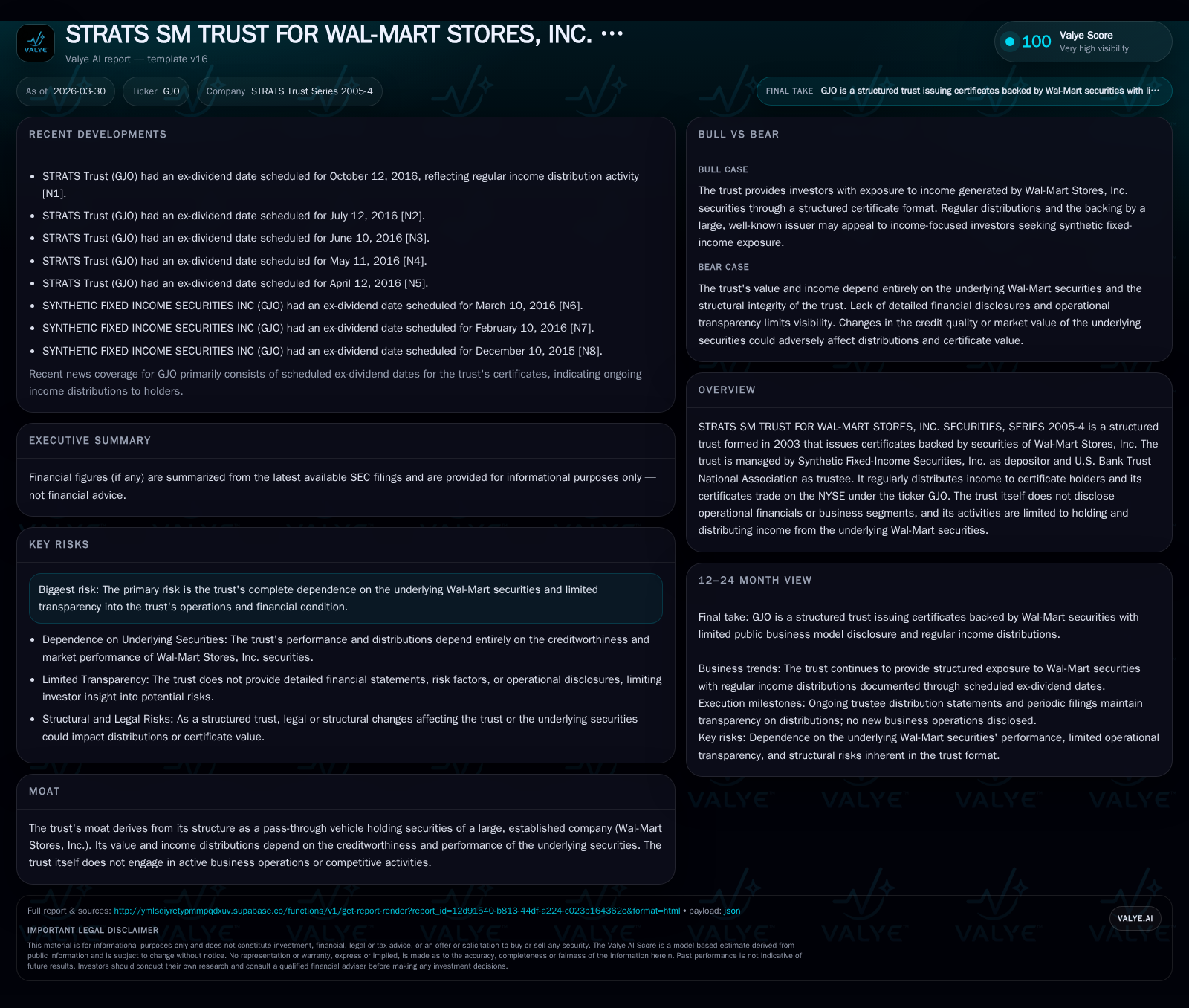
STRATS SM Trust for Wal-Mart Stores, Inc. Securities, Series 2005-4 (GJO) is a pass-through structured trust holding only Wal-Mart securities that distributes income to certificate holders. Recent trustee filings from September 2025 through March 2026 confirm consistent quarterly distributions, reflecting stable income flows dependent solely on Wal-Mart’s creditworthiness. The trust carries concentrated issuer risk without operational revenues or share repurchase programs. Market activity in early 2026 shows GJO certificates breaking above their 200-day moving average, signaling positive technical momentum. Monitoring scheduled distributions and Wal-Mart’s credit profile remains essential for assessing future income stability.
Structural Overview of STRATS SM Trust and Its Backing by Wal-Mart Securities
STRATS SM Trust for Wal-Mart Stores, Inc. Securities, Series 2005-4 (ticker: GJO) is a structured pass-through trust established pursuant to agreements dating back to 2003 [S3][S7]. It holds securities issued solely by Wal-Mart Stores, Inc., without engaging in any operational activities or generating independent revenues [S3]. Synthetic Fixed-Income Securities, Inc. acts as depositor and U.S. Bank Trust National Association serves as trustee and securities intermediary. The trust's role is to hold the underlying collateral securities and distribute associated income to certificate holders, effectively providing investors with fixed-income exposure tied directly to Wal-Mart’s debt instruments.
Historical Income Distributions and Key Performance Drivers
Trustee distribution statements filed between September 15, 2025 and March 16, 2026 confirm consistent quarterly income payments to holders of the certificates [S17][S21][S25]. Scheduled distributions occurred regularly on or about September 15, October 15, November 17, December 15 (2025), January 15, February 17, and March 16 (2026) [S21][S24]. No interruptions or reductions in distributions were reported during this period.
Payments correspond to interest or coupon receipts from held Wal-Mart securities net of administrative expenses inherent in the passive trust structure [S7][S25]. This pattern reflects stable cash flow generation aligned with the credit performance of an investment-grade issuer such as Wal-Mart.
Dependency on Underlying Wal-Mart Securities and Related Risks
The trust’s sole source of income is the underlying collateral issued by Wal-Mart Stores, Inc., making it fully exposed to the issuer’s credit risk [S4][S5]. There are no diversified assets or operational revenue streams at the trust level.
Neither Synthetic Fixed-Income Securities nor the trustee conducts due diligence beyond publicly available documents filed by Wal-Mart with the SEC [S7]. Investors thus bear concentration risk linked to a single corporate issuer without recourse to other assets.
This structure simplifies management but concentrates exposure on credit events affecting Wal-Mart’s ability to meet payment obligations.
Liquidity Position and Capital Structure Insights
Due to its passive nature, the trust does not disclose detailed liquidity reserves or capital structure adjustments [S27]. Regulatory filings primarily confirm distribution payments rather than broader financing activities.
No refinancing events or amendments affecting structural stability have been reported recently. The uninterrupted distribution record implies sufficient liquidity exists to satisfy payment obligations as they mature.
Capital Allocation: Dividends and Shareholder Returns
Distributions to certificate holders represent the trust's exclusive form of capital allocation . These occur approximately quarterly in line with coupon receipt timing.
No evidence exists of share repurchases or alternative return strategies within trustee disclosures. This aligns with GJO's design as a fixed-income pass-through vehicle where capital returns are limited to distribution payments derived from underlying debt coupons.
Market Dynamics: Technical Price Indicators
In March 2026, market commentary noted that GJO certificates traded above their 200-day moving average [N1], a key technical indicator often signaling bullish momentum in fixed-income instrument markets.
This price action may reflect improved investor confidence in the underlying credit fundamentals or shifts in yield expectations affecting valuation.
Outlook: Monitoring Distributions and Credit Quality
While explicit forward guidance is absent from filings reviewed [N1][S7], upcoming scheduled distribution dates remain critical milestones for investors monitoring income continuity.
Changes in Wal-Mart’s credit ratings or financial condition will directly impact the trust’s ability to maintain stable payouts given its full dependence on this single issuer.
Analysts should also watch for future disclosures regarding structural amendments or liquidity provisions that could affect risk profiles.
Summary: Investment Considerations for Fixed-Income Investors
GJO exemplifies a structured fixed-income pass-through product offering exposure solely linked to a blue-chip corporate issuer’s debt:
- Income stability depends on issuer credit quality rather than business operations.
- Risk concentration arises from single-issuer exposure with limited structural transparency.
- Liquidity sufficiency is inferred from consistent distributions though detailed reserves are undisclosed.
- Capital returns consist exclusively of periodic income distributions without buybacks.
- Positive technical signals may enhance market appetite under prevailing conditions.
For investors seeking exchange-listed access to corporate debt exposures with predictable cash flows, GJO provides a specialized instrument balancing yield reliability against issuer-specific credit risks.
This analysis is based exclusively on publicly available SEC filings through March 30, 2026 and Nasdaq market commentary [N1]. It does not constitute investment advice.
Disclaimer: This is research-only, informational analysis and not investment advice. It may include AI-generated interpretation and general industry context. Always verify important details using primary sources.

Comments