
Brookfield Business Partners LP’s Shift from Revenue Contraction to Operational Focus
The company balances a steep revenue decline with operational restructuring and capital recycling to stabilize performance and drive future growth.
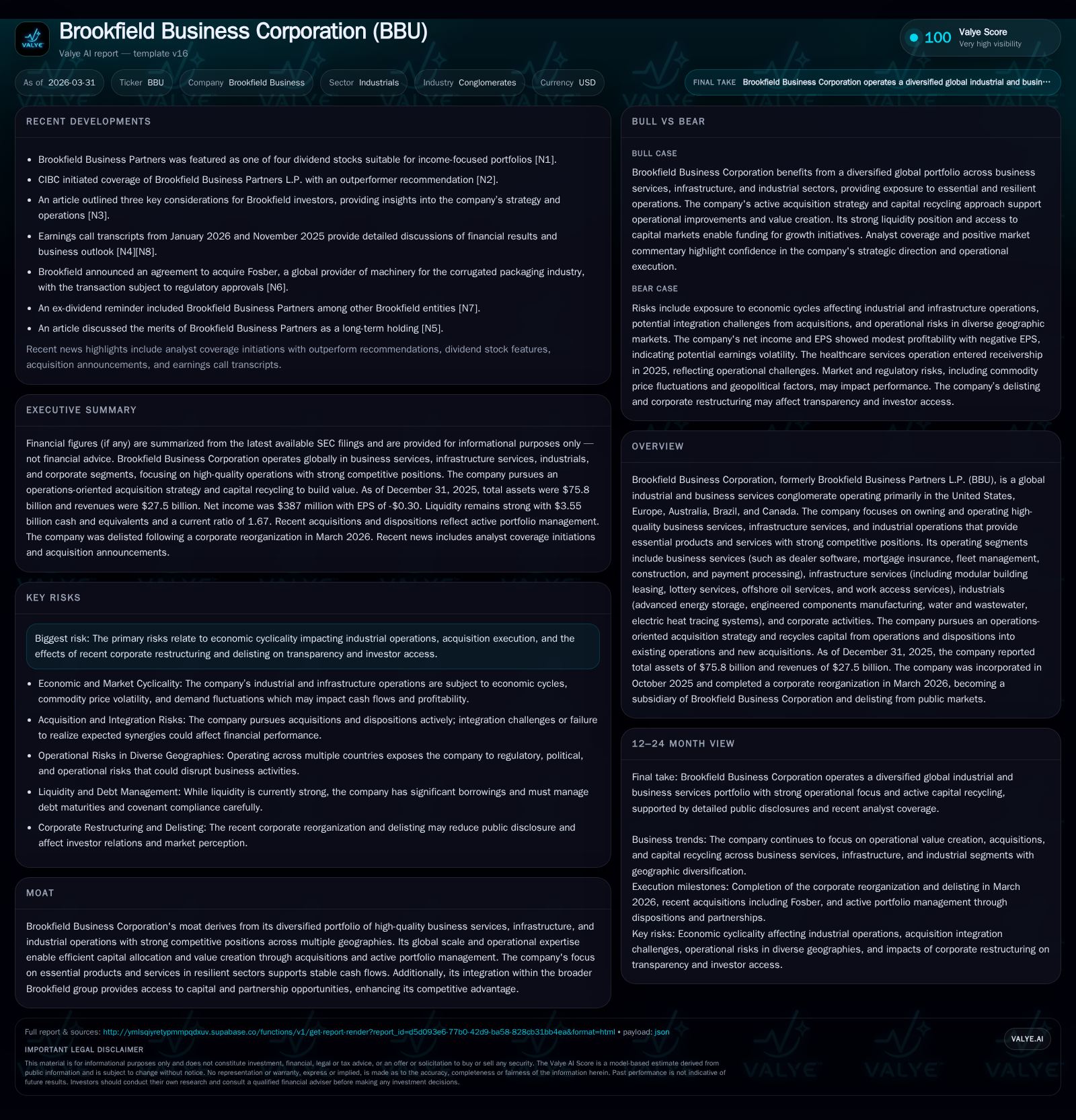
Brookfield Business Partners LP (BBU) has faced significant top-line contraction over recent fiscal years, with revenue dropping by 32.4% YoY in FY2025 amidst broader macroeconomic challenges and portfolio transitions. Despite this, the firm leverages its diversified industrial and business services portfolio across multiple geographies to focus on operational improvements and targeted acquisitions following a corporate restructuring culminating in Brookfield Business Corporation's formation. Capital allocation remains disciplined, with steady preferred equity funding and buybacks, while liquidity and credit facilities support ongoing investment activities. Risks persist around cyclical industrial demand and reduced investor transparency due to delisting, but the strategic shift to an operations-oriented acquisition model provides a pathway for re-acceleration.
Historical Growth Trajectory and Profit Trends
Brookfield Business Partners LP (BBU) reported revenues of approximately $27.46 billion for FY2025, down 32.4% from $40.62 billion in FY2024 according to SEC filings [F1]. This decline reflects portfolio transitions amid broader market challenges.
Net income also declined significantly by 56.8% year-over-year to $387 million in FY2025 from $895 million in FY2024 [F1]. Equity attributable to unitholders fell from $17.3 billion at the end of FY2024 to about $15.3 billion at December 31, 2025, yielding an approximate return on equity of 2.5% for FY2025 [F1].
Historical performance (annual)
| FY | Rev ($bn) | Net ($bn) | Rev YoY | Net YoY |
|---|---|---|---|---|
| 2025 | 27.5 | 0.4 | -32.4% | -56.8% |
| 2024 | 40.6 | 0.9 | -26.2% | -76.3% |
| 2023 | 55.1 | 3.8 | -4.3% | +963.9% |
| 2022 | 57.5 | 0.4 |
Source: SEC companyfacts cache [F1].
Capital returns and efficiency (annual)
| FY | ROE% |
|---|---|
| 2025 | 2.5 |
| 2024 | 5.2 |
| 2023 | 20.4 |
| 2022 | 1.9 |
Source: SEC companyfacts cache [F1].
Note: ROE calculated as net income divided by equity for each fiscal year per SEC data.
Segment Breakdown
The partnership operates across business services, infrastructure services, industrials, and corporate segments [S1]. For the year ended December 31, 2025:
- Business services generated approximately $9.37 billion in revenue supported by assets totaling about $28.58 billion.
- Infrastructure services contributed roughly $3.15 billion in revenue with assets near $16.27 billion.
- Industrials led revenues at about $14.94 billion backed by assets of approximately $29.91 billion.
- Corporate segment held assets around $999 million without direct revenue contribution [S1].
These segments span key regions including the United States, Europe, Australia, Brazil, and Canada [S1][S20]. The company emphasizes operational value creation through an acquisitions-driven approach complemented by capital recycling within its diversified portfolio.
Corporate Restructuring and Outlook
In March 2026, BBU completed a corporate restructuring becoming a subsidiary of Brookfield Business Corporation headquartered in New York [S1][S2]. This transition included delisting BBU from public exchanges and exchanging units for Class A Shares under the new entity structure.
The restructuring aims to sharpen operational focus on value enhancement via hands-on management and an operations-oriented acquisition strategy while maintaining exposure to essential product and service markets globally [S1]. This change introduces some transparency considerations due to delisting but aligns with Brookfield’s broader ecosystem for capital deployment.
Capital Structure and Liquidity Position
As of December 31, 2025:
- Total borrowings stood at approximately $43.75 billion including $1.33 billion at the corporate level and around $42.42 billion in non-recourse subsidiary debt [S4][S6][F1].
- Weighted average interest rate on borrowings was about 7.3%, with a weighted average maturity of roughly 5.7 years [S5][S13].
- Undrawn credit facilities exceeded $8 billion providing ample liquidity for acquisitions and capital expenditure needs [S4][S5][S10].
- Cash and cash equivalents were approximately $3.55 billion supported by operating cash flows near $3.23 billion annually despite reduced scale compared to prior years [F1][S10].
A revolving acquisition credit facility guaranteed by Brookfield offers up to an additional $1 billion availability for bolt-on investments [S6][S7].
Capital Allocation Priorities
The partnership maintains a disciplined capital allocation approach:
- Quarterly distributions are targeted at approximately an annualized rate of $0.25 per unit or share following the new dividend policy post-restructuring [S15].
- Normal course issuer bids have been actively executed during FY2025 with millions of LP Units repurchased signaling opportunistic capital recycling amid valuation dislocations [S15][S21].
- Preferred equity subscriptions totaling $725 million drawn from Brookfield affiliates carry annual dividends near 7%, supporting growth initiatives without adversely impacting leverage or liquidity metrics [S4][F1].
Growth Strategy
Management is focused on continuing its operations-oriented acquisition strategy combined with disciplined portfolio optimization through monetizing mature assets reinvested into high-return platforms such as advanced energy storage manufacturing expansion projects supported by substantial capex plans [N4][S24]. Geographic diversification across multiple continents helps mitigate localized macroeconomic risks while targeting market penetration aligned with each vertical’s competitive strengths.
Risks
Key risks include economic cyclicality affecting industrial segments exposed to manufacturing demand fluctuations and execution risks related to acquisitions integration or pricing dynamics [S24]. The recent delisting may also limit traditional public market transparency potentially impacting investor sentiment.
This document is for informational purposes only and does not constitute investment advice or recommendations.
Disclaimer: This is research-only, informational analysis and not investment advice. It may include AI-generated interpretation and general industry context. Always verify important details using primary sources.

Comments