
Ternium’s Shift from Growth to Profitability: A 2025 Financial Checkup
Examining the strategic transition in Ternium's financial and operational trajectory marked by rising profitability despite top-line contraction.
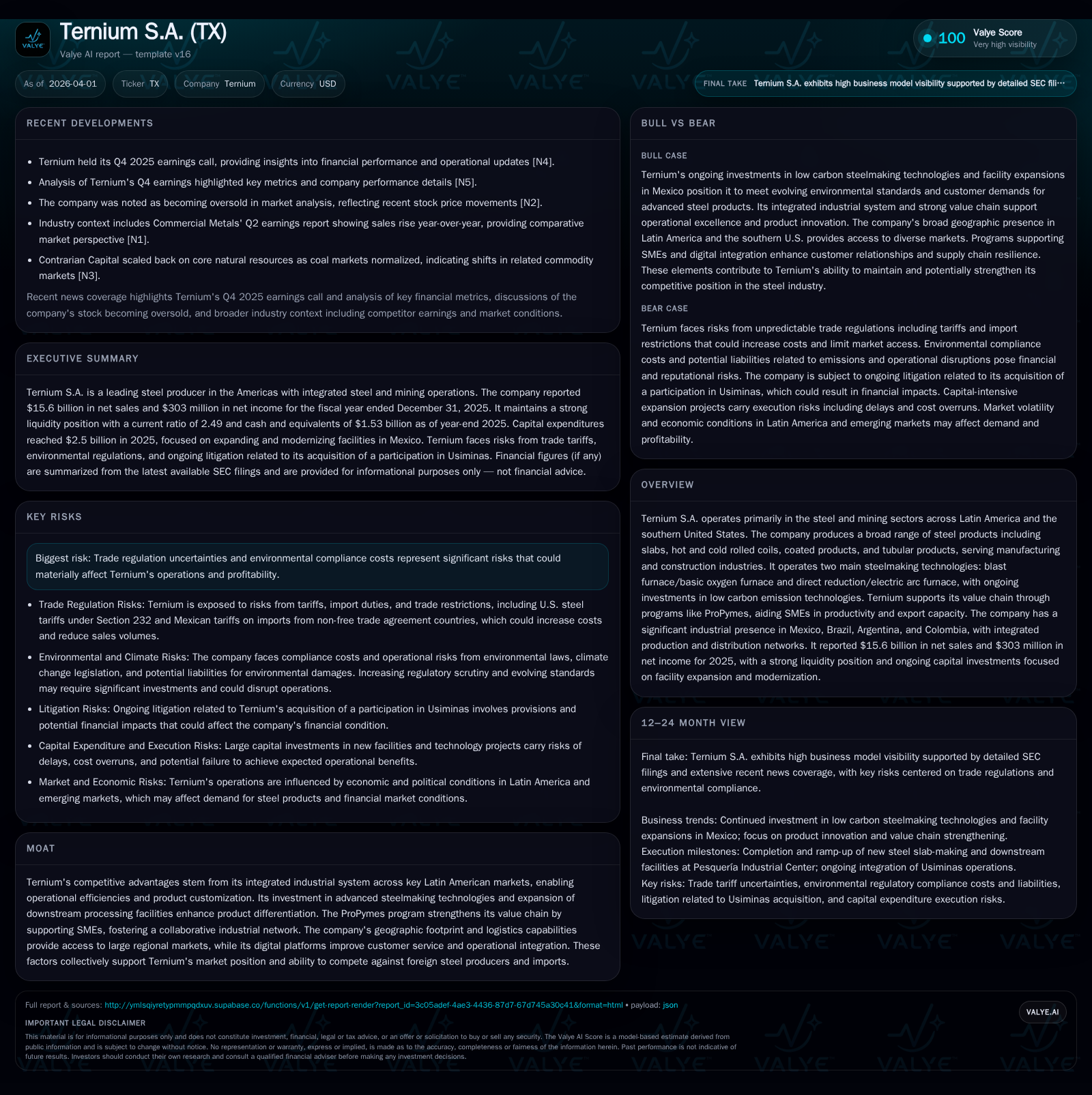
Ternium S.A., a leading steel producer in Latin America and the southern U.S., faced an 11.6% decline in revenue in 2025 to $15.6 billion amidst challenging market conditions, including trade barriers and environmental regulation costs. Yet, net income surged 74.4% year-over-year to $303 million, reflecting improved operational efficiencies and cost management. The company maintains a robust liquidity position and continues capital investments focused on sustainable steelmaking technologies as it recalibrates its growth ambitions toward sustained profitability. Future performance will hinge on navigating evolving trade policies and tightening environmental standards while leveraging its integrated production footprint.
Ternium’s Historical Expansion: Revenue and Income Trends Through 2025
Ternium's financial trajectory through 2025 reflects a clear inflection point from aggressive revenue growth to a more profit-focused phase. The company reported consolidated net sales of $15.6 billion for the full year 2025, down by approximately 11.6% compared to $17.6 billion in 2024 [F1][S1]. This decline juxtaposes with a remarkable net income increase from $174 million in 2024 to $303 million in 2025—a rise of roughly 74.4% [F1]. While revenues have contracted primarily due to decreased steel volumes amid intensifying trade constraints and market softness, margins expanded sufficiently to offset top-line pressures.
Book equity held relatively steady at $16.1 billion, leading to an approximate return on equity (ROE) of 1.9% in 2025 [F1]. Although this level remains modest, the rebound from prior years’ lower profitability signals effectiveness in cost containment and strategic realignment during a challenging macroeconomic backdrop governed by volatile steel demand in Latin America.
Historical performance (annual)
| FY | Rev ($bn) | Net ($bn) | Rev YoY | Net YoY |
|---|---|---|---|---|
| 2025 | 15.6 | 0.3 | -11.6% | +74.4% |
| 2024 | 17.6 | 0.2 | +0.2% | -82.4% |
| 2023 | 17.6 | 1.0 | +7.3% | -52.9% |
| 2022 | 16.4 | 2.1 |
Source: SEC companyfacts cache [F1].
Capital returns and efficiency (annual)
| FY | ROE% |
|---|---|
| 2025 | 1.9 |
| 2024 | 1.1 |
| 2023 | 5.9 |
| 2022 | 15.2 |
Source: SEC companyfacts cache [F1].
Note: Percent changes calculated where data is available; cash equivalents reflect end-of-year balances.
Operational Backbone: Integrated Production and Steelmaking Technologies
Ternium operates through a dual steelmaking paradigm combining traditional blast furnace/basic oxygen furnace (BF/BOF) processes with more flexible direct reduction/electric arc furnace (DRI/EAF) technology [S1]. This blend allows the company to produce a wide range of steel products—from slabs to hot-rolled coils, cold-rolled coils with coatings (galvanized, electrogalvanized, tinplate), tubular products, bars, billets, and value-added customized items serving automotive, construction, appliance manufacturing, packaging sectors, among others [S5][S9].
The BF/BOF route enables large-scale primary steelmaking with integrated raw material input while DRI/EAF plants offer nimbleness for high-end specialized steels necessary for automotive-grade performance [S26]. The recent expansion at Pesquería Industrial Center exemplifies Ternium’s commitment to modernizing its footprint with new downstream finishing lines alongside upcoming electric arc-furnace-based slab production facilities expected online late-2026 [S17][S21].
Operational integration extends beyond production into service centers that provide just-in-time delivery, inventory management, slitting, cutting-to-length, and other processing solutions tailored regionally thanks to the company's strong logistics networks across Mexico, Brazil, Argentina, Colombia, and the southern U.S [S26]. This integration provides significant operating leverage by aligning product mix shifts with regional demand profiles.
Environmental Regulations and Trade Barriers Impacting Market Dynamics
Environmental compliance represents one of the gravest pressures constraining Ternium’s growth landscape going forward [S8][S14]. In Mexico, strict adherence to the "polluter pays" principle obliges restoration measures for pollution breaches with potential criminal liabilities attached [S14]. Mexico's nascent emissions trading system pilot adds complexity as carbon taxes on fuels remain subject to annual assessment; though natural gas currently bears no carbon tax, shifts could increase energy input costs given Ternium Mexico's substantial natural gas consumption [S14].
Brazil’s expansive regulatory web imposes stiff administrative fines up to BRL50 million (~$10 million USD) along with possible activity suspensions or loss of government benefits for environmental infractions [S14][S25]. Moreover, Brazil enacted legislation establishing a legal framework for an emissions trading system requiring Brazilian steel producers such as Usiminas (majority owned by Ternium) to monitor emissions tightly and engage in carbon credit trading—though governance specifics remain under development [S14][S25].
Trade-related headwinds compound environmental challenges: longstanding U.S. Section 232 tariffs on steel imports have reshaped pricing dynamics in North America disproportionately impacting producers reliant on cross-border flows [S8]. Additionally, antidumping/countervailing duties imposed on imports from Brazil and Mexico targeting corrosion-resistant steel varieties have constrained export potential while elevating compliance overheads [S18]. Uncertainties around tariff renewals or trade controversy between USMCA members exacerbate supply chain risk.
Profitability Revival: Analyzing Net Income Surge Amid Revenue Decline
Despite an evident contraction in sales volume leading to decreased revenue streams by nearly one-eighth year-over-year, Ternium remarkably turned around its bottom-line performance with a net income uptick exceeding seventy percent [F1][N2][N3]. Financial disclosures suggest this profitability rebound owed largely to stringent cost controls reinforced during the fiscal year alongside operational efficiency gains realized through optimization of production processes.
Improved pricing discipline supported by product differentiation—particularly towards technologically advanced coated steels—and enhanced logistics reduced penalties associated with inventory holding costs or expedited shipping premiums inherent during volatile markets [N2][N3]. Customized product offerings enabled better margin capture per ton despite weaker aggregate volumes given regional client preferences for premium grade steels serving automotive or infrastructure projects that remained relatively resilient.
The company’s integrated platform facilitated higher asset utilization rates mitigating fixed cost absorption issues typical within capital-intensive steel operations where throughput dips often degrade profitability disproportionally.
Capital Allocation Strategy: Dividends, Buybacks, and Investment Priorities
Ternium maintains an active capital allocation policy aimed at balancing shareholder remuneration through dividends alongside strategic share repurchases authorized under Luxembourg law permitting acquisition of up to ten percent of outstanding shares over rolling five-year periods [S4][S7][S13][S16]. These buyback programs hold flexibility regarding purchase price limits pegged within bounds relative to prevailing market prices [S7].
At fiscal year-end 2025, Ternium held approximately $1.53 billion in cash and equivalents—a sizeable liquidity buffer supporting ongoing investment needs amidst uncertain external conditions [F1]. Capital expenditure spending continues concentrated on sustainability-driven projects chiefly expanding low-carbon emission technologies such as the new EAF slab facility in Pesquería coupled with downstream finishing capacity enhancements ensuring alignment with environmental mandates proactively reducing future regulatory risk exposure [S21].
While explicit return on equity remains modestly positive at circa 1.9%, this marks an improvement compared to previous years as earnings stabilized despite macroeconomic headwinds supporting management’s shift towards prioritizing margin improvement over top-line volume growth expansion [F1].
Geographic Footprint’s Role in Operational Efficiency and Product Customization
Ternium’s extensive industrial presence across four main Latin American countries—Mexico (Pesquería), Brazil (Usiminas), Argentina (several integrated units), Colombia—and distribution centers spanning Central America offers a distinct competitive advantage enabling proximity to diverse markets reducing freight expenses materially versus import-reliant competitors [S5][S6][S26].
This footprint supports rapid response service models tailored by customer segment demands leveraging digital platforms such as "Ternium Activo" that streamline ordering processes enhancing customer retention through superior service quality while fostering real-time supply chain transparency across commercial interfaces [S17].
Complementing this network is the ProPymes Program dedicated to empowering small-medium enterprises upstream within Ternium's value chain through productivity improvement initiatives plus export development support amplifying regional economic synergies while bolstering industrial supply security critical under fluctuating global metal prices or restrictive trade policies [S15][S17].
Forward-Looking Considerations: Market, Regulatory, and Technological Catalysts
Looking ahead into mid-2026 and beyond, key uncertainties orbit regulatory evolutions notably emissions trading scheme implementations planned or underway across both Brazilian federal-provisional regimes and Mexican pilot programs potentially escalating compliance expenditures unpredictably yet incentivizing investments into greener production pathways aligning with corporate ESG commitments stated publicly by Ternium management [N2][N3].
Technological upgrades—like the Pesquería EAF slab mill slated for late-2026 commissioning—promise enhancement toward producing ultrahigh-strength grades tailored expressly for demanding automotive applications compliant with USMCA trade requirements thus aiming both at import substitution domestically within Mexico as well as exports across North America under evolving trade regimes gradually favoring origin-compliant output [S17].
Trade policy uncertainty persists particularly regarding U.S. safeguard duties' renewal cycles affecting imports across various coated steel categories including corrosion-resistant lines pivotal for Ternium's business mix potentially triggering margin compression or market access constraints necessitating vigilant monitoring.
Lastly, the company’s continued emphasis on cutting-edge R&D coupled with operational digitalization channels will be critical levers sustaining pricing power resilience while also managing capital intensity amid shifting demand patterns.
This analysis is based solely on publicly available information including SEC filings under IFRS standards ([F1], [S#]) and verified news transcripts ([N#]). It does not constitute investment advice or recommendations but aims at providing objective insight into Ternium S.A.’s financial health and industry positioning entering mid-2026.
Disclaimer: This is research-only, informational analysis and not investment advice. It may include AI-generated interpretation and general industry context. Always verify important details using primary sources.

Comments