
Alvotech’s Recovery Path: From Operating Losses to Biosimilar Market Expansion
Alvotech shows a financial turnaround fueled by biosimilar launches and strategic capital management.
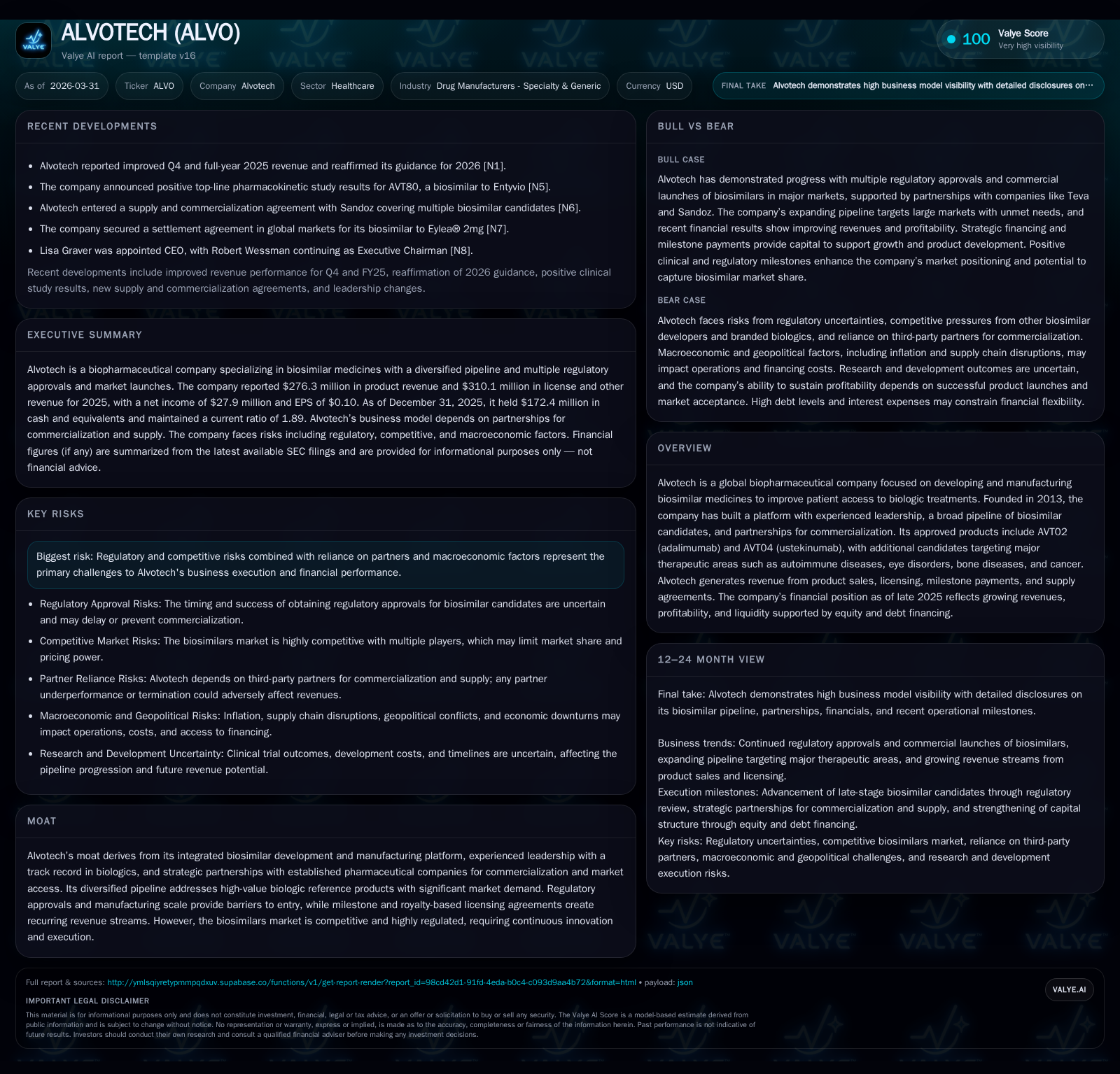
After years of substantial operating losses, Alvotech swung to a net profit in 2025 driven by commercial launches of key biosimilars and milestone revenues. The company’s portfolio includes several FDA- and EMA-approved biosimilars, with regulatory and manufacturing challenges ongoing. Capital structure improvements via debt refinancing and equity raises have strengthened liquidity while the firm remains reliant on partnerships for commercialization. Risks persist around regulatory approvals and competitive pressures, but pipeline breadth supports continuing growth ambitions.
From Losses to Profitability: Tracing Alvotech’s Financial Turnaround
Alvotech has transformed its financial standing remarkably over recent years. After enduring heavy net losses exceeding half a billion dollars in both 2023 (-$551.7 million) and 2022 (-$513.6 million) [F1], the company registered a net profit of $27.9 million in fiscal 2025 [F1]. The prior year also reflected a steep loss of -$231.9 million. This swing represents an approximate 112% year-over-year improvement in net income from 2024 to 2025 [F1].
The inflection stems primarily from ramped commercial activity tied to biosimilar launches alongside milestone payments under license agreements with global partners. Notably, AVT02 (adalimumab) broke through with market entries across more than 25 countries including the U.S., Europe, Canada, Japan, and Australia. Similarly, AVT04 (ustekinumab) advanced FDA approvals culminating in launch by partner Teva in early 2025 [S1][N1].
Operating cash flow improved substantially during the year ended December 31, 2025, compared to prior periods [S6]. Capital expenditures rose to approximately $64.5 million during 2025 primarily focusing on expanding manufacturing infrastructure [S4][S10].
Historical performance (annual)
| FY | Net ($mm) | Net YoY |
|---|---|---|
| 2025 | 28 | +112.0% |
| 2024 | -232 | +58.0% |
| 2023 | -552 | -7.4% |
| 2022 | -514 |
Source: SEC companyfacts cache [F1].
Capital returns and efficiency (annual)
| FY | Div | ROE% |
|---|---|---|
| 2025 | 0 | -9.8 |
| 2024 | 56.2 | |
| 2023 | 0 | 59.2 |
| 2022 | 0 | 91.0 |
Source: SEC companyfacts cache [F1].
(Note: Revenue figures are not explicitly disclosed; net income series illustrates recovery.)
Commercial Expansion and Revenue Drivers: The 2025 Portfolio in Focus
Alvotech’s approved biosimilars underpinning revenue include AVT02 (adalimumab) targeting autoimmune diseases such as rheumatoid arthritis and psoriasis, alongside AVT04 (ustekinumab), which addresses major immunology indications like Crohn’s disease — expanded through both subcutaneous and intravenous formulations allowing label enhancements for ulcerative colitis [S1].
Product sales occurred across diverse markets leveraging commercialization partners notably Teva for U.S., STADA globally, Advanz in Europe for some candidates, and Dr. Reddy acting especially in bone disease segments [S1][N1]. This multi-partner model facilitates milestone-triggered royalty streams often ranging from mid-30% to mid-40% share of net sales, common within biosimilar licensing regimes.
Late-stage clinical assets progressing regulatory filings included AVT03 (denosumab), AVT05 (golimumab), and AVT06 (aflibercept) addressing bone disorders, autoimmune/inflammatory diseases, oncology-related retinal conditions respectively [S1][N1]. These candidates reflect the company's strategy focusing on high-value originator biologics with peak annual global sales topping $130 billion collectively.
Regulatory Landscape and Product Pipeline: Navigating Milestones and Challenges
Q4 2025 witnessed setbacks when the FDA issued complete response letters (CRLs) for three critical biosimilar programs —AVT03, AVT05, AVT06— citing deficiencies uncovered during July inspections of Alvotech’s Reykjavik manufacturing site [S1][S26]. While disruptive to U.S.-market timelines, the European Medicines Agency granted positive opinions for these molecules with full European Commission authorizations following shortly after [S1].
Alvotech immediately launched comprehensive remediation actions targeting GMP compliance gaps flagged by FDA auditors with intentions to resubmit BLAs promptly once facility issues resolve [S1][N1]. Such manufacturing scale-up barriers are typical moat enablers but simultaneously present persistent regulatory risk requiring vigilant quality control.
Additional pipeline notes include clinical advancement of AVT16 (vedolizumab), where global confirmatory studies were discontinued as regulatory authorities deemed them unnecessary for dossier acceptance —a tactical refinement easing development burdens without safety concerns flagged [S1]. Meanwhile AVT23 (omalizumab) progressed marketing applications accepted by EMA/UK MHRA held through Advanz partnership focusing on respiratory disease areas [S1].
Future Growth Trajectory: Opportunities and Constraints in Biosimilar Markets
Management reaffirmed near-term guidance indicating expectations for continued revenue growth driven by expanding biosimilar commercialization footprints across North America, Europe, Japan, Canada, and emerging regions enabled by partner marketing infrastructure [N1][S2]. The pipeline breadth spanning immunology, ophthalmology, oncology and bone disorders supports sustained medium-term opportunity potential.
However competitive intensity escalates as other biosimilar developers pursue identical or adjacent reference products aided by varying regional reimbursement frameworks posing pricing pressure risks [S26]. Macroeconomic volatility including inflationary cost inputs impacts manufacturing economics alongside regulatory uncertainties stemming from evolving inspection stringencies remain material constraints.
One strategic evolution involved discontinuation of the global confirmatory study for AVT16 signaling adaptive resource allocation to prioritize dossiers with higher probability timelines minimizing clinical risk exposure [S1]. Overall growth scenarios hinge on timely resolution of U.S. regulatory hurdles coupled with effective partner-led market launches.
Capital Structure Evolution: Debt Refinancing, Convertible Bonds, and Liquidity
Throughout the recent period Alvotech orchestrated several key capital maneuvers aimed at bolstering liquidity while optimizing interest costs:
- Conversion of majority of the 2022 Convertible Bonds into equity in mid-2024 extinguished $220.7 million debt positions issuing over 22 million new shares at fixed $10/share price [S11][F1];
- July 2024 closing of a secured loan facility totaling $965 million structured initially as two tranches at SOFR plus circa 6.5%–10.5%, later consolidated into single tranche charging SOFR plus uniform 6%, fully cash-payable interest reflecting stronger financial position realized June 2025 amendment [S4][S8];
- Issuance of $108 million senior unsecured convertible bonds at end-2025 bearing coupon of 6.875% maturing in 2030 along with a new senior term loan facility of $100 million at fixed interest rate of 12.50%, maturing late-2027 adding incremental financing flexibility [S4][S6][S7];
- Equipment loans totaling roughly $40 million supporting manufacturing capital expenditures with maturities through early next decade along with mortgage-linked borrowings assumed via acquisitions augment asset-backed leverage capacity [S9][S20].
As of December 31, 2025 total borrowings stood near $1.3 billion against cash balances exceeding $172 million; current assets surpassed current liabilities by approximately $270 million yielding a solid current ratio near 1.89x reflective of prudent working capital management amid scaling commercial activity [F1][S4][S18].
Returns and Capital Allocation: Assessing ROE, Cash Flow, Dividends, and Buybacks
Despite achieving profitability in fiscal year-end December 2025 the company’s book equity remained negative at about -$284 million reflecting accumulated deficits from prior years' substantial losses [F1]. Calculated return on equity is therefore negative around -9.8% illustrating early recovery phase dynamics without positive residual equity capital base yet.
Alvotech did not pay dividends nor conduct share buybacks over recent years as strategic capital emphasis concentrated on business reinvestment encompassing pipeline advancement plus manufacturing ramp-up investments totaling approximately $64.5 million capex during 2025 alone plus financing costs related to new debt issuances [F1][S28]. Operating cash flow showed meaningful improvement but remained negative overall given upfront R&D spending commitments required.
Liquidity remains robust currently via combined cash balances plus anticipated milestone inflows derived from licensing contracts expected over subsequent five years summing estimated contractual revenues above $350 million reflecting successful partner monetization approach [S13][S18].
Strategic Partnerships as Levers for Market Penetration and Risk Mitigation
A cornerstone of Alvotech's model is its network of international commercialization collaborators enabling accelerated biosimilar launches spanning developed pharmaceutical markets:
- Teva Pharmaceuticals manages U.S. distribution for flagship molecules including adalimumab (AVT02) and ustekinumab (AVT04);
- STADA operates significant licensing territories backing supply chain logistics alongside marketing;
- Advanz holds exclusive rights within EEA plus UK/Switzerland territories particularly relevant for ophthalmology products like aflibercept (AVT06);
- Dr. Reddy strengthens presence focused on bone diseases including denosumab biosimilar candidate (AVT03). This partner-driven commercial ecosystem unlocks milestone-triggered payments followed by royalties often constituting ~35–45% share enabling Alvotech to reduce go-to-market execution risk while expanding collective reach globally – vital given the fragmented landscape inherent to biosimilar adoption worldwide [S13].
Risks to Monitor: Regulatory Scrutiny, Facility Inspections, and Competitive Pressures
Manufacturing compliance issues surfaced in mid-2025 FDA inspections pose significant headwinds delaying U.S.-market entry timelines due to CRLs affecting three pivotal candidates (AVT03/05/06) forcing remediation initiatives with uncertain duration before approval can advance further [S26][N3]. Such setbacks highlight inherent regulatory complexity governing biologics production facilities where quality breaches can disrupt entire portfolios despite progress elsewhere internationally.
The sector is highly competitive; established biosimilar players continually innovate dossiers or pricing strategies intensifying pressure on market share capture potential combined with evolving payer landscapes that may constrain uptake volume pricing power versus original reference brands.
Additionally reliance on external partners heightens execution risk given any shifts in collaborator priorities or geopolitical trade tensions affecting cross-border pharmaceutical commerce might impair rollout velocity or contractual terms altering revenue profiles.[N3]
On compliance governance Alvotech maintains dedicated cybersecurity oversight structures integrated within corporate risk frameworks ensuring mitigation around data privacy or operational disruptions relevant for stakeholder confidence particularly amid rising digital threats.[S26]
This analysis is based solely on information provided via official company filings up through March 31, 2026 combined with recent news releases cited herein without extrapolation beyond disclosed data points or issuer commentary. It does not constitute investment advice or recommendations but aims to outline Alvotech's transition towards sustained biosimilar commercialization balanced against identifiable operational risks.
Disclaimer: This is research-only, informational analysis and not investment advice. It may include AI-generated interpretation and general industry context. Always verify important details using primary sources.

Comments