
United Security Bancshares’ Financial Shifts Amid California’s Competitive Banking Market
The bank's concentrated commercial real estate lending, fluctuating earnings, and capital choices critically shape its near-term growth within a tough regional landscape.
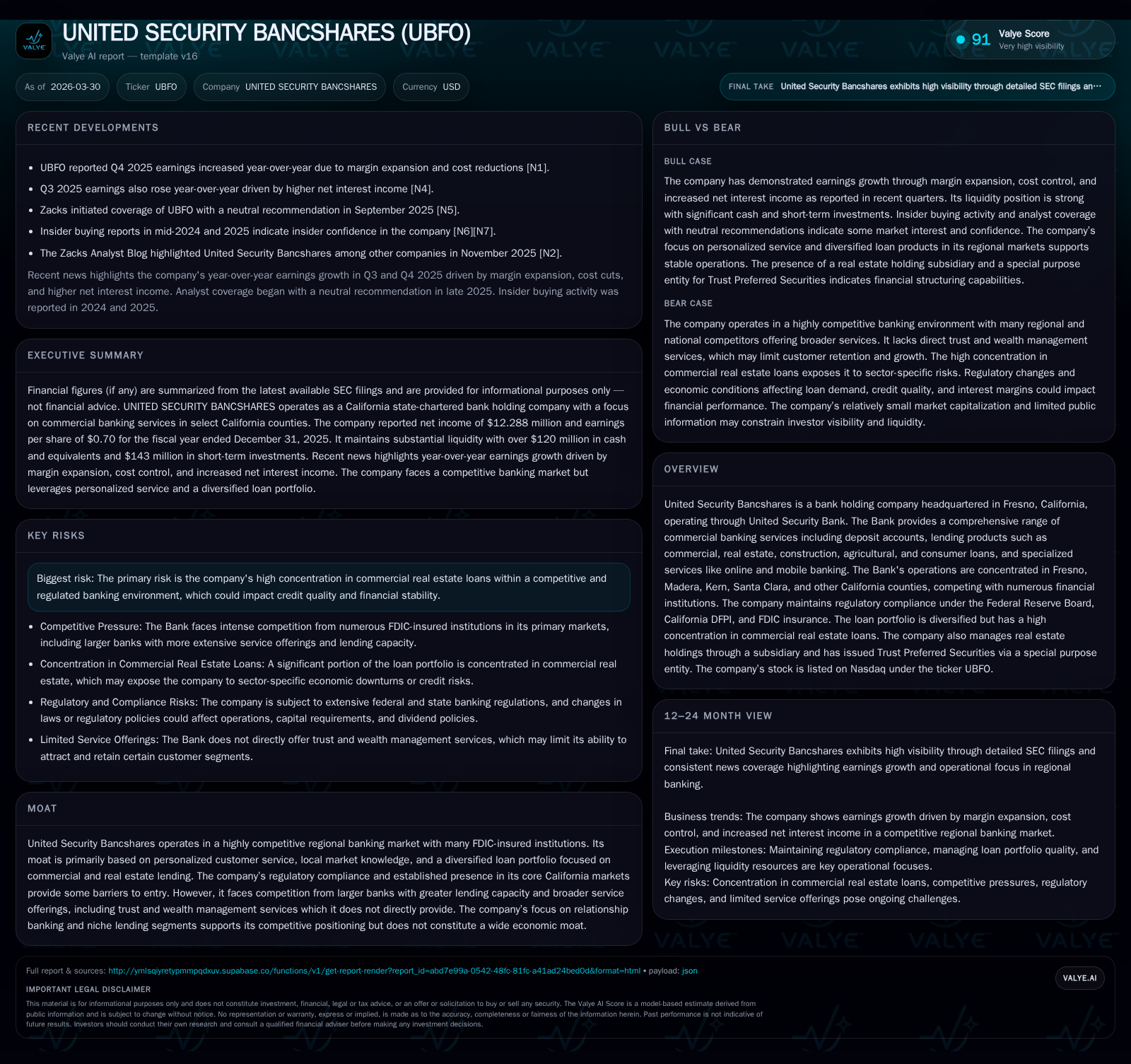
United Security Bancshares (UBFO), anchored in Fresno, California, operates with a concentrated commercial real estate (CRE) loan portfolio that drives both its revenue strength and credit risk exposure. Over the past four years, UBFO’s net income has declined from $19.8 million in 2023 to $12.3 million in 2025 despite improving operating cash flows and rising capital expenditures. The company’s niche in relationship banking and local knowledge underpins its competitive stance against larger banks but also limits access to broader wealth management services. Capital management features include partial redemption of Trust Preferred Securities, supporting liquidity while maintaining regulatory capital adequacy. A recent merger with Community West Bancshares expands its footprint but integration remains a key watchpoint for growth drivers. Investors should monitor CRE loan quality trends, capital adequacy post-merger, and dividend sustainability amid competitive pressure.
Revenue, Earnings, and Cash Flow Trends Over Four Years
United Security Bancshares (UBFO) has experienced notable shifts in its profitability over the last four fiscal years. Net income peaked at $19.8 million in 2023 before declining sharply to $12.3 million in 2025 — a reduction of roughly 38%. This trend can be understood against a backdrop of increasing operating cash flow, which rose from $19.6 million in 2024 to $22.1 million in 2025, a healthy year-over-year increase of about 12.3%. Meanwhile, capital expenditures more than doubled over the same period — up by approximately 119.5% to $2.28 million — suggesting heightened investment levels possibly directed towards branch infrastructure or technology platforms.
Equity grew steadily from $112.5 million in 2022 to nearly $139.7 million by the end of 2025, indicating ongoing accumulation of shareholder value despite profit fluctuations. The resulting return on equity stands at approximately 8.8% for FY2025 — a modest return within the regional banking sector context, reflecting current margin pressures ([F1], [S1]).
Historical performance (annual)
| FY | Net ($mm) | CFO ($mm) | Capex ($mm) | Net YoY |
|---|---|---|---|---|
| 2025 | 12 | 22 | 2 | -16.9% |
| 2024 | 15 | 20 | 1 | -25.3% |
| 2023 | 20 | 21 | 1 | +26.2% |
| 2022 | 16 | 24 | 2 |
Source: SEC companyfacts cache [F1].
Capital returns and efficiency (annual)
| FY | Div ($mm) | FCF ($mm) | ROE% |
|---|---|---|---|
| 2025 | 8 | 20 | 8.8 |
| 2024 | 8 | 19 | 11.3 |
| 2023 | 8 | 21 | 16.2 |
| 2022 | 7 | 22 | 13.9 |
Source: SEC companyfacts cache [F1].
Net income shows volatility over the period with weakening profitability in the latest two years despite improved cash flow.
Concentration in Commercial Real Estate Lending: Risk and Opportunity
UBFO’s loan portfolio is highly concentrated in commercial real estate (CRE), forming the backbone of its lending book and shaping risk-return dynamics significantly ([S1], [S4], [S8]). CRE loans are secured primarily by deeds of trust on commercial properties where repayment hinges largely on borrower cash flows rather than asset liquidation alone.
The bank avoids subprime or Alt-A residential mortgage risk pathways but does engage in interest-only loans structured as revolving lines for commercial or agricultural enterprises with seasonality or development timing considerations — typical for regional banks focused on relationship lending ([S8]). These underwriting standards reduce some inherent credit risk yet intensify sensitivity to regional economic cycles affecting CRE demand and valuation.
Loan participations serve as a tool for loan book diversification; however, UBFO’s customer base remains predominantly local California businesses within Fresno and surrounding counties ([S8]). Regulatory oversight through the FDIC and Federal Reserve reinforces prudent underwriting practices given concentration risks.
This specialization offers opportunity through focused relationship banking but also concentrates exposure to commercial property market downturns or financing disruptions.
Competitive Environment in Core California Markets
Operating mainly across Fresno, Madera, Kern, Santa Clara counties—markets dense with more than fifty FDIC-insured competitors—UBFO confronts intense competition for deposits and lending opportunities ([S6], [S26]). Despite heavy contest from larger regional banks boasting broader service arrays including trust & wealth management offerings absent at UBFO, the bank leverages personalized customer relationships and local market insights as differentiators.
UBFO emphasizes competitive deposit pricing blended with tailored service models characteristic of "relationship banking," aiming to secure customer loyalty even while competing against institutions capable of accommodating larger client lending needs (, [S6]). Loan participations facilitate risk mitigation but cannot fully substitute scale advantages held by larger entities.
Online/mobile banking offerings are present but likely trail technological investments at bigger peers; ITM deployments at branches represent an intermediate approach combining convenience with cost control ([S19]).
Post-Merger Structural Impacts and Growth Implications
A major recent development is the announced merger agreement signed December 16, 2025 between United Security Bancshares and Community West Bancshares ([S3]). Upon closing, USB’s wholly owned subsidiary United Security Bank will merge into Community West Bank with potential for expanded geographic reach and consolidated operational scale.
The registration statement filed February 4, 2026 outlines merger terms aiming to preserve local franchise strength while achieving cost synergies through branch network mergers and centralized functions ([S3]). This deal introduces organic growth prospects via access to new markets but also integration execution risks common in regional bank consolidations affecting short-term earnings consistency.
Monitoring branch rationalization progress together with balance sheet expansion will be critical for assessing sustained growth post-merger beyond incremental footprint increase.
Capital Structure, Trust Preferred Securities, and Liquidity Profile
Capital strategy incorporates use of Trust Preferred Securities (TruPS) issued through USB Capital Trust II – a special purpose entity created for this purpose ([S4], [S20]). Initially issued $15 million have been reduced via redemption totaling $9 million principal by year-end of 2025 leaving an outstanding balance of $6 million junior subordinated debentures supporting these securities.
These floating rate instruments adjust quarterly based on SOFR plus margin (about +1.29%) providing hedge capability against rising interest costs as well as flexibility for early redemption at par value if capital demands change.
Liquidity remains robust supported by $121 million cash & equivalents at FY-end alongside adequate capital ratios aligned with FRB risk-based capital guidelines ([F1], [S21], [S22]). Regulatory frameworks tightly constrain dividend distributions funded only through net income-generated resources ensuring sound financial health under supervisory eyes ([S7], [S21]).
Dividend Policy, Shareholder Returns, and Buyback Activity Analysis
Dividend policy reflects prudent alignment with regulatory expectations: dividends paid amounted to approximately $8.4 million in FY2025 against net income totaling about $12.3 million — comfortably below the FRB recommendation that payouts do not exceed prior year’s net income nor rely on borrowing for support ([F1], [S7]).
No share repurchases were reported or indicated within SEC filings during this period reducing shareholder return variability exclusively to dividends.
This payout ratio balances returning earnings without compromising capital buffers necessary amid risks tied to concentrated CRE exposure and evolving integration demands following merger announcements.
Future Growth Drivers and Key Monitoring Points for Investors
Absent explicit forward guidance from UBFO's filings or official releases, analysis suggests future growth hinges on several interrelated vectors:
- Effectiveness of merger integration driving branch consolidation efficiency gains and expanded client reach without diluting niche CRE lending focus.
- Stability or improvement in loan portfolio credit quality metrics especially related to CRE delinquencies and charge-offs which strongly influence provisions expense and net profitability.
- Maintenance of adequate regulatory capital ratios amid ongoing redemptions of junior subordinated debt instruments or equity issuance if necessitated by growth opportunities or regulatory changes.
- Competitive positioning reinforced through digital banking adoption balancing cost structure discipline against customer retention pressures caused by larger banks' wealth management capabilities.
- Monitoring dividends relative to core earnings resilience post-merger will indicate shareholder returns sustainability under evolving business dynamics.
Keeping tabs on these areas will be crucial for understanding United Security Bancshares’ evolving financial profile within California's competitive regional banking landscape.
This report synthesizes publicly available SEC filings and company disclosures as of March 30, 2026 without offering investment advice or price predictions.
Disclaimer: This is research-only, informational analysis and not investment advice. It may include AI-generated interpretation and general industry context. Always verify important details using primary sources.

Comments