
AudioCodes’ Growth Moderates as Cloud and AI Integration Drive Transition
Continuous innovation in voice networking and AI applications underpin AudioCodes’ evolving market position amid competitive and geopolitical challenges.
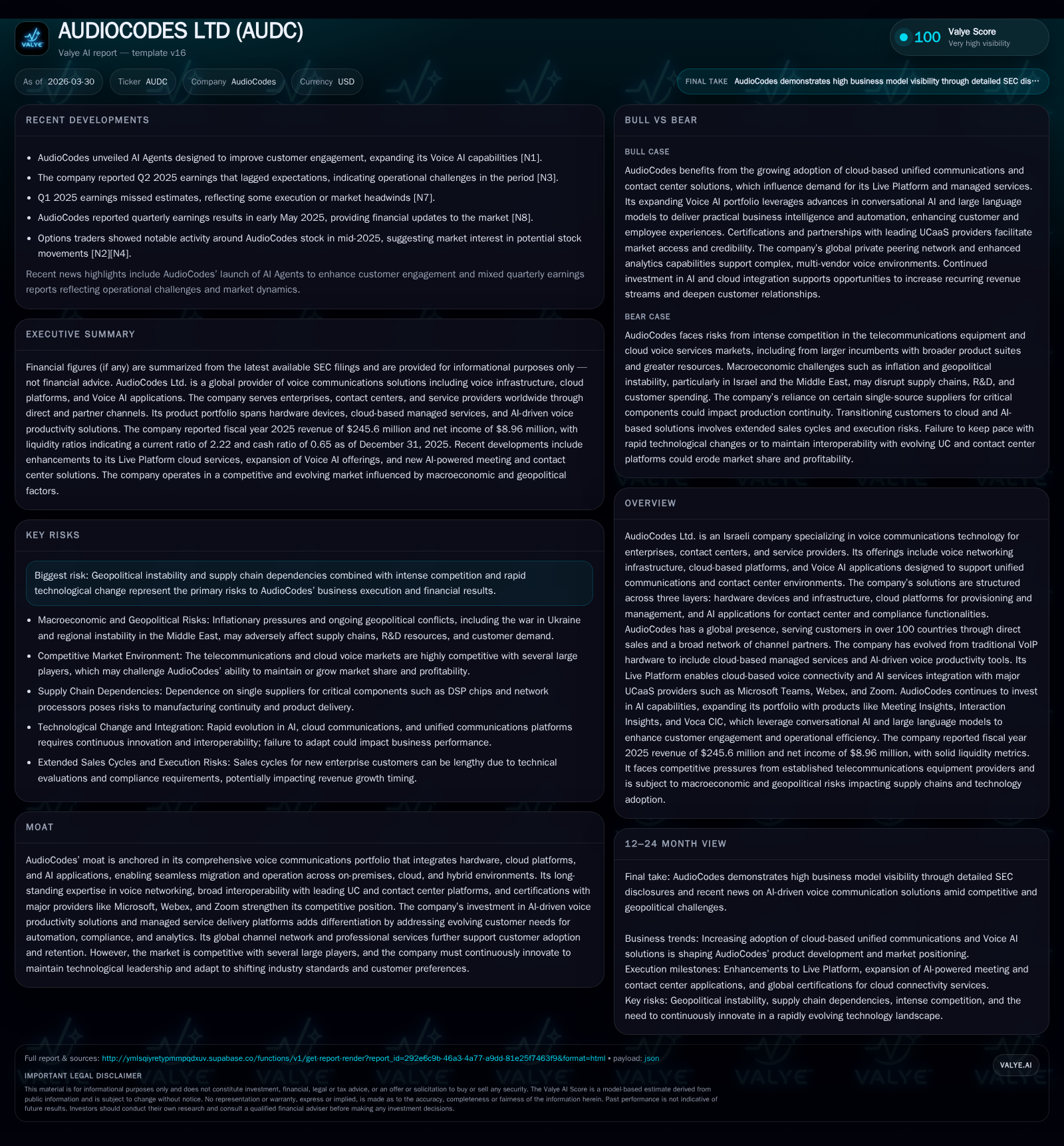
AudioCodes Ltd., an Israeli provider of voice networking infrastructure, cloud platforms, and AI-driven voice applications, saw modest revenue growth of 1.4% in 2025 to $246 million, despite a notable decline in profitability. The company’s long-term strength lies in its comprehensive portfolio that facilitates migration from traditional voice systems to cloud-based unified communications (UC) and contact center environments integrated with AI capabilities. However, earnings pressure from margin compression and geopolitical instability in Israel weigh on near-term performance. Capital allocation remains disciplined with $31 million in share repurchases and dividends totaling $11 million in 2025. Future growth hinges on scaling subscription-based managed services, leveraging partnerships with Microsoft Teams and other UCaaS platforms, and expanding Voice AI-driven solutions.
Company Overview
AudioCodes Ltd., headquartered in Israel and publicly listed on Nasdaq (AUDC) and the Tel Aviv Stock Exchange, specializes in voice communications technology targeting enterprises, contact centers, and telecommunications service providers [S1][S4][S5]. Founded in 1992 initially focusing on VoIP hardware technologies, it has progressively evolved into delivering fully integrated solutions spanning voice networking infrastructure (session border controllers, gateways, routers), cloud-based management platforms (Live Platform), and AI-powered voice applications for contact centers and productivity [S1][S13][S14].
The company's strategy emphasizes enabling clients’ migration from traditional telephony to cloud unified communications as a service (UCaaS), driven primarily through Microsoft Teams but also Webex and Zoom Phone ecosystems [S15][S16]. Its layered solution approach integrates hardware devices with managed cloud services and advanced Voice AI applications such as automated meeting transcription, compliance recording, and conversational AI agent platforms designed for modern hybrid workplace demands [S23][S18].
Global distribution relies on a two-tier channel model involving direct sales for larger enterprise deals plus an extensive network of resellers, system integrators, service providers, and value-added resellers active in over 100 countries [S4][S8]. This multi-channel go-to-market supports both one-time product sales (equipment plus professional services) and a growing "as-a-service" subscription model underlying recurring revenue growth [S14][S15].
Historical Financial Performance
AudioCodes reported revenues of approximately $246 million for fiscal year 2025—a modest increase of 1.4% compared to the prior year—after declines from the higher base seen in 2022 ($275 million) likely impacted by macroeconomic softness [F1]. Operating income contracted more sharply by about 18% to $14.0 million while net income plunged over 40% to $8.95 million year-over-year reflecting margin pressure from elevated operating costs amidst increased R&D investment focused on Voice AI solutions [F1][S7].
Operating cash flow remained robust at nearly $29.4 million despite the earnings drop but was offset by capital expenditures totaling $6.5 million—a steep reduction from the unusually high capex spend of almost $24.3 million in 2024 related primarily to ERP implementation [F1]. The company posted an estimated return on equity around 5%, indicative of subdued profitability relative to equity employed [F1].
Capital returns were active with combined dividends paid of roughly $11 million complemented by accelerated share repurchases reaching approximately $31 million within the fiscal year under court-approved buyback programs designed for shareholder value enhancement despite statutory profit limitations under Israeli law [F1][S6][S21]. Liquidity remains comfortable with cash equivalents exceeding $45 million against current liabilities yielding a current ratio above 2.2x [F1][S12].
Historical performance (annual)
| FY | Rev ($mm) | Net ($mm) | CFO ($mm) | OpInc ($mm) | Rev YoY | Net YoY |
|---|---|---|---|---|---|---|
| 2025 | 246 | 9 | 29 | 14 | +1.4% | -41.5% |
| 2024 | 242 | 15 | 35 | 17 | -0.9% | +74.4% |
| 2023 | 244 | 9 | 15 | 14 | -11.2% | -69.2% |
| 2022 | 275 | 28 | 8 | 31 |
Source: SEC companyfacts cache [F1].
Capital returns and efficiency (annual)
| FY | Div ($mm) | Buybacks ($mm) | FCF ($mm) |
|---|---|---|---|
| 2025 | 11 | 31 | 23 |
| 2024 | 11 | 14 | 11 |
| 2023 | 11 | 18 | 9 |
| 2022 | 12 | 38 | 7 |
Source: SEC companyfacts cache [F1].
Note: Capex spike in FY2024 driven mainly by ERP system rollout.
Market Environment & Competitive Positioning
AudioCodes operates within highly competitive segments serving enterprise session border controllers (competing with Oracle, Ribbon Communications, Cisco), analog/digital gateways (rivals include Grandstream, Sangoma), multi-service business routers (Cisco, Juniper), call recording/compliance software (Verint, NICE), Voice AI connectivity (Twilio), IP phones and meeting room devices (Yealink, Logitech), as well as managed services integrating UCaaS/CCaaS platforms [S10].
The rise of cloud adoption paired with Voice AI innovation underpins a converging unified communications/contact center landscape where customers demand scalable hybrid-cloud infrastructure supporting secure voice connectivity alongside real-time AI analytics for compliance and productivity enhancements [S19][S24]. AudioCodes leverages its legacy expertise while aggressively expanding its software-defined platform Live Platform along with VoiceAI Connect to integrate conversational AI ecosystems including large language models from Azure OpenAI GPT and Anthropic Claude [S23]. This positions it uniquely among primarily hardware-centric competitors.
Strategic partnerships constitute another moat dimension—certifications with Microsoft Teams, Cisco Webex, Zoom Phone—and collaborative go-to-market motion via global system integrators fosters broad solution adoption worldwide [S4][S16]. However, rapid technological change requires continued innovation investment while supply chain dependencies—such as reliance on DSP components from Texas Instruments—pose operational risks exacerbated by Israel-region geopolitical tensions connected to ongoing conflicts impacting R&D continuity and distribution channels [S10][S22].
Future Growth Prospects & Strategy
Looking forward, key growth drivers include:
- Expansion of subscription-based managed services including AudioCodes Live CX managed SBCs and Teams Phone integrations with BYOC capabilities,
- Increasing penetration into contact center as a service markets with Voca CIC solution built atop Microsoft Teams,
- Scaling Voice AI applications dedicated to compliance interaction recording, meeting intelligence powered by AI summarization tools,
- Broadening channel partnerships especially within UCaaS ecosystems,
- Capitalizing on legacy infrastructure transitions such as PSTN shutdown-related analog gateway replacement accelerated notably in North America [N/A] / [S19],[N/A]
Conversely growth could be capped or impaired by persistent competitive pressures across multiple product categories from entrenched incumbents offering bundled solutions or vendor financing programs; ongoing geopolitical uncertainties affecting supply chain or customer activity; speed of cloud migration adoption rates that may vary regionally; plus macroeconomic inflation driving preference toward pay-per-use OPEX models but also dampening discretionary tech spending especially for capital-intensive deployments [S10].
Monitoring & Milestones (Analysis)
With no explicit quantitative guidance disclosed in recent filings or press releases through March/April ‘26 [N/A], investors should track:
- Mix shift towards subscription versus traditional CAPEX sales reflecting sticky recurring revenues,
- Volume growth within managed service contracts linked to Live Platform,
- Adoption trends of Voice AI application suites such as Meeting Insights On-Prem notably among regulated industries demanding data sovereignty,
- Impact assessment from regional conflicts on delivery timelines or R&D throughput,
- New certifications or expanded interoperability deals within leading UCaaS vendors.
Returns & Capital Allocation
AudioCodes demonstrates prudent capital stewardship balancing reinvestment in innovation with shareholder returns:
- The company’s approximate ROE is moderate at ~5%, reflecting transition phase earnings pressure yet steady equity base resilience [F1],
- Positive operating cash flow performance alongside sharply reduced capex has yielded free cash flow around $22.9 million for FY2025 providing flexibility for buybacks/dividends;
- Dividends have been consistently maintained around the low double-digit millions annually while share repurchase activity spiked significantly last year to ~$31 million following court approvals facilitating repurchases even without statutory profit sufficiency under Israeli law [F1][S6][S21],
- Cash holdings remain robust enabling ongoing support for R&D investment despite macroeconomic uncertainties.
Conclusion
AudioCodes stands at a pivotal juncture characterized by stable revenue footing yet squeezed profitability due largely to heavy investments fueling transformation into an integrated cloud-managed services provider complemented by advanced Voice AI offerings across unified collaboration/contact center markets.
Its long industry tenure anchored by multi-layered product architecture—encompassing legacy hardware transitioning towards cloud-native SaaS delivery—and strong alliances with major ecosystem partners provide credible moats amidst intensifying competition.
Geopolitical risks coupled with large incumbent competitors necessitate sustained innovation velocity and operational agility. Monitoring shifts toward subscription uptake levels alongside Voice AI adoption will be critical barometers of success as AudioCodes aims to expand its footprint amidst persistent headwinds.
Disclaimer: This analysis is based solely on publicly available SEC filings dated up to March–April 2026 along with provided official company reports; it does not constitute investment advice or recommendations.
Disclaimer: This is research-only, informational analysis and not investment advice. It may include AI-generated interpretation and general industry context. Always verify important details using primary sources.

Comments