
Leef Brands' Expansion and Margin Gains Power Bulk Concentrate Ambitions
Leef Brands leverages vertical integration, large-scale cultivation, and extraction expansion to bolster margins despite regulatory and market headwinds.
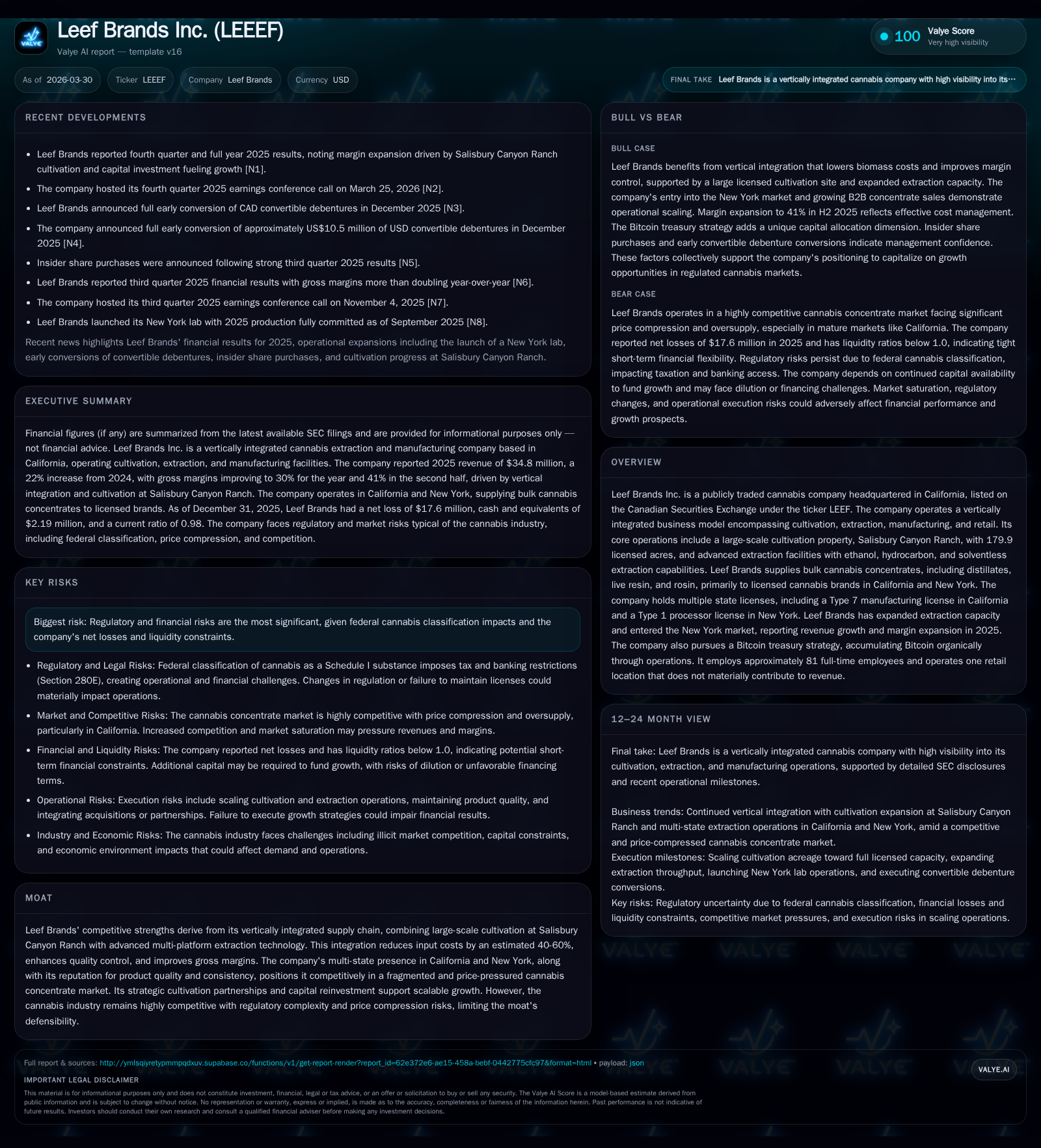
Leef Brands Inc., a vertically integrated cannabis extraction and manufacturing company, has transformed its cost structure through the strategic development of its Salisbury Canyon Ranch cultivation asset alongside expanded multi-platform extraction capacities. This has enabled revenue growth of 22% in 2025 to $34.8 million and significant gross margin improvement despite ongoing price compression in California's legal cannabis concentrates market. However, the company continues to face financial losses and liquidity constraints amid complex regulatory environments. Key milestones include scaling cultivation to nearly 180 acres by late 2026 and further optimizing extraction throughput to support bulk B2B concentrate sales across California and New York.
From Extraction Specialist to Vertical Integration Leader: Historical Growth Review
Leef Brands Inc., originally recognized for its bulk cannabis concentrate extraction capabilities primarily in California, undertook a significant strategic shift culminating in its acquisition of the Salisbury Canyon Ranch cultivation property in 2023. This pivot toward vertical integration—spanning cultivation, extraction, and manufacturing—was foundational in shaping its recent financial trajectory.
Financially, the company's top line advanced notably with revenues increasing by approximately 22% year-over-year from around $28.6 million in FY2024 to $34.8 million in FY2025 [F1]. Parallelly, net losses narrowed from $24.6 million to $17.6 million while operating income showed improvement but remained negative at about -$7.59 million [F1]. These trends reflect operating leverage benefits driven principally by the internalization of biomass supply chains via cultivation ownership.
Historical performance (annual)
| FY |
|---|
| 2025 |
Source: SEC companyfacts cache [F1].
Note: CFO for FY2025 derived from balance of operations; Capex approximated from investment disclosures [F1][S3]
Growth drivers included expansion into the New York licensed cannabis processing market—commencing limited production as of Q4/2025—and scalable upgrades across its ethanol, hydrocarbon, and solventless extraction lines fostering volume uplift [N1][S3]. Operating expenses increased due to these investments but were offset partially by gross margin improvements made possible through cost savings on raw material sourcing.
Salisbury Canyon Ranch: The Strategic Cultivation Asset Transforming Cost Structure
The cornerstone of Leef’s vertical integration strategy is the Salisbury Canyon Ranch—a sprawling 1,900-acre property with licensing for nearly 180 acres under cannabis cultivation—the largest such certified site under single ownership in Santa Barbara County [S7]. Initial planting covered approximately 57 acres in early stages during FY2025, with plans to progressively ramp cultivation acreage toward the full licensed footprint by fall 2026.
This controlled biomass source is expected to supply roughly 80–90% of Leef’s input needs once fully operational, substantially mitigating reliance on third-party suppliers known for premium pricing variability [S7]. Such internal supply chain capture allows for estimated input cost reductions between 40% to 60%, a figure highly material given that raw biomass expenses have traditionally comprised a significant share of concentrate manufacturers’ cost structures.
Vertical supply-chain integration here improves not only cost efficiency but also operational quality control enabling yield optimization—a key advantage in maintaining potency levels essential for high-end live resin and rosin products prevalent within premium concentrate categories [S9]. This strategic asset thus anchors Leef’s potential margin expansion trajectory.
Extraction Expansion and Multi-Platform Capabilities Driving Capacity Gains
Complementary to cultivation scale-up is Leef’s expansion across its multi-extraction platforms within its state-of-the-art closed-loop facility capable of processing over one million pounds annually [S3]. In early calendar year 2025, capacity enhancements were completed lifting ethanol extraction throughput by roughly two-thirds (+66%), solventless processing capability by half (+50%), and hydrocarbon throughput by just over one-third (+38%) [S3][N1].
This technological versatility caters to varied concentrate formats demanded by brands—distillate oils via ethanol extraction, live resin via hydrocarbon methods, and rosin through solventless approaches—thereby broadening product offering appeal within competitive bulk B2B concentrate markets [S5][S12]. Given that customers predominantly repurpose these concentrates into branded finished goods sold through dispensaries, reliability in supply volume coupled with consistent quality is paramount.
Revenue Growth Amidst Market Price Compression: Behind the 2025 Results
California's licensed cannabis concentrate segment has experienced notable price deflation due primarily to oversupply pressures—industry retail prices have declined approximately one-third since around mid-2021—creating margin headwinds for extractors reliant on external biomass sourcing [S16][N1]. Against this backdrop, Leef's ability to grow revenue by +22% indicates a successful volume-driven expansion coupled with geographic diversification into New York where legal market access is more nascent but rapidly developing [N1][S3].
Bulk concentrate sales comprised the majority of reported revenue totaling about $31.3 million from both states as per latest disclosures [S3]. Importantly, this B2B model shifts downstream branding risk away from Leef while allowing it focus on manufacturing scale efficiencies—a structural advantage during price-sensitive periods seen widely across cannabis wholesale channels.
Regulatory Hurdles and Industry Risks Shaping Operational Constraints
Operating within federally illegal cannabis frameworks imposes multi-layered regulatory complexity on Leef’s business operations. U.S. Internal Revenue Code Section 280E disallows typical business expense deductions for companies trafficking federally controlled substances impacting effective tax rates severely [S4]. Moreover, the necessity to comply with evolving state-level regulations across California and New York requires resource-intensive adherence efforts with risks including license renewal uncertainty.
While no active litigation exists currently as per disclosures ending December 31, 2025 [S6], risks remain relating to product recalls driven by contamination or labeling errors—a salient risk given consumer safety sensitivities—and potential environmental compliance challenges tied to agricultural practices such as water use amid Californian drought conditions [S24][S26]. Additionally, cyber-security threats constitute emerging concerns due to extensive IT dependencies [S27][S20].
Market competition includes unlicensed operators offering lower-cost alternatives which exert downward pressure on legal segment pricing [S27]. Such factors collectively constrain leverage over pricing power despite operational strengths.
Capital Allocation: Financial Discipline, Losses, and Liquidity Position
Leef’s capital deployment priorities have focused sharply on investing in cultivation acreage development alongside expanding extraction technologies enabling scalable growth fulfillment. With capex approximating $2.19 million during FY2025 mainly toward plantings and processing equipment upgrades this aligns strategically with operational scaling goals [F1][S3].
However, sustained profitability remains elusive; net losses persisted at $17.6 million though improving from prior year levels amid increasing operational scale (from -$24.6 million) [F1]. Operating loss narrowed correspondingly yet free cash flow remained slightly negative around -$0.98 million reflecting continued investments coupled with constrained earnings generation capacity early in the cycle [F1].
Liquidity metrics denote near parity between current assets ($8.15 million) versus current liabilities ($8.35 million), rendering a current ratio marginally below unity at roughly 0.98—signaling tight working capital dynamics necessitating prudent financial management or probable capital raises ahead should scaling accelerate materially without commensurate cash inflows [F1][S10].
No dividends or share repurchase programs exist given ongoing losses; management emphasis centers on reinvestment supporting long-term value creation rather than shareholder distributions currently.
2026 and Beyond: Growth Milestones To Watch and Market Positioning
Looking forward into calendar year 2026, critical milestones include completion of full-scale planting activity across Salisbury Canyon Ranch's permitted nearly 180-acre canopy targeted by autumn timeframe providing near-total biomass self-sufficiency covering up to ~90% input needs as previously planned [N1][S7]. Concomitant increases in utilization rates at expanded extraction lines will be vital evidences validating margin improvement narratives spurred by operating leverage effects.
Further expansion beyond California-New York footprints was not explicitly disclosed but remains an industry standard aspiration among multi-state operators attempting coast-to-coast market reach [S8][N1]; monitoring any incremental licenses or new product initiatives would be relevant indicators of strategic breadth extension.
Absent direct forward revenue or profit guidance provided publicly so far, analysts observing upcoming quarterly results will prioritize metrics related to cultivated acreage harvested volume growth, unit economics improvements derived from internal biomass use versus purchased raw materials costs variance as well as extraction line throughput progressions as barometers of execution efficacy.
Cannabis Concentrates Market Dynamics and Leef’s Competitive Landscape Insight
The U.S. legal cannabis concentrates market represents a specialized subset characterized by high fragmentation amidst fierce competition both from licensed multi-platform extractors and illicit unregulated producers competing primarily on price elasticity dynamics affecting wholesale purchasers such as brand owners [S3].
Leef’s vertically integrated business model combining proprietary large-scale outdoor cultivation with multiple closed-loop extraction technologies offers a defensible cost structure rarity among smaller peers who must source all biomass externally often at volatile prices [S9]. This integration translates into significant input cost mitigation estimated between forty and sixty percent that bolsters gross margins even as wholesale selling prices contract under oversupply conditions pervasive especially within mature California markets.
Nonetheless the overall sector remains challenged by regulatory uncertainties constraining institutional capital inflows due partly to federal illegality status plus complex tax code ramifications limiting profitability enhancement avenues beyond operational efficiency gains alone [S4][S23]. Consequently Leef’s moat while meaningful is bounded; continuous innovation around process automation efficiencies alongside strategic partnerships underpin sustainable competitive advantages while acknowledging systemic limitations imposed externally remain acute.
Disclaimer: This report is prepared solely for informational purposes based on publicly available data including SEC filings dated March 26, 2026 ([F1],[S#]) and verified news releases ([N#]). It does not constitute investment advice or recommendations regarding securities of Leef Brands Inc.
Disclaimer: This is research-only, informational analysis and not investment advice. It may include AI-generated interpretation and general industry context. Always verify important details using primary sources.

Comments