
How TELA Bio Shapes Soft-Tissue Reconstruction Through Innovation and Capital Strategy
TELA Bio leverages proprietary reinforced tissue matrix technology and strategic capital management to grow in a competitive soft-tissue reconstruction market while managing persistent operating losses.
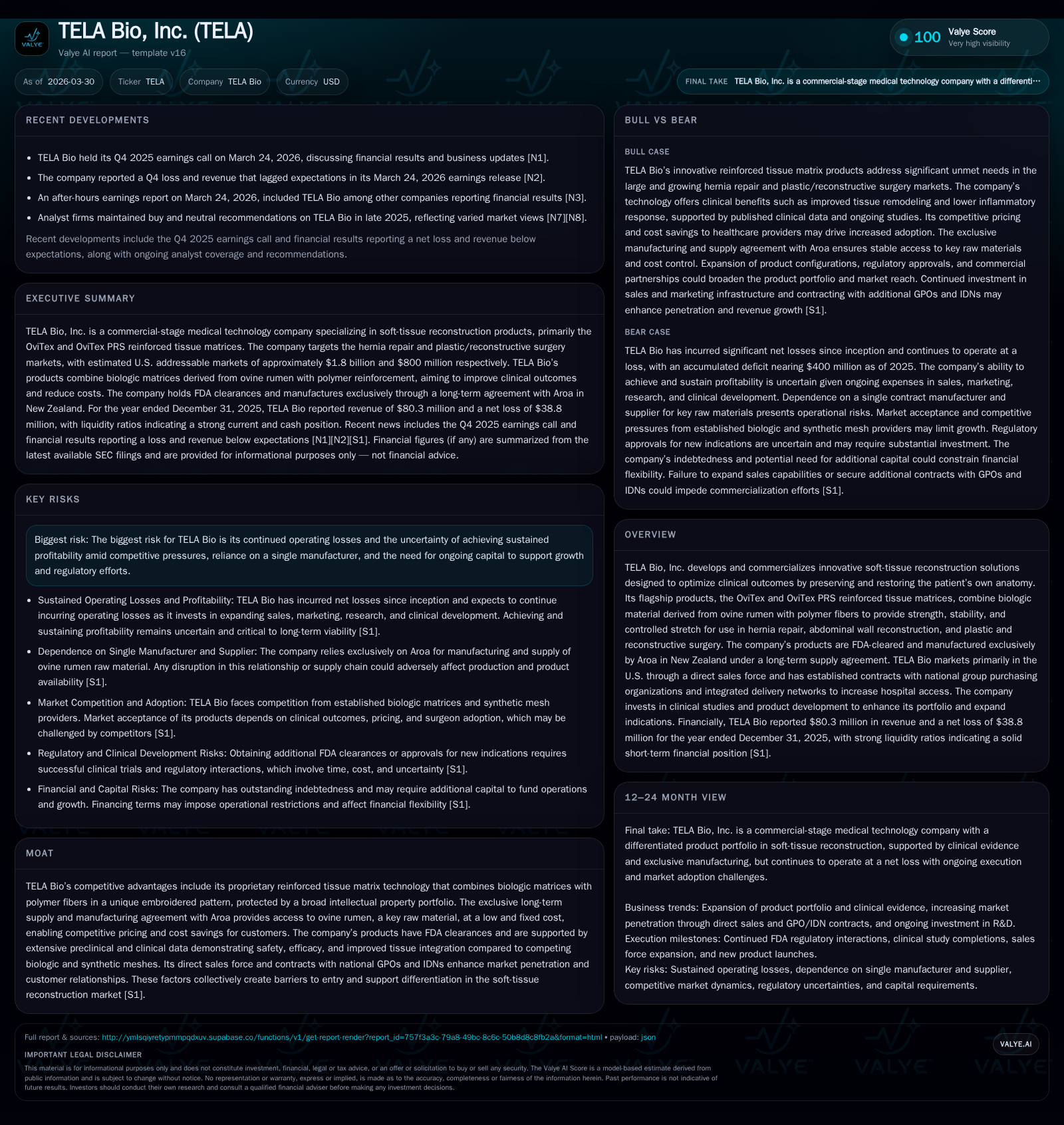
TELA Bio, Inc. markets innovative OviTex reinforced tissue matrices combining ovine-derived biologic material with polymer fibers for hernia repair and soft-tissue reconstruction. The company’s growth is supported by FDA clearances, clinical validation, a focused U.S. direct sales effort, and contracts with national GPOs and IDNs that enhance hospital penetration. Despite persistent net losses exceeding $38 million in 2025 [F1], TELA Bio benefits from a stable supply agreement with Aroa and invests in R&D for product enhancements. Its $60 million indebtedness with restrictive covenants imposes financial constraints, challenging the path to profitability amid evolving regulatory and competitive pressures [S1][S6][S7].
Innovative Reinforced Tissue Matrix Technology Drives Early Success
TELA Bio's core technology centers on its OviTex reinforced tissue matrices, which integrate biologic material derived from ovine rumen with polymer fibers arranged in a patented embroidered pattern. This hybrid design aims to harness the biologic's natural healing properties alongside the mechanical strength provided by polymers—addressing limitations observed in purely synthetic or biologic meshes. These matrices are FDA-cleared and positioned primarily for use in hernia repair, abdominal wall reconstruction, and plastic/reconstructive surgery.
The exclusive long-term manufacturing agreement with Aroa Biosurgery in New Zealand secures stabilized access to ovine rumen raw material at fixed costs, enabling competitive pricing structures that appeal to hospital procurement specialists. Clinical evidence supports OviTex products’ safety profile and improved tissue integration compared to legacy biologic/synthetic meshes; this is reflected in published studies including the notable BRAVO trial showing low recurrence rates (2.6% at 24 months) in ventral hernias treated using OviTex matrices [S1].
This technology creates differentiation obstacles for competitors: the embroidery not only reinforces mechanical stability but facilitates controlled stretch accommodating patient anatomy variations—a feature not broadly replicated across alternatives. Moreover, OviTex addresses challenges of chronic inflammation commonly linked to synthetic-only implants by integrating biologic components.
Market Footprint and Sales Strategy: Direct Force and GPO/IDN Penetration
TELA Bio’s commercialization predominantly targets the U.S., where hernia repair accounts for approximately 1.2 million surgeries annually representing an estimated $1.8 billion addressable market based on OviTex pricing levels [S1]. The company employs a direct sales force concentrated on hospital accounts coupled with contracts spanning three national Group Purchasing Organizations (GPOs) along with Integrated Delivery Networks (IDNs). This dual approach facilitates deeper penetration of hospital systems by easing purchasing pathways.
Beyond basic coverage expansion, TELA Bio continuously refines sales force effectiveness through customer segmentation analytics, targeted physician education programs, clinical engagement initiatives, and leveraging medical affairs support to accelerate surgeon adoption. These tactics optimize resource allocation while addressing procedural variability such as open versus robotic-assisted hernia repairs which now have dedicated product configurations (e.g., OviTex LPR launched in late 2018; larger sizes introduced subsequently) [S6].
Contracting with national GPOs reduces friction for hospital supply chain managers while IDN relationships facilitate systematic inclusion in bundled service agreements encouraging wider utilization across affiliated facilities. This layered go-to-market strategy reflects sector best practices ensuring both breadth (via GPOs) and depth (direct rep contacts) during early-stage growth phases.
Analyzing Historical Financial Trends: Growth, Losses, and Operating Cash Flow
Despite its technical advances and market positioning efforts, TELA Bio’s financial performance exhibits ongoing significant operating losses concomitant with investment-driven growth dynamics.
Historical performance (annual)
| FY | Net ($mm) | CFO ($mm) | OpInc ($mm) | Capex ($) | Net YoY |
|---|---|---|---|---|---|
| 2025 | -39 | -28 | -34 | 448000 | -2.6% |
| 2024 | -38 | -42 | -34 | 989000 | +18.9% |
| 2023 | -47 | -41 | -44 | 611000 | -5.3% |
| 2022 | -44 | -41 | -39 | 872000 |
Source: SEC companyfacts cache [F1].
Capital returns and efficiency (annual)
| FY | FCF ($mm) | ROE% |
|---|---|---|
| 2025 | -29 | -615.1 |
| 2024 | -43 | -133.0 |
| 2023 | -41 | -247.1 |
| 2022 | -42 | -309.7 |
Source: SEC companyfacts cache [F1].
These figures underscore several points: First is the persistence of sizeable net losses exceeding $38 million as of FY2025 combined with operating income consistently negative though relatively stable year over year (+1.1%). The operating cash flow improvement of over 30% suggests some efficiency gains or better working capital management despite continuing negative free cash flow after accounting for minimal CAPEX expenditures ($448K in FY2025 reflects curtailed investment spending). Capital expenditures have notably contracted more than half since FY2024 indicative of scaled-back fixed asset investments possibly reflecting mature plant-build phases or tighter cost controls.
Equity position diminished sharply from $28 million at end-2024 to just $6.3 million by end-2025 highlighting capital erosion consistent with accumulated deficits near $398 million [F1]. Calculated return on equity is deeply negative (~-615%), emphasizing absence of profitability adversely impacting shareholder value.
Understanding Capital Structure, Indebtedness, and Liquidity Constraints
Capital management at TELA Bio reflects its developmental stage: On November 14th 2025 it closed a $60 million senior secured credit facility with Perceptive Credit Holdings V LP maturing in November 2030 featuring an interest rate approximate to prime plus ~7.85%, subject to minimum floor rates [S7][S21]. Accompanying financial covenants impose strict restrictions including prohibiting additional debt issuance without consent — effectively limiting recapitalization options — barring dividend payments or significant investments absent lender approval.
At fiscal year-end 2025 the company maintained liquidity of roughly $50.8 million cash plus equivalents against current liabilities near $17.9 million yielding a robust current ratio circa 4.2x supporting short-term obligations comfortably [F1]. However this strong liquidity must be weighed against sustained cash burn indicated by trailing negative operating cash flows emphasizing ongoing funding need until positive EBITDA emergence.
Debt service on the term loan imposes repeated capital deployment requirements potentially constraining financial flexibility needed for aggressive commercialization or expanded R&D spend; breach of covenants could trigger acceleration risking foreclosure events severely impacting operational continuity [S1][S7]. Equity capital raises remain critical given the growing accumulated deficit nearing $400 million constraining balance sheet strength.
Research, Development, and Pipeline Prospects to Extend Product Portfolio
TELA Bio continues active investment into iterative enhancements of its flagship OviTex product line focusing on augmentations such as longer-acting resorbable polymers aimed at improving matrix durability tailored for diverse surgical indications where biological remodeling timelines differ substantially [S6][N1]. Packaging innovations pursuing extended shelf life also reflect operational responsiveness to clinician feedback optimizing logistics.
Further exploratory research involves higher-margin polymer-based devices as well as complementary technologies broadening application scope within soft tissue reconstruction beyond hernia repair encompassing plastic surgery domains where wound healing dynamics differ widely [S6]. Given industry norms where clinical acceptance hinges critically on robust data generation supporting efficacy/safety profiles these R&D expenditures are vital yet costly prerequisites underpinning reimbursement negotiations and surgeon preference shifts.
Navigating Regulatory and Intellectual Property Risks Impacting Operations
Operational risks tied intricately to regulatory compliance surface amid evolving FDA device oversight regimes intensified post-Medical Device Regulation reforms affecting both U.S./EU markets [S12][S18]. Diligent adherence is mandatory around labeling modifications due to design updates or adverse event reporting obligations lest regulatory sanctions including fines or import/export restrictions arise jeopardizing market access.
The patent environment presents heightened challenges given rapid technology proliferation driving potential infringement claims raising litigation risk costly both monetarily due to damages or royalties payable but also strategically by diverting key resources during protracted adjudication periods [S4][S5][S14]. Sole reliance on contract manufacturing by Aroa necessitates vigilance towards supply chain disruptions given limited alternative manufacturers certified for the specialized ovine-derived material processing critical for product consistency.
Healthcare laws imposing anti-kickback statutes alongside transparency mandates heighten commercial compliance burdens enforcing carefully structured interactions between sales teams and surgeon stakeholders adding overhead while reducing risk exposures from potential violations that could elicit regulatory penalties impacting business reputation [S9][S11].
Additionally external market pressures from increasing governmental healthcare cost containment initiatives challenge pricing power illustrating continuing reimbursement uncertainty risking revenue growth if payors reject premium-priced advanced solutions despite clinical merits [S16][S25].
What to Watch: Catalysts for Scale, Profitability Milestones, and Operational Leverage
Forward-looking indicators center on accelerating adoption metrics from key U.S. hospital clients via deepened GPO/IDN contract coverage enabling expanded procedural volumes driving revenue ramp recorded during recent earnings season commentary suggesting moderate progress albeit revenue estimates lagging consensus expectations noted Q4/2025 results [N1][N2].
Critical upcoming clinical readouts validating long-term outcomes vis-à-vis competing meshes could solidify surgeon buy-in further enhancing switching economics necessary to overcome entrenched incumbents thereby unlocking scale advantages sustaining margin improvement trajectories warranted given high fixed cost base particularly R&D amortization.[S6]
Success in advancing pipeline expansion into higher-margin resorbables may additionally tilt overall portfolio profitability upwards mitigating risks inherent in mature legacy product lines facing commoditization effects common within surgical implant sectors.
On the capital front vigilance remains warranted respecting debt covenant compliance under the Perceptive credit facility especially considering ongoing cash burn trends mitigated somewhat by disciplined CAPEX controls; ability or failure thereof will influence strategic optionality including future financings or partnership pursuits.[S7]
In sum, TELA Bio’s business model converges innovative bio-polymer composite technology with disciplined commercial execution but contends simultaneously with structural challenges characteristic of emerging medtech companies still distilling proof-of-concept into durable economic returns.
Disclaimer: This is research-only, informational analysis and not investment advice. It may include AI-generated interpretation and general industry context. Always verify important details using primary sources.

Comments