
American Exceptionalism Acquisition Raises $345 Million in IPO, Focuses on Trust Fund Preservation
Since its September 2025 IPO, American Exceptionalism Acquisition Corp. A has maintained capital in a trust while preparing for a business combination under a strict 24- to 27-month deadline.
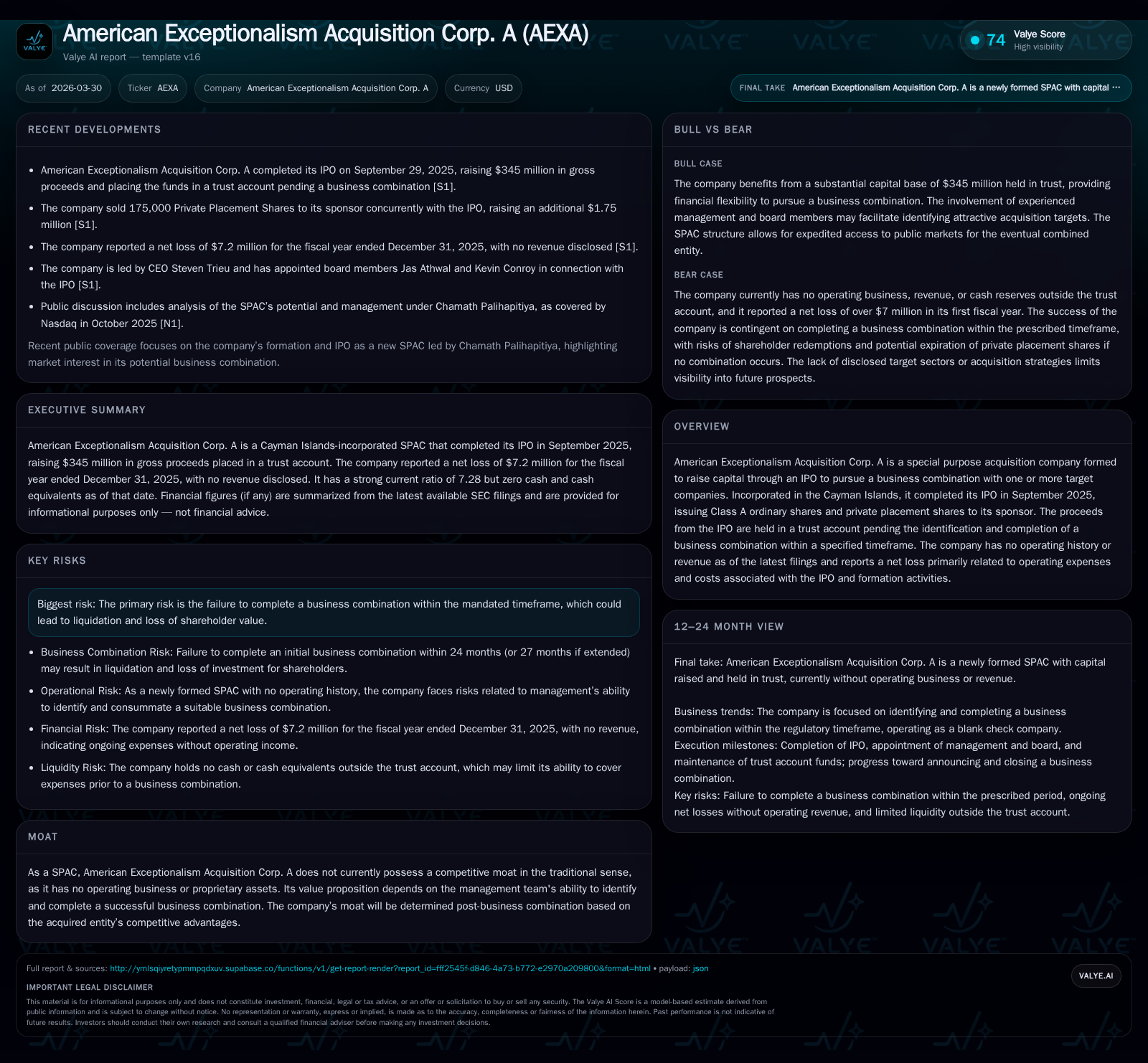
American Exceptionalism Acquisition Corp. A (ticker: AEXA) completed its IPO in September 2025, raising $345 million and placing proceeds into a trust pending a business combination. As a blank check SPAC with no operating revenues, its historical financials reflect standard formation and IPO expenses leading to net losses. Future growth depends entirely on successful identification and execution of a target merger or acquisition within the mandatory 24- to 27-month timeframe, after which liquidation is compelled. Careful management of shareholder dynamics during the initial business combination vote and potential share redemptions underscores governance complexities in this sector. Absent operating cash flows, capital allocation currently centers on preserving trust account funds and adhering closely to regulatory mandates.
Company Overview
American Exceptionalism Acquisition Corp. A (AEXA) is a newly formed special purpose acquisition company (SPAC), incorporated in the Cayman Islands. It launched its initial public offering (IPO) on September 29, 2025 [S6][S8], raising gross proceeds of approximately $345 million by issuing 34.5 million Class A ordinary shares at $10 each, inclusive of the underwriters’ overallotment option [S6][S8]. Concurrently, it sold private placement shares to its sponsor totaling $1.75 million [S8][S10]. These proceeds were placed into a U.S.-based trust account managed by Continental Stock Transfer & Trust Company at JPMorgan Chase Bank [S6][S8].
As a blank check company, AEXA currently does not generate any revenue nor has it commenced operations beyond organizational activities [F1]. The net loss for its first reporting year ending December 31, 2025 amounts to approximately $7.2 million, largely attributable to operating expenses associated with company formation, underwriting fees, legal costs, and other IPO-related expenditures [F1]. This is typical for SPACs in their pre-merger phase.
Historical Financial Performance
Given its nascent status, financial history comprises solely internal costs with no top-line activity or operational cash flow generation:
Historical performance (annual)
| FY |
|---|
| 2025 |
Source: SEC companyfacts cache [F1].
(Data sourced from latest SEC XBRL filings as of March 2026 [F1])
The high current ratio primarily reflects the segregation of trust account funds from operating assets and liabilities. Cash equivalents are reported as zero due to classification where IPO proceeds reside exclusively in the segregated trust account rather than general corporate cash balances [F1].
Industry Context: SPAC Lifecycle and Structure
SPACs like AEXA serve as investment vehicles designed to raise capital through an IPO with the intent to acquire or merge with an operating business within a defined timeframe. The company benefits from exemption from SEC Rule 419 due to net tangible assets exceeding $5 million at IPO closing, allowing immediate tradability of shares and longer periods to complete an initial business combination (IBC) compared to traditional blank check companies [S1].
Governance complexities include potential insider purchases of public shares before or after shareholder votes on the IBC that may reduce public float and influence transaction approvals without using trust funds [S1]. Additionally, shareholder redemptions face restrictions when holdings exceed 15% ownership thresholds unless consented by the board [S1]. Failure to consummate an IBC within prescribed deadlines results in mandatory liquidation and distribution of remaining trust funds pro rata to public shareholders [S1][S9].
Future Growth Prospects
The company's growth outlook hinges entirely on identifying and executing an accretive initial business combination within the regulatory timeframe:
- Successful target identification with sustainable competitive advantages will define future operational performance.
- Navigating shareholder approval processes while managing redemption rights remains critical.
- Deal structuring must satisfy minimum net worth or liquidity conditions stipulated in definitive agreements.
No explicit guidance or milestones have been publicly disclosed beyond regulatory deadlines as of early 2026; market participants should monitor forthcoming proxy statements or definitive agreement announcements for updates.
Capital Allocation and Returns
Capital deployment since inception has focused on preservation and compliance:
- All gross proceeds ($345 million plus $1.75 million private placement) are held in a segregated U.S.-based trust account earning interest that may be used solely for tax obligations [S6][S8][S10].
- No dividends or share repurchases have occurred; such actions await operational cash flow generation post-combination.
- Management retains authority to negotiate share purchases from public shareholders outside redemption processes subject to securities laws but does not use trust funds for these transactions [S1].
Return metrics such as return on equity currently do not reflect economic performance due to absence of operating earnings; an approximate ROE derived from accounting figures stands at +36% but is not indicative of cash returns or profitability [F1].
Governance Considerations
Following the IPO close, independent directors Jas Athwal and Kevin Conroy were appointed with roles overseeing audit, compensation, nominating, and governance committees to ensure transaction integrity prior to any business combination execution [S7]. Directors have indemnity agreements consistent with industry standards for SPAC leadership navigating complex negotiations.
Redemption limits restrict shareholders or groups exceeding 15% ownership from redeeming all such shares without board approval—potentially limiting liquidity during vote periods [S1]. Insider share purchases intended to influence shareholder composition comply with Exchange Act rules including Rule 14e-5 regarding tender offers [S1].
Key Risks
Risks primarily stem from failure to complete an IBC within mandated deadlines (24 months extendable up to three months upon timely definitive agreement execution), triggering liquidation with only pro rata return of trust funds minus expenses—eliminating upside potential for public investors expecting combined entity growth [S1][S9]. Additional risks include intense competition among SPACs for quality targets, shareholder voting complexities potentially impeding approvals, and reliance on sponsor team capabilities absent operating history.
Conclusion & Monitoring Points
American Exceptionalism Acquisition Corp. A exemplifies a modern SPAC positioned between capital formation vehicle and future operating entity. Its success depends wholly on executing a value-accretive business combination while managing multifaceted stakeholder dynamics before expiration deadlines. Investors should monitor disclosures around:
- Definitive agreement announcements,
- Proxy statements detailing deal terms and shareholder votes,
- Changes in redemption policies or insider ownership levels,
- Regulatory updates affecting timelines or governance provisions. Absent definitive transactional progress, financial reporting will continue reflecting administrative expenses without operational results. Post-combination performance will reveal fundamental value creation capabilities stemming from this initial capital formation exercise.
This analysis is based solely on publicly filed SEC documents as of March 30, 2026 ([S1]-[S12]) along with company facts data snapshot ([F1]). It excludes non-public information or speculative content and is provided solely for informational purposes without investment recommendations.
Disclaimer: This is research-only, informational analysis and not investment advice. It may include AI-generated interpretation and general industry context. Always verify important details using primary sources.

Comments