
Interpace Biosciences’ Transition Focuses on Thyroid Cancer Testing Amid Reimbursement and Competitive Pressures
Interpace Biosciences concentrates on thyroid cancer molecular diagnostics following discontinuation of its pancreatic test due to reimbursement challenges.
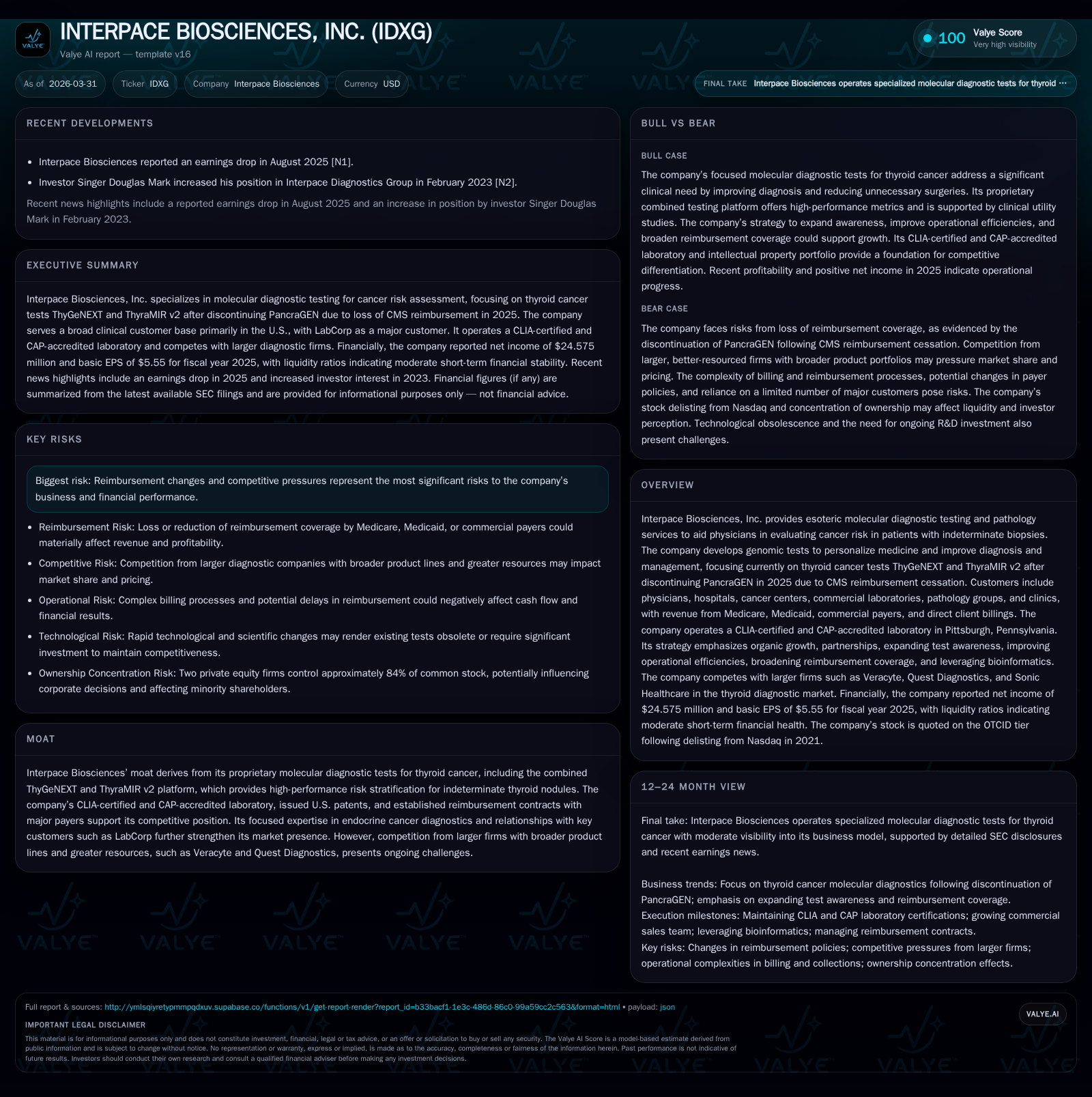
Interpace Biosciences has shifted its strategic focus exclusively to its molecular diagnostic tests for thyroid cancer, ThyGeNEXT and ThyraMIR v2, after CMS ceased reimbursement for its PancraGEN test in 2025. This move responds to significant regulatory headwinds and intensifying competition within the specialty molecular diagnostics space. The firm’s financial trajectory shows a recovery with profitability restored in 2025, driven by operational efficiencies and a refined product portfolio targeting a sizable oncology diagnostics market. However, reimbursement risks and the need for clinical utility data remain key growth constraints.
Company Overview and Business Model
Interpace Biosciences specializes in esoteric molecular diagnostic testing primarily aimed at improving cancer risk evaluation in patients with indeterminate biopsy results. Its testing portfolio currently centers on thyroid cancer through its proprietary genomic suite: ThyGeNEXT® and ThyraMIR® v2. These tests combine next-generation sequencing with microRNA profiling to enhance diagnostic precision beyond traditional cytopathology.
Historically, Interpace also offered PancraGEN®, an assay assessing pancreatic cyst progression risk to cancer. However, this product was discontinued in May 2025 following the Centers for Medicare & Medicaid Services (CMS) ceasing coverage effective April 24, 2025—a development emblematic of reimbursement volatility in diagnostics [S1][S20].
The company’s laboratory operates under CLIA certification and CAP accreditation out of Pittsburgh, ensuring compliance with quality standards critical for clinical adoption. Its customer segments are broadly healthcare providers including hospitals, physicians, pathology groups, commercial labs, and specialized cancer centers. Significant payer channels include Medicare (traditional and Advantage), Medicaid, commercial insurers such as Blue Cross Blue Shield and UnitedHealthcare, complemented by direct client billing [S20][S24].
Historical Performance and Financial Trajectory
The revenue trend reflects a pronounced decline over recent years, largely owing to the loss of PancraGEN reimbursement and related volumes:
Historical performance (annual)
| FY | Net ($mm) | CFO ($mm) | OpInc ($mm) | Capex ($) | Net YoY |
|---|---|---|---|---|---|
| 2025 | 25 | 6 | 4 | 356000 | +266.7% |
| 2024 | 7 | 5 | 8 | 876000 | +735.7% |
| 2023 | 1 | 4 | 3 | 470000 | +103.7% |
| 2022 | -22 | -8 | -4 | 322000 |
Source: SEC companyfacts cache [F1].
Capital returns and efficiency (annual)
| FY | FCF ($mm) | ROE% |
|---|---|---|
| 2025 | 5 | 109.9 |
| 2024 | 4 | -302.3 |
| 2023 | 3 | -1.3 |
| 2022 | -8 | 34.8 |
Source: SEC companyfacts cache [F1].
*Note: Net income in FY2025 includes items that materially elevated profitability beyond operating income levels [F1]. Revenue data for FY2023-25 were not explicitly disclosed.
The shift back to operating profitability post-2022 stems from cost reductions linked to ceasing PancraGEN operations alongside tighter management of general expenses amid revenue pressure [F1][S11]. Operating cash flow has improved consistently since negative outflow in 2022 (–$7.7 million), turning positive at nearly $5.8 million by year-end 2025 with capital expenditures maintained relatively low—implying a capital-efficient business structure supportive of near-term sustainability.
Equity turnaround from significant deficits toward a positive net position ($22.4 million equity at end-2025) suggests a recapitalization or profitable retention of earnings [F1][S23]. No substantive share repurchase activity is noted recently; prior buybacks concentrated around mid-2010s before delisting issues limited public market financing options.
Market Position and Competitive Moat
Interpace’s moat lies predominantly in its proprietary thyroid cancer molecular diagnostics platform combining ThyGeNEXT's gene panel with ThyraMIR's microRNA classifier—tools that offer additive clinical value by stratifying malignancy risk more precisely than conventional methods.
Its CLIA-certified lab operations undergird consistent quality control necessary for complex genetic assays while patent protections safeguard key technology aspects against immediate replication [S1][S6][S26]. Strategic partnerships like that with LabCorp expand distribution reach into large commercial laboratory networks.
Nevertheless, the company confronts formidable competition from larger diagnostic players such as Veracyte and Quest Diagnostics which boast wider product arrays and larger sales forces—a significant barrier given economies of scale in payer negotiations and physician outreach [S6][S24]. The molecular diagnostics sector also demands persistent innovation to stay current with rapidly evolving scientific knowledge—a challenging endeavor given resource constraints relative to larger peers.
Growth Prospects and Constraints
Future growth hinges on several pillars:
- Expanding Clinical Adoption: Driving physician awareness and confidence through new clinical utility studies validating the impact of assays on patient management decisions is critical to uptake [S25]. Older studies may not align fully with evolving standards; thus generating updated peer-reviewed data will be imperative.
- Reimbursement Strategy: Securing broad payer coverage remains fundamental amid tightening CMS policies post-PancraGEN episode; internal managed care efforts target both maintaining existing reimbursement agreements and developing new contracts particularly with commercial insurers [S1][S24].
- Product Pipeline: The company plans continued R&D investment aimed at enhancing bioinformatics capabilities embedded within assays to better correlate genetic markers with cancer progression risk—potentially differentiating offerings further while seeking synergistic acquisitions or partnerships for technology expansion [S24].
- Operational Efficiencies: Ongoing restructuring has reduced fixed costs; judicious scaling of sales resources aligned with demand can preserve margins amid competitive pricing pressures.
Conversely:
- The decision by CMS to cease PancraGEN reimbursement underscores vulnerability to abrupt policy shifts affecting revenue streams profoundly; similar future actions could affect remaining tests if clinical utility or cost-effectiveness isn’t adequately demonstrated [S1][S12].
- Potential FDA regulatory changes concerning Laboratory Developed Tests (LDTs) pose compliance uncertainties that could increase costs or delay product introductions if additional approvals or studies are mandated [S8][S9][S26].
- Competitive pricing pressures from entities leveraging broader portfolios might force price concessions jeopardizing profitability [S6].
- Intellectual property challenges and litigation risks remain an ongoing concern requiring defensive legal resource allocation [S16][S22].
Outlook and Milestones to Watch (Analysis)
The latest SEC filings do not provide explicit financial guidance or projected milestones beyond strategic focus areas described for fiscal year ending December 31, 2025 [N/A], hence performance outlook depends largely on execution against stated initiatives:
- Successful completion and publication of updated clinical utility studies validating thyroid test efficacy.
- Broadened insurance coverage sustaining or improving reimbursement rates across Medicare Advantage and commercial payers.
- Progress in integrating enhanced bioinformatics tools enabling improved genomics interpretation.
- Stability or growth in specimen testing volumes through expanded physician adoption.
Given the structural shift away from PancraGEN-related revenues and intensified competition dynamics in a highly specialized niche segment within oncology diagnostics, regained momentum will be closely tied to payor relations and tangible evidence supporting tests’ impact on clinical decision-making.
Capital Allocation and Returns
The company’s robust operating cash flows ($5.83 million FY25) after minimal capex expenditure ($360k) highlight generation of near free cash flow ($5.47 million) indicative of solid operational leverage within current scale—important for funding R&D or potential strategic initiatives internally without immediate external capital raising needs [F1].
No recent dividend payments or stock repurchases are reported post-delisting era; retainment of earnings supports financial flexibility amid uncertain capital markets access due to OTC listing status [F1][S23][N/A].
Return on equity calculated approximately at ~110% based on latest net income relative to equity reflects recovery from prior operational losses partially inflated by non-operating factors but nonetheless demonstrates improved capital efficiency compared to recent years when equity was deeply negative [F1].
Regulatory Compliance and Legal Environment
Maintaining CLIA certification along with CAP accreditation remains critical operational prerequisites ensuring test validity under federal oversight [S1][S26]. While FDA enforcement discretion currently applies allowing operation without premarket approval submissions for these LDTs there remains impending uncertainty if regulatory regimes tighten which might necessitate costly filings or adjustments.
Moreover, adherence to federal anti-kickback statutes, False Claims Act provisions regarding billing practices, proprietary rights management amid patent challenges as well as various state-level privacy laws impose ongoing compliance burdens placing managerial focus squarely on regulatory risk reduction across all jurisdictions encountered in operations [S14][S15][S18][S21][S25].
No material pending legal proceedings are reported currently suggesting an absence of imminent litigation threats impacting business continuity [S3][S7].
Disclaimer: This analysis is based solely on publicly available information extracted from SEC filings dated through March 31, 2026 ([F1],[S#]) without incorporating non-public data or forecasts beyond stated company disclosures; it does not constitute investment advice but aims only to offer an informed synthesis grounded strictly in documented facts.
Disclaimer: This is research-only, informational analysis and not investment advice. It may include AI-generated interpretation and general industry context. Always verify important details using primary sources.

Comments