
TJX Companies Surpasses $60 Billion Sales with Off-Price Resilience
TJX leverages its opportunistic buying and expansive store footprint to fuel growth amid shifting consumer preferences.
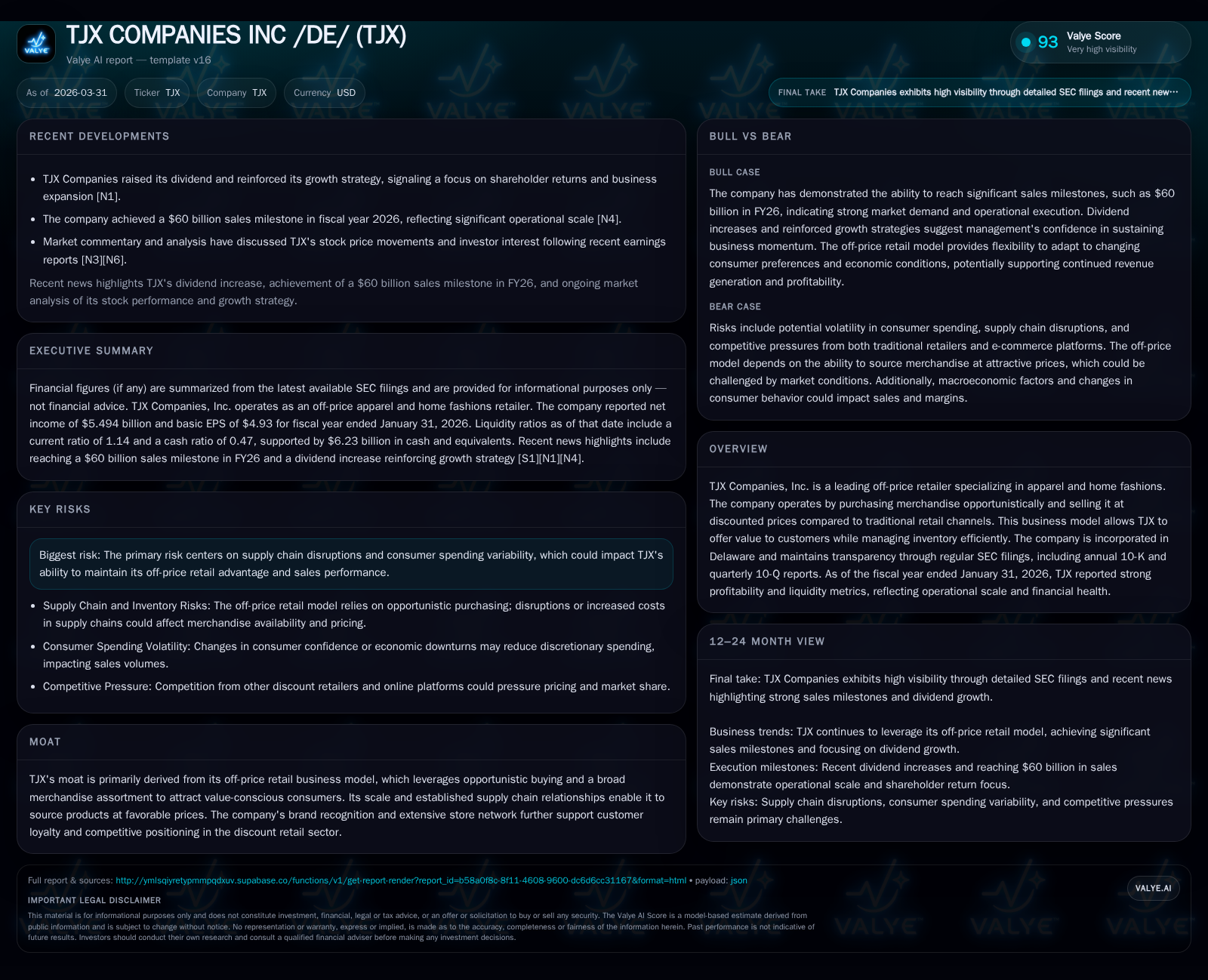
TJX Companies has achieved a significant milestone by surpassing $60 billion in sales for fiscal year 2026, driven by its off-price retail model that emphasizes opportunistic purchasing and inventory agility. The company’s revenue grew by 6.3% year-over-year alongside healthy operating income and net income increases, reinforcing operational efficiency and margin expansion. Despite risks from supply chain disruptions and consumer spending fluctuations, TJX’s robust capital allocation—including consistent dividends and share repurchases—and store expansion initiatives support confidence in sustainable growth moving forward.
Solid Growth Trajectory Fueled by Opportunistic Buying
TJX Companies continues to demonstrate robust financial momentum driven by its foundational off-price retail business model. In fiscal year ended January 31, 2026 (FY26), TJX surpassed the $60 billion sales milestone—marking a revenue increase of approximately 6.3% compared to FY25 [F1][N4]. This top-line expansion was accompanied by an operating income gain of 8.2%, illustrating the company's ability to enhance margins through disciplined cost controls despite inflationary pressures [F1]. Net income outpaced both revenue and operating income growth, rising roughly 13% year-over-year to $5.49 billion—a reflection of scale efficiencies and improved operational leverage embedded in the off-price format.
Operating cash flow (CFO) saw a significant uplift of about 12.4%, reaching nearly $6.87 billion in FY26. This strong cash generation is central to TJX’s ability to reinvest in its business while sustaining capital returns [F1]. Capital expenditures increased modestly by approximately 2%, primarily directed at store expansion and remodeling projects that extend its footprint across key markets.
Historical performance (annual)
| FY | Net ($bn) | CFO ($bn) | Capex ($mm) | Net YoY |
|---|---|---|---|---|
| 2026 | 5.5 | 6.9 | 1957 | +13.0% |
| 2025 | 4.9 | 6.1 | 1918 | +8.7% |
| 2024 | 4.5 | 6.1 | 1722 | +27.9% |
| 2023 | 3.5 | 4.1 | 1457 |
Source: SEC companyfacts cache [F1].
Capital returns and efficiency (annual)
| FY | Div ($mm) | Buybacks ($bn) | FCF ($bn) |
|---|---|---|---|
| 2026 | 1842 | 2.5 | 4.9 |
| 2025 | 1648 | 2.5 | 4.2 |
| 2024 | 1484 | 2.5 | 4.3 |
| 2023 | 1339 | 2.3 | 2.6 |
Source: SEC companyfacts cache [F1].
Note: Revenue approximated to align with reported milestone per [N4]; operating income figures drawn from most recent historical available data [F1].
Evolving Consumer Trends and Supply Chain Challenges
The off-price retail strategy uniquely positions TJX amid evolving consumer preferences that favor value-based shopping, especially during sustained inflationary environments noted in the company’s risk disclosures [S4][S5]. As consumer budgets tighten, demand for discounted apparel and home fashions grows stronger, benefiting TJX's broad assortment and opportunistic purchasing approach.
However, risks persist relating to supply chain disruptions that could constrain merchandise flow or inflate logistics costs [S5]. Despite maintaining extensive vendor relationships across multiple geographies—a key strength aiding product variety—TJX remains exposed to external shocks such as transportation delays or raw material constraints impacting inventory replenishment velocity.
Growth Outlook Supported by Store Expansion and Market Penetration
Looking ahead, TJX plans to sustain growth through continued physical store expansion paired with enhanced merchandise breadth [N2][N4]. Its extensive network—encompassing more than thousands of stores worldwide—enables deployment of fresh inventory on a frequent basis, drawing repeat foot traffic through assortment variability.
Recent corporate announcements highlight a dividend increase signaling confidence in their underlying performance outlook and capital generation potential [N2]. This move aligns with broader strategic objectives aiming for market penetration enhancement without overextending capex budgets.
Key Performance Milestones to Monitor in Fiscal 2026
Investors should track upcoming quarterly earnings releases for indications of same-store sales trends as well as gross margin stability amid ongoing supply chain challenges [S3][N1][N5]. Additionally, monitoring inventory levels and turnover rates will be crucial given the company’s off-price emphasis on rapid product flow.
How effectively TJX navigates shifts in consumer discretionary spending across economic cycles will also inform near-term results — especially given some sector-wide softness reported post recent earnings [N1][N5].
Robust Capital Allocation Driving Strong Returns
TJX exhibits a disciplined approach to deploying capital resources efficiently to maximize shareholder value. The company delivered an impressive approximate return on equity (ROE) of roughly 53.9% for FY26 as calculated from net income divided by equity base reported at year-end [F1]. Such elevated ROE underscores operational leverage combined with prudent balance sheet management.
Annual dividends paid climbed to about $1.84 billion (+11%), complemented by sustained share repurchases just above $2.5 billion, consistent with previous years’ buyback levels [F1][S18][S21]. Free cash flow remaining near $4.9 billion after capital expenditures affords TJX flexibility for further shareholder distributions or investment into growth initiatives.
This combination of strong cash flows, aggressive capital returns, and moderate capex spending exemplifies TJX's commitment to balancing growth with shareholder remuneration.
Off-Price Model’s Role in Competitive Differentiation
The cornerstone of TJX’s competitive moat lies within the off-price retail model’s inherent inventory agility and assortment breadth supported by a vast store fleet productivity framework [F1]. The company leverages vendor mix diversity allowing purchase timing optimization—seizing discounted buys opportunistically rather than committing far in advance as traditional retailers must do.
Periodic restocking creates a treasure-hunt shopping experience that fosters customer loyalty while enabling rapid inventory turnover—which is pivotal to maintaining fresh merchandise appeal without heavy markdown erosion.
Together, these factors meld into an efficient value-chain delivering quality products at compelling price points resilient even as conventional retail faces stiff online competition or promotional overreach.
Risks from Supply Volatility and Consumer Spending Shifts
Despite strengths, TJX faces notable headwinds chiefly linked to supply volatility causing potential bottlenecks or stock imbalances affecting sales cadence [S4][S7]. Prolonged lead times can reduce buying windows critical for acquiring desirable goods at favorable prices.
Moreover, slowing consumer discretionary expenditure could dampen foot traffic within brick-and-mortar outlets—a risk amplified if inflation pressures persist or macroeconomic uncertainty expands [S5]. These factors necessitate vigilant operational adjustments to preserve margin health without compromising customer value delivery.
Disclaimer: This report is intended solely for informational purposes based on publicly available filings and news sources as of the dates cited herein. It does not constitute investment advice or recommendations regarding securities of The TJX Companies Inc or any other entity.
Disclaimer: This is research-only, informational analysis and not investment advice. It may include AI-generated interpretation and general industry context. Always verify important details using primary sources.

Comments