
MDB Capital Holdings’ Public Venture Model Balances Early-Stage Tech Growth with Regulatory and Financial Challenges
MDB Capital Holdings employs an integrated public venture capital approach focusing on early-stage technology startups, supported by complementary services and a proprietary investor community.
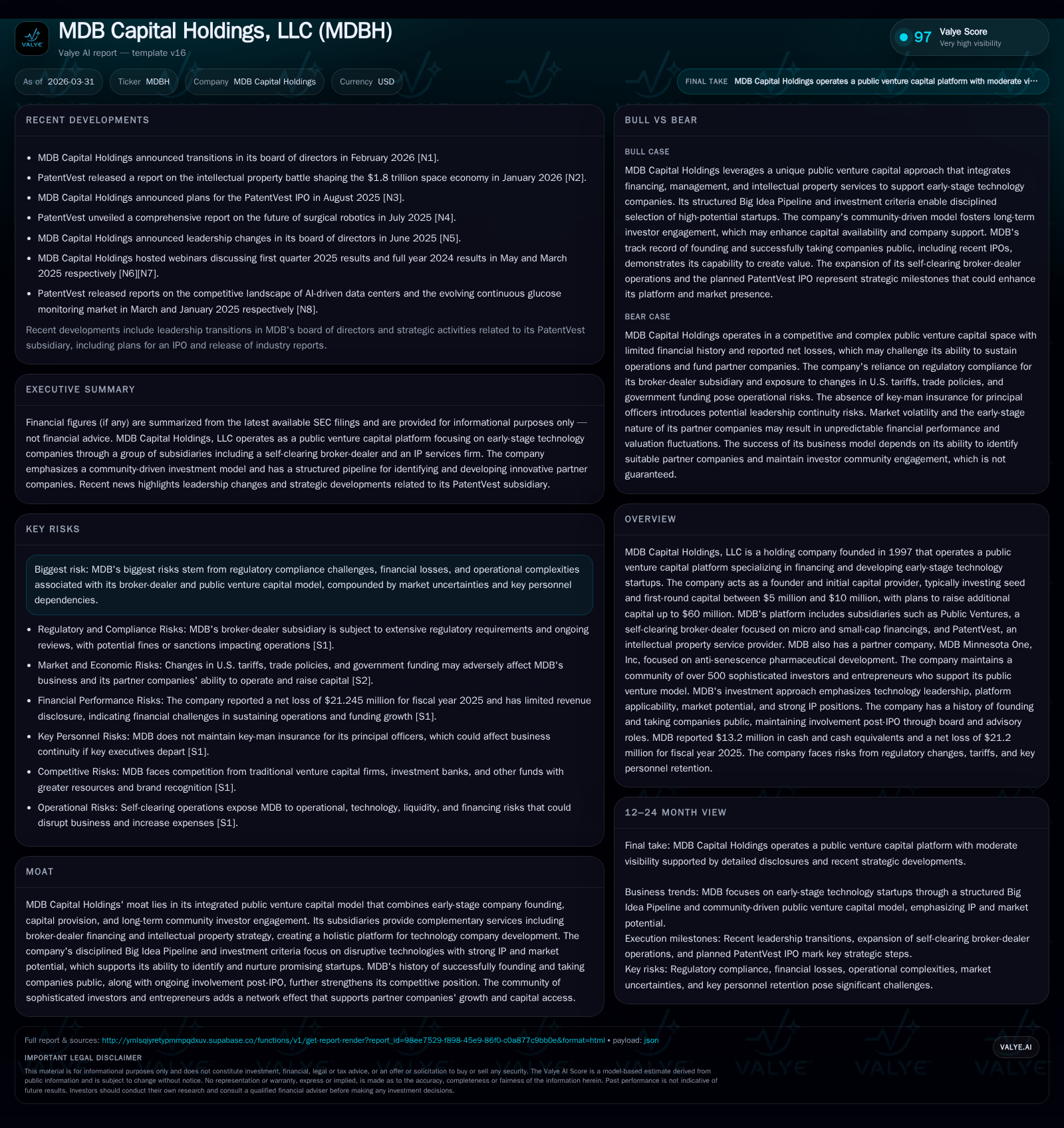
MDB Capital Holdings, LLC operates a differentiated public venture capital platform targeting disruptive technology startups. The company’s model combines founding early-stage partners, providing seed and initial funding, and leveraging its self-clearing broker-dealer and IP services to build partner companies poised for public markets. While operating income grew notably in 2025, MDB continues to post net losses and negative operating cash flow reflecting ongoing investment in its portfolio and infrastructure. Future growth hinges on scaling capital raises for partner companies and advancing its pharmaceutical development initiative. Key risks include regulatory scrutiny of its broker-dealer subsidiary alongside operational complexities inherent in the microcap-focused financial ecosystem.
Introduction
MDB Capital Holdings, LLC (MDBH) presents a non-traditional approach to venture capital through its public venture capital model established in 1997. The company acts not only as an early-stage financier but also as a founder of disruptive technology startups, aiming to build lasting value via an integrated ecosystem that includes financing execution (Public Ventures), intellectual property strategy (PatentVest), and targeted pharmaceutical R&D (MDB Minnesota One).
Historical Performance and Past Growth Drivers
Over recent years ending FY2025, MDB achieved solid progress in operating income with a notable increase of approximately 128% year-over-year to $4.9 million from $2.2 million in FY2024 [F1]. This uptick reflects expanding scale within its brokerage financing activities alongside broader portfolio developments.
However, net income has remained volatile: MDB swung from $11.7 million positive in FY2024 back into a sizeable loss position of $21.2 million negative for FY2025 [F1]. These losses underscore the intensive investment phase MDB is operating within—funding new technologies, refining platform capabilities, and absorbing significant operating expenses.
Operating cash flow remained negative at -$5.68 million but improved by some 37% relative to prior year levels [F1], indicating incremental operational efficiencies despite continued capital deployment.
Historical performance (annual)
| FY | Net ($mm) | CFO ($mm) | OpInc ($mm) | Net YoY |
|---|---|---|---|---|
| 2025 | -21 | -6 | 5 | -281.7% |
| 2024 | 12 | -9 | 2 | +267.8% |
| 2023 | -7 | -7 | 6 |
Source: SEC companyfacts cache [F1].
Capital returns and efficiency (annual)
| FY | ROE% |
|---|---|
| 2025 | -35.0 |
| 2024 | 16.7 |
| 2023 | -18.7 |
Source: SEC companyfacts cache [F1].
Note: Revenue figures are not explicitly disclosed; analysis focuses on available profitability and cash flow data.
Business Model Overview
MDB’s core proposition is to act as both incubator and investor for breakthrough technologies—initially deploying seed plus first-round capital usually between $5 million to $10 million per partner company [S14][S16]. Subsequently it aims to raise larger sums (up to $60 million) through public offerings or alternative liquidity events.
Public Ventures operates as a fully licensed self-clearing broker-dealer initiated in early 2024 that specializes in microcap/small-cap markets—typically companies with valuations under $500 million [S16][S22]. This focus enables MDBH’s affiliated startups access to capital markets otherwise challenging for early-stage enterprises.
PatentVest fills an important advisory niche by delivering comprehensive intellectual property strategy services critical for technology leadership positioning—a vital ingredient given MDB’s emphasis on IP-driven disruption [S16][S23][S24].
Complementing these is MDB Minnesota One (M1), created mid-2024 with a distinct focus on anti-senescence pharmaceuticals targeting age-related diseases linked to senescent cell pathology [S16][S26]. While still pre-clinical with no products commercially available yet, M1 represents a high-risk/high-reward component of MDB’s portfolio.
Future Growth Prospects
Growth will likely be catalyzed by several factors:
- Continued sourcing from the Big Idea Pipeline that filters roughly 250 ideas annually down to about ten promising ventures actively nurtured toward commercialization or public listing [S16].
- Expansion of Public Ventures’ capabilities around underwriting IPOs valued generally between $20–50 million and follow-on financings post-IPO [S16], accentuating deal flow volume.
- Successful clinical advancement at M1 could unlock significant valuation milestones given the unmet needs addressed by anti-senescence platforms—though milestones carry contingent payments up to $5 million upon NDA approval events [S12].["]
- Broader engagement of its community of over 500 investors providing deep sector knowledge and facilitating syndication of financing rounds beyond initial seed phases [S16][S18].
Constraints potentially impinging upon growth include:
- Heightened regulatory burdens around broker-dealer activity involving microcap securities markets pose operational risk that could limit scale or incur fines impacting profitability [S15][S20].
- The competitive landscape features larger venture funds and investment banks targeting similar small-cap segments with greater resources and brand recognition [S19].
- Dependency on successful technology identification and execution within diverse verticals where not all pipeline candidates may mature commercially or achieve financing milestones.
Forecasts & Expectations
MDBH has not publicly issued detailed forward guidance but highlights ongoing plans to pursue one or two partner company formations annually conditional upon suitable Big Idea discoveries [S6]. Milestones tied particularly to M1’s developmental pathway include Phase II/III trials initiation payments ($0.25m/$1.5m respectively), New Drug Application acceptance ($2m), plus NDA approvals ($5m each) starting after commercial sales commence—as noted in licensing terms with Mayo Clinic [S12].
Analysts should monitor:
- Progression of active Big Idea Companies along these developmental trajectories.
- Regulatory outcomes related to Public Ventures’ broker-dealer operations amid evolving SEC/FINRA/DTCC rules especially regarding self-clearing settlement changes.
- Capital raising activities beyond seed rounds into large-scale public financings as tangible signals of market validation.
Returns & Capital Allocation
The firm maintains a holding company structure holding majority stakes in partner companies during their nascent phases before expanding external financings [S6][S18]. Dividend policy is not emphasized; rather shareholder returns are expected primarily via appreciation from underlying portfolio growth and liquidity events such as IPOs or asset sales.
From available data:
- MDB posted an approximate negative Return on Equity near -35% based on FY2025 net loss relative to equity base [$21.2m loss / $60.69m equity] indicating ongoing absorptive investments over the short term [F1].
- Operating cash flow remained negative suggesting continued reliance on equity financings or capital raises to fund operations plus partner company development activities rather than generating free cash flow currently [F1][S19].
- Management underscores shareholder alignment through enabling participation rights in subsequent capital raises via preferred offerings or rights issues related to partner companies where feasible [S6][S18].
Industry & Competitive Context (Analysis)
Microcap-focused clearing broker-dealers like Public Ventures face unique regulatory regimes balancing opportunity with heightened compliance demands around AML/KYC protocols because small caps historically attract more scrutiny due to perceived higher manipulation risk. Integration with venture capital activities further complicates oversight but allows closer control over early stage investing pathways compared with passive funds.
Meanwhile patent strategy is paramount across tech-heavy venture portfolios; PatentVest’s law firm model within MDB gives specialized IP service capabilities helping mitigate typical startup vulnerabilities around defensive patenting—a distinct advantage against fragmented third-party service arrangements common in this segment.
On the pharmaceutical front developing anti-senescence modalities taps into burgeoning longevity therapeutics markets but carries inherent high R&D failure rates intrinsic to biotech investing; success timelines are long with upfront milestone payment structures reducing upfront financial exposure but requiring patient capital commitment.
Regulatory & Legal Risks
MDB faces considerable complexity managing broker-dealer compliance amid evolving SEC rules including Regulation S-P privacy mandates and conflicts-of-interest provisions that affect how recommendations are made for microcaps traded through Public Ventures [S8][S15][S20]. Further risk arises from potential regulatory actions leading to fines or business constraints which could diminish revenues or require costly operational changes.
Additionally:
- Intellectual property litigation risks could impair patent portfolios crucial for competitive positioning within partner companies especially internationally where enforcement varies substantially [S23][S24].
- Tax status as a publicly traded partnership offers favorable pass-through treatment but failure to continue qualifying under IRS rules could unexpectedly trigger corporate-level taxation adversely affecting investor returns [S1].
- Cybersecurity threats growing alongside self-clearing functions expose MDB’s client data assets potentially leading to reputational damage or fines if breaches occur without adequate insurance coverage [S5][S17].
Conclusion
MDB Capital Holdings operates a novel hybrid public venture capital vehicle combining founding roles with community-backed seed investing into emerging technology companies supported by complementary legal IP services and financial market access through its clearing broker-dealer apparatus. This holistic platform differentiates it from traditional VC funds albeit accompanied by elevated financial losses reflective of developmental stage investing plus complex regulatory exposures inherent in microcap brokering segments.
Future performance will depend critically on MDBH's ability to scale financing rounds beyond initial funding tranches successfully; advance select pipeline companies especially in pharmaceuticals toward commercialization benchmarks; maintain strict compliance controls preventing regulatory sanctions; and leverage its investor community network effectively amid competition from better-capitalized peers.
Shareholders should weigh the company's long-duration value creation approach built on patient equity investment against near-term earnings volatility inherent in pioneering this integrated public venture operating model.
Disclaimer: This analysis is based solely on factual disclosures sourced from official SEC filings dated up to March 31, 2026 ([F1],[S#]) without conjecture beyond stated information. It does not constitute investment advice or recommendations regarding buying or selling securities of MDB Capital Holdings.
Disclaimer: This is research-only, informational analysis and not investment advice. It may include AI-generated interpretation and general industry context. Always verify important details using primary sources.

Comments