
StableX Technologies’ Strategic Pivot to Stablecoin Infrastructure Faces Profitability and Regulatory Challenges
Shift from EV manufacturing to digital asset investments creates growth opportunities but amplifies financial and operational risks.
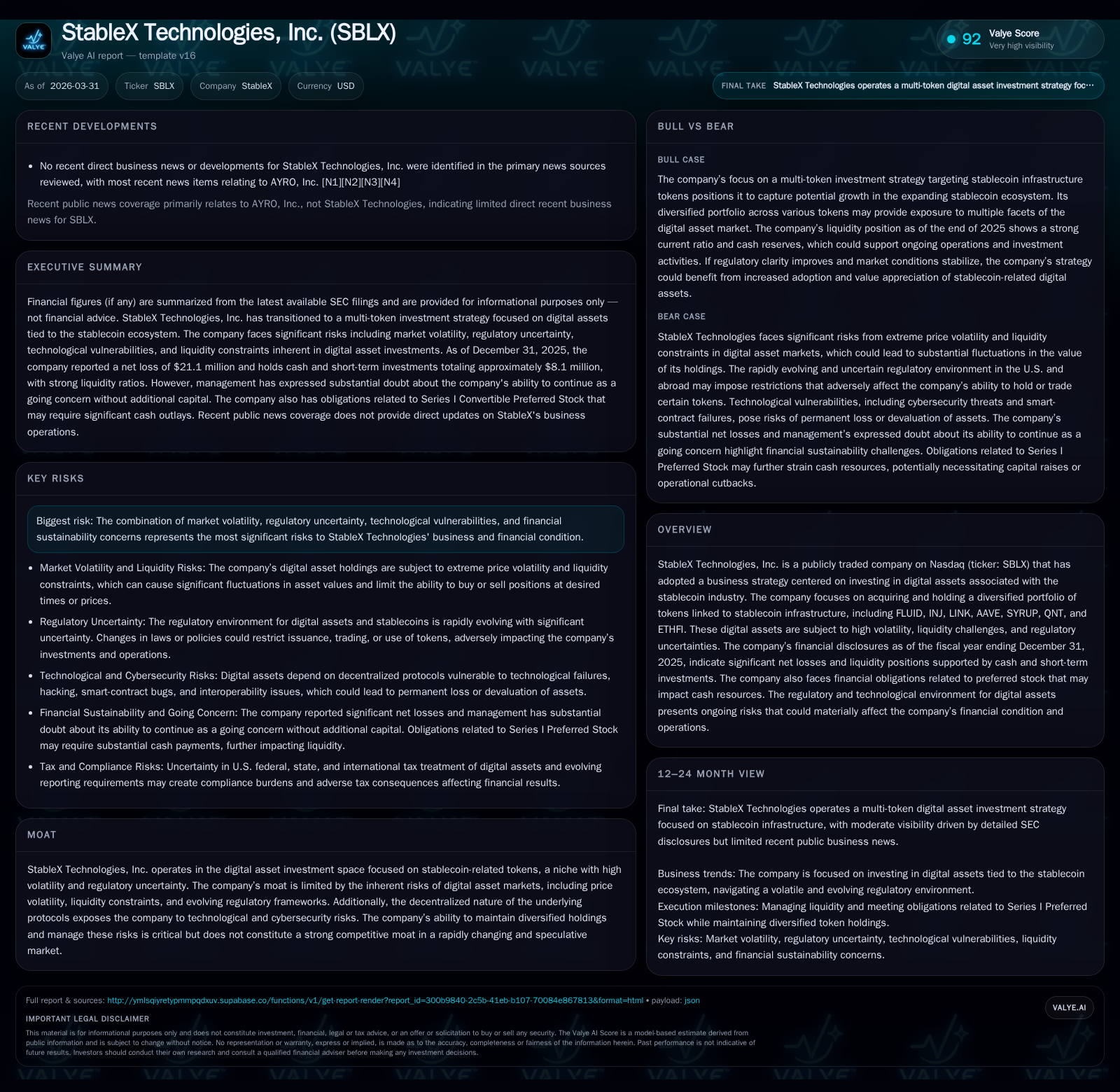
StableX Technologies, Inc. transitioned in 2025 from electric vehicle manufacturing to a focused investment strategy targeting tokens associated with stablecoin infrastructure. Despite the promise of capturing growth in a burgeoning digital asset sector, the company recorded a substantial net loss of $21 million in 2025 on no revenue, reflecting the financial drag of this strategic repositioning. The ongoing regulatory uncertainty surrounding digital assets, combined with significant liquidity constraints and onerous preferred stock obligations, casts doubt on the company’s near-term financial sustainability. Investors should monitor portfolio performance, regulatory developments, and capital raising outcomes as key indicators.
Historical Performance
StableX Technologies originated as an electric vehicle (EV) manufacturer but fundamentally shifted its strategic focus in mid-2025 toward a multi-token investment approach centered on stablecoin infrastructure. This represents a significant departure from prior operations which had generated modest revenue—$4.6 million in 2019 declining from $16.7 million in early historical periods [F1]. Prior to the pivot, the company consistently incurred net losses surpassing $17 million in recent years.
Concretely, for fiscal year 2025 ending December 31, StableX reported zero revenues while registering an operating loss of approximately $10.5 million and a net loss totaling nearly $21 million [F1]. This loss magnified compared to the previous year’s net loss of around $1.75 million despite the historic operating environment due to transition costs and valuation impacts on digital assets held.
Operating cash flow reflected continued negative trends with outflows close to $7.7 million in 2025 [F1], improving somewhat relative to larger cash burns over prior periods yet underscoring ongoing funding requirements. Capital expenditures fell significantly—from over $2 million historically down to under $200 thousand annually—indicating a shift away from capital-intensive product manufacturing toward lighter technology-focused asset holdings.
Historical performance (annual)
| FY | Net ($mm) | CFO ($mm) | OpInc ($mm) | Capex ($mm) | Net YoY |
|---|---|---|---|---|---|
| 2025 | -21 | -8 | -10 | 0 | -1101.3% |
| 2024 | -2 | -13 | -19 | 0 | +94.9% |
| 2023 | -34 | -26 | -28 | 2 | -48.9% |
| 2022 | -23 | -19 | -23 | 2 |
Source: SEC companyfacts cache [F1].
Capital returns and efficiency (annual)
| FY | Buybacks ($) | FCF ($mm) | ROE% |
|---|---|---|---|
| 2025 | 376630 | -8 | -568.4 |
| 2024 | 376630 | -14 | -37.5 |
| 2023 | -28 | -241.6 | |
| 2022 | -20 | -44.1 |
Source: SEC companyfacts cache [F1].
Note: Revenue ceased as company exited manufacturing; losses magnify post-transition.
Future Growth Prospects
StableX’s future growth prospects rely heavily on the outlook for stablecoins and their associated infrastructure tokens rather than traditional revenue generation models [S1]. The firm’s strategic rationale is predicated on acquiring up to $100 million worth of tokens that underpin stablecoin ecosystems—fragmented across exchanges supporting swap (FLUID), derivatives (INJ), oracle services (LINK), lending (AAVE), collateral management (SYRUP), interoperability (QNT), and Ethereum finance utilities (ETHFI) [S1][S11].
This "picks-and-shovels" approach intends indirect participation by owning protocols facilitating stablecoin issuance and use rather than exposure to the stablecoins themselves [S1]. Delivery of value rests on ecosystem expansion driving transaction fees and network utilization.
However, this opportunity is double-edged: tokens experience pronounced volatility independent of broader crypto markets due to speculative trading patterns and token-specific risks—for example:
- FLUID faces pressure as pre-restricted tokens unlock,
- ETHFI responds sensitively to Ethereum network congestion and gas fees,
- SYRUP’s valuation may shift with fluctuations in real-world asset collateral markets [S15].
Furthermore, abrupt regulatory revisions on stablecoin issuance or usage—either by U.S. federal regulators or through international frameworks such as MiCA—could restrict market participation or impose compliance costs impairing token liquidity or value [S9][S11][S24].
Custody presents additional challenges; as digital assets are prone to hacking risks and private key mismanagement without insurance protections governing traditional securities [S19]. Technological vulnerabilities inherent in decentralized finance platforms add another vector of exposure through potential smart contract bugs or oracle failures disrupting token functionality [S14].
The company does not currently engage in staking crypto assets nor plans immediate deployment beyond passive treasury holdings mitigating some operational complexity but limiting yield enhancement sources [S1].
Forecasts and Milestones
StableX has not issued formal revenue or profit guidance post-pivot but set internal goals around deploying capital toward acquiring crypto assets up to $100 million subject to market conditions [S1]. Management emphasizes that stockholder value improvement hinges fundamentally on portfolio appreciation rather than traditional profitability signals.
Upcoming milestones likely include subsequent purchases completing portions of their target token investment allocation and navigating regulatory adaptation driven by U.S. legislation or IRS reporting reforms affecting cost basis tracking for crypto transactions commencing January 2025 onward [S9][S12].
Key events investors should watch are:
- Quarterly redemption payments beginning November 30, 2025 on Series I Preferred Stock that require cash outflows,
- Regulatory clarity regarding stablecoin classification impacting token tradability,
- Portfolio performance updates reflecting volatility-induced value changes,
- Additional capital raises necessary if operating cash flows remain negative,
- Enhancements or setbacks due to smart-contract exploits within held protocols.
Returns and Capital Allocation
Given lack of operating revenue coupled with large losses amounting to roughly $21 million for fiscal year 2025 alone [F1], StableX generates no returns or positive free cash flow at present. Approximate return on equity is deeply negative at -568% based on net loss relative to shareholder equity near $3.7 million at year-end [F1], highlighting substantial capital erosion during transition.
Free cash flow remains negative at approximately -$7.9 million when subtracting capex from operating cash flow outflows [F1]. The company’s investments have primarily been equity-funded with no material debt disclosed beyond preferred stock obligations with strict covenants restricting further borrowings until these instruments are redeemed or converted [S3][S4][S8].
Capital allocation is affected notably by the issuance of Series I Convertible Preferred Stock completed August 2025 for net proceeds of about $6.2 million after fees [S13]. This preferred stock accrues dividends at a compounded rate of 7% per annum payable quarterly starting November 2025—in either cash or reinvestment—and requires redemption installments that may exert considerable liquidity pressure given current cash balances below $5 million [F1][S10][S14].
Share repurchases have been negligible given financial constraints and no dividends are paid on common stock due to ongoing losses [F1][S20]. Raising further capital will be critical for sustaining operations amid aggressive portfolio positioning.
Industry Context Analysis
The stablecoin ecosystem sits at a regulatory crossroads worldwide. In the U.S., various legislative proposals seek enhanced controls over reserve management requirements, custody standards for custodians holding stablecoins, and reporting mandates that may affect how companies like StableX manage holdings. In Europe under MiCA regulations entering effect soon, issuing platforms face compliance demands that could limit cross-border liquidity flows affecting token prices.
Decentralized finance protocols offer high yield opportunities but expose token holders like StableX Technologies to amplified cybersecurity risk vectors uncommon in traditional finance settings: oracle manipulation attacks can distort pricing data influencing token values; smart contract bugs have historically led to multi-million-dollar losses across platforms analogous to those held by StableX.
Market liquidity risk adds difficulty especially for tokens traded infrequently where large buy/sell orders might create severe price slippage affecting realized valuation gains/losses realized by StableX upon portfolio turnover.
Conclusion
StableX Technologies embodies a high-risk commercial experiment transitioning from hardware manufacturing into a volatile niche investing wholly within blockchain’s stablecoin infrastructure tokens. While offering theoretically robust exposure to an expanding segment of digital finance infrastructure without direct stablecoin redemption risk exposure itself,[S1] it carries profound operational uncertainties including sharply negative earnings trends persisting beyond transition years,[F1] substantial liquidity stress exacerbated by preferred security covenants,[S3]and challenging regulatory terrain.[S9]
Without near-term revenue generation or proven capability to control digital asset risk volatility reliably,[S19] StableX depends heavily on maintaining capital reserves sufficient for mandated dividend and redemption obligations.[F1][S10] Investors should carefully track digital asset market dynamics alongside legislative developments impacting crypto asset investability.
This report synthesizes publicly filed data without providing investment recommendations.
Disclaimer: This is research-only, informational analysis and not investment advice. It may include AI-generated interpretation and general industry context. Always verify important details using primary sources.

Comments