
Dare Bioscience’s Dual-Path Strategy Challenges in Women’s Health Innovation
The company's specialized focus on women's health combines FDA approval and Section 503B compounding to accelerate market access amid significant revenue fluctuations.
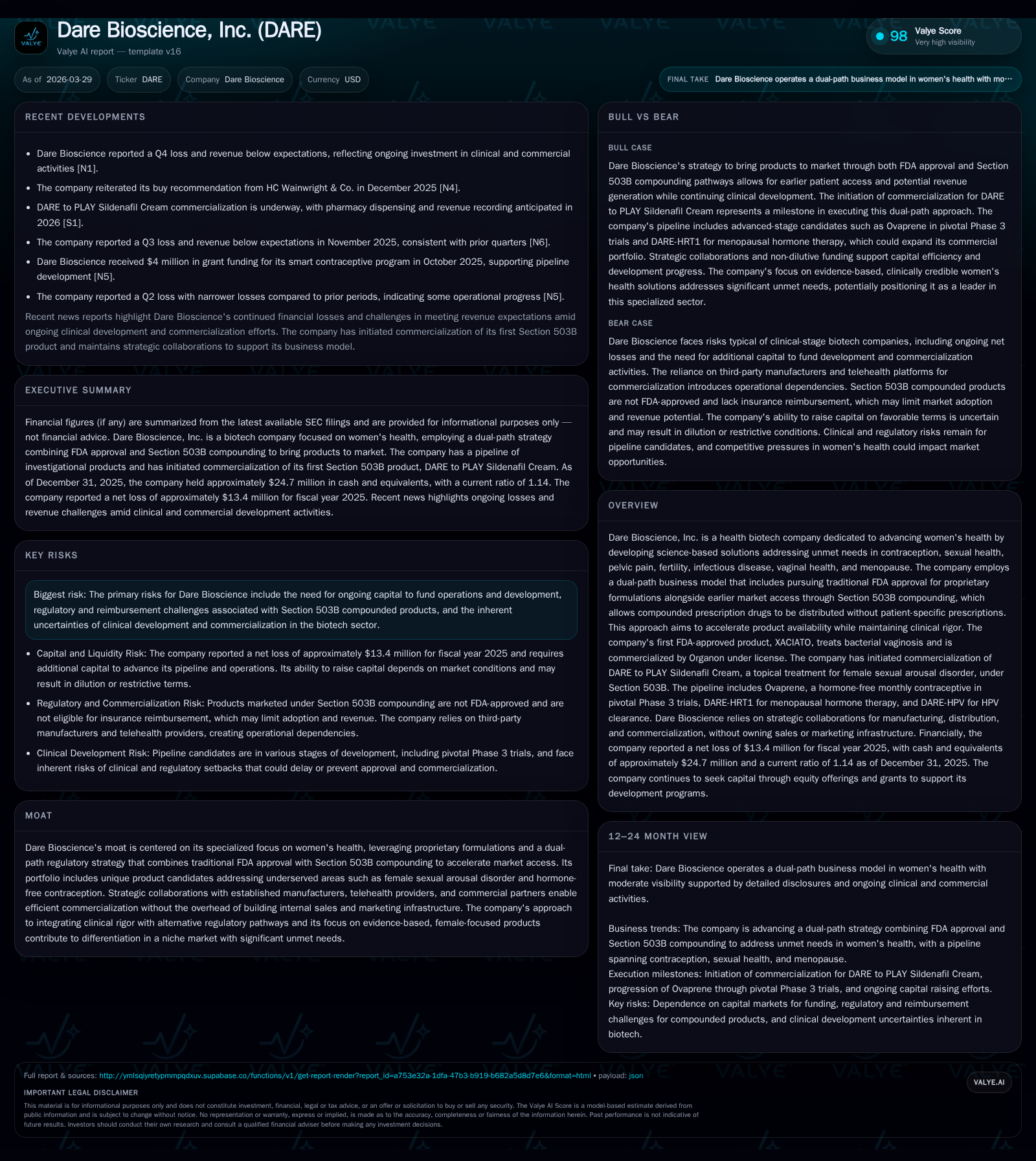
Dare Bioscience operates a distinctive dual-path regulatory approach aimed at bridging critical gaps in women’s health by combining traditional FDA approval with earlier availability via Section 503B compounding. Despite advancing a promising pipeline with upcoming product launches, the company has experienced a steep revenue decline post-2022 linked to licensing terminations and royalty financing restructurings. Heavy R&D investment sustained through substantial grant offsets continues alongside operating losses and shrinking cash reserves, imposing pressure on liquidity and capital needs. Monitoring the commercialization progress of compounded and consumer health products slated for Q2 2026 will be key to gauging future growth trajectories.
Contraction and Commercial Shifts: A Look Back at Recent Financials
Dare Bioscience has undergone a material contraction in revenue following notable licensing changes in recent years. The company reported revenue of $10 million in fiscal year 2022, primarily driven by license fee income including revenues related to its Bayer agreement [F1]. However, revenue plunged approximately 72%, falling to about $2.8 million by FY2023, reflecting the termination of licensing arrangements and reallocation of royalties under royalty interest financing deals involving XACIATO sales [F1],[S1],[S7]. This decline highlights the company's shift away from dependence on traditional license payments toward nascent revenue sources tied to its dual-path product commercialization strategy.
Despite top-line erosion, operating losses narrowed from $31.4 million in 2022 to $13.6 million in FY2025 — an encouraging margin improvement influenced partially by tighter expense management and increased grant offsets applied against R&D costs [F1],[S7]. Net loss followed a similar pattern; however, it remains substantial at nearly $13.4 million in the latest fiscal year [F1]. The company's financial profile during this period depicts a business transitioning amidst operational recalibration seeking sustainable commercial footing.
Historical performance (annual)
| FY | Rev ($mm) | Net ($mm) | CFO ($mm) | OpInc ($mm) | Rev YoY | Net YoY |
|---|---|---|---|---|---|---|
| 2025 | -13 | -10 | -14 | -230.6% | ||
| 2024 | -4 | 5 | -23 | +86.6% | ||
| 2023 | 3 | -30 | -39 | -31 | -71.9% | +2.5% |
| 2022 | 10 | -31 | -18 | -31 |
Source: SEC companyfacts cache [F1].
Capital returns and efficiency (annual)
| FY | FCF ($mm) | ROE% |
|---|---|---|
| 2025 | -10 | -471.4 |
| 2024 | 5 | 67.4 |
| 2023 | -39 | 597.5 |
| 2022 | -18 | -278.5 |
Source: SEC companyfacts cache [F1].
Driving Forces Behind Revenue Decline and Expense Structure Evolution
The sharp drop in revenue chiefly stemmed from cessation of Bayer license fees during early 2024 and redirection of royalties previously collected from XACIATO net sales into non-cash royalty revenue under the financing agreement with UiE starting April 2024 [S1],[S7]. While royalties no longer represent direct cash inflows benefiting Dare Bioscience, they underpin liabilities recorded on its balance sheet illustrating accounting implications of such funding structures [F1],[S12].
Selling, general and administrative expenses have decreased modestly but remain significant as the company invests in groundwork for emerging products within its dual business paths. Meanwhile, research and development expenses reported a pronounced drop owing largely to contra R&D charges arising from grant awards—these offset gross spending considerably but reflect sustained R&D activity when considered before offsetting entries [S5],[S7],[S11]. This bifurcated approach combining federally approved drug development alongside compounding pharmacy commercialization complicates expense recognition patterns but supports flexibility.
Pipeline Potential: Upcoming Product Launches and Regulatory Milestones
In Q2 2026 Dare plans initial revenue recognition from commercial launch of proprietary products including DARE to PLAY Sildenafil Cream targeting female sexual arousal disorder as well as Flora Sync LF5 vaginal probiotic suppositories under its consumer health brand DARE to RESTORE [N1],[S1],[S17]. These launches exemplify the company’s strategy of offering products both through traditional FDA-regulated channels and via Section 503B compounding routes enabling earlier market access with clinical rigor maintained.
Success criteria extend beyond immediate sales numbers—in particular alignment on Phase 3 study designs with the FDA (notably for Ovaprene contraceptive) remains pivotal for future label-claim based commercialization efforts alongside ongoing clinical developments such as DARE-LARC1 implantable contraception candidates [S1],[S16]. Progression through these milestones will critically shape medium-term revenue trajectories.
Market Access via Section 503B: Advantages and Regulatory Risks Explored
Section 503B compounding allows registered outsourcing facilities to produce prescription drugs for distribution without patient-specific prescriptions—advantageous for novel women's health formulations facing unmet needs by sidestepping protracted FDA approval timelines [S14],[S17]. This path leverages existing infrastructure for cGMP-compliant manufacturing while responding swiftly to clinician demand.
However this regulatory nuance introduces reimbursement ambiguity since compounded drugs often lack standard insurance coverage or third-party payor pathways posing hurdles for market penetration despite clinical data support. Additionally compliance complexities arise given stringent Food Drug & Cosmetic Act (FDCA) Section 503B requirements mandating facility registration quality controls reporting obligations and FDA oversight that compound operational risk profiles relative to traditional pharma models [S14].
Capital Utilization Patterns: Heavy R&D Investment Amid Operating Losses
R&D remains Dare’s core operational focus despite headline declines post-grant adjustments. In FY2025 gross R&D expenses were approximately $14.3 million before contra expense reductions totaling roughly $13.9 million due chiefly to grants supporting programs like Ovaprene Phase 3 trials and other early-stage assets [F1],[S11]. This dynamic results in reported net R&D outlays near $5.5 million yet masks substantive investment levels.
Key contributors include agreements with clinical research organizations contract manufacturing expenditures related to both clinical trial material production and Section 503B outsourcing preparations milestone payments tied to licensed technologies plus indirect costs including personnel compensation within R&D functions [S5],[S8]. Such targeted spending sustains pipeline advancement critical for long-term value creation despite short-term profitability pressures.
Balance Sheet Health and Cash Flow Trends Through Years of Expansion
At December 31 2025 Dare held cash and cash equivalents totaling approximately $24.7 million with current assets around $27.1 million versus current liabilities exceeding $23.6 million—yielding a current ratio close to 1.14x indicative of just sufficient near-term liquidity buffers [F1],[S4]. Working capital stood modestly positive near $3.4 million.
Operational cash flow remains negative at roughly -$9.9 million for FY2025 versus positive inflows around $5.4 million in FY2024—a swing attributable largely to lower licensing-related collections offsetting improved expense control efforts [F1],[S10]. Capital expenditures continue modestly below historical frequency ($0.38 million in FY25) reflective of limited fixed asset investment consistent with asset-light outsourcing strategies.
Absent fresh capital infusions or material upticks in commercial revenues expected mid-2026 onward liquidity constraints may intensify impacting operational cadence without strategic financing steps promptly undertaken [S9],[S13].
Strategic Partnerships Fueling Cost-effective Commercialization
Dare pursues collaborations as central pillars for marketing execution in lieu of an internal sales force—a pragmatic choice given scale constraints typical among specialized biotech focused on women’s health niches.
Organon holds global commercial rights for XACIATO under exclusive licensing arrangements enabling broader distribution reach while Dare retains focus on product innovation and regulatory navigation [S17]. For novel Section 503B compounded offerings like DARE to PLAY Sildenafil Cream partnerships with compounding outsourcing facilities plus telehealth pharmacies facilitate cost-effective direct-to-patient models limiting overhead investment burdens common within pharma launches.
Such alliances balance speed-to-market objectives against resource rationalization—key in competitive specialty segments demanding agility.
Risks from Reliance on Licensing and Royalty Financing Mechanisms
Historically reliant revenue streams tied to licensing fees (notably Bayer) have diminished leaving royalties converted into non-cash recognition under royalty interest financing agreements where upfront proceeds are recorded as liabilities repayable via future royalty streams—essentially debt-like obligations on Dare’s books [F1],[S12],[S14].
This structural shift introduces potential volatility; reductions or delays in downstream royalties can translate into payment timing mismatches impairing cash flows even if non-cash accounting inflates reported top-line figures contemporaneously.
Consequently dependence on milestone licenses or anticipated collateral payments imbues financial reporting complexity coupled with corresponding economic uncertainties until commercialization stabilizes own-product revenue generation fully independent from third-party agreements.
What to Watch: Key Near-Term Catalysts and Financial Indicators
Investors should monitor multiple vectors starting with anticipated commercial launches slated for Q2 2026 encompassing DARE to PLAY Sildenafil Cream alongside Flora Sync LF5 probiotic consumer product introduction marking diversification into over-the-counter vaginal health spaces upstream of prescription product cycles [N1],[S17]. Uptake momentum here will inform early validation of the dual-path business model efficacy particularly Section 503B compounded product acceptance among prescribers and patients congruent with reimbursement framework evolutions.
Regulatory engagement progress including final alignment with FDA on pivotal Phase 3 trial protocols especially regarding Ovaprene contraceptive signals will also be pivotal next-phase growth determinants [S16]. Additionally assessing operating expense leverage framed against evolving R&D grant dynamics alongside liquidity runway metrics will clarify sustainability outlook absent external capital events.[N1],[S13]
In summary Dare Bioscience stands at a transformative juncture employing innovative regulatory approaches paired with high-science women’s health therapeutics targeting significant unmet medical needs yet faces financial execution risks inherent amid nascent commercialization efforts intersecting complex regulatory landscapes.
This analysis is based solely on disclosed filings from Dare Bioscience as of March 29, 2026 ([F1], [N1]–[N3], [S1]–[S29]) without speculative forecasting or investment advice.
Disclaimer: This is research-only, informational analysis and not investment advice. It may include AI-generated interpretation and general industry context. Always verify important details using primary sources.

Comments