
TXO Partners Reports Strong Revenue Growth Amid Operating Losses and Expanded Credit Facility
TXO Partners delivered a 42% revenue increase in 2025 driven by acquisitions and higher commodity prices, while operating losses widened amid rising costs and leverage.
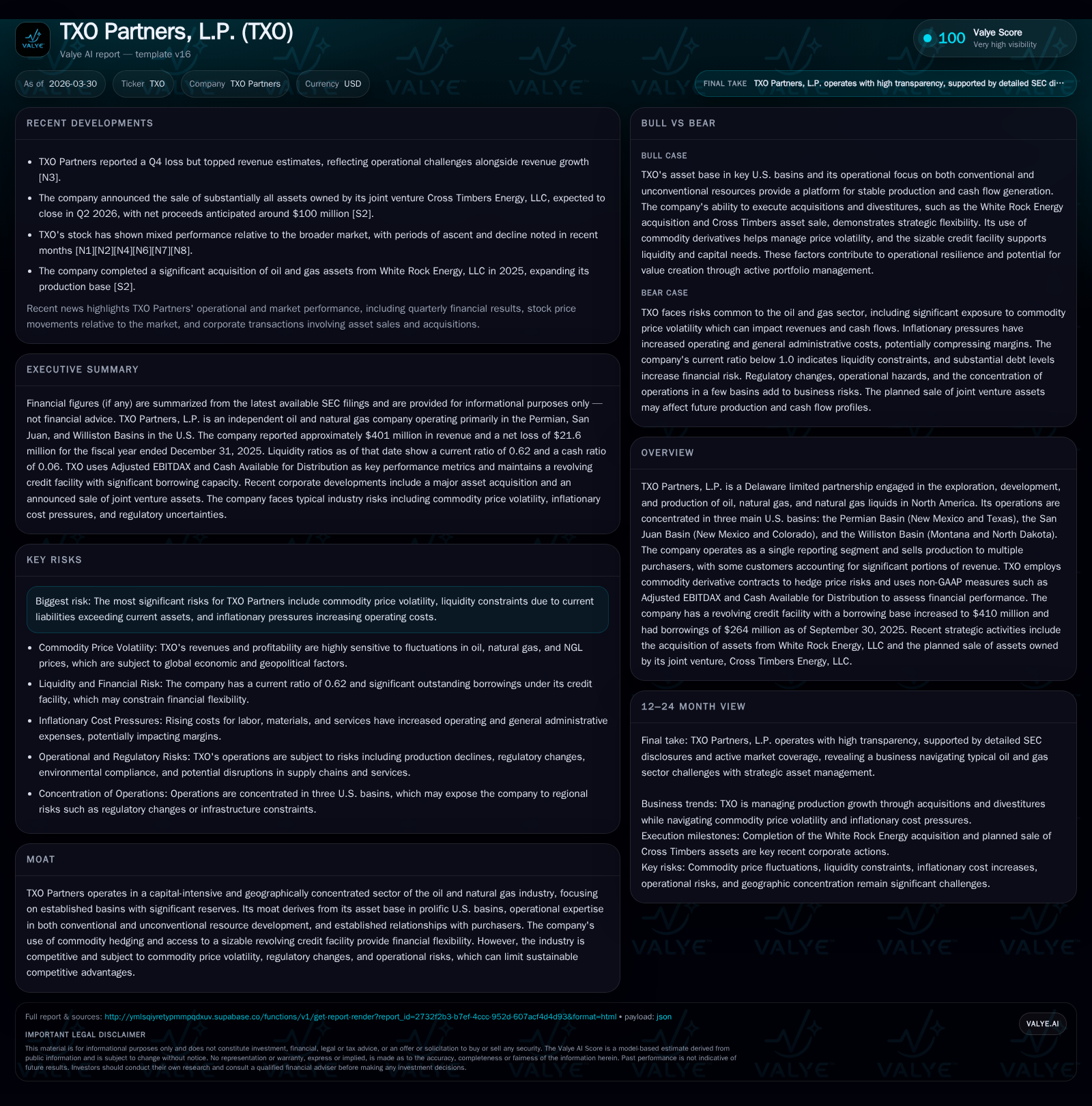
In 2025, TXO Partners, L.P. achieved a 41.8% increase in revenue to $401 million, reflecting production growth from recent acquisitions and favorable commodity prices. Despite this top-line growth, operating income declined further into negative territory at -$30.6 million due to increased general & administrative expenses, depreciation, depletion and amortization, and higher interest costs. The company expanded its revolving credit facility’s borrowing base to $410 million with $264 million drawn as of September 30, 2025, maintaining liquidity headroom but facing a current ratio below 1. Operating cash flow remained strong at $118 million, supporting capital expenditures and distributions, though working capital remains negative. TXO’s future performance will hinge on commodity price trends and operational execution within its core basins.
Historical Performance
TXO Partners, L.P., a Delaware limited partnership, operates primarily in the Permian Basin (NM/TX), San Juan Basin (NM/CO), and Williston Basin (MT/ND) focusing on oil, natural gas, and natural gas liquids production [N4][N5][S1]. The company reports its operations as a single segment.
The following table summarizes key financial metrics for the last three fiscal years:
Historical performance (annual)
| FY | Rev ($mm) | Net ($mm) | CFO ($mm) | OpInc ($mm) | Rev YoY | Net YoY |
|---|---|---|---|---|---|---|
| 2025 | 401 | -22 | 118 | -31 | +41.8% | -192.0% |
| 2024 | 283 | 23 | 109 | -7 | -25.7% | +122.6% |
| 2023 | 381 | -104 | 77 | -124 |
Source: SEC companyfacts cache [F1].
Capital returns and efficiency (annual)
| FY | FCF ($mm) |
|---|---|
| 2025 | 113 |
| 2024 | 104 |
| 2023 | 76 |
Source: SEC companyfacts cache [F1].
The revenue growth in 2025 reflects contributions from strategic acquisitions—particularly in the Williston Basin—and higher commodity price realizations [F1][S12]. However, operating income declined significantly due to increased general & administrative expenses (+59%), elevated depreciation/depletion/amortization rates linked to acquired assets with higher cost bases, and rising interest expenses associated with increased debt levels [F1][S12][S25]. Net income shifted from positive in 2024 to a loss in 2025.
Operating cash flow remained robust at $118 million for the year ended December 31, 2025, up modestly from prior periods, supporting capital expenditures which remained relatively low at under $5 million despite ongoing development programs [F1][S10]. This strong cash generation resulted in significant free cash flow.
Capital Structure & Liquidity
In mid-2025, TXO expanded its revolving credit facility’s borrowing base from $275 million to $410 million through Amendment No. 5, extending maturity to August 2030 and adding new lenders [S4][S14][S19][S21]. The credit facility is secured by substantially all assets including interests in joint ventures such as Cross Timbers Energy LLC where TXO holds a substantial stake [S3]. Interest rates are variable based on SOFR or ABR plus margins typically between approximately 2% and 4%, with an average effective rate near 7.9% for calendar year 2025 [S19].
As of September 30, 2025, borrowings under the credit facility totaled approximately $264 million compared with $150 million at December 31, 2024 reflecting financing for acquisitions and development activity [F1][S6]. Despite available credit capacity of about $146 million undrawn at that date, liquidity metrics show constraints: current assets stood near $95 million while current liabilities were approximately $154 million resulting in a current ratio around 0.62 [F1][S6][S19]. This level is below the covenant requirement of maintaining greater than a one-to-one current ratio under the credit agreement.
Leverage remains moderate with net-debt-to-EBITDAX estimated between roughly one and one-and-a-half times following debt-funded acquisitions completed during the year; TXO complies with all related debt covenants [S6][S11][S19].
Operational Drivers & Cost Structure
Production benefits from focused operations across prolific basins rich in conventional and unconventional hydrocarbon reserves [N4][N5][S12]. The Williston Basin acquisition contributed both higher volumes and elevated DD&A rates reflective of asset cost profiles [S17][S25]. Commodity price volatility has been significant through early-to-mid-2025 with crude oil prices peaking near $86 per barrel in early 2024 before moderating; natural gas prices showed seasonal variability [S14].
Operational costs increased notably: general & administrative expenses rose more than 50% year-over-year driven by personnel additions related to acquisitions, ongoing public company costs, amortization of unit awards under incentive plans, and acquisition-related expenses [S12][S17][S25]. On a per barrel of oil equivalent basis these expenses increased despite higher production.
TXO employs commodity derivative contracts to hedge price exposure which introduce non-cash earnings volatility through mark-to-market adjustments; outstanding liabilities related to these hedges amount to several millions as of late-2025 [S19][S20][S22]. Hedging levels are influenced by leverage ratios tied to borrowing base utilization.
Future Growth Outlook
TXO’s growth strategy emphasizes disciplined capital deployment toward development programs within core basins alongside selective accretive acquisitions aimed at bolstering reserves and production scale while maintaining financial discipline as outlined by management’s flexible capex approach responsive to market dynamics [N4][N5][S10][S18][S26].
Commodity price uncertainty remains a key risk factor affecting margin stability; however, the enlarged revolving credit facility provides financial flexibility allowing TXO to navigate near-term volatility while sustaining distributions consistent with partnership agreements that mandate distribution of available cash flows unless restricted by operational or covenant constraints [S11][S18][N1][N2].
Inflationary pressures persist on input costs including steel for drilling equipment, fuel logistics, labor wage inflation and regulatory factors impacting lease operations especially in New Mexico and Texas where environmental policies may affect cost structures or royalty frameworks [N4][N6][S13][S14].
Returns & Capital Allocation
While explicit return on equity metrics are not publicly disclosed for TXO Partners, the company’s financial policy prioritizes distribution of nearly all available cash flow according to partnership terms balanced against reinvestment needs funded from free cash flow supplemented by debt or equity issuance when opportunistic transactions arise; recent equity offerings augmented capital used alongside debt proceeds primarily for the WRE acquisition closed mid-2025 which enhanced production scale despite short-term profit dilution due to integration costs and financing charges [F1][S11][S15][N2][N4][N5].
Free cash flow generation remains solid driven by strong operating cash flows relative to subdued capital expenditures supporting distributions that may vary quarterly aligned with commodity price fluctuations; however negative working capital highlights liquidity risks requiring vigilant monitoring particularly if capital spending increases or sustained commodity downturns pressure margins.
What To Watch Going Forward
Investors should monitor quarterly trends in cash available for distribution relative to Adjusted EBITDAX excluding non-cash derivatives as indicators of operational health along with evolving leverage ratios influenced by borrowing base redeterminations semi-annually tied largely to reserve valuations sensitive to market prices.
Cost control effectiveness particularly relating to G&A expense growth together with hedging program utilization intensity will provide insight into margin management amid ongoing energy market uncertainty.
Capital expenditure pacing against budgeted amounts (~$65 million annually for drilling/completions) will signal management’s responsiveness to market conditions balancing growth ambitions against liquidity preservation.
Disclaimer
This report is based solely on publicly available filings through fiscal year-end December 31, 2025 combined with verified news sources without speculative extrapolation beyond documented facts and does not constitute investment advice.
Disclaimer: This is research-only, informational analysis and not investment advice. It may include AI-generated interpretation and general industry context. Always verify important details using primary sources.

Comments