
MeiraGTx's Expansion and Financial Burn Shape Gene Therapy Prospects
MeiraGTx Holdings operates proprietary gene therapy platforms with substantial revenue growth offset by persistent losses and capital demands.
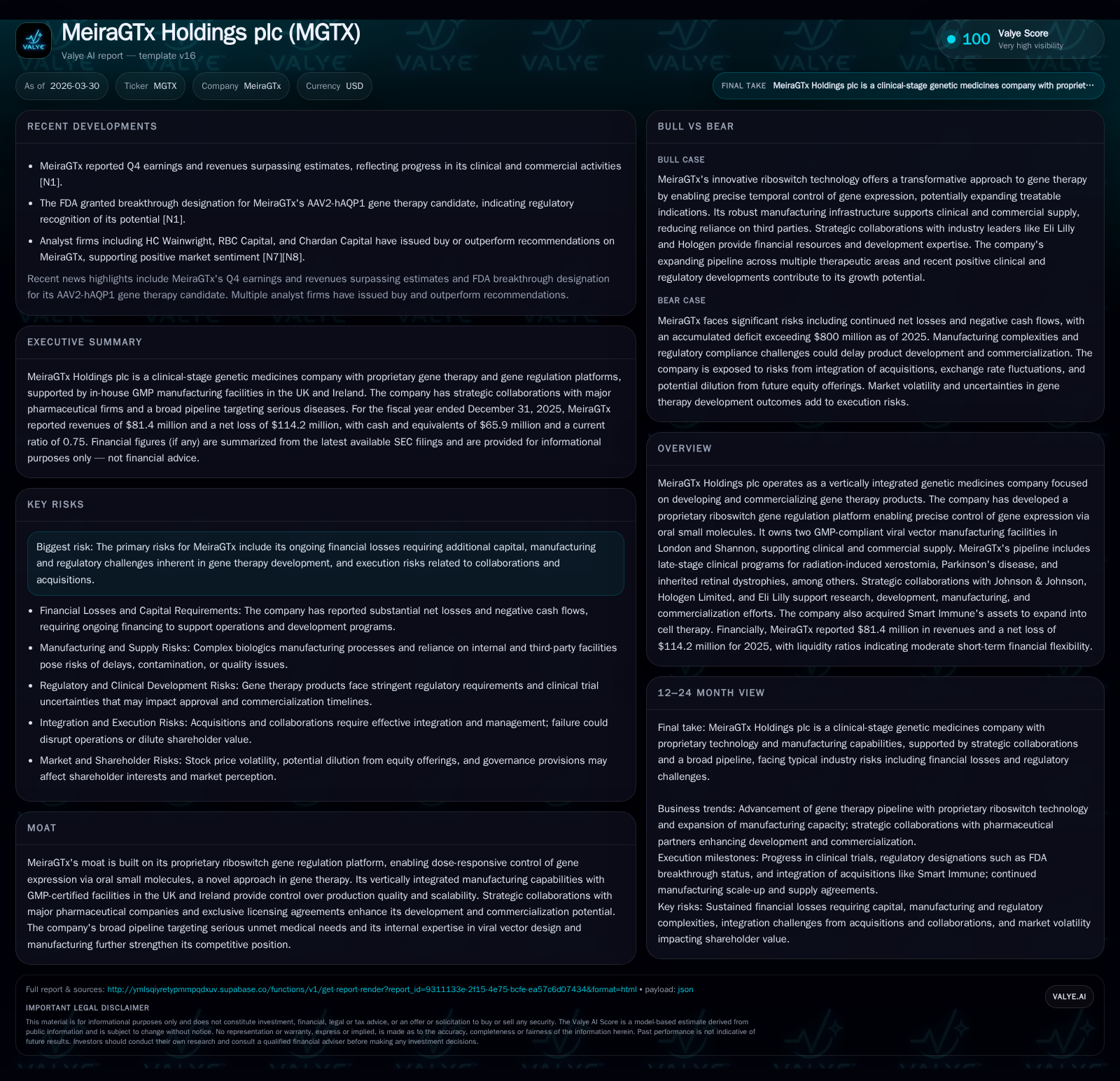
MeiraGTx Holdings plc, a vertically integrated clinical-stage genetic medicines company, has delivered significant top-line growth in 2025, driven by its unique riboswitch gene regulation platform and expanding manufacturing footprint. Despite this revenue surge, the company continues to incur substantial net losses, underpinned by heavy R&D investment and ongoing operational costs. Its proprietary viral vector manufacturing facilities in London and Shannon underpin clinical and potential commercial supply, while strategic collaborations bolster its pipeline across diverse indications including xerostomia and Parkinson’s disease. Capital structure constraints and regulatory hurdles remain key challenges as MeiraGTx navigates scalability and commercialization milestones.
Company Overview
MeiraGTx Holdings plc operates as a vertically integrated, clinical-stage genetic medicines company with end-to-end control of its drug discovery through commercial manufacturing. Central to its competitive advantage is a proprietary riboswitch gene regulation platform which offers dose-responsive control of transgene expression using oral small molecules. This technology addresses key limitations in traditional gene therapy approaches where gene expression is often constant once delivered, potentially leading to safety or efficacy issues.
Supporting this innovation are two fully GMP-certified viral vector manufacturing facilities: a 29,000 square foot unit in London, U.K., and a larger campus in Shannon, Ireland encompassing 150,000 square feet for viral vector and plasmid production [S1]. Ownership of these sites—secured through long-term leaseholds expiring well into the next century—grants MeiraGTx manufacturing scale, supply reliability, and regulatory readiness from clinical trials through commercialization.
Historical Performance
Financially, MeiraGTx has exhibited robust top-line growth over recent years as it leveraged partnerships and advanced pipeline programs:
Historical performance (annual)
| FY | Rev ($mm) | Net ($mm) | CFO ($mm) | OpInc ($mm) | Rev YoY | Net YoY |
|---|---|---|---|---|---|---|
| 2025 | 81 | -114 | -46 | -106 | +144.6% | +22.7% |
| 2024 | 33 | -148 | -104 | -164 | -75.9% | |
| 2023 | -84 | -105 | -137 | |||
| 2021 | -130 | -73 | -116 |
Source: SEC companyfacts cache [F1].
Capital returns and efficiency (annual)
| FY | FCF ($mm) | ROE% |
|---|---|---|
| 2025 | -50 | 1971.4 |
| 2024 | -109 | -217.9 |
| 2023 | -126 | -60.8 |
| 2021 | -118 | -110.1 |
Source: SEC companyfacts cache [F1].
*Revenue not available for FY2023.
Revenue surged approximately 145% in 2025 versus the prior year primarily due to early product-related revenues and expanded collaboration income as the company progressed late-stage clinical candidates [F1]. Operating loss narrowed substantially by about one-third from a peak loss of -$164 million in 2024 to -$106 million in 2025 despite continued heavy investment in research programs.
Negative cash flow from operations remains sizable (-$46 million in 2025), though improved from previous years where spending exceeded $100 million annually largely driven by R&D scale-up and manufacturing investments. Capital expenditures drastically reduced in recent years as the company completed major facility build-outs by 2018; this decline supports near-term cost stabilization prospects.
Equity deteriorated into negative territory (-$5.79 million at end-2025), reflecting accumulated deficits from losses across early-stage pipeline development [F1]. No dividend distributions have been made or contemplated given the developmental stage.
Proprietary Technology and Manufacturing Infrastructure
MeiraGTx's moat chiefly resides in its novel riboswitch gene regulation system that responds dynamically to orally administered small molecules to modulate therapeutic protein production within patients post-gene therapy delivery. This offers unprecedented control enabling titration of therapeutic effect or rapid termination if adverse events occur—a critical safety feature not broadly available among competitors.
The company's capacity to produce sophisticated adeno-associated viral vectors internally at scale further fortifies its position by reducing dependency on external contract manufacturers who face industry-wide supply constraints amid rising demand for gene therapies.
In addition to internal innovation, strategic partnerships enhance technical depth and market reach:
- Collaborations with Johnson & Johnson facilitate joint research endeavors on novel capsids and delivery systems.
- Eli Lilly partnership supports exploration of metabolic peptide targets utilizing the riboswitch platform.
- Acquisition of Smart Immune assets broaden cell therapy capabilities intersecting with oncology indications [S1].
These alliances validate MeiraGTx's technological platforms while diversifying potential future revenue streams.
Pipeline and Growth Prospects
The company is progressing several late-stage clinical candidates targeting conditions with high unmet need:
- Radiation-induced xerostomia (dry mouth syndrome): Recently granted FDA breakthrough therapy designation for AAV2-hAQP1, which could accelerate development timelines and regulatory review processes [N7].
- Parkinson’s Disease: Efforts focus on delivering therapeutic genes locally within the brain aiming at symptom modification rather than palliation.
- Inherited retinal dystrophies including AIPL1-associated retinopathies leveraging targeted ocular gene delivery.
Moreover, the riboswitch platform opens avenues beyond traditional monogenic diseases toward metabolic diseases mediated by peptides like GLP-1 or PYY—underscoring expansion into more prevalent therapeutic areas with commercial scale potential.
Future growth hinges on successful clinical trial readouts translating into market approvals alongside ramping own or partnered commercialization efforts. Manufacturing capacity utilization must correspondingly increase to meet clinical trial supply demands initially then shift toward commercial scale—necessitating operational efficiencies amid regulatory compliance burdens across multi-national jurisdictions (FDA, MHRA) [S1][N7].
Financial Structure and Capital Allocation
The company's financial profile as of end-2025 highlights ongoing liquidity pressures typical of biotech startups advancing costly late-stage pipelines:
- Cash & equivalents totaled approximately $65.9 million providing a limited runway without supplemental capital infusions [F1].
- The capital structure includes senior secured notes originally issued in August 2022 totaling $75 million with option for additional $25 million tranche; interest expense was about $10.9 million in 2025 at effective interest rates above 14% per annum due to risk spreads over SOFR benchmarks [S4][S6][S7].
- Amendments extended debt maturity from August 2026 to May 2027 but require partial principal redemption of $25 million by June 30, 2026 impacting near-term liquidity management.
- Covenants restrict additional indebtedness, distributions, asset dispositions and require minimum cash balances maintained at $3 million safeguarding creditor protections but constraining flexibility.
Capital allocation has prioritized enhancing manufacturing capabilities alongside intensive R&D expenditures. Substantial operating losses have eroded equity but no share repurchases or dividends have occurred reflecting appropriation of resources toward value creation activities rather than shareholder returns currently.
Free cash flow remains negative (~-$50 million) signaling reliance on future fundraising potentially via equity issuances or partner advances given extant burn rates exceeding operational inflows [F1][S20].
Industry Context and Risks
Gene therapy remains one of the most promising yet challenging segments within biotechnology characterized by high upfront investment requirements, complex regulatory environments, evolving standards for pricing/reimbursement, intellectual property entanglements, and fierce competition not only from peer developers but also emerging modalities like gene editing-based solutions.
Specific risks confronting MeiraGTx include:
- Continued net losses necessitate fresh capital raising which can dilute existing shareholders or impose burdensome financing terms [S2].
- Manufacturing scale-up challenges including maintaining GMP standards simultaneously supporting multiple candidates pose operational risks [S5].
- Regulatory hurdles include demonstrating long-term safety/efficacy for novel modalities often requiring extensive post-market commitments [S9].
- Healthcare legislative changes particularly around drug pricing reforms globally could constrain market acceptance or reimbursement rates undermining revenue projections [S10].
- Competition from larger established pharmaceutical companies accelerating their own genetic medicine initiatives might outpace MeiraGTx's development timeline or capture market share [S14].
- Intellectual property disputes represent potential litigative exposures that could delay product launches or inflate costs [S18].
- Data privacy regulations impose compliance complexities especially when conducting multinational clinical trials [S24].
What To Watch Next
Although explicit forward guidance is not stated within filings or public statements beyond broad collaborative milestones:
- Clinical data readouts from pivotal trials of programs such as radiation-induced xerostomia will be critical value drivers.
- Regulatory submissions progress especially leveraging FDA breakthrough designations.
- Capacity utilization rates for viral vector manufacturing signaling commercial readiness.
- Additional strategic partnerships or licensing deals which may infuse capital or broaden pipeline diversity.
- Capital markets activity reflecting ability to raise funds under reasonable dilution terms amid volatile biotech sector dynamics.
The confluence of these factors will determine how quickly MeiraGTx can transition from a developmental stage enterprise toward sustainable commercial operations while managing financial discipline amidst scientific complexities.
This report synthesizes publicly available data including SEC filings ([S#]), recent news ([N#]), and XBRL financial datasets ([F1]) without providing any investment recommendations or price assessments. The biotechnology sector involves considerable uncertainties; investors should conduct their own due diligence before making decisions.
Disclaimer: This is research-only, informational analysis and not investment advice. It may include AI-generated interpretation and general industry context. Always verify important details using primary sources.

Comments