
Yale Transaction Finders, Inc.: Evaluating the Viability and Strategic Ambitions of a Shell Company
Yale Transaction Finders has evolved from an online platform operator into a shell company seeking a business combination amid persistent financial challenges.
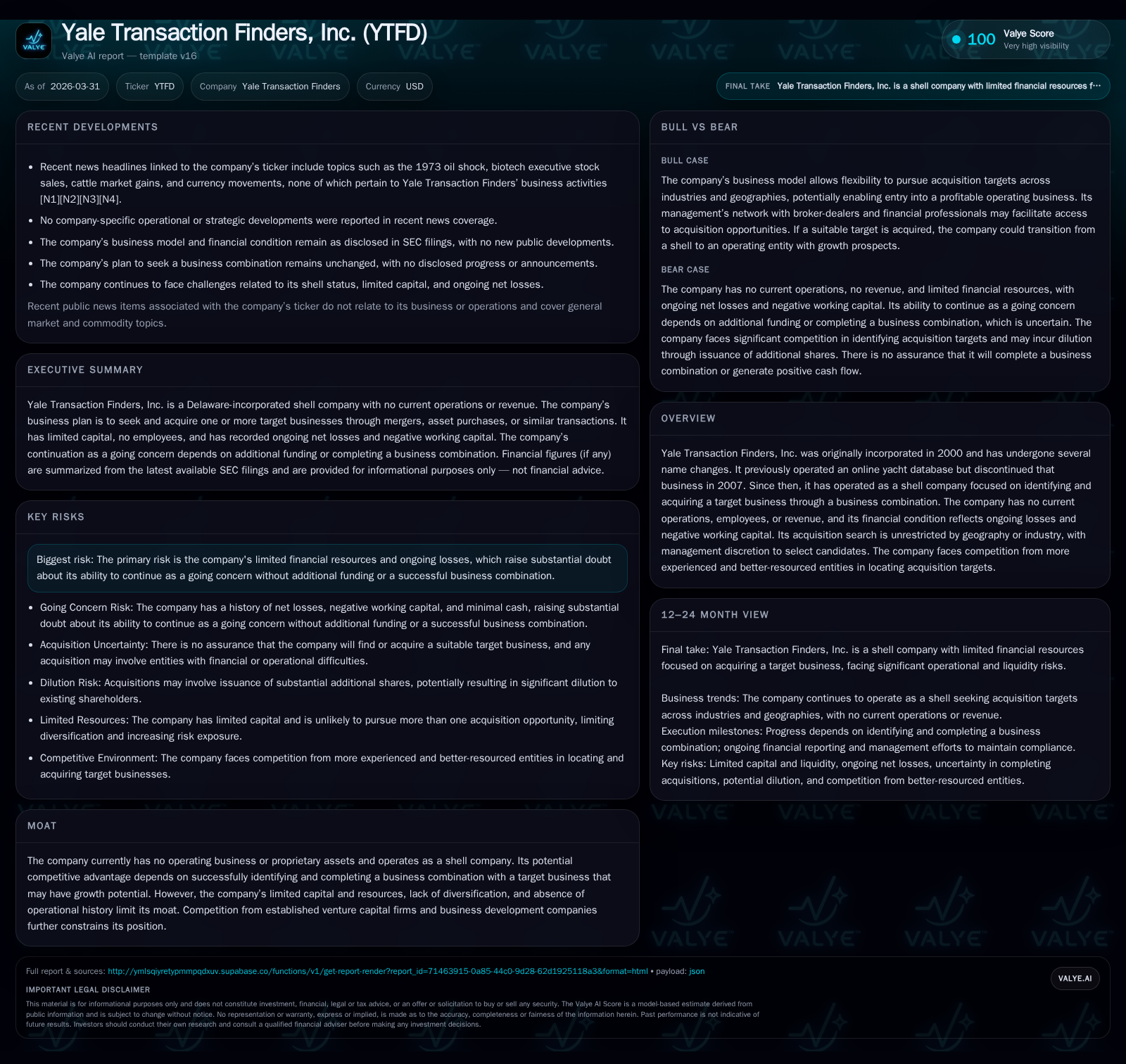
Yale Transaction Finders, Inc. originated in 2000 focused on an online yacht database but discontinued operations in 2007 and has since operated as a shell company aimed at completing a business combination. The company faces ongoing losses, negative equity, and working capital deficits, relying heavily on management advances to sustain operations. Its unrestricted but resource-constrained search for acquisition targets occurs under intense competition from better-capitalized investors. Absent explicit forecasts, key investor milestones hinge on acquisition announcements or capital raises—without dividends or buybacks, capital allocation remains centered around cash burn and survival.
Three Decades of Identity Shift: Tracing Yale Transaction Finders’ Historical Trajectory
Incorporated originally as Sneeoosh Corporation in Delaware on August 15, 2000, the company underwent a series of name changes to Snohomish Corporation in October 2000 and then to Yacht Finders, Inc. in April 2003. Its initial business plan revolved around operating an online database facilitating connections between yacht buyers and brokers—a niche digital marketplace concept ahead of its time. This operation persisted until November 6, 2007, when the company discontinued its legacy online yacht business and pivoted its strategy wholly toward pursuing mergers or acquisitions that could trigger business combinations [S1].
A major strategic reset occurred in March-April 2022 after a securities purchase agreement transferred approximately 98.5% ownership to a consortium including Fountainhead Capital Management Limited and others, coinciding with another rebranding to Yale Transaction Finders, Inc. Since this transaction, the firm operates purely as a shell entity with plans solely focused on identifying acquisition candidates across any geography or industry [S1]. This evolution underscores a transition from active digital service provider to an acquisition search vehicle constrained by limited capital resources.
Financial Snapshot: Persistent Losses and Worsening Working Capital Position
Financial statements from fiscal years ending 2022 through 2025 demonstrate consistent operating losses albeit with modest year-over-year improvement; operating income shrank from -$56,865 in FY2022 to -$33,710 in FY2025 representing an approximate improvement of 8.9% YoY [F1]. Net losses follow similar patterns with $-68,042 reported in FY2022 improving somewhat to $-40,368 by FY2025 (4.7% YoY gain). Operating cash flows remain negative across these years signaling ongoing cash burn without revenue inflows [F1].
At the same time, equity continues to deteriorate; it was -$46,295 at FY2022 and ballooned negatively to -$167,325 by FY2025 [F1]. The deepening accumulated deficit coupled with persistent negative working capital (reported around -$142K mid-year 2025) paints a stark picture of financial fragility [S6],[S21]. The company’s current ratio effectively stands at zero based on available data [F1], emphasizing insufficient current assets against liabilities.
Historical performance (annual)
| FY | Net ($) | CFO ($) | OpInc ($) | Net YoY |
|---|---|---|---|---|
| 2025 | -40368 | -31283 | -33710 | +4.7% |
| 2024 | -42352 | -36934 | -37007 | -10.6% |
| 2023 | -38310 | -33275 | -35275 | +43.7% |
| 2022 | -68042 | -58871 | -56865 |
Source: SEC companyfacts cache [F1].
Capital returns and efficiency (annual)
| FY | ROE% |
|---|---|
| 2025 | 24.1 |
| 2024 | 33.4 |
| 2023 | 45.3 |
| 2022 | 147.0 |
Source: SEC companyfacts cache [F1].
Table note: Data sourced from SEC XBRL companyfacts cache [F1]; ROE calculated as net income divided by equity for FY2025.
Operational Status: From Active Online Platform to Barebones Shell Entity
Since shuttering its original online yacht database in late 2007, Yale Transaction Finders has had no employees nor revenue-generating operations [S1]. It holds no proprietary intellectual property nor diversified business segments. The company's strategic purpose now hinges solely on its ability to identify and consummate a merger or asset acquisition that would revive operational scale . Without an active operating unit or products/services portfolio, Yale is essentially dormant apart from acquisition activity efforts.
This status classifies it formally as a "shell company" under SEC definitions (Rule 12b-2), which typically denotes entities existing primarily for the purpose of effecting a business combination rather than producing goods or services themselves [S14]. Consequently, Yale's competitive moat depends entirely on management's success navigating acquisition opportunities.
Capital Structure Challenges and Going Concern Risks
Repeated disclosures across quarterly filings emphasize liquidity constraints and worsening working capital shortages. As of June through September 2025 periods, the Company reported negative working capital approximating $140K to $150K alongside an accumulated deficit exceeding $1.37 million by mid-2025 [S6],[S12],[S17],[S21]. The balance sheet reveals no borrowings nor plans for debt issuance; rather management relies predominantly on shareholder advances to cover operational expenses which accrue as reimbursable notes [S3],[S7],[S22].
Filings clearly highlight "substantial doubt" about continuing as a going concern without additional financing infusion or completion of an acquisition providing necessary cash flow [S6],[S12],[S21]. This uncertainty exposes risks such as failure to meet SEC filing deadlines potentially leading to trading suspensions or penalties—damaging investor confidence and liquidity further [S7],[S21].
Attempts to mitigate diligence costs during acquisition searches through candidate deposits are uncertain given candidates’ willingness to participate financially remains unguaranteed [S7]. Without stable funding sources beyond management advances—who themselves are not obliged to provide funds—the Company's financial viability is precarious.
Competitive Environment in Business Combination Landscape
The landscape Yale operates within is highly competitive and structurally challenging due to presence of established players like business development companies (BDCs), venture capital partnerships affiliated with sizeable funds, small investment companies well versed in mergers & acquisitions (M&A), and affluent individual investors ,[S16]. These entities benefit from deeper pockets, more experienced management teams familiar with rapid target screening and due diligence processes, as well as stronger networks for deal flow generation.
The cost barrier for adequate investigation into prospective deals is significant given legal fees, auditing expenses and travel costs integral during negotiation phases—areas where Yale’s limited capitalization constrains activity relative to rivals who can absorb such expenses readily [S8],. In addition, these competitors may offer superior terms that increase their attractiveness over smaller participants.
Strategic Outlook: Search Criteria and Constraints on Acquisition Targets
Yale’s mandate allows selection of target businesses broadly without geographical or industry-specific restrictions offering theoretical latitude in target identification [S1],. However practical constraints driven by scarce financial resources mean real choices will be narrow—it likely can pursue only one combination successfully before resource limitations inhibit further deals.
Management intends to focus on opportunities promising long-term growth potential rather than immediate earnings improvements underscoring a vision weighted toward eventual value creation instead of swift profitability jumps [S11]. Nevertheless inherent risks include acquiring newly organized companies lacking operational history or exhibiting financial stress compelling substantial post-acquisition restructuring by Yale’s management team—an endeavor complicated by its own limited operating scale [S18].
Each transaction contemplated would be governed by detailed definitive agreements specifying representations/warranties and conditions precedent typical in M&A deals that could delay closing if issues arise during due diligence [S8]. This procedural complexity adds uncertainty around timing or likelihood of deal completion.
What Investors Should Watch: Milestones and Funding Signals
The company provides no explicit forward guidance or forecasts identifiable in filings up through Q4 FY2025 making it difficult to concretely predict timeline or outcome probabilities regarding its acquisition search trajectory. Consequently, investor attention should concentrate on periodic SEC disclosures such as Form 8-K’s announcing material events including executed letters of intent (LOIs), definitive agreements signed for acquisitions, financing rounds undertaken through share issuances—or sudden management commentary shifts altering strategic direction.
Tracking shareholder loan advances input numbers may also provide hints about internal financial health trends when public data surfaces through periodic reports although these tend not to be explicitly quantified beyond qualitative remarks [S7],[S22]. News coverage highlighting involvement with broker-dealers or corporate financiers might surface alongside acquisition rumors but remain unconfirmed until official documentation follows.
Capital Allocation Realities: Lack of Dividend Policy and Cash Burn Dynamics
Absent any operating cash inflows aside from potential future acquisition-related revenues — non-existent so far — Yale pays no dividends nor conducts share repurchase activities given continuous net losses reported annually [F1], , [S20], [S23]. Rather the company absorbs inevitable cash burn from accounting fees, filing expenses along with investor relations costs needed merely to maintain exchange compliance.
Management asserts intention not to borrow funds externally but relies on deferring reimbursements owed for out-of-pocket costs incurred covering corporate overheads until post-acquisition when funded companies potentially repay those sums [S3],[S7],[S22]. The theoretical return on equity computation is skewed by severely negative equity balances resulting presumably in inconsistent ratios though latest calculations suggest roughly +24% ROE based mathematically simply due to denominator effects rather than genuine profitability metrics reflective of continued losses nonetheless reported contemporaneously [F1].
In sum the company’s capital structure reveals strained survival mode dynamics awaiting transformational events rather than yielding measurable shareholder returns at present.
Disclaimer: This analysis is based exclusively on public filings and documented evidence available as of March 31, 2026, without any speculative estimates beyond presented data. It does not constitute investment advice.
Disclaimer: This is research-only, informational analysis and not investment advice. It may include AI-generated interpretation and general industry context. Always verify important details using primary sources.

Comments