
Check Point Software’s Balancing Act: Subscription Growth vs Operating Margin Pressure
Check Point Software Technologies sustains growth through subscriptions and strategic AI acquisitions while navigating margin compression from rising costs.
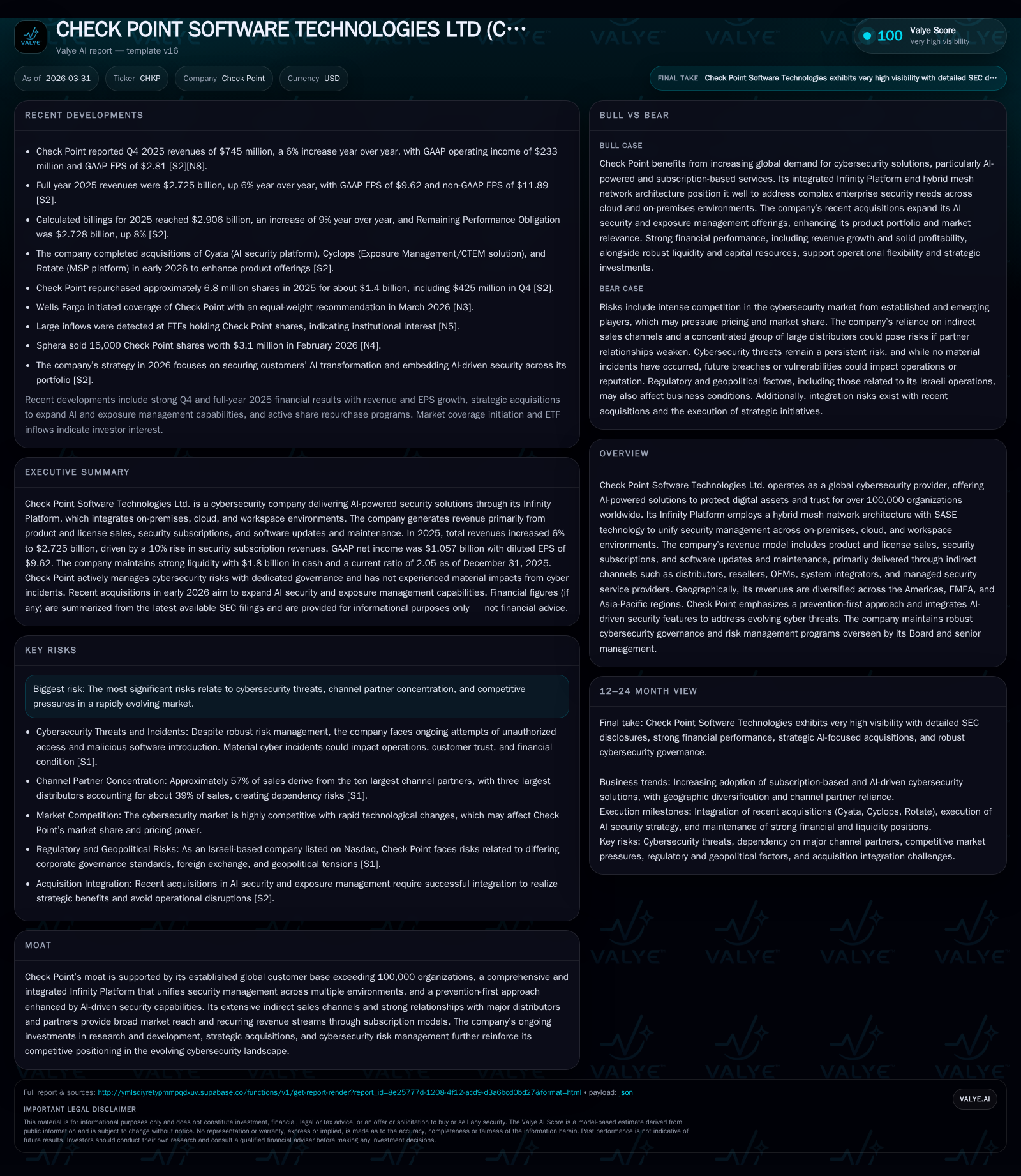
Check Point delivered steady revenue growth of 6.3% in 2025, driven by a 10% rise in security subscription revenues reflecting customer demand for its AI-enhanced cybersecurity platforms. Operating income declined by roughly 5%, pressured primarily by increased R&D, cloud infrastructure expenses, and stock-based compensation tied to recent acquisitions. The company’s capital allocation reflects a disciplined approach with significant share repurchases funded partly by convertible note proceeds. Looking ahead, integration of AI-focused acquisitions and the expansion of hybrid mesh and exposure management offerings underpin growth prospects but margin sustainability remains challenged amidst competitive and operational headwinds.
Historical Financial Performance
Check Point Software Technologies Ltd. has demonstrated consistent revenue growth over the past four years with total revenues increasing from approximately $2.33 billion in FY2022 to $2.73 billion in FY2025, reflecting a compound annual growth rate near 5%. The expansion in top-line is principally propelled by increasing traction in security subscription services—a segment that grew by roughly 10% year-over-year in FY2025, reaching over $1.2 billion or approximately 45% of total revenue [F1][S1].
Historical performance (annual)
| FY | Rev ($bn) | Net ($mm) | CFO ($mm) | OpInc ($mm) | Rev YoY | Net YoY |
|---|---|---|---|---|---|---|
| 2025 | 2.7 | 1057 | 1199 | 831 | +6.3% | +25.0% |
| 2024 | 2.6 | 846 | 1052 | 876 | +6.2% | +0.6% |
| 2023 | 2.4 | 840 | 1038 | 899 | +3.6% | +5.4% |
| 2022 | 2.3 | 797 | 1099 | 884 |
Source: SEC companyfacts cache [F1].
Capital returns and efficiency (annual)
| FY | Buybacks ($mm) | FCF ($mm) | ROE% |
|---|---|---|---|
| 2025 | 1400 | 1173 | 36.7 |
| 2024 | 1300 | 1028 | 30.3 |
| 2023 | 1288 | 1019 | 29.8 |
| 2022 | 1300 | 1076 | 27.2 |
Source: SEC companyfacts cache [F1].
Operating income has shown some volatility, declining from $899 million in FY2023 to $831 million in FY2025 (a drop of approximately -5%). This contraction is attributed largely to increased spending on research and development—including personnel costs and cloud infrastructure—and higher stock-based compensation expense connected with recent acquisitions [S4][S7]. Despite this margin pressure, net income expanded strongly (+25%) driven by favorable tax treatment—reflected as an effective negative tax rate (-12%) due primarily to Israeli tax benefits—and increased financial income stemming from interest on cash reserves augmented by a $2 billion convertible note issuance [F1][S11].
Free cash flow remained robust at over $1.17 billion in FY2025 after deducting modest capital expenditures which amounted to $26.6 million—largely computer equipment, software and leasehold improvements—from operating cash flow of nearly $1.2 billion [F1][S3][S4]. Concurrently Check Point continued sizable share repurchases totaling $1.4 billion across the year as part of its capital allocation strategy alongside reissuance of shares under employee stock plans [F1][S21].
Business Model and Revenue Streams
Check Point's revenue model centers around three main components: product and license sales; security subscriptions providing access to its suite of cloud-based cybersecurity solutions; and software updates and maintenance services supplying ongoing technical support and upgrades [S1][S10]. The company sells primarily through indirect channels —distributors, resellers, OEMs, system integrators, and managed security service providers—which accounted for about 57% of sales from the top ten channel partners alone during recent years [S1][S8]. This entrenched distribution enhances reach across diverse customer bases globally.
Geographically revenue contributions remain relatively balanced: around 42% derives from the Americas (dominated by US), about 46% from Europe, Middle East and Africa (EMEA), and close to 12% from Asia-Pacific [S1][S8]. This diversification mitigates concentration risks but also exposes Check Point to currency fluctuations—particularly impacting R&D costs as most personnel expenses are paid in Israeli shekels while reporting is in US dollars [S7][S24]. The firm employs financial hedging strategies on part of this currency exposure.
Growth Drivers and Strategic Initiatives
In recent quarters, the company has emphasized its cross-environment Infinity Platform underpinned by a hybrid mesh network architecture integrating SASE technology to deliver unified security management across on-premises data centers, clouds, and remote workspaces . This prevention-first design philosophy augmented with AI-powered threat intelligence aligns with enterprise demand for advanced cybersecurity solutions able to handle evolving complex threats.
The fiscal year ended December 2025 saw prominent growth in recurring subscription revenues (+10%), signaling stronger customer preference shift toward cloud-delivered security-as-a-service models [F1][S1]. Furthermore, Check Point announced early-2026 acquisitions such as Cyata—a move that expands capabilities into AI agent discovery and governance—and Cyclops which bolsters cyber exposure management offerings delivering comprehensive CTEM solutions [N5][S2]. These moves underscore Check Point’s ambition to embed AI-driven security features deeply into its portfolio while expanding addressable market segments related to AI governance.
Management commentary highlights focus on four strategic pillars: Hybrid Mesh Network; Workspace Security; Exposure Management; and embedding AI-driven capabilities throughout the portfolio—all aiming at securing customers’ ongoing AI transformation initiatives [N5][S2]. This aligns with broader industry trends stressing zero trust architectures combined with automated risk mitigation via intelligent analytics.
Margin Pressure and Operating Leverage Challenges
While revenue gains remain commendable, operating margins contracted from approximately 34% in FY2024 to around 30% in FY2025 [F1][S15]. The margin dip stems primarily from several factors:
- Increased workforce-related expenses including salary inflation,
- Rising cloud infrastructure costs required to support SaaS delivery,
- Higher amortization expenses related to intangible assets acquired through recent M&A,
- Elevated stock-based compensation reflecting retention efforts among key talent post-acquisition.
R&D spend accounted for roughly 17% of revenues in FY2025 versus around 15% prior year; selling & marketing expenses similarly increased as part of significant investments aimed at partner ecosystems growth and brand marketing [S7][S12]. General administrative costs ticked higher as well but remain a smaller component (~5%).
This blend points toward operating leverage challenges common among cybersecurity providers investing aggressively in innovation amidst intensely competitive markets seeking differentiation through technology leadership.
Returns & Capital Allocation
Check Point manifests disciplined capital stewardship evidenced by consistently strong free cash flow generation enabling substantial shareholder returns via buybacks exceeding $1.4 billion annually since FY2023 [F1][S21]. Dividend policy is supportive but secondary relative to share repurchases.
The December 2025 issuance of zero-coupon convertible senior notes raising approximately $2 billion infused additional liquidity that management allocated partly toward further repurchases ($225 million planned shortly after issuance) and M&A funding while preserving cash flow sufficiency for organic investments [S11][S21]. The use of capped call transactions concurrently mitigates potential dilution arising from future conversion events.
Return on equity stands near an impressive ~37%, reflecting efficient utilization of equity base combined with substantial net income gains post-tax benefits [F1]. This illustrates healthy profitability despite margin pressures.
Risk Factors & Industry Considerations
Key risks identified include:
- Cybersecurity threats constantly evolving requiring ongoing investment lest platforms lag competitors’ efficacy,
- Dependence on a concentrated set of top-tier channel partners accounting for over half total sales presents execution risk if these relationships sour,
- Currency volatility owing to R&D expense base located chiefly in Israel affects expense predictability despite hedging efforts,
- Competitive pressures intensifying especially from next-generation rivals emphasizing cloud-native architectures,
- Regulatory exposures spanning data privacy laws impacting product compliance contentions.
Industry context reveals that cybersecurity firms must balance tight margins while scaling SaaS subscription models amid heightened compliance cost layers—a dynamic Check Point grapples with similarly .
What To Watch Next: Forecasts & Milestones (Analysis)
Without explicit quantitative guidance recently disclosed [N#], stakeholders should monitor first-half FY2026 results focusing on:
- Subscription revenue trends as indicator of platform adoption velocity,
- Margins trajectory considering integration costs from new acquisitions like Cyata,
- RPO (Remaining Performance Obligation) growth signalling forward revenue visibility,
- Effectiveness of capital deployment balancing buybacks against strategic innovation investments.
Evolving geopolitical tensions creating new cyber threat vectors may also spur incremental demand albeit alongside heightened risk environment monitoring requirements.
Summary
Check Point Software Technologies continues its march as a stalwart global cybersecurity provider anchored by a robust hybrid mesh network platform powered increasingly by AI enhancements targeting broad enterprise digital risk surfaces. It leverages its extensive indirect distribution network covering Americas, EMEA, and Asia-Pacific markets effectively while expanding subscription penetration—the chief driver behind reported double-digit growth rates.
However, judicious balancing is required given evident margin compression amid rising investment needs spanning R&D scale-up, cloud infrastructure maintenance, acquisition-related amortization charges, as well as retention incentives expressed via stock comp expenses.
Capital discipline remains notable with substantial share repurchase levels accompanied by sizable convertible bond issuance facilitating both shareholder returns and acquisition finance capability.
Thus far the company steers well through competitive headwinds but will need sustained innovation rigor coupled with channel strategy refinement to preserve its moat amid accelerating industry shifts towards integrated AI-led security operations.
This report synthesizes publicly available regulatory filings as of March 31, 2026 ([F1],[S#]) along with Nasdaq-sourced news items ([N#]). It does not constitute investment advice or recommendations but aims to provide detailed analytical insight based on documented data sources.
Disclaimer: This is research-only, informational analysis and not investment advice. It may include AI-generated interpretation and general industry context. Always verify important details using primary sources.

Comments