
Massimo Group’s Growth Challenges and Supply Chain Risks Test Utility Powersports Expansion
Massimo Group focuses on all-weather utility powersports vehicles with a scalable U.S. distribution model but faces margin pressures and litigation headwinds.
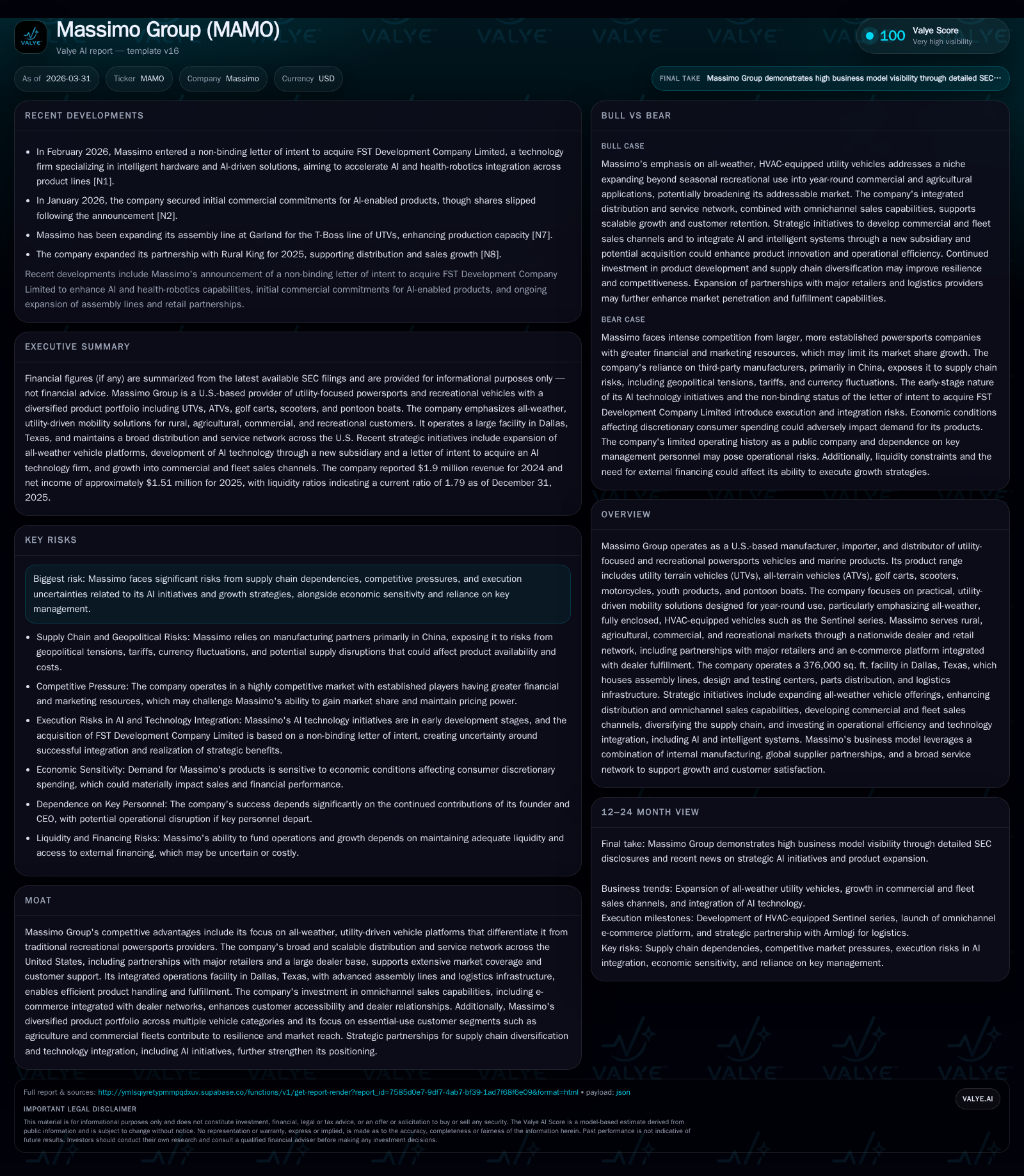
Massimo Group has built a niche in utility-focused, all-weather powersports vehicles, targeting rural and commercial markets via a broad dealer network and omnichannel sales. While revenue showed growth through 2024, operating income declined sharply in 2025 amid supply chain constraints and litigation expenses. The company’s Sentinel series and expanding electric product lines offer growth avenues, yet persistent risks around China-based suppliers, regulatory compliance, and limited R&D temper outlook. Capital allocation remains conservative with minimal capex and no disclosed buybacks or dividends. Monitoring legal cases, supply chain stabilization, and execution on AI-enabled product initiatives will be critical.
Company Overview and Business Model
Massimo Group is a U.S.-based manufacturer, importer, and distributor specializing in utility-focused powersports vehicles such as UTVs (Utility Terrain Vehicles), ATVs (All-Terrain Vehicles), golf carts, scooters, motorcycles, youth products, and pontoon boats [S1][S9]. Unlike traditional recreational powersports providers, Massimo emphasizes practical, year-round mobility solutions designed for agricultural, commercial, and rural applications. A key differentiator is the development of all-weather vehicles—fully enclosed units equipped with HVAC systems such as the Sentinel 570 and Sentinel 770—allowing operation across climates and seasons [S14][S19].
The company operates from a significant physical base: a 376,000 sq. ft. Dallas facility containing assembly lines (including automated robotics), design/testing centers, parts inventory (40,000 sq. ft.), test track, dynamometer capabilities, and adjacent boat storage [S9][S21]. Massimo’s operations reflect an asset-efficient model that uses both internal resources and third-party manufacturing partnerships primarily in China [S5][S20].
Massimo distributes products through approximately 2,800 independent dealers nationwide plus national retailers like Tractor Supply Co., Lowe’s, Walmart, alongside its proprietary e-commerce platform launched in partnership with Ekho Dealer in March 2025 [S9][S17][S21]. This omnichannel approach integrates online vehicle configuration/purchasing directly tied to dealer fulfillment to accommodate evolving customer purchasing preferences.
Historical Financial Performance
Revenue data is available for FY2024 at approximately $1.9 million [F1]. Operating income has seen considerable volatility: from $12.9 million in FY2023 down to $5 million in FY2024 and further down to about $2 million by FY2025—a decline exceeding 60% year-over-year between FY2024 and FY2025—indicating margin pressures or extraordinary costs related to operational challenges or litigation provisioning [F1]. Net income declined by about 14% from $1.76 million in FY2024 to roughly $1.5 million in FY2025.
Operating cash flow turned negative in FY2025 at -$98k versus positive inflows of over $6.6 million in FY2024—a swing indicating working capital changes or increased operational expenditures [F1]. Capital expenditures shrank sharply by over 80% from nearly $388k in FY2024 to about $65k in FY2025 as the company appears to be conserving cash amidst rising costs [F1]. Equity grew steadily as well—from $14.5 million at FY2023's end to over $23.7 million by FY2025—reflecting post-IPO capital inflows [F1].
Historical performance (annual)
| FY | Net ($mm) | CFO ($mm) | OpInc ($mm) | Capex ($) | Net YoY |
|---|---|---|---|---|---|
| 2025 | 2 | 0 | 2 | 65361 | -14.3% |
| 2024 | 2 | 7 | 5 | 387876 | -83.1% |
| 2023 | 10 | 11 | 13 | 134662 |
Source: SEC companyfacts cache [F1].
Capital returns and efficiency (annual)
| FY | FCF ($mm) | ROE% |
|---|---|---|
| 2025 | 0 | 6.4 |
| 2024 | 6 | 8.1 |
| 2023 | 11 | 71.9 |
Source: SEC companyfacts cache [F1].
Note: Revenue data only available for FY2024; other years omitted.
Future Growth Prospects
Massimo’s growth strategy focuses on essential-use segments such as agriculture and commercial applications rather than solely recreational markets [S14]. The company prioritizes innovation around "all-weather" utility UTVs featuring enclosed cabins with heating/air conditioning aimed at year-round usability under diverse environmental conditions—a niche less penetrated by larger incumbents like Polaris or BRP [S16][S19].
Additional growth initiatives include:
- Launching electric vehicle chargers and electric pontoon boats reflecting strategic efforts toward electrification trends within powersports and marine sectors [S9][S8].
- Exploring AI-enabled products for agriculture/security/logistics through third-party manufacturing partnerships; these remain early stage [S12].
- Expanding dealer relationships regionally/nationally with emphasis on training sales teams to secure new distributors despite talent retention challenges [S16][S18].
- Enhancing e-commerce platform integration to streamline customer purchase experience while strengthening dealer alignment; digital channels have shown increasing order volumes since early 2025 launch [S13][S17].
- Initial international expansion efforts target Europe via independent distributors but have yet to significantly impact revenues.
Constraints include dependence on Chinese suppliers—particularly state-owned Linhai Powersports—and tariff-related cost pressures that may limit pricing flexibility [S20][S7]. Ongoing trade tensions present supply chain disruption risks.
Risks and Litigation Challenges
Key risk factors include:
- Pending lawsuits involving unpaid shipments and contract disputes present unresolved financial exposure; appeals are active without settlement progress reported [S4][S10][S24][S25].
- Product safety concerns related to past defective components have triggered injury claims; provisions may not fully cover future claims posing reputational threats [S6][S15][S24].
- Compliance requirements across emissions standards (EPA), state licensing laws (e.g., California Air Resources Board), and product safety regulations entail significant administrative costs; penalties remain possible if controls fail [S6][S10].
- Customer concentration risk exists as approximately two-thirds of consumers are farmers benefiting from government incentives that could change [S16].
- Supply chain reliance on Chinese suppliers exposes Massimo to currency fluctuations (USD/CNY), tariffs up to 20%, and geopolitical risks impacting Linhai Powersports operations despite diversification efforts [S7][S20][S26].
- Management team exhibits limited public company experience; founder David Shan retains majority ownership raising governance considerations amid scaling challenges [S23][S24].
Returns & Capital Allocation
Financial metrics reveal:
- An approximate return on equity near 6.4% based on FY2025 net income relative to shareholder equity levels—moderate capital efficiency by sector standards [F1].
- Negative free cash flow around -$164k for FY2025 due to slightly negative operating cash flow after minimal capex outlays reflecting conservative spending amid external pressures [F1].
- No disclosed dividends or share repurchase programs suggesting focus on reinvestment or liquidity preservation given legal contingencies.
- A healthy current ratio of approximately 1.79 indicates adequate liquidity despite negative cash flow signals caution regarding short-term operational cash generation effectiveness [F1].
Industry Context Analysis
Utility powersports vehicles trend toward durable models serving daily functional needs including farming/agricultural land maintenance—a segment demanding weather-resilient designs like Massimo's HVAC-equipped UTVs which few competitors comprehensively offer.
The pontoon boat market in the U.S. remains fragmented with competition centered on product offerings and pricing; Massimo’s local manufacturing presence supports higher domestic content which may mitigate elevated shipping costs affecting foreign competitors' geographic reach.
Supply chains face ongoing challenges from tariffs disrupting import cost structures; multi-region sourcing flexibility is vital though complex given specialized supplier bases.
What To Watch Next
Investors should monitor:
- Developments in key legal proceedings including appeal outcomes affecting contingent liabilities.
- Quarterly signs of supply chain normalization or ability to pass through tariff-induced cost increases.
- Progression of AI-enabled product initiatives toward commercialization.
- Expansion pace of dealer network beyond core regions alongside dealer financing health amid noted credit dependencies.
- Frequency of product recalls or new safety concerns impacting brand reputation.
- Margin recovery potential if inflationary pressures ease or new higher-margin products gain traction.
Conclusion
Massimo Group occupies a distinctive niche emphasizing durable utility vehicles tailored for essential-use markets often overlooked by larger peers focused on recreational lineups. Its broad distribution footprint coupled with integrated e-commerce facilitates market reach though execution risks tied to supply chain complexities—especially Sino-American trade tensions—and unresolved litigation pose substantial near-term headwinds.
Profitability metrics reflect declines despite stable net income affirming margin compression coincident with investments into innovative products like fully enclosed Sentinel UTVs for year-round operation. Capital allocation appears prudent yet conservative as management navigates growth ambitions amid external uncertainties.
Subsequent improvements in supply stability alongside successful commercialization of electrified offerings will be pivotal for sustaining long-term momentum while managing legacy risks remains critical for investor confidence.
This report is prepared solely for informational purposes reflecting publicly available data as of March 31st, 2026 without offering investment recommendations or predictive assurances about future performance.
Disclaimer: This is research-only, informational analysis and not investment advice. It may include AI-generated interpretation and general industry context. Always verify important details using primary sources.

Comments