
Professional Diversity Network's Revenue Decline and AI-Powered Recruitment Ambitions
IPDN grapples with shrinking revenues and escalating losses while pursuing innovation in AI recruitment and Web3 platforms.
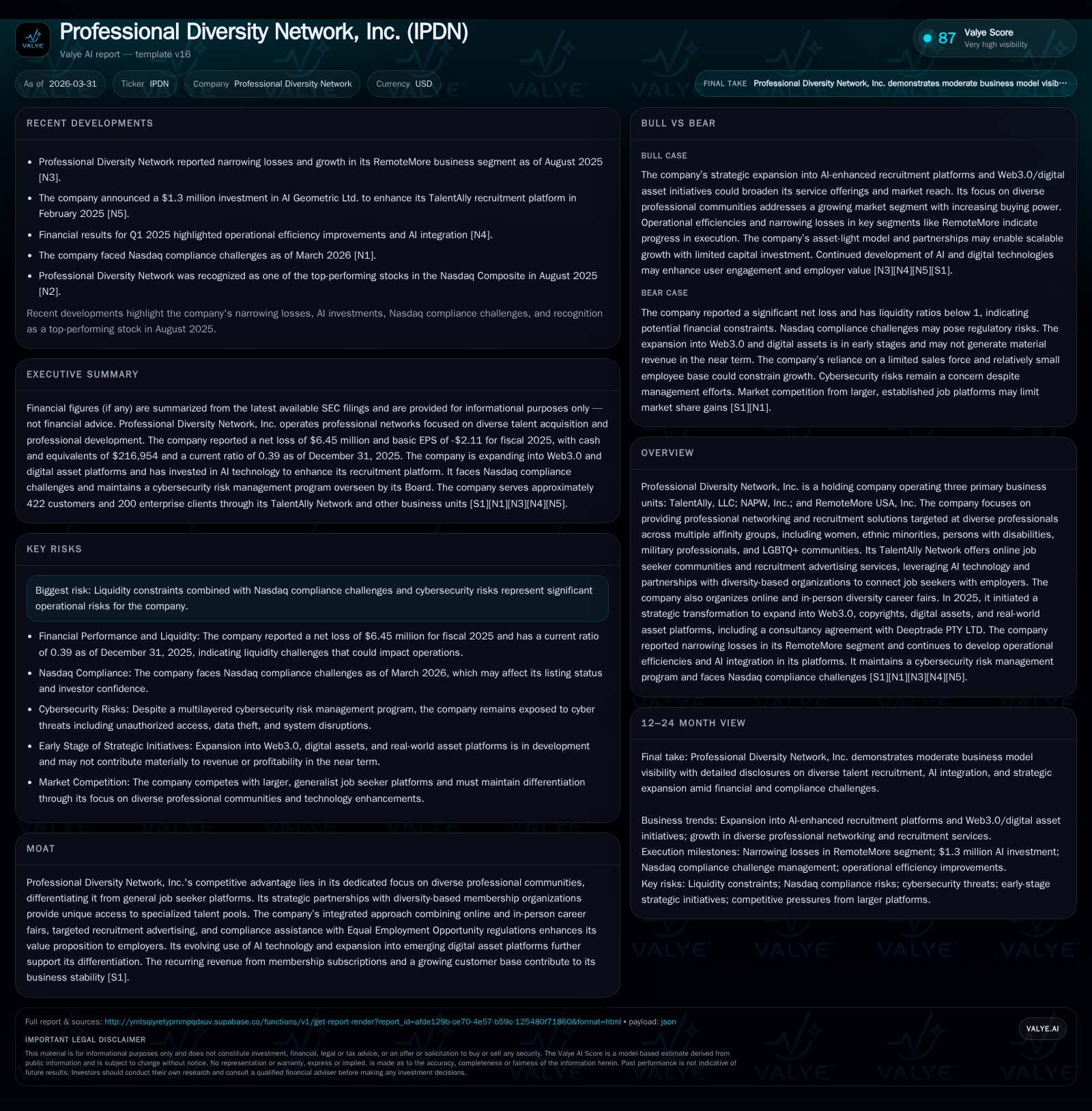
Professional Diversity Network, Inc. (IPDN) has experienced a notable revenue decline of approximately 15.9% year-over-year, coupled with widening operating losses that reached over $6.4 million in 2025 as it expands its digital recruitment and diversity hiring offerings. The company operates through three core units—TalentAlly, NAPW, and RemoteMore USA—that collectively target diverse professional communities with a blend of online job boards, career fairs, and customized software development services. IPDN’s strategic pivot into AI-enhanced recruitment tools and exploratory ventures in Web3.0 and digital assets aims to differentiate its platform amid competitive pressures but coincides with liquidity challenges and Nasdaq compliance risks that may constrain near-term growth.
Historical Performance: Analyzing Revenue Declines and Operating Loss Trajectory
IPDN’s financial trajectory over recent years has been marked by declining top-line revenue paired with escalating operating deficits. The available SEC XBRL data shows revenue peaking at $38.6 million in 2015 before declining to approximately $22 million by the end of 2017 [F1]. While full annual figures between 2018-2024 are not explicitly provided, the worsening operating income figures imply continued fiscal stress through these periods.
By 2025, IPDN’s operating loss widened substantially to over -$6.45 million from a loss of roughly -$2.4 million in 2024, representing a -168.3% deterioration year-over-year [F1]. Net income followed this negative trend with losses deepening similarly.
Operating cash flows remained negative across recent years; however, there was a modest improvement from -$2.5 million in 2024 to about -$2.09 million in 2025. Capital expenditures contracted sharply in 2025 to merely $3,995 from roughly $20,873 the previous year signaling tightening investment [F1].
Historical performance (annual)
| FY | Net ($mm) | CFO ($mm) | OpInc ($mm) | Capex ($) | Net YoY |
|---|---|---|---|---|---|
| 2025 | -6 | -2 | -6 | 3995 | -156.8% |
| 2024 | -3 | -3 | -2 | 20873 | +41.7% |
| 2023 | -4 | -3 | -5 | 30426 | -65.6% |
| 2022 | -3 | -2 | -3 | 15602 |
Source: SEC companyfacts cache [F1].
Capital returns and efficiency (annual)
| FY | FCF ($mm) | ROE% |
|---|---|---|
| 2025 | -2 | -54.9 |
| 2024 | -3 | -47.2 |
| 2023 | -3 | -141.4 |
| 2022 | -2 | -102.2 |
Source: SEC companyfacts cache [F1].
The inability to stabilize revenue combined with intensifying operational losses poses key questions about sustainability without substantial business model adjustments or capital infusion.
Business Model Unpacked: The Triad of TalentAlly, NAPW, and RemoteMore USA
IPDN operates through three primary subsidiaries targeting professionals from diverse demographic groups including women and ethnic minorities: TalentAlly LLC (100% owned), NAPW Inc. (100% owned), and RemoteMore USA Inc. (84.6% owned) [S24].
TalentAlly forms the core recruitment solution comprising online affinity job seeker communities across Women, Hispanic-Americans, African-Americans, Asian-Americans etc., layered with diversified offerings such as recruitment advertising compliant with OFCCP/EEOC regulations and professionally curated career fairs both virtual and physical [S4][S28]. Over half (~53%) of revenue emanates from this segment.
NAPW, focusing on professional women’s personal and career development through membership programs sold via direct marketing teams offline and online subscriptions contributes about 5% of revenue; it employs lead generation approaches yielding recurring membership cash flows [S5][S28].
RemoteMore USA provides remote software engineering staffing solutions linking vetted developers globally to corporate clients; this unit accounted for roughly 42% of gross revenues in the latest fiscal period illustrating diversification into technology services beyond pure recruitment networks [S24][S29].
Sales efforts involve segmented teams addressing federal/state government contractors plus small-medium enterprises (<2500 employees) and large enterprises (>2500), leveraging multichannel sales including telesales and industry events participation supported by e-commerce enablement [S5]. Customer success teams enhance member retention while ensuring ethical sales conduct fostering sustainable client relationships [S11]. As of late-2025 the company serviced an estimated total customer count of ~422 including around 200 enterprises across segments [S4].
AI Integration and Strategic Partnerships Fueling Product Evolution
Notably reflecting sector trends embracing digital transformation IPDN has augmented its TalentAlly Network capabilities through strategic partnerships deploying artificial intelligence technology. A standout collaboration is with AI Geo—a platform providing AI-powered mock interview simulations tailored specifically to enhance engagement among diverse job seekers seeking to refine their interviewing skills effectively prior to employer interactions [S4].
Within the recruitment technology arena where automation accelerates screening accuracy and candidate matching precision especially for niche talent pools like diverse professionals this kind of AI integration positions TalentAlly distinctively against conventional job boards reliant solely on manual postings or rudimentary search filters . This enables improved user experience as well as strengthens value propositions toward employer clients hunting hard-to-find specialized talent subsets.
Emerging Web3.0 Initiatives and Their Role in Growth Strategy
From a strategic vantage point IPDN initiated exploration into emergent blockchain-enabled ecosystems embodying copyrights management alongside digital asset utilization frameworks encompassing real-world assets tokenization during fiscal year 2025 — activities currently nascent yet representing diversification efforts aimed at evolving beyond legacy recruitment-centric models [S1][N1][S6].
The establishment of a wholly owned Japanese subsidiary dedicated to nurturing business development for these Web3-oriented endeavors reflects management’s intent to tap into Asia-Pacific markets—which have shown early receptivity toward decentralized finance applications—as potential growth arenas paralleled by leveraging professional networking infrastructure synergistically [S24][S19].
However operational contributions remain immaterial thus far; commercial viability remains uncertain pending regulatory approvals or market acceptance among traditional HR buyers cautious about blockchain applications so far peripheral to core hiring workflows .
Customer Base Dynamics: Enterprise Engagement and Market Penetration
A granular look reveals IPDN's customer profile comprising approximately 422 total customers as of December 31st 2025 including nearly half represented by enterprise accounts (~200) spanning governmental contractors – who require compliance solutions adhering to OFCCP standards – alongside private sector organizations segmented by size class supporting tailored sales approaches optimized for scale efficiency versus bespoke enterprise negotiations [S4][S16][S23].
This segmentation aligns well with differentiated procurement practices where smaller businesses seek streamlined self-service platforms whereas larger corporations prioritize compliance risk mitigation embedded within recruitment advertising solutions offering measurable diversity hiring outcomes compliant with Equal Employment Opportunity mandates.
Client acquisition leverages direct telemarketing combined with strategic alliances that enhance outreach penetration among affinity groups; ongoing development of web-based propensity matching products augurs enhanced organic lead generation akin to predictive analytics increasingly standard within talent acquisition systems .[S5]
Liquidity Constraints and Nasdaq Compliance Challenges
A pressing operational concern centers on liquidity where IPDN reports current assets totaling roughly $2.56 million against current liabilities exceeding $6.6 million culminating in a precarious current ratio near only 0.39—underscoring material short-term funding stresses potentially restricting operational flexibility or growth investments absent new financing arrangements [F1][S7][S9][S14].
Moreover public disclosures reveal active Nasdaq listing compliance challenges noted explicitly in March 2026 reports which threaten trading status continuity if unresolved promptly thereby heightening investor uncertainty amid tightened capital access conditions [N1][S13][S15].
These dual constraints necessitate vigilant monitoring especially considering incremental cash burn accompanying innovation-related R&D initiatives as well as demands posed by expanding regulatory requirements governing digital asset initiatives.
Capital Allocation Review: ROE, Cash Flows, Dividends, and Buyback Activity
From a capital stewardship perspective IPDN exhibits deeply negative equity returns approximating -54.9% as net losses surpassed equity base for the period ending fiscal year-end 2025 while operating cash flows remain persistently negative (-$2.09 million) after minimal capital expenditures (<$4k) indicating limited reinvestment outlays currently prioritized against liquidity conservation needs [F1].[S6]
Dividend distributions have been absent historically consistent with loss-making status while share repurchase activities ceased well before recent years confirming lack of discretionary capital for returns amid funding pressures observed post-2017 when buybacks approximated $3 million dwindling thereafter [F1].[S8].[S10]
Hence management’s capital allocation focuses primarily on sustaining operations alongside selective strategic investments rather than shareholder payouts.
Risks: Cybersecurity Threats and Operational Vulnerabilities
Given IPDN’s reliance on proprietary platforms involving sensitive personal data aggregated from diverse professional communities managing cyber risk is paramount.
The company employs a multi-layered cybersecurity risk mitigation program overseen directly by its Chief Technology Officer reporting to the CEO—with continuous audit committee oversight ensuring real-time reporting on threat landscape evolution plus incident response readiness including cyber insurance coverage albeit acknowledged insufficiency against potentially high-impact breaches [S1].[S22]
Third-party vendor risk management further complements controls given external service dependencies—a crucial consideration given increasing social engineering attacks targeting HR data repositories impacting not only privacy but client trust essential for business viability within recruitment ecosystems dominated increasingly by compliance scrutiny.
What to Watch: Milestones, Regulatory Developments, and Technology Adoption
Looking forward key metrics meriting close observation encompass:
- Continuous registered user growth within the TalentAlly network enabling scalability benefits convergent with augmented AI functionalities like mock interviews enhancing user engagement profiles.
- Progress milestones related to commercial traction realized from Web3 initiatives especially partnerships or pilot deployments arising from Tokyo-based operations signaling entry into APAC markets.
- Resolution outcomes regarding Nasdaq listing deficiencies which will directly affect capital market access evaluated closely by investors.
- New enterprise-level contracts evidencing penetration efficacy within government contractor segments whose compliance complexity could lock-in recurring business relationships.
- Adoption rates among clients for AI-enhanced recruitment advertising products reflecting the degree these technological innovations translate into competitive differentiation versus established generalist platforms.
While prospects carry potential upsides due diligence must weigh execution risks inherent in nascent digital asset ventures coupled with entrenched financial constraints thus framing IPDN’s trajectory as one balancing transformative ambitions with an urgent imperative for operational stabilization.
This analysis synthesizes publicly filed SEC disclosures alongside verified financial data without advocating any investment action but aims at providing comprehensive insight into Professional Diversity Network’s current state and evolving strategy within specialized diversity recruitment domains augmented by digital innovation trends.
Disclaimer: This is research-only, informational analysis and not investment advice. It may include AI-generated interpretation and general industry context. Always verify important details using primary sources.

Comments