
Camber Energy Advances Patented Technologies Despite Revenue Volatility
Camber Energy leverages a diversified patent portfolio in waste treatment and grid safety technologies amid steep revenue declines and liquidity challenges.
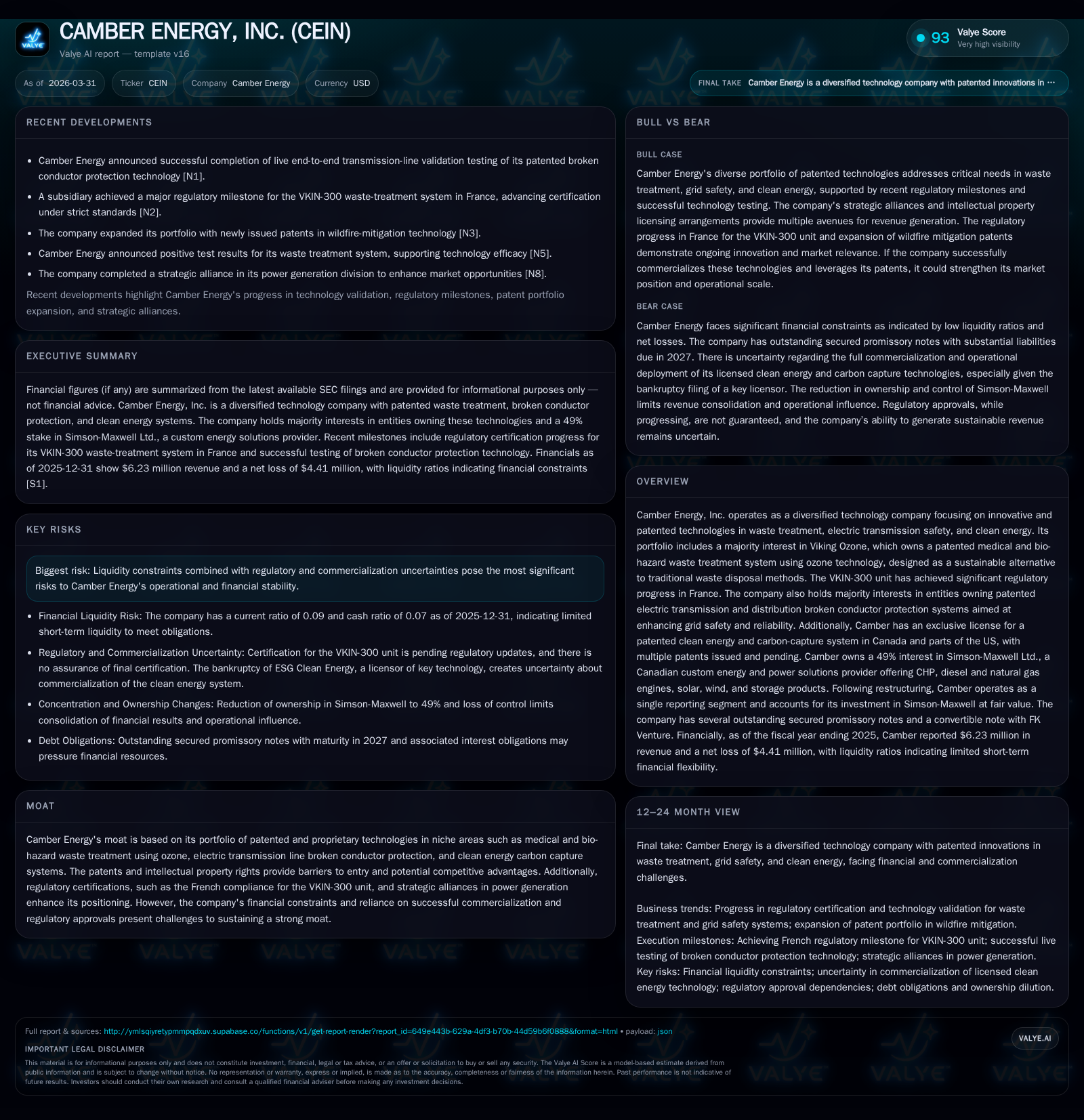
Camber Energy has transitioned from oil & gas to focus on patented technologies including medical and biohazard waste ozone treatment, broken conductor protection systems, and clean energy carbon capture solutions. Key technical milestones include French regulatory acceptance of the VKIN-300 unit and successful live transmission-line tests. However, revenues have contracted sharply due to asset divestitures and commercialization delays. The company's liquidity remains constrained with a current ratio near 0.09 and secured convertible notes maturing in 2027. Capital allocation prioritizes technology development without dividends or buybacks. Commercialization risks and financial constraints continue to shape Camber's outlook.
From Oil & Gas to Tech Focus: Camber’s Transition and Historical Growth Drivers
Camber Energy has shifted from traditional oil and gas operations toward a diversified technology company through strategic acquisitions of majority interests in entities holding patented technologies addressing environmental and electric utility sectors [S1].
This pivot significantly impacted financials. Revenues increased from $597K in FY2022 to over $32 million in FY2023 before declining sharply to $6.23 million by FY2025 [F1]. Early growth was driven by legacy oil & gas streams combined with initial contributions from new tech businesses. The subsequent revenue contraction reflects asset sales—including full exit from oil & gas holdings by 2024—and challenges scaling nascent patented technologies commercially [S1]. This highlights that past revenue growth largely stemmed from transitioning assets rather than organic tech commercialization.
Historical performance (annual)
| FY | Rev ($mm) | Net ($mm) | CFO ($mm) | OpInc ($mm) | Rev YoY | Net YoY |
|---|---|---|---|---|---|---|
| 2025 | 6 | -4 | -2 | -8 | -78.2% | +93.7% |
| 2024 | 29 | -70 | -1 | -11 | -10.7% | -279.1% |
| 2023 | 32 | -19 | -5 | -7 | +5266.9% | +82.8% |
| 2022 | 1 | -108 | -5 | -4 |
Source: SEC companyfacts cache [F1].
Capital returns and efficiency (annual)
| FY | ROE% |
|---|---|
| 2025 | 8.9 |
| 2024 | 154.4 |
| 2023 | 512.4 |
| 2022 | 629.2 |
Source: SEC companyfacts cache [F1].
These figures illustrate Camber’s contracting financial footprint as it divested traditional assets while increasing investment in emerging technologies amid capital-intensive conditions [F1].
Patent-Protected Technologies: Medical Waste Ozone Treatment, Transmission Line Safety, and Carbon Capture
Camber's technological portfolio includes three primary areas: a patented medical/biohazard waste treatment system using ozone technology; patented electric transmission line broken conductor protection systems; and a licensed clean energy carbon capture system for North America [S1].
The most advanced is Viking Ozone’s VKIN-300 medical waste pretreatment unit protected by U.S Utility Patent No. 11,565,289. It offers a sustainable alternative to incineration and other conventional treatments by converting waste into renewable fuel feedstock for waste-to-energy facilities globally [S1].
In November 2025 the VKIN-300 passed the Laboratoire national de métrologie et d’essais (LNE) acceptance review in France for compliance with French Standard NFX 30-503—among the world’s strictest standards for decontamination equipment—with formal certification pending updates to reference standards [S1][S29].
Additionally, Camber holds majority interests in Viking Sentinel entities owning patents on transmission line safety devices designed to detect broken conductors and initiate immediate power shutdowns [S1][N1]. On March 4th 2026 Camber announced successful live end-to-end validation testing of these technologies on active transmission lines—a critical milestone for customer adoption given the safety implications [N1][S3].
The company also holds an exclusive license for a patented carbon capture system targeting power generation facilities primarily in Canada and select U.S regions [S1]. Commercial deployment depends on ESG/Scuderi's ability to complete installations following ESG’s Chapter 11 filing in mid-2025 [S18].
Together these assets combine intellectual property protections with regulatory compliance requirements that underpin Camber’s competitive positioning.
Recent Technical Milestones and Regulatory Progress
Key recent achievements include Viking Protection Systems’ successful live transmission-line validation test announced March 4th 2026 confirming operational readiness under real-world conditions [N1][S3]. This demonstration is essential given the safety-critical nature of broken conductor protection.
On the regulatory side Viking Ozone’s VKIN-300 satisfied LNE acceptance criteria signaling likely imminent formal certification once related decrees are updated—a process outside Camber’s direct control but viewed positively based on evaluation reports [S1][S29].
These milestones advance commercial credibility but precede broader revenue realization.
Financial Overview: Declining Revenues Amid Sustained Losses and Cash Burn
Revenues plunged nearly four-fifths (-78%) between FY2024 ($28.6M) and FY2025 ($6.2M), reflecting asset sales alongside still nascent commercialization of new technologies [F1]. Operating losses narrowed year-over-year from $11.18M to $7.95M driven mainly by reduced overheads but remain substantial [F1]. Net income improved due largely to prior impairments.
Operating cash flow deteriorated further with a $2.33 million outflow in FY2025 indicating ongoing cash burn typical of early-stage technology companies yet to scale revenues [F1]. Capital expenditures remained minimal at approximately $16K consistent with focus on intangible R&D rather than physical assets [F1][S11][S15].
This financial profile reflects challenges common among IP-centric firms pursuing extended product validation phases before achieving stable sales.
Liquidity Position and Debt Structure
Liquidity is under significant pressure: as of FY-end 2025 current assets totaled about $1.58 million versus current liabilities exceeding $17.4 million yielding a precarious current ratio near 0.09 highlighting severe short-term funding gaps [F1][S5][S7].
The company carries multiple secured convertible promissory notes maturing in late 2026/early 2027 originally issued at high interest rates but amended to prime plus ~3.25% annually [S5][S14][S18][F1]. An April 2025 convertible note includes conversion rights at $0.15 per share raising dilution risks if exercised given limited public float [S5].
Debt covenants restrict borrowing capacity and asset disposals potentially requiring refinancing or equity issuance solutions which could dilute shareholder value amid uncertain market reception [S7][S24].
Managing this constrained capital structure will be critical to sustaining operations through commercial ramp-up.
Capital Allocation: No Dividends or Buybacks; Minimal Capex Focused on Intangibles
Camber does not pay dividends nor conduct share repurchases as it prioritizes conserving resources for advancing its technology development projects during this pre-commercial stage [S17][S24]. Capital expenditures remain minimal (~$16K annually), aligned with an emphasis on intangible asset development such as patent portfolios rather than heavy infrastructure investments [F1][S15].
While net losses have produced deeply negative book equity (~-$49.8M at FY-end), reflecting accumulated deficits rather than operational returns—the company accepts short-term capital erosion betting on eventual commercialization success [F1].
Investor expectations should account for ongoing cash burn balanced against uncertain timelines for positive returns.
Risks: Commercialization Challenges and Market Acceptance Hurdles
Camber faces risks typical for companies developing new technologies including extended timelines for product validation and market acceptance amidst competition from established incumbents with entrenched customer relationships [S12][S21][N1]. Intellectual property litigation risk exists though no material lawsuits are presently pending per filings [S8][S13]. Regulatory dependencies—such as government certifications—and evolving energy subsidies add complexity.
Financial constraints limit sales investment capacity potentially delaying breakeven while macroeconomic conditions may impact capital access further complicating outlooks [S16][S18].
Outlook: Key Milestones To Monitor
Important near-term developments include:
- Final official certification of VKIN-300 under updated French standards enabling broader European market access,
- Additional pilot projects or licensing agreements for broken conductor protection systems,
- Progress by ESG/Scuderi completing carbon capture installations affecting royalty potential,
- Announcements regarding refinancing or capital raises addressing liquidity,
- Changes or waivers related to debt covenants impacting operational flexibility,
- Management commentary on scaling commercialization efforts post-validation events.[N1][S1]
Balancing technical progress against financial constraints will shape Camber's feasibility going forward.
Disclaimer: This analysis relies solely on publicly available SEC filings and news releases as of March 31st, 2026 without any earnings forecasts or investment advice.
Disclaimer: This is research-only, informational analysis and not investment advice. It may include AI-generated interpretation and general industry context. Always verify important details using primary sources.

Comments