
Rail Vision’s AI-Enabled Railway Safety Systems Drive Early Commercial Momentum Amid Investment Phase
Rail Vision leverages proprietary AI and multi-spectral electro-optic technology to advance railway safety through extended-range obstacle detection, progressing from pilots to initial commercial deployments with strategic market expansions and stable liquidity despite ongoing losses.
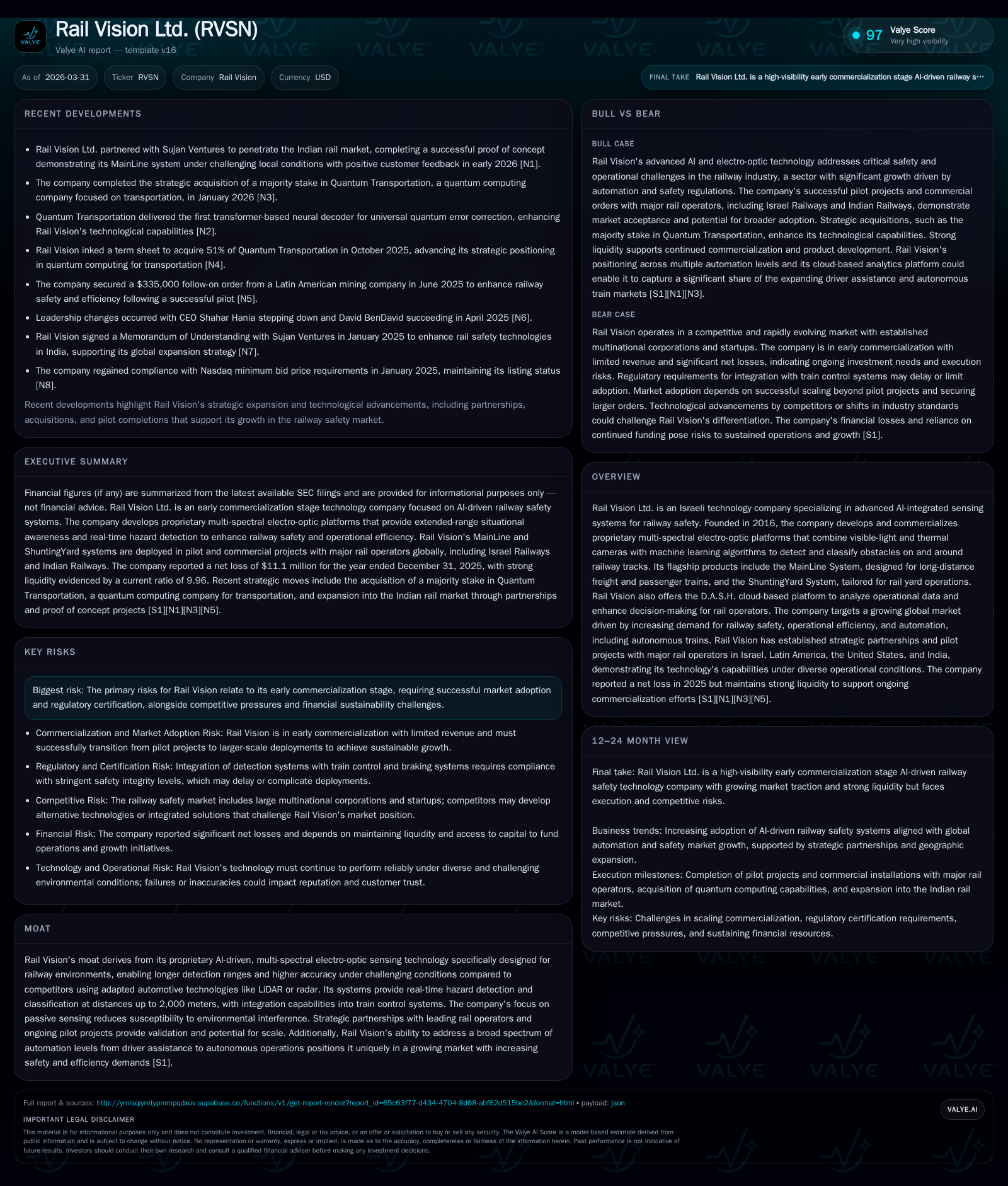
Founded in 2016, Rail Vision Ltd. develops AI-integrated multi-spectral detection systems focused on railway safety, including the MainLine and ShuntingYard platforms. The company remains unprofitable through 2025 amid significant R&D and operational investments but has secured key contracts with Israel Railways, U.S. rail companies, and Latin American mining firms. Notable progress includes successful proofs of concept in India and installations underway in multiple regions. Rail Vision maintains strong liquidity with $19.95 million in cash against modest liabilities, though negative operating cash flow underscores the need for scaling sales and certification achievements. The company operates in a growing driver assistance market driven by automation trends and safety imperatives.
Company Overview
Rail Vision Ltd., founded in Israel in 2016, specializes in advanced AI-driven multi-spectral electro-optic sensing systems designed to enhance railway safety through extended-range situational awareness and real-time hazard detection. Its technology integrates visible-light and thermal cameras with onboard machine learning algorithms tailored specifically for the railway environment.
Key products include:
- MainLine System: Provides long-distance obstacle detection up to two kilometers for mainline passenger and freight trains, enabling early warnings under poor visibility or severe weather conditions.
- ShuntingYard System: Targets rail yard operations with AI-based real-time classification of obstacles within approximately 200 meters, enhancing safety during train assembly and disassembly.
- D.A.S.H. Platform: A cloud-based analytics service that aggregates data from multiple sensors to support operational decision-making and efficiency improvements.
Historical Financial Performance
Rail Vision remains in an early commercialization stage with concentrated investment in product development and market entry efforts. Revenue declined sharply from $421,000 in FY2022 to $142,000 in FY2023 as the company transitioned from pilot projects toward initial commercial sales [F1]. Operating losses have been consistently substantial: approximately -$11.7 million recorded in FY2025 compared to -$11.4 million in FY2023 [F1], reflecting continued investment.
Operating cash flow remains negative but shows slight improvement, with -$9.12 million reported for FY2025 versus over -$10 million annually in prior years. Capital expenditures remain modest relative to operating loss levels.
Historical performance (annual)
| FY | Rev ($) | Net ($mm) | CFO ($mm) | OpInc ($mm) | Rev YoY | Net YoY |
|---|---|---|---|---|---|---|
| 2025 | -11 | -9 | -12 | +63.9% | ||
| 2024 | -31 | -10 | -9 | -175.5% | ||
| 2023 | 142000 | -11 | -11 | -11 | -66.3% | -6.4% |
| 2022 | 421000 | -10 | -10 | -11 |
Source: SEC companyfacts cache [F1].
Capital returns and efficiency (annual)
| FY | Buybacks ($mm) | FCF ($mm) | ROE% |
|---|---|---|---|
| 2025 | 81 | -9 | -54.6 |
| 2024 | 8 | -10 | -173.5 |
| 2023 | -11 | -400.0 | |
| 2022 | -10 |
Source: SEC companyfacts cache [F1].
*Latest annual figures per FYE; revenue for FY2025 not disclosed explicitly [F1]
Growth Drivers & Market Positioning
Rail Vision addresses critical challenges faced by railway operators including limited visibility under adverse weather conditions and the need for enhanced obstacle detection at extended ranges to improve safety margins.
The company’s competitive advantages include:
- Passive long-range sensing technology well-suited for complex rail environments where active sensors face interference.
- Specialized AI algorithms capable of classifying diverse hazard types such as humans and wildlife.
- Integration capabilities allowing interfacing with locomotive control systems subject to regulatory certification.
These strengths position Rail Vision well within an expanding Advanced Driver Assistance Systems market for locomotives projected to grow at a CAGR exceeding 4% over the next decade [S22]. Increasing adoption of autonomous rail operations globally further supports demand.
Commercial traction includes:
- A contract with Israel Railways for ten MainLine Systems following a successful pilot; installations began February 2024 with certification achieved by year-end; eight units operational as of Q1/26 [S9][S10].
- U.S.-based rail customers contracted up to $5 million for ShuntingYard Systems since early 2024 [S4][S9].
- Latin American mining customers progressed from pilots to orders totaling over $800K between late 2023 and mid-2025 [S10][S11].
- Expansion into India via partnership with Sujan Ventures; a proof of concept completed successfully in early 2026 involving local rail operators under real-world conditions [N1][S18].
Outlook & Milestones
While formal guidance is not provided due to early-stage operations, key milestones include:
- Scaling orders from pilot customers towards broader fleet implementations (e.g., potential expansion beyond initial ten units at Israel Railways).
- Achieving additional regulatory certifications enabling integration with critical train control functions.
- Expanding geographic reach notably within the large Indian rail market following positive POC outcomes.
- Progressing development of a cost-reduced ShuntingYard variant aimed at more price-sensitive segments currently under research.
Capital Allocation & Financial Positioning
As of December 31, 2025, Rail Vision held approximately $19.95 million in cash and equivalents against current liabilities near $2.2 million resulting in a strong current ratio close to 10x [F1][S5]. Equity increased significantly from about $2.8 million at end-2023 to over $20 million at end-2025 through equity financings [F1][S13][S15].
Capital expenditures were controlled at $125K relative to operating losses nearing $11.7 million in FY25 consistent with an asset-light business model focused on intellectual property development rather than heavy manufacturing [F1][S14].
No dividends or share repurchases occurred given ongoing net losses; equity-based compensation continues as part of talent retention strategies [F1][S8].
Competitive Landscape & Differentiation
Rail Vision competes against multinational engineering firms offering integrated rolling stock controls alongside startups employing automotive-derived LiDAR/radar adapted for rail applications [S7][S20].
Its differentiation lies in passive electro-optical sensing combined with railway-specific AI tuned for longer range detection unaffected by metallic infrastructure interference. Thermal imaging capabilities provide enhanced nighttime and poor visibility detection absent from many competitors’ offerings.
The D.A.S.H platform further augments value by integrating sensor data streams into actionable insights supporting operational efficiency beyond hardware deployment alone.
Risks & Challenges
Key risks include:
- The need for timely regulatory certifications especially relating to integration with automated braking systems requiring stringent safety compliance levels [S19].
- Market adoption hurdles due to incumbent legacy system preferences or competing technologies adapted from other transport sectors [S6][S12].
- Financial sustainability concerns given persistent operating losses exceeding $11 million annually coupled with negative free cash flows necessitating future capital raises potentially dilutive if growth timelines extend unexpectedly [F1][S13].
- Cybersecurity risks inherent in cloud-connected sensor platforms mitigated through ISO27001 certification but requiring ongoing vigilance overseen by senior management reporting regularly to the audit committee [S6].
Conclusion & Outlook Analysis
Rail Vision demonstrates meaningful progress converting pilots into funded orders across developed markets like Israel and the U.S., as well as emerging markets such as India and Latin America — validating both technology efficacy and strategic partnership approaches.
Market dynamics driven by heightened focus on railway safety combined with workforce challenges accelerating autonomous operation initiatives create an expanding opportunity aligned with Rail Vision’s technology strengths.
Future performance will depend on successful scaling of deployments post-certification milestones, geographic expansion execution, cost variant development progress, and prudent financial management amidst ongoing investment demands. Monitoring quarterly updates on order growth trajectories and certification achievements will be essential indicators during this formative phase of tech-enabled railway transformation.
Disclaimer: This report is based solely on documented data without any investment advice or recommendations.
Disclaimer: This is research-only, informational analysis and not investment advice. It may include AI-generated interpretation and general industry context. Always verify important details using primary sources.

Comments